1. Background
Cerebral palsy (CP) is a postural and motor disorder of the nervous system resulting from damage to the immature and developing brain, occurring before, during, or up to 2 years after birth (1). This condition exerts continuous and permanent effects on body movements and muscle coordination (1). Individuals with cerebral palsy may experience difficulties in various aspects, such as eating, movement weakness, imbalance, and breathing problems, with symptom severity varying based on the extent of damage to the motor cortex. Although cerebral palsy is not progressive, symptoms may evolve, especially in individuals lacking access to rehabilitation programs (1, 2). Hemiparetic cerebral palsy (HCP) is the most prevalent type of CP (3). Hemiparesis is defined as unilateral motor disability resulting from brain injury, wherein one side of the body is more significantly affected than the other (3). In hemiparetic CP, the upper extremities may suffer more severe impairments than the lower parts (4). Such upper limb disorders can significantly limit a child's ability to engage in daily activities and lead a normal life (5). Numerous rehabilitation programs have been developed to enhance muscular strength and range of motion in the affected upper extremity joints (6).
For children with hemiparetic cerebral palsy, bimanual movement—wherein both hands are used simultaneously—has emerged as one of the most effective methods (5). Common rehabilitation approaches include physiotherapy and occupational therapy, which aim to improve muscle coordination and overall quality of life (7). Recent research indicates that combining innovative methods, such as virtual reality, wearable robots, biofeedback, and electrical stimulation, with traditional rehabilitation approaches can enhance movement outcomes compared to conventional methods alone. Utilizing various graphical, visual, and auditory tools in rehabilitation can make the process more engaging and attractive to children, encouraging regular participation (7). Furthermore, adopting the human-machine interaction mechanisms can boost the effectiveness. In recent years, virtual and augmented reality have gained significant attention and are increasingly utilized in education, entertainment, medicine, and rehabilitation (8, 9). Virtual reality rehabilitation involves employing computer games as part of the exercise regimen, making it an appealing and enjoyable experience for children and promoting adherence to the training schedule. Studies have shown that combining virtual reality games with conventional interventions can yield more effective results (8).
Nevertheless, one challenge in virtual reality-based rehabilitation is designing and selecting the appropriate video game scenario. Although conclusive evidence on the superiority of specific methods remains elusive, there are indications of interrelationships between bimanual performance and cognition (executive functions) in hemiparetic CP children (10). Improving working memory, an executive function, can lead to enhanced memory consolidation and expedited motor learning, thus benefiting long-term memory.
Moreover, computer games have positively impacted cognitive functions (8, 9). Therefore, an intervention approach based on conducting bi-manual task exercises using a computer game holds promise as a rehabilitation strategy. Such an approach provides an engaging and interactive platform and addresses cognitive aspects while improving motor function in children with hemiparetic cerebral palsy.
2. Objectives
The present study introduces a novel bimanual training exercise utilizing a computer game to enhance motor-cognitive abilities in children with hemiparetic cerebral palsy. This approach incorporates a human-machine interaction mechanism, where the game's design engages the patient in motor-cognitive processes, including maintaining the position of a specific object on the screen, predicting its next position, visualizing movements, and making informed choices.
Drawing on the established interrelationships between bimanual performance and cognition (specifically executive functions) in hemiparetic children, we hypothesize that this exercise can yield dual benefits: improving working memory, as assessed by the Corsi block-tapping test, and enhancing motor control processes, as assessed by the Fugl-Meyer assessment of the upper extremities. Consequently, this intervention has the potential to significantly enhance motor-cognitive ability in the targeted population.
3. Methods
This interventional study introduces a novel approach to enhancing motor and cognitive ability in children with hemiplegic cerebral palsy. The study involved designing a competitive game setup for bimanual training and selecting children with hemiparetic CP based on specific inclusion and exclusion criteria. Pre-test and post-test assessments were conducted, including the Fugl-Meyer assessment of upper extremities (FMA-UE) to evaluate sensorimotor function and the Corsi block-tapping test to assess cognitive ability. The assessments were conducted before and after the intervention, and statistical analyses were performed to demonstrate motor-cognitive enhancement. The process of implementing the proposed method is depicted in Figure 1.
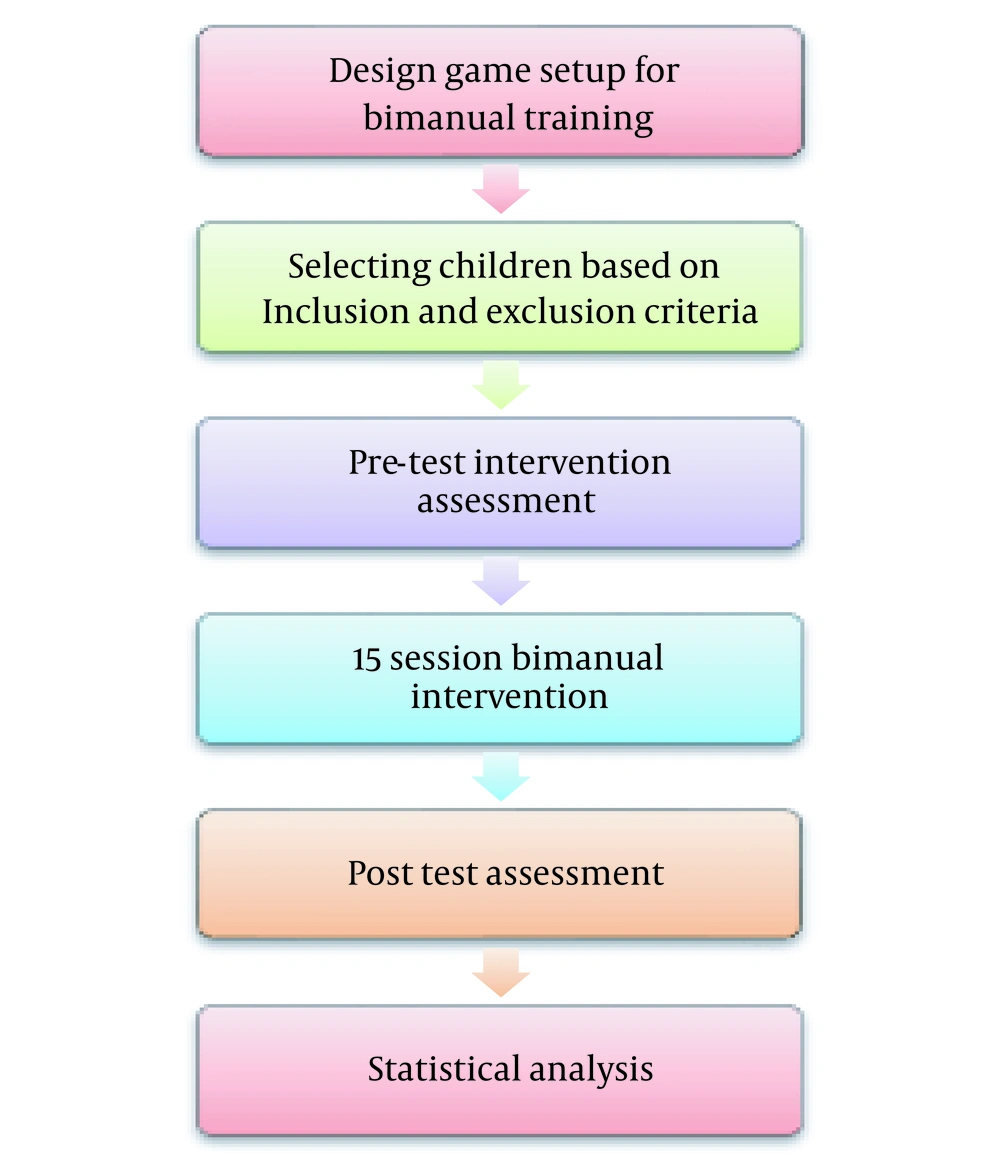
Figure 1.
The block diagram showing the stages of the proposed method
3.1. Implementing the Game System
The rehabilitation method presented in this study involves a game environment designed to facilitate hand movements in children with hemiparetic cerebral palsy. Computer games offer an interactive and engaging setting for the child to learn movements effectively. The game system comprises the software environment of the computer game and specially designed joysticks to enable bi-manual tasks.
The computer game was developed using the Unity game engine, providing simple programming and compatibility with various platforms such as Windows, Android, and iOS. The game simulates a car race in which the child moves along a straight path while encountering randomly appearing boxes. Breaking each box rewards the child with a positive score.
To perform the bi-manual task, a custom joystick was created. As children with hemiparetic cerebral palsy may tend to ignore their affected hands, the design enforced using both hands during exercises. The child controlled the car's speed in the vertical direction using a joystick with the less-affected hand. In contrast, movement in the horizontal direction was managed with a separate joystick by the affected hand. This setup required simultaneous and separate coordination of the left and right hands to move the car toward the boxes and accumulate more points. Through interaction with the game, the child learns to improve hand coordination, potentially leading to enhanced working memory.
The intervention consisted of 15 sessions, with each session lasting 30 minutes. Throughout the game, the child learns to enhance coordination between both hands by actively engaging with the game, potentially resulting in improved working memory.
3.2. Patient Selection
The study involved five children, aged 4 to 8 years (2 girls and 3 boys), with hemiparetic cerebral palsy. The selection criteria included children with the least capacity for perceptual, cognitive, and hand movement abilities, ensuring effective joystick manipulation.
Inclusion and exclusion criteria were defined as follows (10-13): (A) Children with a confirmed diagnosis of hemiparetic cerebral palsy by pediatric neurologists were selected. Those with severe impairment based on the Gross functional criteria were excluded. (B) Children aged between 4 and 8 years were included in the study. (C) Children with severe vision and hearing impairments were excluded. (D) Children unable to perform the task for cognitive or behavioral reasons were excluded. (E) Valid and repeatable tests were performed to evaluate the performance and capacity of the child's hands and fingers. Children with orthopedic hand defects were excluded.
The study's objectives and methods were thoroughly explained to the participants and their parents, ensuring informed consent was obtained and confidentiality of personal information was assured.
The study did not include a control group, as one of the objectives was to evaluate working memory as a cognitive ability. Implementing a matched control group receiving other cognitive rehabilitation protocols such as neurofeedback or tDCS would have been challenging. Therefore, the study compared pre- and post-intervention assessment results to effectively attribute observed improvements to the designed method.
3.3. Pre-test and Post-test Assessment
The study conducted pre-test and post-test assessments using the Fugl-Meyer upper extremity test (FMA-UE) (14) and the Corsi block-tapping test (15) to measure motor and cognitive abilities, respectively.
The Fugl-Meyer assessment (FMA) scale is a clinical index used to evaluate sensorimotor ability in individuals with motor impairments, providing insights into disease severity and motor recovery (14). The scale items are scored based on direct performance observation, using a 3-point ordinal scale where 0 = cannot perform, 1 = performs partially, and 2 = performs fully (14). The final score for evaluating upper limb performance is derived from the total points obtained in the upper limb, wrist, hand, coordination, and hand speed criteria, ranging from 0 to 66 (14). Additionally, sensation-related abilities are scored between 0 and 12, and passive joint motion and pain are scored between 0 and 24 (14).
The Corsi block-tapping test is a psychological test used to assess working memory. In this task, nine blocks are arranged in front of the participant, and the number of blocks is displayed in yellow during each stage. The participant must remember the blocks' yellow order and their corresponding numbers at the end of each stage. The complexity of the sequence increases as the participant's performance declines. The number of blocks successfully recalled is known as the Corsi Span, with the average for a "normal" person being between 5 - 6 (15). Cognitive performance and academic tests based on the Corsi block-tapping test were evaluated using PEBL software (15).
The Fugl-Meyer assessment and Corsi block-tapping test were conducted before and after the intervention in the same participants.
3.4. Bimanual Intervention
The intervention consisted of a car racing computer game. Prior to starting the intervention, a familiarization session was conducted to introduce the game and perform initial examinations. The child was instructed to control the car by correctly placing their hands on the joysticks. The hand with movement disorder controlled the car horizontally, while the healthy hand controlled the speed vertically. The child was required to use both hands simultaneously but independently during the game. Coordination between the left and right hands led to better control and higher points during the game, improving motor and cognitive abilities. Figure 2 illustrates a child with left-sided hemiplegia engaging in the bimanual game and the proposed setup.
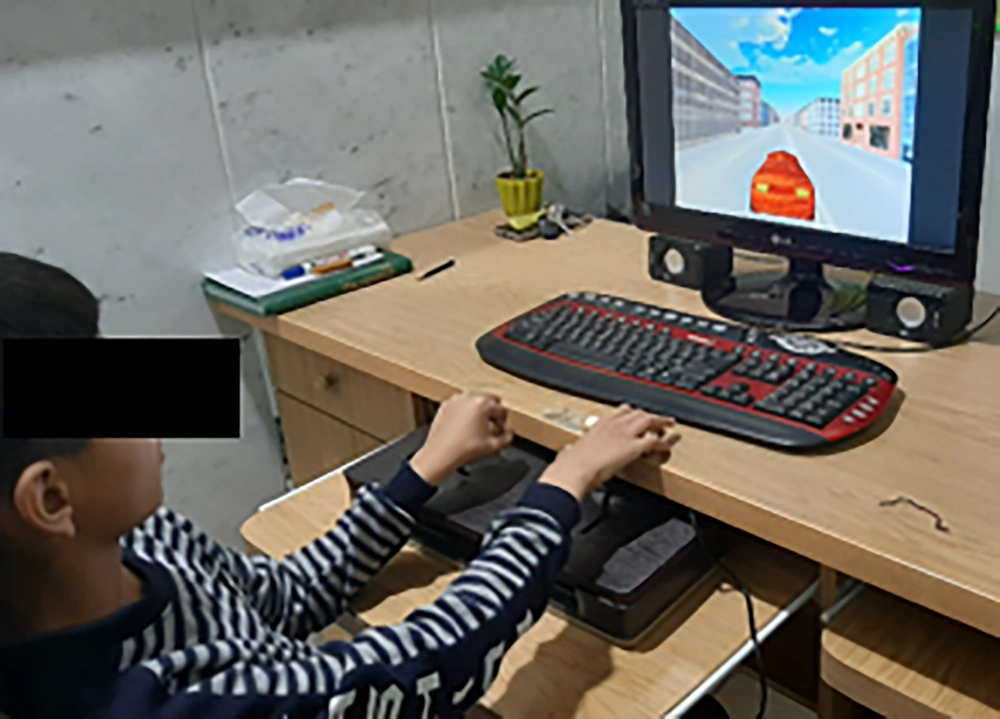
Figure 2.
A child with left-sided hemiplegia playing the bimanual computer game and game setup.
3.5. Statistical Analysis
The obtained data were analyzed using SPSS software. Descriptive statistics, including mean ± standard deviation, were used for quantitative variables with a normal distribution. An independent t-test was conducted to assess the difference between pre-test and post-test intervention scores for both the Fugl-Meyer assessment and the Corsi block-tapping test, which were quantitative variables with normal distribution. The significance level was set at 0.05 for all tests.
4. Results
The differences in FMA-UE scores and Corsi block-tapping test scores before and after the intervention are presented in Table 1. The mean FMA-UE score before the intervention was 51 ± 3.31, and after the intervention, it increased to 59.5 ± 1.14, showing a statistically significant difference (P = 0.008). Notably, there was a significant improvement in the total score of upper extremity motor function, particularly in the wrist joint movement.
Table 1.
The Mean Scores of FMA-UE Criteria and Corsi Block-Tapping Test Criteria Before and After the Intervention
| FUGL-MEYER Criteria and Groups | Mean ± SD | Mean Differences |
|---|---|---|
| A. Upper extremity | 3.20000 | |
| Pre-intervention | 28.0000 ± 3.31662 | |
| Post-intervention | 31.2000 ± 1.64317 | |
| B. Wrist | 3.60000 | |
| Pre-intervention | 5.2000 ± 0.44721 | |
| Post-intervention | 8.8000 ± 1.09545 | |
| C. Hand | 1.40000 | |
| Pre-intervention | 11.8000 ± 0.83666 | |
| Post-intervention | 13.2000 ± 0.83666 | |
| D. Coordination | 0 | |
| Pre-intervention | 6.0000 ± 0.00000 | |
| Post-intervention | 6.0000 ± 0.00000 | |
| Total A-D (motor function) | 8.40000 | |
| Pre-intervention | 51.0000 ± 3.31662 | |
| Post-intervention | 59.4000 ± 1.14018 | |
| H. Sensation | 1.60000 | |
| Pre-intervention | 10.4000 ± 2.19089 | |
| Post-intervention | 12.0000 ± 0.00000 | |
| I. Passive joint motion | 1.40000 | |
| Pre-intervention | 22.6000 ± 1.67332 | |
| Post-intervention | 24.0000 ± 0.00000 | |
| J. Joint pain | 0.40000 | |
| Pre-intervention | 23.6000 ± 0.54772 | |
| Corsi Block Tapping Test | ||
| Block span | 1.0000 | |
| Pre-intervention | 2.8000 ± 1.30384 | |
| Post-intervention | 3.8000 ± 1.30384 | |
| Total score | 9.40000 | |
| Pre-intervention | 8.8000 ± 6.57267 | |
| Post-intervention | 18.2000 ± 13.02690 | |
| Total correct trials | 1.60000 | |
| Pre-intervention | 2.6000 ± 1.67332 | |
| Post-intervention | 4.2000 ± 2.28035 | |
| Memory span | 8.0000 | |
| Pre-intervention | 2.3000 ± 0.83666 | |
| Post-intervention | 3.1000 ± 1.14018 | |
Motor function was measured by summing the scores of upper extremity assessment, wrist, hand, coordination, and speed. The results indicated significant improvements in wrist stability at dorsiflexion and repeated dorsiflexion/volar flexion, while no improvement was observed in wrist circumduction. Additionally, the mean score of the memory span block in the Corsi block-tapping test increased from 2.3 ± 0.84 before the intervention to 3.1 ± 1.14 after the intervention, indicating an improvement in cognitive ability. Consequently, the proposed intervention has demonstrated positive effects on motor-cognitive ability.
5. Discussion
Choosing a method for human-system interactions is an essential consideration when designing a rehabilitation approach. Computer games have emerged as a popular method of hand movement rehabilitation for children with cerebral palsy (8). Recent evidence also supports the significant relationship between performing bimanual tasks and executive functions (10). Thus, this study introduces and evaluates a new bimanual training protocol based on a computer game.
The study's main objective was to assess this intervention's impact on working memory (evaluated by the Corsi block-tapping test) and motor-related abilities (assessed by the Fugl-Meyer assessment of upper extremities). The significant increase in the FMA-UE score demonstrates the positive impact of the proposed approach on motor-related abilities during coordinated bimanual tasks, with wrist movement-related scores showing notable improvement. The need to control the joystick's position during the game likely contributed to increased wrist muscle recruitment and fine control. Furthermore, the increase in the Corsi block-tapping test score indicates improved working memory as a cognitive ability. These findings confirm the underlying assumption regarding the interrelationship between bimanual task performance and cognitive abilities in hemiparetic CP children. The proposed concept of improving motor-cognitive abilities by enhancing working memory has also been validated, as boosting working memory appears to facilitate motor learning of bimanual tasks.
While some studies have shown the effectiveness of using video games alongside conventional therapies for children with cerebral palsy (8), this study contributes to understanding a proper design strategy for an optimal computer game-based intervention. Though the lack of comparable studies for CP children presents challenges in direct comparison, the achieved results demonstrate the expected benefits of the proposed method in enhancing motor-cognitive abilities in hemiparetic CP children.
While the short duration of the interventions can be considered a limitation, the fact that the patients received no other therapies alongside the designed intervention suggests that the observed improvements can be attributed to the proposed rehabilitation approach. Additionally, the comparison between pre-and post-intervention assessments further supports the effectiveness of the designed method.
However, further research involving more patients and extended sessions is necessary before transforming this system into a certified clinical device. Additionally, designing joysticks to perform different upper limb movements, such as supination, pronation, and rotation, could be the next step in this work.