Journal of Semnan University of Medical Sciences
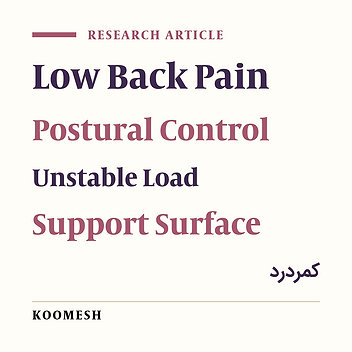
Image Credit:Koomesh
Outline
Effects of load and unstable support surface on postural control in patients with chronic low back pain
Authors
 ,*, Mahmood Reza Azghani, Parviz Azadfallah, Mohammad Gholami Fesharaki
Abstract
Introduction: Several studies have demonstrated the postural control alterations in patients with low back pain. However, the difference in center of pressure (COP) parameters in the body sway in unstable conditions is relatively unknown in these patients. Therefore, the aim of the present study was to investigate the effects of unstable load and support surface on postural control in chronic low back pain (CLBP) patients. Materials and methods: CLBP patients (n=20) (mean age 31.30 years and mean BMI 25.20 kg/m2) and 20 healthy subjects (mean age 30.00 years and mean BMI 24.12 kg/m2) were asked to hold a load weighing 10 percent of their body weight while standing. Experimental conditions were manipulated based on stability of load (stable or unstable) and support surface (firm or foam). Using a force plate, COP sway parameters including sway amplitude (and its standard deviation) and sway velocity (and its standard deviation) in anteroposterior (AP) and mediolateral (ML) directions were measured. Results: Patients with CLBP exhibited less AP sway amplitude compared to control subjects (P=0.03). Furthermore, they had less ML sway velocity while holding the unstable load (P=0.05) and more ML sway amplitude while standing on foam (P=0.04). Conclusion: In compare to healthy subjects, patients with CLBP demonstrated a different pattern of postural control during instability of load and support surface. In these conditions, altered proprioception and stiffening strategy can increase the risk of spine injuries
Highlights
References
- 1.Massion J. Postural control system. Curr Opin Neurobiol 1994; 4: 877-887.
- 2.Loram ID, Lakie M. Human balancing of an inverted pendulum: position control by small, ballistic-like, throw and catch movements. J Physiol 2002; 540: 1111-1124.
- 3.Brumagne S, Janssens L, Knapen S, Claeys K, Suuden-Johanson E. Persons with recurrent low back pain exhibit a rigid postural control strategy. Eur Spine J 2008; 17: 1177-1184.
- 4.Henry SM, Hitt JR, Jones SL, Bunn JY. Decreased limits of stability in response to postural perturbations in subjects with low back pain. Clin Biomech 2006; 21: 881-892.
- 5.Mientjes MI, Frank JS. Balance in chronic low back pain patients compared to healthy people under various conditions in upright standing. Clin Biomech 1999; 14: 710-716.
- 6.Mok NW, Brauer SG, Hodges PW. Hip strategy for balance control in quiet standing is reduced in people with low back pain. Spine 2004; 29: E107-112.
- 7.Salavati M, Mazaheri M, Negahban H, Ebrahimi I, Jafari AH, Kazemnejad A, et al. Effect of dual-tasking on postural control in subjects with nonspecific low back pain. Spine 2009; 34: 1415-1421.
- 8.van Dieen JH, Koppes LL, Twisk JW. Low back pain history and postural sway in unstable sitting. Spine 2010; 35: 812-817.
- 9.Ruhe A, Fejer R, Walker B. Center of pressure excursion as a measure of balance performance in patients with non-specific low back pain compared to healthy controls: a systematic review of the literature. Eur Spine J 2011; 20: 358-368.
- 10.Ruhe A, Fejer R, Walker B. Is there a relationship between pain intensity and postural sway in patients with non-specific low back pain? BMC Musculoskelet Disord 2011; 12: 162.
- 11.Van Daele U, Hagman F, Truijen S, Vorlat P, Van Gheluwe B, Vaes P. Differences in balance strategies between nonspecific chronic low back pain patients and healthy control subjects during unstable sitting. Spine 2009; 34: 1233-1238.
- 12.della Volpe R, Popa T, Ginanneschi F, Spidalieri R, Mazzocchio R, Rossi A. Changes in coordination of postural control during dynamic stance in chronic low back pain patients. Gait Posture 2006; 24: 349-355.
- 13.Davis JR, Horslen BC, Nishikawa K, Fukushima K, Chua R, Inglis JT, et al. Human proprioceptive adaptations during states of height-induced fear and anxiety. J Neurophysiol 2011; 106: 3082-3090.
- 14.Moseley GL, Hodges PW. Reduced variability of postural strategy prevents normalization of motor changes induced by back pain: a risk factor for chronic trouble? Behav Neurosci 2006; 120: 474-476.
- 15.Takala EP, Viikari-Juntura E. Do functional tests predict low back pain? Spine 2000; 25: 2126-2132.
- 16.Oie KS, Kiemel T, Jeka JJ. Multisensory fusion: simultaneous re-weighting of vision and touch for the control of human posture. Brain Res Cogn Brain Res 2002; 14: 164-176.
- 17.Shumway-Cook A, Woollacott MH. Motor control: translating research into clinical practice. 4th ed. Philadelphia: Wolters Kluwer Health 2012; P: 181-184.
- 18.Henry SM, Fung J, Horak FB. EMG responses to maintain stance during multidirectional surface translations. J Neurophysiol 1998; 80: 1939-1950.
- 19.Brumagne S, Cordo P, Lysens R, Verschueren S, Swinnen S. The role of paraspinal muscle spindles in lumbosacral position sense in individuals with and without low back pain. Spine 2000; 25: 989-994.
- 20.Gill KP, Callaghan MJ. The measurement of lumbar proprioception in individuals with and without low back pain. Spine 1998; 23: 371-377.
- 21.Taimela S, Kankaanpaa M, Luoto S. The effect of lumbar fatigue on the ability to sense a change in lumbar position. A controlled study. Spine 1999; 24: 1322-1327.
- 22.Brumagne S, Janssens L, Janssens E, Goddyn L. Altered postural control in anticipation of postural instability in persons with recurrent low back pain. Gait Posture 2008; 28: 657-662.
- 23.Kohler JM, Flanagan SP, Whiting WC. Muscle activation patterns while lifting stable and unstable loads on stable and unstable surfaces. J Strength Cond Res 2010; 24: 313-321.
- 24.Mannion AF, Adams MA, Dolan P. Sudden and unexpected loading generates high forces on the lumbar spine. Spine 2000; 25: 842-852.
- 25.Shahvarpour A, Shirazi-Adl A, Lariviere C, Bazrgari B. Trunk active response and spinal forces in sudden forward loading: analysis of the role of perturbation load and pre-perturbation conditions by a kinematics-driven model. J Biomech 2015; 48: 44-452.
- 26.Lee YH, Lee TH. Human muscular and postural responses in unstable load lifting. Spine 2002; 27: 1881-1886.
- 27.van Dieen JH, Koppes LL, Twisk JW. Low back pain history and postural sway in unstable sitting. Spine 2010; 35: 812-817.
- 28.Lee YH, Lee TH. Muscle response while holding an unstable load. Clin Biomech 2002; 17: 250-256.
- 29.Roland M, Morris R. A study of the natural history of back pain. Part I: development of a reliable and sensitive measure of disability in low-back pain. Spine 1983; 8: 141-144.
- 30.Mousavi SJ, Parnianpour M, Mehdian H, Montazeri A, Mobini B. The oswestry disability index, the roland-morris disability questionnaire, and the quebec back pain disability scale: translation and validation studies of the Iranian versions. Spine 2006; 31: E454-459.
- 31.Azevedo R, Mourao P, Abade E, Carvalho A. Is it important to know the load mass in lifting tasks to prevent falls? Work 2015; 51: 439-444.
- 32.Elsayed W, Farrag A, El-Sayyad M, Marras W. Changes in muscular activity and lumbosacral kinematics in response to handling objects of unknown mass magnitude. Hum Mov Sci 2015; 40: 315-325.
- 33.Beaudette SM, Graham RB, Brown SH. The effect of unstable loading versus unstable support conditions on spine rotational stiffness and spine stability during repetitive lifting. J Biomech 2014; 47: 491-496.
- 34.Meyers BM, Keir PJ. Trunk muscle response to lifting unbalanced loads with and without knowledge of centre of mass. Clin Biomech 2003; 18: 712-720.
- 35.Ivanenko YP, Solopova IA, Levik YS. The direction of postural instability affects postural reactions to ankle muscle vibration in humans. Neurosci Lett 2000; 292: 103-106.
- 36.Hlavacka F, Mergner T, Krizkova M. Control of the body vertical by vestibular and proprioceptive inputs. Brain Res Bull 1996; 40: 431-434.
- 37.Ershad N, Kahrizi S, Parnianpour M, Azghani MR, Kazem Nejad A. The effect of dynamic and static loads on trunk muscle activities. J Res Rehabil Sci 2013; 8: 1077-1086.
- 38.Cholewicki J, Panjabi MM, Khachatryan A. Stabilizing function of trunk flexor-extensor muscles around a neutral spine posture. Spine 1997; 22: 2207-2212.
Copyright
© 2016, Author(s). This open-access article is available under the Creative Commons Attribution 4.0 (CC BY 4.0) International License (https://creativecommons.org/licenses/by/4.0/), which allows for unrestricted use, distribution, and reproduction in any medium, provided that the original work is properly cited.
Similar Articles

Pelvic Incidence and Lumbar Spine Instability Correlations in Patients with Chronic Low Back Pain
Golbakhsh M, Hamidi MA, Hassanmirzaei B. Pelvic Incidence and Lumbar Spine Instability Correlations in Patients with Chronic Low Back Pain. Asian J Sports Med. 2012;3(4):34554. doi: https://doi.org/10.5812/asjsm.34554

The Effect of Fatigue and Instability on Postural Control Parameters in Standing Posture in Healthy Adults and Patients with Chronic Low Back Pain
Kahlaee AH, Bahrpeyma F, Esteki A. The Effect of Fatigue and Instability on Postural Control Parameters in Standing Posture in Healthy Adults and Patients with Chronic Low Back Pain. Zahedan J Res Med Sci. 2012;14(6):e93404. doi:
Effects of Dynamic Neuromuscular Stabilization on Lumbar Curvature, Pelvic Alignment, and Pain in Individuals with Hyperlordosis and Chronic Non-specific Low Back Pain: A Quasi-Experimental Study
Seyedahmadi M, Amani F, Khalaghi K, Hosseini Abrishami L. Effects of Dynamic Neuromuscular Stabilization on Lumbar Curvature, Pelvic Alignment, and Pain in Individuals with Hyperlordosis and Chronic Non-specific Low Back Pain: A Quasi-Experimental Study. J Kermanshah Univ Med Sci. 2025;29(3):e164687. doi: https://doi.org/10.5812/jkums-164687
Stabilization Exercises and their effect on Fear-Avoidance Belief and Disability in Patients with Recurrent Nonspecific Low Back Pain
Kahrizi S, parnianpour M, bahrami F, kazem nejad A, mobini B, et al. Stabilization Exercises and their effect on Fear-Avoidance Belief and Disability in Patients with Recurrent Nonspecific Low Back Pain. koomesh. 2015;17(1):e150775. doi:
Effects of stability exercises in water on pain intensity and
Mahjur M. Effects of stability exercises in water on pain intensity and. Med Surg Nurs J. 2014;3(2):e87912. doi:
- Scopus by DOI: 0
Last Update: 4 days ago
- Scopus by Title: 1
Last Update: 4 days ago
- Scopus by Title (Ref): 1
Last Update: 4 days ago
- CrossRef: 0
Last Update: 5 hours ago
- OpenAlex: 0
Last Update: 7 hours ago
- OpenCitations: 0
Last Update: 4 days ago