Journal of Semnan University of Medical Sciences
Paraoxonase and Arylesterase activities of human serum paraoxonase in coronary artery disease
Authors
Abstract
Introduction: Considering the importance of serum paraoxonase (PON1) in preventing from production of oxidized low-density lipoprotein (LDL), and consequently, its role in prohibiting from development of atherosclerosis, we investigated paraoxonase and arylesterase activities of PON1 in patients with coronary artery disease (CAD) and with different coronary stenosis. Materials and Methods: In the present study, 120 patients with CAD were examined and their stenosis documented by coronary angiography. Then, the patients were divided into two groups: 60 patients with less than 50% of stenosis and 60 patients with more than 70% of stenosis. Paraoxonase and arylesterase activity was measured with substrates of paraoxon and phenylacetate, respectively. The effects of eight drugs, which are prescribed in cardiovascular diseases, were assayed on paraoxonase activity. Results: There were no significant differences in LDL-C, total cholesterol and triglyceride levels between two groups, but HDL levels in patients with >70% of stenosis were significantly decreased as compared with those of patients who had
Highlights
Copyright
© 2008, Author(s). This open-access article is available under the Creative Commons Attribution 4.0 (CC BY 4.0) International License (https://creativecommons.org/licenses/by/4.0/), which allows for unrestricted use, distribution, and reproduction in any medium, provided that the original work is properly cited.
Similar Articles
Determination of serum paraoxonase phenotype distribution by double-substrate method in patients with coronary artery disease
Mahrooz A, Nori M, Rashidi M, AslanAbadi N, Ghojagh D. Determination of serum paraoxonase phenotype distribution by double-substrate method in patients with coronary artery disease. koomesh. 2011;12(3):e152455. doi:
Association Assessment of Paraoxonase 1 Gene Polymorphism with Coronary Artery Disease in Golestan, Iran
Abdolahpour S, Bakhshandeh A, Farazmandfar T, Rayatnavaz M, Shahbazi M. Association Assessment of Paraoxonase 1 Gene Polymorphism with Coronary Artery Disease in Golestan, Iran. Int Cardiovasc Res J. 2017;11(4):e61212. doi:
The Correlation between Serum ApoA1 and B and Coronary Artery Disease as Well as Its Severity
Mashayekhi SR, Sadrnia S, Chehrei A, Javaheri J. The Correlation between Serum ApoA1 and B and Coronary Artery Disease as Well as Its Severity. Int Cardiovasc Res J. 2017;8(1):e12043. doi:
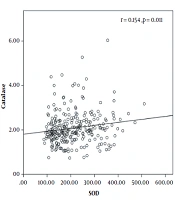
Investigation of Antioxidant Status in Coronary Artery Disease Patients
Dinarvand N, Rasouli M, Meshkini F, Zargari M. Investigation of Antioxidant Status in Coronary Artery Disease Patients. J Adv Immunopharmacol. 2021;1(1):e115238. doi: https://doi.org/10.5812/tms.115238
The Association between PAI-1 Gene Promoter Polymorphism and Serum Serpin E1, MDA, and Hs-CRP Levels in Coronary Artery Disease
Karimian A, Farajnia S, Ghojazadeh M, Khaki-Khatibi F. The Association between PAI-1 Gene Promoter Polymorphism and Serum Serpin E1, MDA, and Hs-CRP Levels in Coronary Artery Disease. Int Cardiovasc Res J. 2016;10(3):e10176. doi:
- Scopus by DOI: 0
Last Update: 3 weeks ago
- Scopus by Title: 0
Last Update: 3 weeks ago
- Scopus by Title (Ref): 0
Last Update: 3 weeks ago
- CrossRef: 0
Last Update: 6 hours ago
- OpenAlex: 0
Last Update: 1 day ago
- OpenCitations: 0
Last Update: 4 days ago