Journal of Semnan University of Medical Sciences
Effects of family-centered empowerment model on perceived satisfaction and self concept of multiple sclerosis patients care givers
Authors
 ,*, Leili Rabei, Nasim Bahrami, Safar Ali Esmaieli
Abstract
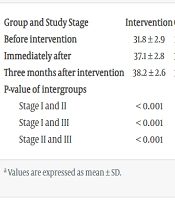
Introduction: Multiple sclerosis is a chronic central nervous system disease that affected all the aspects of life of patient, family and community. The importance of empowering programs has been increased with changed care approach from hospital to community. The aim of this study was to determine the effect of family- center empowerment model on the perceived satisfaction and self concept of the caregivers of multiple sclerosis patients. Materials and Methods: In this clinical trial study, 70 multiple sclerosis patients’ caregivers were grouped using random allocation to experimental and control groups. Based on training needs in the experimental group, 8 sessions for empowerment model were implemented in three months. Three months after the program implementation and collecting of self report checklists, the perceived satisfaction and self-esteem were evaluated in both experimental and control groups again. Results: Independent t tests showed significant differences in two groups after the intervention (P=0.001). In the experimental group, paired T- test also showed significant increase in the perceived satisfaction and self-esteem of family caregivers of patients (P=0.001). However in the control group, there were no significant differences in the perceived satisfaction and self-esteem of family caregivers of patients after three months. Conclusion: Family caregivers of chronic patients as hidden patients, have many problems. The interventions such as empowerment model implementation based on educational and therapeutic needs because of their low cost, safety and effectiveness for caregivers can enhance their perceived satisfaction and self-esteem.
Highlights
Copyright
© 2013, Author(s). This open-access article is available under the Creative Commons Attribution 4.0 (CC BY 4.0) International License (https://creativecommons.org/licenses/by/4.0/), which allows for unrestricted use, distribution, and reproduction in any medium, provided that the original work is properly cited.
Similar Articles
The Effect of Family Empowerment Model on Self-care in Hemodialysis Patients of Zahedan, Iran
Taheri BAH, Salar A. The Effect of Family Empowerment Model on Self-care in Hemodialysis Patients of Zahedan, Iran. Health Scope. 2021;10(1):e90951. doi: https://doi.org/10.5812/jhealthscope.90951
Effect of progressive muscle relaxation program on self-efficacy and quality of life in caregivers of patients with multiple sclerosis
Masoudi R, Soleimany M, Moghadasi J, Qorbani M, Mehralian H, et al. Effect of progressive muscle relaxation program on self-efficacy and quality of life in caregivers of patients with multiple sclerosis. J Inflamm Dis. 2024;15(2):e155614. doi:
The Effect of Family-Centered Empowerment Program on Husbands' Understanding of Illness, Perceived Stress and Self-care Behaviors of Type 2 Diabetes Patients
Moazeni M, Aliakbari F, Kheiri S, Salehi Tali S. The Effect of Family-Centered Empowerment Program on Husbands' Understanding of Illness, Perceived Stress and Self-care Behaviors of Type 2 Diabetes Patients. Jundishapur J Chronic Dis Care. 2024;13(4):e143656. doi: https://doi.org/10.5812/jjcdc-143656
The effect of mindfulness-based self-care empowerment training on depression of breast cancer patients’ spouses and their family functioning
Rostamvand M, Danesh M, Ali Mohammadpour R, AzimiLolaty H, Ghasemi mianaee P. The effect of mindfulness-based self-care empowerment training on depression of breast cancer patients’ spouses and their family functioning. J Nurs Midwifery Sci. 2022;9(4):e134526. doi:
Effect of Orem-based self-care education program on disease-related problems in patients with multiple sclerosis: A clinical trial
Dahmardeh H, kianian T, Vagharseyyedin SA. Effect of Orem-based self-care education program on disease-related problems in patients with multiple sclerosis: A clinical trial. Med Surg Nurs J. 2030;6(1):e67854. doi:
- Scopus by DOI: 0
Last Update: 2 weeks ago
- Scopus by Title: 0
Last Update: 2 weeks ago
- Scopus by Title (Ref): 0
Last Update: 2 weeks ago
- CrossRef: 0
Last Update: 4 hours ago
- OpenAlex: 0
Last Update: 1 day ago
- OpenCitations: 0
Last Update: 5 days ago