
1. Background
The kidney is a vital and complex organ of the body responsible for maintaining the balance of fluids and electrolytes in the body (1). Chronic kidney failure is a progressive disorder affecting the function of the kidneys, which impairs the body's ability to maintain the balance of fluids and electrolytes and ultimately leads to uremia. The incidence of the disease is 242 cases in one million (2). According to the data provided by the Center for Transplant Administration and Special Diseases, the number of patients with advanced renal failure in Iran is around 25,000, of whom approximately 50% are hemodialysis patients (3). Although treatment with dialysis has been shown to increase the hope of patients with chronic renal failure, this treatment, due to the requirements and possible complications, presents the patient with several problems, such as hypotension, painful muscle contractions, and seizure (4). To overcome the complications of treatment in these patients, patient involvement is important in the treatment and care process. This requires raising awareness, changing attitudes, and acquiring patient self-care skills (5). Self-care training emphasizes the person’s ability to care for himself (6). In some countries, health care managers have focused on increasing patient participation in the care process in response to the increasing prevalence of chronic diseases (7). Self-care involves an active, learned, conscious, and purposeful activity and behaviors observed in objective situations of life by the person or his relatives. The goal of self-care is to regulate factors affecting the person's growth and performance in relation to his life, health, and well-being.
The best health care outcomes are achieved when patients are actively engaged in self-care; for example, in the treatment progress, symptom and side effects monitoring, and follow-up of positive health-related behaviors, such as having a healthy diet and regular exercise. It is difficult to improve the general health of the patient, which will ultimately lead to a reduction in medical costs (8). On the other hand, it is an effective way to improve self-care empowerment, which is a fundamentally consistent concept that refers to the capabilities of individuals and those around them to preferably identify and manage problems and deficiencies (9). The family empowerment model means mainly to corporate and help the family to get the level of change (10). One of the effective ways for empowering chronic patients is the implementation of a family-centered empowerment model (11). The family, as the most fundamental element of society, is responsible for providing proper and appropriate health care to the patient and his relatives (12). Teaching family members for disease control and even prevention can be very helpful as there is a strong relationship between the family and the health status of its members. People, especially those with chronic diseases, are dependent on their family members, and even their attitude is influenced by the family (13). Therefore, the best source for transferring information between the health team and dialysis patients is the family of patients. Normawizer et al. suggested that group training (patient and family) is more relevant to individual education than diet, which indicates improved nutritional status and better dietary habits in families subjected to group training. Therefore, training the patients with chronic disease in groups and, if possible, in the presence of family members is suggested (14). Bramen et al. indicated that there is a strong relationship between dialysis patient satisfaction and family support (15). In Iran, in addition to improving some aspects of self-efficacy, Moatarian could improve self-care in these patients by implementing the empowerment program (16).
2. Objectives
Considering the importance of the patient's active role in self-care to control the complications and hemodialysis problems and the limited impact of the family-centered empowerment model on self-care in hemodialysis patients in the country, and due to the longer period of implementation of this study than similar studies, which can result in awareness improvement and changes in attitude and performance in subjects, the present study was done to investigate the effect of family-centered empowerment model on self-care of patients with hemodialysis referring to Imam Ali Hospital in Zahedan, Iran.
3. Methods
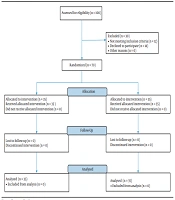
The present study is a quasi-experimental study that was performed on hemodialysis patients referring to the Hemodialysis Department of Imam Ali Hospital in Zahedan in 2018. The sample size was estimated to be 38 patients with a confidence level of 95%, and considering the possible drop in the number of samples in each group, a total of 100 cases n = 50 per group) were determined (17). In the first step, all the patients who met the inclusion criteria were chosen by available sampling. In the next step, each patient was numbered from 1 to 100, and the patients were divided into two groups of 50 cases due to odd and even numbers. Finally, patients were divided into the control and case groups randomly. The researcher, after obtaining a license, referred to the hemodialysis department of Imam Ali Hospital, while presenting the study objectives and how to conduct the research and invited patients to participate in the study. Then, the patients were selected based on inclusion criteria and randomly assigned to the intervention group from cases in the evening shift and the control group from patients in the morning shift. At first, the research tools were completed in both groups, then the intervention group was divided into 6 groups (11 - 8), and then the program was scheduled in 4 sessions of 90 minutes for 4 weeks, in the form of group meetings, with active participation. The patient and one of the family members (at least the main caregiver of the family) was interviewed by a researcher in the hemodialysis department of Imam Ali Hospital. The control group did not receive any training.
The data gathering tool in this study included the demographic characteristics of the patient and a self-care questionnaire. The self-care questionnaire was used for measuring self-care (18). This questionnaire’s reliability was confirmed by Cronbach's alpha (α = 0.91). In this study, instrumental validity was determined through content validity, and its reliability was determined by Cronbach's alpha. The tool was administrated to 20 hemodialysis patients except those included in the study, and its Cronbach's alpha coefficient was 0.89, and its reliability was confirmed. The questionnaire measures the self-care activities of hemodialysis patients, such as daily weight control, diet, fluid control, follow-up therapy, vascular care, and skincare, and has 11 sentences scoring on a 4-point Likert scale (Never: 1, Very low: 2, Too many: 3, and Always: 4). The score range is 11 to 44 and the total score is 44. The questionnaire was completed in three stages before the intervention and one and two months after the intervention by both intervention and control groups simultaneously.
3.1. Step 1: Understanding the Threat
This phase is conducted in two 45-min sessions by the researcher using a lecture and group discussion aiming to increase knowledge and cognition and then to understand the threat through awareness of nature and effects, aggravating factors, nutritional factors, exercise, and effective factors.
3.2. Step 2: Problem-Solving
This phase was conducted in two 45-min group discussion sessions. In this section, the patients encountered their problems and the problem-solving process and took advantage of each other's experiences to solve the problems caused by the disease and to better control it. At this stage, the best way to solve patients' problems was selected and lectured on nutrition style, healthy and physical activity, and its relationship with disease control, hemodialysis, and related issues.
3.3. Step 3: Educational Participation
Increasing self-esteem and self-control through educational participation by transferring educational contents to the patient in group discussion sessions to active family members.
3.4. Step 4: Evaluation
The evaluation process was performed to evaluate the model steps before each session with questions and answers on the topics discussed to ensure the learning from the sessions. One month after the end of the training sessions, the questionnaire was completed by the intervention and control groups. The final evaluation was done after 2 months of intervention in both groups by completing the self-care questionnaire. During this time, the researcher was in touch with patients to respond to their problems.
To compare the mean scores before and after the intervention in both intervention and control groups, and also to compare the mean scores before and one and two months after the intervention in the groups, an independent t-test was used. Repeated measures ANOVA and chi-square test were used to compare the frequency of qualitative variables in the two groups. Using the Shapiro-Wilk test, the normalization of the obtained data was controlled. The significance level in this study was 0.05.
4. Results
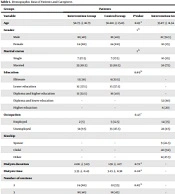
The results showed that in the intervention group, 42% were female and 58% were male, and in the control group, 44% were female and 56% were male. The mean age of the participants in the intervention and control groups was 48.18 ± 15.78 and 47.24 ± 16.14 years, respectively. The mean duration of disease in the intervention group was 46.68 ± 33.56 months, and in the control group, it was 52.08 ± 55.04 months. The mean duration of hemodialysis in the intervention group was 34.56 ± 26.79 with a range of 6 to 120 months, and in the control group, it was 21.14 ± 27.88 with a range of 6 to 145 months. Both groups were similar in terms of their specific characteristics (age, sex, duration of the disease, duration of hemodialysis), and they did not differ significantly. However, there was a significant difference in the "main caregiver relation" variable (P = 0.006). (Table 1). Regarding the mean self-care score in hemodialysis patients, the mean self-care in the intervention group before and one and two months after the completion of family-centered empowerment was 23.08 ± 3.95, 33.38 ± 3.75, and 38.83 ± 14.3, respectively. These values for the control group were 23.9 ± 3.39, 23.66 ± 25.23, and 23.23 ± 22.23, respectively. Independent t-test showed that there was a significant difference in the mean self-care scores between the two groups (P < 0.001) (Table 2). The repeated measures ANOVA results showed that changes in self-care scores in the two groups were not the same, and the self-care scores of the intervention group increased compared with the control group (P < 0.001). The results of the interaction of "time" and "intervention" effects also showed that these two variables had a significant effect on mean self-care scores (P < 0.001) (Table 3).
Table 1.
Frequency of Hemodialysis Patients in the Intervention and Control Groups Referring to the Imam Ali Hospital in Zahedan a
| Demographic Information | Control | Intervention | Significance Level | |
|---|---|---|---|---|
| Age | 47.24 ± 16.14 | 48.18 ± 15.78 | t = 0.294 | P = 0.76 b |
| Illness duration | 21.14 ± 27.88 | 34.56 ± 26.79 | t = 0.592 | P = 0.55 b |
| hemodialysis duration | 46.68 ± 33.56 | 52.08 ± 55.04 | t = 2.454 | P = 0.16 b |
| Sex | χ2 = 0.041 | P = 0.84 c | ||
| Male | 28 (51.2) | 29 (50.9) | ||
| Female | 22 (49.1) | 21 (48.8) | ||
| Relationship with the main caregiver | χ2 = 14.52 | P = 0.006 c | ||
| Wife/Husband | 7 (29.2) | 17 (70.8) | ||
| Mother | 2 (66.7) | 1 (33.3) | ||
| Children | 24 (49) | 25 (51) | ||
| Brother/Sister | 17 (50) | 7 (50) | ||
aValues are expressed as mean ± SD and frequency (%).
bT-test
c Chi-square test
Table 2.
Comparison of the Mean Scores of Self-care in Hemodialysis Patients Before and One and Two Months After the Family-Centered Empowerment Intervention in the Intervention and Control Groups
| Group | Time | ||
|---|---|---|---|
| Before the Intervention | One Month After the Intervention | Two Months After the Intervention | |
| Self-care | |||
| Control | 23.9 ± 3.39 | 23.16 ± 3.25 | 23.32 ± 3.22 |
| Intervention | 23.08 ± 3.95 | 33.38 ± 3.75 | 38.38 ± 3.14 |
| T-test | |||
| P | 0.26 | < 0.001 | < 0.001 |
| t | 1.11 | 14.55 | 23.66 |
| df | 98 | 98 | 98 |
Table 3.
Results of Repeated Measures Analysis of Variance of Self-care Before and One and Two Months After the Family-Centered Empowerment Intervention in the Intervention and Control Groups
| Variable | Sum of Squares | Degrees of Freedom | Mean Square | Effect Size | The Significance Level | Test Power |
|---|---|---|---|---|---|---|
| Time | 227480.403 | 1 | 227480.403 | 8137.645 | < 0.001 | 1 |
| Group | 4985.763 | 1 | 4985.763 | 178.355 | < 0.001 | 0.239 |
| Time and group interaction | 3152.180 | 1 | 3152.180 | 594.820 | < 0.001 | 1 |
| Error | 519.340 | 98 | 5.92 |
5. Discussion
The aim of this study was to determine the effect of education based on the family-centered empowerment model on self-care in patients undergoing hemodialysis referring to Imam Ali Hospital in Zahedan. Findings showed that education based on the family-centered empowerment model increased the mean score of self-care in the intervention group compared with the control group after the intervention. This increase was also statistically significant between the two groups, which shows the positive effect of the empowerment model on patient self-care behaviors. Accordingly, Razmara et al. (2016) aimed at determining the effect of family-centered education on self-care in type 2 diabetic patients and showed that the mean scores of total self-care in the intervention group significantly increased compared with the control group after training (19), which is consistent with the present study.
In this study, we used a family-centered approach. General education was conducted within 3 months, and evaluation was done only before and immediately after the intervention. After completing the intervention, the educational package, including pamphlets and CDs, is given to the intervention group only. The training was categorized based on the steps of the family-centered empowerment model, which indicates more credibility of education. Bakiyani Moghadam et al. (2014), investigated the effect of the health belief model (HBM)-based educational intervention with text messages on adopting self-care behavior in patients with type 2 diabetes. Although the mean score of self-care behaviors in the intervention group after the intervention increased, there was no significant increase in the control group in the mean score of self-care behaviors, which means that the text messages in the intervention group improved their behavioral behaviors (20). In this study, training was performed only by sending SMS, and the evaluation was carried out only before and immediately after the intervention. In the present study, the training was conducted by holding educational sessions. In the study by Piau et al. (2003), the effect of instruction through the booklet on the knowledge and performance of people with the osteoporotic function was evaluated, by face to face interviews, and then two eight-page brochures were presented (21). They found no significant statistical difference between the two intervention and control groups regarding self-care behaviors, which can justify the need for a longer time to change the behavior. Also, they concluded that other social and cultural factors may change behavior.
In addition, Sharifirad et al. (2007) (22) and Zia Price et al. (2009) (23) indicated that the use of face-to-face learning increases self-care behaviors in studied cases. In the study by Bakiyani et al. (2014), the effect of training on self-care behaviors in dialysis patients was assessed, and it increased the scores of self-care behaviors after the intervention (17). In this study, general education was done in three 30 min sessions, and one month after the intervention, the final evaluation was carried out. In the present study, training was based on the steps of the family-centered empowerment model conducted in four 90-min sessions. The final evaluation was performed one and two months after the end of the intervention. Because changing the behavior of patients requires time, we considered more time to achieve this, and then the final evaluation was done. Therefore, the efficiency of this teaching method was increased and indicated the change in the attitude of the participants.
Berna and Safran (2003) stated that self-care is a derivative of patient empowerment. Empowerment is defined as a health care philosophy based on the view that maximum health care outcomes are achieved when the patient becomes an active participant in health care. Therefore, patients with higher abilities have better self-care (24). Self-care behaviors in hemodialysis patients are very important, and because patients in our study and also all hemodialysis patients in Iran do not have high self-care thus, the care of these patients using empowerment programs seems necessary. Also, in the process of changing self-care behavior, patients should be encouraged to take care of themselves. Accordingly, the family-centered empowerment program focuses on the awareness and motivation of the patient and his family to improve self-care behaviors.
5.1. Conclusion
Patients with chronic diseases, such as hemodialysis patients, depending on their family members. Therefore, increasing family members' knowledge about the self-care needs of these patients is the best measure to support and enhance their adaptation to lifestyle changes. Thus, paying attention to training the family members of the patient can facilitate the management and control of the disease. Family-centered education and follow-up can be very effective in improving the awareness, performance, and attitudes of hemodialysis patients with self-care problems.