Journal of Semnan University of Medical Sciences
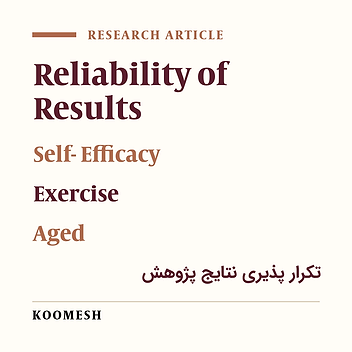
Image Credit:Koomesh
Outline
Psychometric properties of Persian version the self-efficacy for exercise scale for older adults
Authors
Abstract
Introduction: The purpose of this study was to determine the psychometric properties of Persian version the self-efficacy for exercise Scale for older adults. Materials and Methods: For this purpose, 352 older adults from two genders (%59 men and %41 women) were chosen by cluster random sample and completed the Persian version the self-efficacy for exercise scale for older adults. At first, data was confirmed with use of translation- retranslation, face validity and translation accuracy methods. Meaningly, for scale construct validity, confirmatory factor analysis and for scale;#39s internal constancy and also infraclass correlations coefficient temporal stability, Cranach alpha coefficient was used. Results: The results show that the model fit index (RMSEA, 0.055 CFI, 0.95 & TLI, 0.94), internal consistency the total scale (0.90) and temporal stability the total scale (0.83) showed Persian version the self-efficacy for exercise scale for older adults have good reliability and validity.. Conclusion: These findings indicated a good validity and reliability for the Persian version of the self-efficacy for exercise Scale and for older adults. Therefore, the Persian version the self-efficacy for exersice scale for older adults can be employed as a tool in order to study and evaluate the efficacy of Iranian men and women for older adults.
Highlights
References
- 1.Blair SN, Brodney S. Effects of physical inactivity and obesity on morbidity and mortality: current evidence and research issues. Med Sci Sports Exerc 1999; 31: S646-S662.
- 2.Rhodes RE, Plotnikoff RC. Can current physical activity act as a reasonable proxy measure of future physical activity? Evaluating cross-sectional and passive prospective designs with the use of social cognition models. Prev Med 2005; 40: 547-555.
- 3.GHahremani L NM. Comparison of predicted exercise intention and behavior based on self-efficacy theory and the theory of planned behavior. Faculty of Health and Nutrition, Shiraz Univ Med Sci 2012. (Persian).
- 4.Organization WH. The world health report 2002: reducing risks, promoting healthy life: World Health Organization; 2002.
- 5.Afzali M, Baradaran Eftekhary M, Hejazi F, Khojasteh T, Tabrizi R, Faridi T. Social mobilization for health promotion in the elderly. Hakim Res J 2007; 9: 1-6. (Persian).
- 6.Orlick T, Partington J. Mental links to excellence. Sport Psychol 1988; 2: 105-130.
- 7.Duncan RM, Cheyne JA. Incidence and functions of self-reported private speech in young adults: A self-verbalization questionnaire. Canadian Journal of Behavioural Science/Revue canadienne des sciences du comportement 1999; 31: 133.
- 8.Simar asl N FM, GHolipur A. Explaining the positive impact of psychological factors in the organization. J Manag Sci 2010; 17: 23-45.
- 9.Tahmassian K, Anari A. The Relation between domains of self-efficacy and Depression in adolescence. 2009. (Perjsian).
- 10.Bandura A. Self-efficacy: toward a unifying theory of behavioral change. Psychol Rev 1977; 84: 191.
- 11.Bandura A. Social foundations of thought and action: A social cognitive theory: Prentice-Hall, Inc; 1986. (Persian).
- 12.Hoy WK, Tarter CJ, Hoy AW. Academic optimism of schools: A force for student achievement. Am Educ Res J 2006; 43: 425-446.
- 13.Zimmerman BJ. Self-efficacy: An essential motive to learn. Contemp Educ Psychol 2000; 25: 82-91.
- 14.Vazirniya T. Family and Elderly. Nursing and Midwifery (Mashhad) 1999; 2: 14. (Persian).
- 15.Hellstrom K, Lindmark B, Wahlberg B, Fugl-Meyer AR. Self-efficacy in relation to impairments and activities of daily living disability in elderly patients with stroke: a prospective investigation. J Rehab Med 2003; 35: 202-207.
- 16.Chang SH, Crogan NL, Wung SF. The self-care self-efficacy enhancement program for Chinese nursing home elders. Geriatr Nurs 2007; 28: 31-36.
- 17.Singh B, Udainiya R. Self-efficacy and well-being of adolescents. J Indian Acad Appl Psychol 2009; 35: 227-232.
- 18.Judge TA, Erez A, Bono JE, Thoresen CJ. Are measures of self-esteem, neuroticism, locus of control, and generalized self-efficacy indicators of a common core construct? J Personal Soc Psychol 2002; 83: 693.
- 19.Muris P. A brief questionnaire for measuring self-efficacy in youths. J Psychopathol Behav Assess 2001; 23: 145-149.
- 20.Tipton RM, Worthington EL. The measurement of generalized self-efficacy: A study of construct validity. J Per Assess 1984; 48: 545-548.
- 21.Lee LL, Perng SJ, Ho CC, Hsu HM, Lau SC, Arthur A. A preliminary reliability and validity study of the Chinese version of the self-efficacy for exercise scale for older adults. Int J Nurs Studies 2009; 46: 230-238.
- 22.Vispoel WP, Chen P. Measuring Self-Efficacy: The State of the Art. 1990.
- 23.Resnick B, Jenkins LS. Testing the reliability and validity of the self-efficacy for exercise scale. Nurs Res 2000; 49: 154-159.
- 24.McAuley E. Self-efficacy and the maintenance of exercise participation in older adults. J Behav Med 1993; 16: 103-113.
- 25.McAuley E, Lox C, Duncan TE. Long-term maintenance of exercise, self-efficacy, and physiological change in older adults. J Gerontology 1993; 48: P218-P24.
- 26.McAuley E. The role of efficacy cognitions in the prediction of exercise behavior in middle-aged adults. J Behav Med 1992; 15: 65-88.
- 27.Resnick B, Luisi D, Vogel A, Junaleepa P. Reliability and validity of the self-efficacy for exercise and outcome expectations for exercise scales with minority older adults. J Nurs Measur 2004; 12: 235-248.
- 28.Choi M, Ahn S, Jung D. Psychometric evaluation of the Korean Version of the Self-Efficacy for Exercise Scale for older adults. Geriatr Nurs 2015; 36: 301-305.
- 29.Durand-Bush N, Salmela JH, Green-Demers I. The ottawa mental skills assessment tool (OMSAT-3*). The Sport Psychologist 2001.
- 30.Zeidabadi R, Rezaie F, Motashareie E. Psychometric properties and normalization of persian version of ottawa mental skills assessment tools (OMSAT-3). Sport Psychol Rev 2014; 3: 63-82. (Persian).
- 31.Mels G. LISREL for Windows: Getting started guide. Lincolnwood, IL: Scientific Software International 2006.
- 32.Kline RB. Principles and practice of structural equation modeling: Guilford publications; 2015.
- 33.Kontodimopoulos N, Pappa E, Niakas D, Tountas Y. Validity of SF-12 summary scores in a Greek general population. Health Qual Life Outcomes 2007; 5: 55.
- 34.Lawshe CH. A quantitative approach to content validity1. Person Psychol 1975; 28: 563-575.
- 35.Terry PC, Lane AM, Fogarty GJ. Construct validity of the Profile of Mood StatesAdolescents for use with adults. Psychol Sport Exerc 2003; 4: 125-139.
- 36.Hashim HA, Zulkifli EZ, Yusof HA. Factorial validation of Malaysian adapted Brunel Mood Scale in an adolescent sample. Asian J Sports Med 2010; 1: 185.
- 37.Burgess PW, Alderman N, Evans J, Emslie H, Wilson BA. The ecological validity of tests of executive function. J Int Neuropsychol Soc 1998; 4: 547-558.
- 38.Schutz R, Gessaroli M, Singer R, Murphey M, Tennant L. Use, misuse, and disuse of psychometrics in sport psychology research. Handbook Res Sport Psychol 1993; 901-917.
- 39.Kashani V, Shiri H, Manaseri H. Psychometric properties and normalization of persion version of mental toughness scale (MTS). Res Univ Sport 2015; 7: 83-98.
- 40.Bartlett MS. Tests of significance in factor analysis. Br J Stat Psychol 1950; 3: 77-85.
- 41.Kaiser HF. A note on guttman's lower bound for the number of common factors1. Br J Stat Psychol 1961; 14: 1-2.
- 42.Raykov T. Behavioral scale reliability and measurement invariance evaluation using latent variable modeling. Behav Ther 2004; 35: 299-331##.
Copyright
© 2017, Author(s). This open-access article is available under the Creative Commons Attribution 4.0 (CC BY 4.0) International License (https://creativecommons.org/licenses/by/4.0/), which allows for unrestricted use, distribution, and reproduction in any medium, provided that the original work is properly cited.
Similar Articles
Validation of the Persian Version of the Exercise Adherence Rating Scale in Iranian Population: A Methodological Study
Ghaderi F, Amirshakeri B, Adigozali H, Havaei N. Validation of the Persian Version of the Exercise Adherence Rating Scale in Iranian Population: A Methodological Study. Middle East J Rehabil Health Stud. 2023;10(3):e133898. doi: https://doi.org/10.5812/mejrh-133898
Psychometric features of Persian version of self-efficacy tool for patients with hypertension
Ghanei Gheshlagh R, Parizad N, Ghalenoee M, Dalvand S, Baghi V, et al. Psychometric features of Persian version of self-efficacy tool for patients with hypertension. Int Cardiovasc Res J. 2018;12(2):e65333. doi:
Determining validity and reliability of the Persian version of activities-specific balance confidence scale for elderly
Kashani V, Zarifkar M, Alinaghipoor Z. Determining validity and reliability of the Persian version of activities-specific balance confidence scale for elderly. koomesh. 2018;20(4):e153015. doi:
Development and Validation of Social Cognitive Theory Based Questionnaire for Physical Activity to Preventing Osteoporosis (PAQ-SCT)
Nematollahi M, Eslami AA. Development and Validation of Social Cognitive Theory Based Questionnaire for Physical Activity to Preventing Osteoporosis (PAQ-SCT). Iran J Psychiatry Behav Sci. 2018;12(3):e12662. doi: https://doi.org/10.5812/ijpbs.12662
Reliability and Validity of the Persian Version of Child Asthma Self-Efficacy Scale
Ganje P, Mehrabizade Honarmand M, Davodi I, Zargar Y. Reliability and Validity of the Persian Version of Child Asthma Self-Efficacy Scale. Jentashapir J Cell Mol Biol. 2017;8(2):e60163. doi: https://doi.org/10.5812/jjhr.60163
- Scopus by DOI: 0
Last Update: 2 days ago
- Scopus by Title: 4
Last Update: 2 days ago
- Scopus by Title (Ref): 4
Last Update: 2 days ago
- CrossRef: 0
Last Update: 4 hours ago
- OpenAlex: 0
Last Update: 5 hours ago
- OpenCitations: 0
Last Update: 4 days ago