
1. Background
Exercise is widely recognized as necessary for preventing and treating physical dysfunctions (1). An exercise program depends on clients’ status, intensity, and progression of their illness (2). Adherence to exercise is the degree to which an individual's behavior conforms to the agreed recommendations of health care providers (3), which has significant and positive effects on treatment outcomes (4, 5). These outcomes are important for the patients’ life and economic situation (6). In recent decades, many studies have been conducted on patient compliance or adherence (7). However, prescribed exercise programs are often offered as a home-based practice or self-management and are typically unsupervised by healthcare providers. Thus, it is not clear if the patient participated in the exercise program and did it accurately and completely; hence, non-adherence to exercise is an obstacle to achieving therapeutic goals (6). Therefore, knowing the patient's participation and how to implement the program is very important, and one of the methods used is self-report measures (8). Numerous self-reported measures have been designed to evaluate exercise adherence (8). One of the practical and common tools that can be mentioned is the Exercise Adherence Rating Scale (EARS), which has been translated into various languages (9), but the Persian version is not available. There is no standard tool or scale for measuring exercise adherence rate in Iran, and it is needed to investigate the effects of home-based exercise in different subjects.
2. Objectives
This study was done to translate and validate the EARS in the Iranian population.
3. Methods
3.1. Study Design and Participants
A total of 160 clients volunteered to participate in this methodological and cross-sectional study. Patients with musculoskeletal pain who were referred to physiotherapy clinics and needed home-based exercise regimens were included in this study. Participants who did not sign the informed consent and complete the questionnaire during treatment were excluded.
Participants were recruited from physiotherapy outpatient centers of the rehabilitation faculty of Tabriz University of Medical Sciences, Iran. They had chronic musculoskeletal pain and received ten sessions of routine physiotherapy for their complaints. All of them had home-based exercises and volunteered to participate in this study.
Thirty participants agreed to participate in the study's reliability (test-retest) phase. Participants entered the study with informed consent. This study was ethically approved (code: IR.TBZMED.REC.1398.948).
3.2. Procedures
3.2.1. Translation and Adaptation Process
We obtained the developers' permission to translate EARS into Persian (Naomi A. Beinart). The English version of EARS was first translated into the Persian language. The translation process was applied in a forward and backward fashion by four native Persian speakers (physical therapists and Persian-to-English translators) based on the international checklist (COSMIN checklist) (10). An additional certified translator approved backward translation. The final version with minor revisions was prepared under the corresponding author's and coauthors' supervision by consensus. The developer confirmed the backward translated final version. Minor revisions were made in the Persian version because of the linguistic differences to improve the simplicity and clarity of some items.
3.2.2. Psychometric Properties
The validation process included content validity, construct validity (factor analysis), test-retest reliability (with almost a two-week interval between the two test occasions), and internal consistency. Participants under the supervision of a trained physiotherapist in a quiet room completed the EARS. The data collection process was started in January 2020 in Tabriz and lasted for 12 months (from 2020 to 2021).
Fifteen academic members (ten physiotherapists, three occupational therapists, and two physical education graduates) participated in an expert panel in multiple sessions to qualify the content validity of the EARS. The content validity was assessed by calculating the CVI (acceptable value > 0.79) and CVR (acceptable value > 0.49). Construct validity is done in several ways, and we used exploratory factor analysis. Based on the recommended sample size, five to ten participants should be per measurement item. According to the EARS items, a minimum size of 80 subjects was required, and 160 participants, regardless of gender at any age, were included to survey the EFA of the EARS. If the participants were illiterate or with cognitive deficits, they were excluded from the study. The Persian version of the mini-mental state examination (MMSE) was used to assess cognitive status (11). All of the subjects had to do prescribed home exercises for their musculoskeletal problems during ten sessions of treatment. If they had pain or other problems with doing the exercises, they were replaced with others. The prescribed exercises were not the same and it depended on their problem. The participants completed the EARS after ten sessions of treatment.
Because the EARS has two separate parts and based on other studies (9), the factor analysis of adherence and reason parts were done separately.
To determine the EARS’ internal consistency, a correlation between the questionnaire’s items was investigated (item to total). For test-retest reliability, the scores of 30 participants were correlated in intervals of two weeks.
3.3. Instrument
The EARS is a self-reported questionnaire with 16 items that evaluate adherence to the prescribed exercises (12). The EARS includes three sections. The first section is related to the prescribed exercises. This section has five items, which are related to the method of performing exercises and activities that people mostly perform to promote their life quality. The second section is related to exercise adherence. This section consists of six items or questions to recognize exercise adherence. This part evaluates whether the person does her exercises or not. The third part is related to reasons for adherence or non-adherence. This part has ten questions, which evaluate factors that facilitate and hinder the exercises (13).
3.3.1. Scoring the EARS
This scoring information relates to the 6 - item EARS. The EARS is scored on a 5 - point Likert scale (0 - completely agree to 4 - completely disagree). Items one and four are scored reversely, resulting in a possible score of 0 - 24. A higher score indicates better adherence.
3.4. Statistical Analysis
Statistical analysis was done using SPSS 25 (significant level: P-values < 0.05). The content validity of the Persian versions of EARS was obtained by calculating CVR and CVI. Because of the number of experts participating in this study (n = 15), CVR > 0.49 was acceptable. Also, CVI values > 0.79 were accepted.
Principal axis factoring with a Promax rotation was used to assess the nature of the group-correlated measurements and the interrelationship of the EARS items. Bartlett’s test of sphericity and the Kaiser-Meyer-Olkin (KMO) test were used to evaluate the appropriateness of the factor analysis and the sampling adequacy. We used eigenvalues greater than one to determine the number of factors (14).
The test-retest reliability was analyzed by the intra-class correlation coefficient (ICC). The ICCs were interpreted according to the Koch and Landis criteria (almost perfect = 0.81 - 1, substantial = 0.71 - 0.80, moderate = 0.41 - 0.7, fair = 0.21 - 0.4, and poor = 0 - 0.2) (15). Cronbach’s alpha (item to total) was used for the evaluation of internal consistency. Alpha coefficients > 0.6 were satisfactory for all domains.
4. Results
4.1. Descriptive Statistics
In this study, 160 clients participated, of whom 85 were female, and 75 were male. Their age range was 19 to 83 years [mean (SD) = 53.62 (14.52)].
4.2. Validation
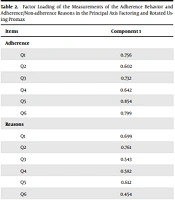
Three expert panels (n = 15) were formed to approve the content validity of the EARS. The CVI and CVR results are shown in Table 1. Exploratory factor analysis (construct validity) of the EARS was assessed on 160 participants. Principal axis factoring indicated that the questionnaire items loaded to one component (adherence behavior: variance = 67.76%, adherence/non-adherence reasons: variance = 61.88%) (Table 2). The study sample size was adequate based on the KMO test and Bartlett’s test of sphericity (adherence behavior = 0.739, adherence/non-adherence reasons = 0.736). The correlation matrix was appropriate for factor analysis (adherence behavior: χ2 = 363 and P < 0.001, adherence reasons: χ2 = 465 and P < 0.001). The results of internal consistency (n = 160) and test-retest reliability (n = 30) of EARS are indicated in Tables 3 and 4.
Table 1.
CVR and CVI Values for Adherence Behavior (Q1 - Q6) and Adherence/Non-adherence Reasons (Q7 - Q16) (n = 15)
| Items | CVR | CVI (Relative) | CVI (Clarity) | CVI (Simplicity) |
|---|---|---|---|---|
| Adherence | ||||
| Q1 | 0.86 | 0.93 | 1 | 0.86 |
| Q2 | 1 | 1 | 0.93 | 1 |
| Q3 | 0.73 | 1 | 1 | 1 |
| Q4 | 0.86 | 1 | 1 | 1 |
| Q5 | 1 | 0.93 | 0.93 | 1 |
| Q6 | 0.73 | 1 | 0.93 | 1 |
| Reasons | ||||
| Q1 | 0.6 | 0.93 | 1 | 1 |
| Q2 | 0.6 | 0.86 | 1 | 1 |
| Q3 | 0.86 | 0.93 | 1 | 1 |
| Q4 | 0.6 | 0.86 | 1 | 1 |
| Q5 | 0.6 | 0.93 | 0.93 | 1 |
| Q6 | 0.73 | 1 | 1 | 0.93 |
| Q7 | 0.6 | 0.86 | 1 | 0.93 |
| Q8 | 0.73 | 0.8 | 0.8 | 0.86 |
| Q9 | 1 | 1 | 1 | 1 |
| Q10 | 0.86 | 0.93 | 0.93 | 0.93 |
Table 2.
Factor Loading of the Measurements of the Adherence Behavior and Adherence/Non-adherence Reasons in the Principal Axis Factoring and Rotated Using Promax
| Items | Component 1 |
|---|---|
| Adherence | |
| Q1 | 0.756 |
| Q2 | 0.602 |
| Q3 | 0.732 |
| Q4 | 0.642 |
| Q5 | 0.854 |
| Q6 | 0.799 |
| Reasons | |
| Q1 | 0.699 |
| Q2 | 0.761 |
| Q3 | 0.543 |
| Q4 | 0.582 |
| Q5 | 0.612 |
| Q6 | 0.454 |
| Q7 | 0.6 |
| Q8 | 0.713 |
| Q9 | 0.812 |
| Q10 | 0.484 |
Table 3.
The Results of Internal Consistency Analysis for EARS (n = 160)
| Items | Alpha Coefficient |
|---|---|
| Adherence behavior | 0.7 |
| Adherence/non-adherence reasons | 0.73 |
| Total | 0.74 |
Table 4.
The Results of Test-Retest Analysis for EARS (n = 30)
| Items | ICC | CI |
|---|---|---|
| Q1 | 0.97 | 0.93 - 0.98 |
| Q2 | 0.97 | 0.95 - 0.99 |
| Q3 | 1 | 1 |
| Q4 | 0.88 | 0.75 - 0.94 |
| Q5 | 0.99 | 0.98 - 0.99 |
| Q6 | 0.98 | 0.97 - 0.99 |
| Q7 | 0.98 | 0.97 - 0.99 |
| Q8 | 0.98 | 0.96 - 0.99 |
| Q9 | 0.99 | 0.97 - 0.99 |
| Q10 | 0.98 | 0.97 - 0.99 |
| Q11 | 0.99 | 0.98 - 0.99 |
| Q12 | 1 | 1 |
| Q13 | 0.97 | 0.94 - 0.98 |
| Q14 | 0.99 | 0.98 - 0.99 |
| Q15 | 0.97 | 0.94 - 0.98 |
| Q16 | 0.98 | 0.97 - 0.99 |
| Q1 to Q6 | 0.98 | 0.96 - 0.99 |
| Q7 to Q16 | 0.99 | 0.97 - 0.99 |
| Total | 0.98 | 0.97 - 0.99 |
5. Discussion
This study aimed at translation, validation, and cross-cultural adaptation of the EARS among Iranian patients prescribed to do home exercises.
The findings showed acceptable content validity for the Persian version. Principal axis factoring (construct validity) showed that the measurement items of the EARS loaded to one component (adherence behavior: variance = 67.76%, adherence/non-adherence reasons: variance = 61.88%). Test-retest reliability analysis showed good to excellent reproducibility (0.88 - 1) for the Persian version of the EARS. The internal consistency of the translated questionnaire was in good ranges (0.7 - 0.74).
For the first time, Newman-Beinart developed and reported initial validation of the EARS (13), and then other researchers studied the face validity and comprehensibility of the English version of EARS (12).
Recently, cross-cultural adaptation, validation, and reliability studies have been conducted for the Brazilian and Nepali versions of EARS (9, 16), and the results of the present study were in line with their results. The forward and back translation and adaptation procedure with the expert panels showed no content- or language-related issues. Translation and cultural adaptation phases for the Persian version of the EARS questionnaire were performed by formal linguistic validation method as a translation–back translation and using expert panel opinions. Our experts consisted of physiotherapy and occupational therapy staff members and physical education departments with the maximum amount of home exercise prescriptions. The Persian version of the EARS had good content validity.
Heterogeneous participants in terms of age, gender, chief complaints, socioeconomic status, and urban or suburban residence were involved in this study. Thus, the reliability and validity studies were done in a heterogeneous sample of participants.
The internal consistency of the Persian version of EARS was excellent (α = 0.7 - 0.74) for the first part of the questionnaire (6-item adherence behavior). The results of the English, Brazilian and Nepali versions were 0.8, 0.88, and 0.94, respectively. The results of the present study and these three studies were in the acceptable range (9, 16, 17).
The EFA revealed sufficient construct validity of the adherence behavior items of the Persian version of EARS. The adherence and reason scales separately indicated a one-factor solution with a vigorous loading. The factor loading was similar to English, Brazilian, and Nepali versions (9, 16, 17).
Adherence to prescribed home exercise in rehabilitation is very important. Previous systematic reviews showed that most of the studies did not have a reliable and valid way to assess exercise adherence (16). Nepali and Brazilian versions of EARS were translated and validated recently and except that we did not find any other version of this questionnaire (9, 16).
Our results indicated that the Persian version of this questionnaire has acceptable validity and reliability in patients who do home exercises and is comparable with the English, Brazilian, and Nepali versions (9, 13, 16, 17).
5.1. Limitations
Our study also has some limitations. The study was stopped in the middle of the data collection period because of the COVID-19 outbreak; thus, we did not have enough patients, and then we continued after the outbreak. Also, participants had to be literate to respond to the EARS, and lack of literacy is a limitation of the EARS. An oral version of the EARS is required for future studies.
5.2. Conclusions
Our findings indicated that the Persian version of EARS is a reliable and valid measure to assess exercise adherence. Our study results have implications for conducting comparative studies and clinical trials in the Iranian population who need home-based exercise.