Journal of Semnan University of Medical Sciences
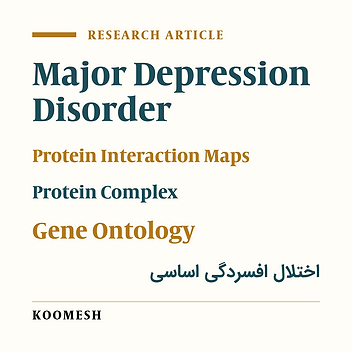
Image Credit:Koomesh
Outline
Protein-protein interaction network analysis of major depression disorder via proteomic approach from cerebrospinal fluid sample
Authors

Abstract
Introduction: As the major depression disorder (MDD) is one of the prevalent psychiatric conditions, molecular characteristic is important to gain a better understanding of its complex nature. In this study, the protein-protein interaction network analysis is carried out in order to have a better understanding the molecular mechanism of MDD. Materials and Methods: The MDD differentially expressed proteins of cerebral fluid were extracted from the literature. Cytoscape Software was used for the network construction of 39 retrieved proteins. In addition, Cytoscape plug-ins, MCODE and ClueGO+CluePedia identified the protein complexes and biological processes, respectively. Results: The MDD map centrality analysis identified 15 hub proteins. This network comprises of four protein complexes and seven significant biological processes. Conclusion: In this study, some of the central proteins, protein complexes, and biological processes related to MDD are introduced. The further investigations can help validating possible drug targets and diagnostic biomarkers
Highlights
References
- 1.Ghorbani R. Effects of cognitive therapy, drug therapy and combined therapy in improvement of major depression. Koomesh 2011; 13: 114-119.
- 2.Bot M, Chan MK, Jansen R, Lamers F, Vogelzangs N, Steiner J, et al. Serum proteomic profiling of major depressive disorder. Transl Psychiatry 2015; 5: 1-9.
- 3.Martins-de-Souza D, Guest P, Harris L, Vanattou-Saifoudine N, Webster M, Rahmoune H, Bahn S. Identification of proteomic signatures associated with depression and psychotic depression in post-mortem brains from major depression patients. Transl Psychiatry 2012; 2: 1-13.
- 4.Hamet P, Tremblay J. Genetics and genomics of depression. Metabolism 2005; 54: 10-15.
- 5.Mirmohammadkhani M. Vitamin D serum levels in nurses in Semnan educational hospitals and its association with depression. Koomesh 2016; 17: 313-322.
- 6.Zamanian-Azodi M, Mortazavi-Tabatabaei SA, Mansouri V, Vafaee R. Metabolite-protein interaction (MPI) network analysis of obsessive-compulsive disorder (OCD) from reported metabolites. Arvand J Health Med Sci 2016; 2: 112-120.
- 7.Rezaei-Tavirani M, Rahmati-Rad S, Rezaei-Tavirani M. Ethanol and cancer induce similar changes on protein expression pattern of human fibroblast cell. Iran J Pharmac Res 2016; 15: 175-184. (Persian).
- 8.Zali H, Zamanian-Azodi M, Tavirani MR, Baghban AA-z. Protein drug targets of lavandula angustifolia on treatment of rat Alzheimer's disease. Iran J Pharmac Res 2015; 14: 291-302.
- 9.Rezaie-Tavirani M, Fayazfar S, Heydari-Keshel S, Rezaee MB, Zamanian-Azodi M, Rezaei-Tavirani M, Khodarahmi R. Effect of essential oil of Rosa Damascena on human colon cancer cell line SW742. Gastroenterol Hepatol Bed Bench 2013; 6: 25-31.
- 10.Tohyama M, Miyata S, Hattori T, Shimizu S, Matsuzaki S. Molecular basis of major psychiatric diseases such as schizophrenia and depression. Anat Sci Int 2015; 90: 137-143.
- 11.Stelzhammer V, Haenisch F, Chan MK, Cooper JD, Steiner J, Steeb H, et al. Proteomic changes in serum of first onset, antidepressant drug-nave major depression patients. Int J Neuropsychopharmacol 2014; 17: 1599-1608.
- 12.Ditzen C, Tang N, Jastorff AM, Teplytska L, Yassouridis A, Maccarrone G, et al. Cerebrospinal fluid biomarkers for major depression confirm relevance of associated pathophysiology. Neuropsychopharmacology 2012; 37: 1013-1025.
- 13.Schutzer SE, Liu T, Natelson BH, Angel TE, Schepmoes AA, Purvine SO, et al. Establishing the proteome of normal human cerebrospinal fluid. PLoS One 2010; 5: e10980.
- 14.Zamanian-Azodi M, Rezaei-Tavirani M, Rahmati-Rad S, Hasanzadeh H, Rezaei Tavirani M, Seyyedi SS. Protein-protein interaction network could reveal the relationship between the breast and colon cancer. Gastroenterol Hepatol Bed Bench 2015; 8: 215-224.
- 15.Ranjbar MM, Ahmadi NA, Ghorban K, Ghalyanchi Langeroudi A, Dadmanesh M, Amini H-R, Sedighi Moghaddam B. Immnoinformatics: novel view in understanding of immune system function, databases and prediction of immunogenic epitopes. Koomesh 2015; 17: 18-26.
- 16.Safaei A, Rezaei Tavirani M, Arefi Oskouei A, Zamanian Azodi M, Mohebbi SR, Nikzamir AR. Protein-protein interaction network analysis of cirrhosis liver disease. Gastroenterol Hepatol Bed Bench 2016; 9: 114-123.
- 17.Shannon P, Markiel A, Ozier O, Baliga NS, Wang JT, Ramage D, et al. Cytoscape: a software environment for integrated models of biomolecular interaction networks. Genome Res 2003; 13: 2498-2504.
- 18.Szklarczyk D, Franceschini A, Wyder S, Forslund K, Heller D, Huerta-Cepas J, et al. STRING v10: proteinprotein interaction networks, integrated over the tree of life. Nucleic Acids Res 2015; 43: D447-452.
- 19.Bader GD, Hogue CW. An automated method for finding molecular complexes in large protein interaction networks. BMC Bioinformatics 2003; 4: 1-27.
- 20.Bindea G, Mlecnik B, Hackl H, Charoentong P, Tosolini M, Kirilovsky A, et al. ClueGO: a Cytoscape plug-in to decipher functionally grouped gene ontology and pathway annotation networks. Bioinformatics 2009; 25: 1091-1093.
- 21.Bindea G, Galon J, Mlecnik B. Cluepedia cytoscape plugin: pathway insights using integrated experimental and in silico data. Bioinformatics 2013; 29: 661-663.
- 22.Sayehmiri K. Is there a relationship between metabolic syndrome and depression? A systematic review and meta-analysis. Koomesh 2015; 16: 488-494.
- 23.Puchades M, Hansson SF, Nilsson CL, Andreasen N, Blennow K, Davidsson P. Proteomic studies of potential cerebrospinal fluid protein markers for Alzheimer's disease. Brain Res Mol Brain Res 2003; 118: 140-146.
- 24.Lim J, Hao T, Shaw C, Patel AJ, Szab G, Rual JF, et al. A proteinprotein interaction network for human inherited ataxias and disorders of Purkinje cell degeneration. Cell 2006; 125: 801-814.
- 25.Lage K, Karlberg EO, Strling ZM, Olason PI, Pedersen AG, Rigina O, et al. A human phenome-interactome network of protein complexes implicated in genetic disorders. Nature Biotechnol 2007; 25: 309-316.
- 26.Yang Y, Wan C, Li H, Zhu H, La Y, Xi Z, et al. Altered levels of acute phase proteins in the plasma of patients with schizophrenia. Anal Chem 2006; 78: 3571-3576.
- 27.Small SA, Petsko GA. Retromer in Alzheimer disease, parkinson disease and other neurological disorders. Nat Rev Neurosci 2015; 16: 126-132.
- 28.Harold D, Abraham R, Hollingworth P, Sims R, Gerrish A, Hamshere ML, et al. Genome-wide association study identifies variants at CLU and PICALM associated with Alzheimer's disease. Nature Genet 2009; 41: 1088-1093.
- 29.Zamanian-Azodi M, Rezaei-Tavirani M, Nejadi N, Arefi Oskouie A, Zayeri F, Hamdieh M, et al. Serum proteomic profiling of obsessive-compulsive disorder (OCD), washing subtype: a preliminary study. Basic Clin Neur J (Persian)##.
Copyright
© 2017, Author(s). This open-access article is available under the Creative Commons Attribution 4.0 (CC BY 4.0) International License (https://creativecommons.org/licenses/by/4.0/), which allows for unrestricted use, distribution, and reproduction in any medium, provided that the original work is properly cited.
Similar Articles
Bioinformatics’ Study of the Protein Association Network of Schizophrenia
Nasab Najjar R, Bossagh Zadeh F, Khoshnood Z. Bioinformatics’ Study of the Protein Association Network of Schizophrenia. Zahedan J Res Med Sci. 2025;27(4):e162029. doi: https://doi.org/10.5812/zjrms-162029

FK506 Binding Protein 5 and Solute Carrier Family 6 Member 4 Genes as Biomarkers and Treatment Responders in Major Depressive Disorder: Randomized Clinical Trial
Jalalian M, Pourasghar M, Majd A, Ghalehnoei H, Kianmehr Z. FK506 Binding Protein 5 and Solute Carrier Family 6 Member 4 Genes as Biomarkers and Treatment Responders in Major Depressive Disorder: Randomized Clinical Trial. Iran J Psychiatry Behav Sci. 2024;18(4):e153409. doi: https://doi.org/10.5812/ijpbs-153409
Uncovering Systemic Lupus Erythematosus Candidate Proteomic Biomarkers: A Bioinformatics Approach
Zamanian Azodi M, Rezaei Tavirani M, Rostami-Nejad M, Arjmand B, Razzaghi M. Uncovering Systemic Lupus Erythematosus Candidate Proteomic Biomarkers: A Bioinformatics Approach. J Cell Mol Anesth. 2022;7(1):e151411. doi: https://doi.org/10.22037/jcma.v6i4.34797
Protein-Protein Interaction Analysis of Common Top Genes in Obsessive-Compulsive Disorder (OCD) and Schizophrenia: Towards New Drug Approach Obsessive-Compulsive disorder (OCD) and Schizophrenia Comorbidity Gene Analysis
Mahboubi M, Zamanian Azodi M, Rezaei Tavirani M, Mansouri V, Ali Ahmadi N, et al. Protein-Protein Interaction Analysis of Common Top Genes in Obsessive-Compulsive Disorder (OCD) and Schizophrenia: Towards New Drug Approach Obsessive-Compulsive disorder (OCD) and Schizophrenia Comorbidity Gene Analysis. Iran J Pharm Res. 2018;17(Suppl2):e126092. doi: https://doi.org/10.22037/ijpr.2018.2378

Is there a relationship between metabolic syndrome and depression? A systematic review and meta-analysis
Ghanei Gheshlagh R, parizad N, Sayehmiri K, Zamanian Azodi M, Rashidy-pour A. Is there a relationship between metabolic syndrome and depression? A systematic review and meta-analysis. koomesh. 2015;16(4):e151232. doi:
- Scopus by DOI: 0
Last Update: 2 days ago
- Scopus by Title: 2
Last Update: 2 days ago
- Scopus by Title (Ref): 2
Last Update: 2 days ago
- CrossRef: 0
Last Update: 5 hours ago
- OpenAlex: 0
Last Update: 7 hours ago
- OpenCitations: 0
Last Update: 4 days ago