Journal of Semnan University of Medical Sciences
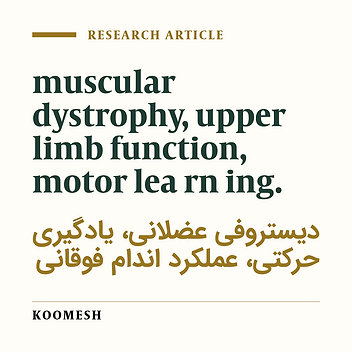
The investigation on the effect of simple and complex models of motor learning on the upper limb performance in facioscapulohumeral muscular dystrophy patients during the activities of daily living
Authors
Abstract
Introduction. Disease progression in muscular dystrophy (MD) patient s results in the gradual loss of ability to produce an appropriate contra ction and consequen tly th e loss of necessary force for completing the activities of daily living (ADL). As there is no any recognised treatment for MD and the certain benefit of exercise has not proved yet for these patients. On the other hand, it has been shown that motor lea rni ng (ML) may improve the performance, we decided to examine the effect of ML on the upper limb performance in MD pa tients. Materials and Methods. Upper limb function and the effect of ML on upper limb performance was investigated in two experiments. In the first experiment, the performance of 7 facioscapulohumeral muscula r dystrophy (FSHD) patients and 7 age and sex matched healthy volunteers was investigat ed during a simulated drinking task. Performance was assessed by measurement of electromyographic (EMG) activity of biceps brachii and brachioradialis muscles elbow joint flexion shoulde r joint flexion and abdu ction maximum accelera tion at the onset of movement (MAM) movement time (MT) and reaction time (RT), both before and afte r a 30 min novel complex ML task. In the secon d experiment, the complex ML task was re placed by a novel simple ML task for another 6 FSHD patients and their age and sex matched healthy subjects. Except that the EMG activity of triceps and deltoid muscles (anterior part) were measured instead of brachior adialis EMG, the other measurements were same as the first study. Results. In both studies, the FSHD patients showed significantly larger values for all parameters except the flexion of shoulder joint aad RT compared with controls. While the complex ML resulted in decreases in the brachiorad ialis EMG activity (P < O.Ol) and RT (P< O.Ol) in the FSHD group, the simple ML model resulted in significant changes towards the normal value in all parameters measured except flexion of shoulder. Conclusion. The change in the measured variables towards normal values indicates that motor learning may help to improve performance in FSHD and its effects are more impressive if a simple ML model is used in a therapeutic protocol
Highlights
Copyright
© 2000, Author(s). This open-access article is available under the Creative Commons Attribution 4.0 (CC BY 4.0) International License (https://creativecommons.org/licenses/by/4.0/), which allows for unrestricted use, distribution, and reproduction in any medium, provided that the original work is properly cited.
Similar Articles
Effects of Limb-Specific Fatigue on Motor Learning during an Upper Extremity Proprioceptive Task
Siekirk N, Kendall B. Effects of Limb-Specific Fatigue on Motor Learning during an Upper Extremity Proprioceptive Task. J Motor Control Learn. 2024;1(2):e146451. doi: https://doi.org/10.29252/ijmcl.1.1.76
The Effect of Proprioceptive Neuromuscular Facilitation on Learning Fine Motor Skills: A Preliminary Study
Shahabi Kaseb MR, Mehranian A, Rezaei K. The Effect of Proprioceptive Neuromuscular Facilitation on Learning Fine Motor Skills: A Preliminary Study. J Kermanshah Univ Med Sci. 2016;20(2):e69701. doi: https://doi.org/10.22110/jkums.v20i2.2922
Training with Non-dominant Limb: A Helpful Strategy for Motor Function and Dual-task Cost in Multiple Sclerosis Patients
Tahmasebi Boroujeni S, Abbasnia A, Doosti M. Training with Non-dominant Limb: A Helpful Strategy for Motor Function and Dual-task Cost in Multiple Sclerosis Patients. J Motor Control Learn. 2023;5(3):e143465. doi: https://doi.org/10.61186/ijmcl.5.3.24
Motor Correlation Between Upper and Lower Limbs in a Throwing Task: The Effect of Fatigue and Distance
Parhizmeymandi N, Azimi R, Sanjari MA, Farsi A. Motor Correlation Between Upper and Lower Limbs in a Throwing Task: The Effect of Fatigue and Distance. J Motor Control Learn. 2026;8(1):e166980. doi: https://doi.org/10.69107/jmcl-166980
The comparison between unilateral and bilateral movement training on upper limb function in hemiplegic patients
Mohammadi A, Talebi M, Havaei N. The comparison between unilateral and bilateral movement training on upper limb function in hemiplegic patients. J Kermanshah Univ Med Sci. 2013;17(2):e77124. doi:
- Scopus by DOI: 0
Last Update: 3 weeks ago
- Scopus by Title: 0
Last Update: 3 weeks ago
- Scopus by Title (Ref): 0
Last Update: 3 weeks ago
- CrossRef: 0
Last Update: 2 hours ago
- OpenAlex: 0
Last Update: 7 hours ago
- OpenCitations: 0
Last Update: 4 days ago