
1. Background
Throwing performance relies on coordinated neuromuscular interactions along a proximal-to-distal kinetic chain, involving torque generation, force transfer, and increasing joint angular velocities from the lower limbs through the trunk to the upper limbs (1, 2). Previous studies have highlighted that effective throwing depends on the well-timed activation of this sequence, as shown in skilled throwers who transfer force from the lower to the upper body at release (3). Kohler and Witt (4) also reported that efficient energy flow from the chest to the arm not only increases release velocity but also reduces joint loading at the shoulder and elbow. Makino and Tauchi (5) demonstrated the kinematic contribution of the lower limbs to the vertical velocity of the javelin throw. In baseball throwing, the arm has been suggested to be primarily responsible for precise control, whereas the lower body serves as the force generator (6). Another study reported joint coupling between the upper and lower limbs in dart throwing under normal, nonfatigued conditions (7).
Prior research highlights the critical role of upper-lower limb coordination in throwing; however, how this coordination is influenced by fatigue, psychological state, distance, and environmental factors remains unclear.
Fatigue includes mental and physical components. Mental fatigue is defined as a psychophysiological state of reduced motivation and cognitive performance resulting from prolonged cognitive activity. Under mental fatigue, individuals often struggle to sustain attention and concentration (8). Attention is regarded as a key factor in motor control (9) and performance execution (10). Furthermore, recent findings indicate that mental fatigue impairs information-processing capacity by affecting higher-order brain functions (11, 12). Reduced cognitive resources during mental fatigue may also lead to substantial alterations in motor coordination. In contrast, muscular fatigue refers to a decline in the ability of muscles to produce the required force (13). Previous findings have shown that muscular fatigue impairs peak muscle activation (14), execution accuracy and speed, and the force-generating capacity of muscles (15). Muscular fatigue not only involves changes in muscle activity and reduced performance accuracy but also induces modifications in motor coordination (16). Another study showed that muscular fatigue in the shoulder and elbow causes angular changes in the upper limb and trunk joints. In addition, trunk muscle fatigue increases trunk abduction and elbow flexion, thereby altering shoulder-trunk joint coordination (17). The negative impact of mental fatigue on performance has also been observed during goal-directed movements (18-20). Moreover, studies have shown that fatigue is associated with changes in movement patterns, joint angles, and motor strategies (21, 22). However, the potential influence of mental or muscular fatigue on interjoint coupling between the upper and lower limbs during throwing movements has not yet been examined.
Target distance influences throwing coordination by altering mechanical demands, with greater distances prompting adjustments in joint coordination. For example, Cabarkapa et al. (23, 24) reported sex-specific changes in limb angles and release positions in basketball players, highlighting distance-dependent motor adaptations. Nakagawa et al. (7) showed that greater throwing distances increased elbow-ankle and elbow-knee interjoint correlations, indicating distance-dependent motor control strategies that emphasize upper-lower limb coordination for accuracy and force production, although their study did not consider moderating factors such as fatigue.
A clear understanding of how fatigue modulates neuromuscular control mechanisms is essential for interpreting movement coordination. Electromyographic (EMG) studies have revealed that muscular fatigue alters muscle activation patterns, including delayed onset timing, decreased median frequency, reduced torque, and reduced activation amplitude (25, 26). From a motor-control perspective, these changes represent compensatory strategies of the neuromuscular system, such as increased motor-unit recruitment and synchronization, to maintain task performance. However, such compensations may manifest as increased movement variability and reorganization of motor synergy (27, 28). Similarly, mental fatigue primarily disrupts central control by impairing corticospinal excitability and inhibitory mechanisms, thereby influencing descending motor commands (29, 30). Therefore, considering the distinct underlying mechanisms of mental and muscular fatigue, the present study aimed to investigate the effects of mental and muscular fatigue on upper-lower limb interjoint coordination.
2. Objectives
Throwing skills rely on coordinated upper- and lower-limb movements, which can be altered by fatigue and task demands. However, the combined effects of mental fatigue, muscular fatigue, and throwing distance on interjoint coordination during precision tasks remain unclear. This study examined how these factors influence upper- and lower-limb coordination in dart throwing, with implications for motor control, training, and rehabilitation.
3. Methods
3.1. Subjects
In this study, 28 male and female students from Shahid Beheshti University participated voluntarily. To determine the required sample size, G*Power software version 3.1.9.4 was used for a two-way repeated-measures ANOVA with a 3 fatigue × 2 distance design (31). Assuming a medium effect size (f = 0.25), α error = 0.05, statistical power = 0.95, 1 group, and 6 measurements, the estimated sample size was 28 participants. To account for dropout, 33 right-handed individuals aged 25 - 35 years, with no regular experience in dart throwing, were initially recruited. Ultimately, data from 28 participants were analyzed.
Participants had normal or corrected-to-normal vision, no musculoskeletal or neurological disorders, and did not use psychoactive drugs. Mental fatigue was defined as a score of at least 50 on the Visual Analog Scale (VAS) (32), and muscular fatigue was defined as at least a 50% reduction in maximal upper-limb force (33). The study was approved by the Ethics Committee for Biological Research of Shahid Beheshti University under the ethical approval code IR.SBU.REC.1400.157.
3.2. Apparatus and Task
3.2.1. Three-Dimensional Motion Analysis System
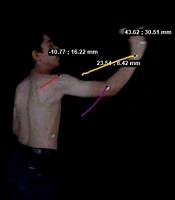
Kinematic data were collected using an 8-camera motion capture system (240 Hz) with precise calibration, ensuring high marker visibility and spatial accuracy below 0.1 mm.
3.2.2. Stroop Task Software
Mental fatigue was induced using a computerized incongruent Stroop task. Color words (green, blue, red, and yellow) were presented sequentially in mismatched font colors. Participants identified the font color by pressing one of 4 color-coded keys, except when the font color was red, in which case they responded to the written word. Responses were required to be as fast and accurate as possible.
3.2.3. Visual Analog Scale
Perceived mental fatigue was assessed using the VAS. The scale includes 18 items, with items 1 - 5 and 11 - 18 assessing fatigue and items 6 - 10 assessing energy, rated on a 0 - 10 scale. The VAS has demonstrated high internal consistency (α = 0.94 - 0.96) and concurrent validity with established fatigue measures (34, 35).
3.2.4. Resistance Band Exercise
Muscular fatigue was induced using a dart-throwing simulation with a resistance band fixed at shoulder height. Participants performed repeated frontal-plane pulling movements that mimicked dart throwing. Upper-limb force was assessed using a spring dynamometer to verify fatigue.
3.3. Procedures
After providing written informed consent, participants attended an orientation session and were instructed to avoid strenuous exercise for 48 hours, sleep deprivation, stimulants, and mentally demanding activities before testing. The experimental protocol consisted of 4 parts.
3.3.1. Part 1: Familiarization and Practice
3.3.2. Part 2: Baseline Trials
3.3.3. Parts 3 and 4: Fatigue Conditions
The mental and muscular fatigue conditions were performed in a counterbalanced order and separated by 1 week.
3.3.4. Mental Fatigue Condition
3.3.5. Muscular Fatigue Condition
Maximal upper-limb force was first measured. Participants then performed repeated resistance-band exercises until force output declined to 50% of baseline (33). Dart-throwing trials were then completed as in the baseline condition, with 1 fatigue set administered after each block. Final force measurements confirmed sustained fatigue (33).
3.4. Data Analysis
In this study, dart-throwing movements were analyzed in the frontal plane. To examine coordination between the upper and lower limbs during dart throwing at standard and extended distances, as well as under mental and muscular fatigue conditions, the normalized cross-correlation between the kinematic data (joint angles) of the upper and lower limbs was calculated and compared (5).
Joint-angle time series from elbow flexion to extension were extracted, time-normalized, and averaged for each condition. Upper-lower limb interjoint correlations were computed across 6 fatigue-distance conditions. Data were analyzed using the Shapiro-Wilk test and a 3 × 2 repeated-measures ANOVA (P < 0.05).
4. Results
4.1. Accuracy
The mean and standard deviation of dart accuracy under the no-fatigue, mental-fatigue, and muscular-fatigue conditions are presented in Table 1.
Table 1.
Descriptive Statistics of Dart-Throwing Accuracy
| Condition | Mean | SD |
|---|---|---|
| Mental fatigue/long distance | 2.38 | 1.21 |
| Mental fatigue/standard distance | 4.89 | 1.17 |
| No fatigue/long distance | 3.15 | 1.01 |
| No fatigue/standard distance | 5.34 | 0.94 |
| Muscular fatigue/long distance | 1.41 | 0.96 |
| Muscular fatigue/standard distance | 3.76 | 1.17 |
4.2. Motor Correlation
To examine the effects of fatigue and throwing distance on interlimb coordination across nine joint pairs, a two-way repeated-measures ANOVA with a 3 (fatigue) × 2 (distance) design was conducted at a significance level of 0.05.
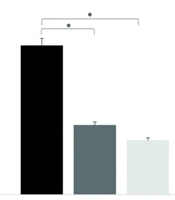
A significant main effect of fatigue was found for the shoulder-ankle joint pair (F(2, 54) = 3.67, η2P = 0.120, P = 0.032). Post hoc comparisons with Bonferroni correction indicated that coordination between the shoulder and ankle was significantly higher under the mental-fatigue condition than under both the no-fatigue and muscular-fatigue conditions (Figure 1).

Figure 1.
Mean and standard error of the mean for the correlation coefficient of the shoulder-ankle joint pair under different fatigue conditions
A significant main effect of distance was observed for the elbow-ankle (F(1, 27) = 8.76, η2P = 0.245, P = 0.006) and wrist-ankle (F(1, 27) = 8.62, η2P = 0.242, P = 0.007) joint pairs, with greater coordination at the extended distance (Figure 2). For the remaining joint pairs, no significant main effects of fatigue or distance were detected (P > 0.008). In addition, no significant fatigue × distance interaction was observed for any joint pair (P > 0.012).

Figure 2.
Mean and standard error of the mean for the correlation coefficients of the wrist-ankle and elbow-ankle pairs at the long and standard distances
5. Discussion
This study investigated the effects of throwing distance and fatigue on upper-lower limb interjoint coordination in dart throwing. The findings showed that longer distances increased coordination, particularly in the elbow-ankle and wrist-ankle pairs, likely because of greater force-generation and energy-transfer demands. This finding is consistent with previous findings (7).
Hirashima et al. (6) showed that although the arm primarily controls accuracy, lower-limb joints, particularly the ankle, contribute to force generation. This suggests that longer-distance throws require integrated upper-lower limb coordination to optimize energy transfer and maintain performance.
Evidence from Cabarkapa et al. (23, 24) supports the role of coordinated elbow and ankle involvement in long-distance throwing. These studies showed concurrent adaptations in lower-limb kinematics and elbow motion, which align with the present findings despite the absence of direct coordination measures.
No previous study has examined the combined effects of throwing distance, mental fatigue, and muscular fatigue on upper-lower limb coordination. Differences from Nakagawa et al. (7), such as the absence of distance-related changes in elbow-knee coordination, likely reflect the inclusion of fatigue conditions, which can redistribute joint roles within the kinetic chain.
Mental fatigue increased shoulder-ankle coordination, supporting the hypothesis that fatigue modulates upper-lower limb coordination and likely reflecting compensatory motor strategies arising from reduced cognitive resources and increased perceived effort.
In precision throwing, the lower limbs and ankles provide postural stability, and increased shoulder-ankle coordination likely reflects a compensatory strategy involving a stiffer, more tightly coupled whole-body kinetic chain. Tighter proximal-to-distal coupling under mental fatigue may reduce the effective degrees of freedom, thereby simplifying motor control (39). Similar compensatory neural mechanisms, such as increased frontal-central-parietal connectivity, may also help maintain coordination despite limited cognitive resources.
In contrast, no significant changes were observed under muscular fatigue, suggesting that no alternative coordination strategy was recruited. This finding contrasts with that of Wang et al. (22), who reported increased hip and knee flexion angles after repetitive baseball pitching, potentially as a compensatory mechanism to maintain center-of-mass control and pitching performance. Several factors may explain this discrepancy. First, dart throwing is a low-intensity, precision-oriented task with minimal whole-body involvement, whereas baseball pitching is a high-velocity, explosive movement that relies heavily on lower-extremity power generation and transfer. In baseball pitching, fatigue-induced kinematic adjustments, such as greater flexion, may be necessary to sustain performance. In dart throwing, preserving stable interjoint coordination patterns may instead be prioritized to maintain endpoint accuracy. In addition, differences in fatigue protocols likely contributed to this discrepancy. Wang et al. (22) used a high-volume simulated game in collegiate pitchers, inducing substantial whole-body fatigue, whereas the present protocol, although effective in producing measurable muscular fatigue, was adapted to the lower demands of dart throwing.
Unlike Wang et al. (22), who examined absolute joint angles, we assessed temporal interjoint coupling. The observed null effects underscore the task-specific nature of fatigue responses and suggest that stable coordination may protect performance in precision throwing.
Taken together, these findings suggest that mental fatigue, by taxing higher-order cognitive processes (11, 12), alters joint coordination strategies at a central level, whereas muscular fatigue primarily reflects peripheral limitations in force generation (28) and therefore exerts minimal influence on coordination patterns. This distinction highlights the divergent pathways through which mental and muscular fatigue affect motor control: mental fatigue is associated with reduced central nervous system efficiency, whereas muscular fatigue is tied to local biomechanical constraints.
Mental fatigue and throwing distance differentially affected upper-lower limb coordination in dart throwing. Mental fatigue elicited compensatory shoulder-ankle coordination patterns, whereas longer throwing distances enhanced elbow-ankle and wrist-ankle coordination. However, these findings are limited to novice participants.