Journal of Semnan University of Medical Sciences

Image Credit:Koomesh
Outline
Design and synthesizing appropriate carrier for release of dexamethasone as an anticancer drug
Authors
Abstract
Introduction: One of the effective drugs in the treatment of cancer is dexamethasone. Dexamethasone is known as one of the safest glucocorticoid, but there is still side-effects, due to its hydrophobicity and low bioavailability. The purpose of the present study is to design a controlled release carrier for dexamethasone in order to overcome constraints and reduce side effects. Materials and Methods: In the current experimental study, electrospun fibers were prepared in three Polylactic acid concentrations of 10% (w/v), 14% (w/v) and 18% (w/v) containing 5% (w/v) dexamethasone and were broken by aminolysis process using 1.6 diaminohexan / isopropanol. The morphology of the fibers and broken fibers was evaluated by scanning electron microscopy. The amount of drug loaded and cumulative percentage of drug-released from the broken fibers was determined in 144 h. Results: The result of fiber morphology evaluation showed that fiber diameter of 18% (w/v) compared to 14% (w/v) and in 14% (w/v) compared to 10% (w/v) increased by 13.1% and 17.5% respectively. Length of broken fibers in sample 18% (w/v) compared to 14% (w/v) and in the sample 14% (w/v) compared to 10% (w/v) decreased by 24.07% and 7.8%, respectively. The drug loading efficacy in broken fibers was 85%. The cumulative release of dexamethasone from the broken fibers increased with increasing polymer concentration. Conclusion: The design of a polylactic acid non-spherical controlled-release release system with a zero-degree release model can be useful for increasing therapeutic efficacy and reducing the side effects of high-dose dexamethasone.
Highlights
References
- 1.Urba J, Karewicz A, Nowakowska M. Polymeric delivery systems for dexamethasone. Life Sci 2014; 96: 1-6.
- 2.Mao Y, Triantafillou G, Hertlein E, Towns W, Stefanovski M. Milatuzumab-conjugated liposomes as targeted dexamethasone carriers for therapeutic delivery in CD74+B-cell malignancies. Clin Cancer Res 2013; 19: 347-356.
- 3.Wang W, Zhou F, Ge L, Liu X, Kong F. Transferrin-PEG-PE modified dexamethasone conjugated cationic lipid carrier mediated gene delivery system for tumor-targeted transfection. Int J Nanomedicine 2012; 7: 2513-2522.
- 4.Popilski H, Abtew E, Schwendeman S, Domb A, Stepensky D. Efficacy of paclitaxel/dexamethasone intra-tumoral delivery in treating orthotopic mouse breast cancer. J Control Release 2018; 279: 1-7.
- 5.Honorat M, Mesnier A, Pietro A Di, Lin V, Cohen P, Dumontet C, et al. Dexamethasone down-regulates ABCG2 expression levels in breast cancer cells. Biochem Biophys Res Commun 2008; 378: 308-314.
- 6.Asche CV, Kirkness CS, McAdam-Marx C, Fritz JM. Role of corticosteroids in palliative care. J Pain Palliat Care Pharmacother 2007; 21: 25-33.
- 7.Distelhorst CW, Fukuoka S, Shitara K, Noguchi M, Kawazoe A, Kuboki Y. Prophylactic use of oral dexamethasone to alleviate fatigue during regorafenib treatment for patients with metastatic colorectal cancer. Cell Death Differ 2017; 9: 6-19.
- 8.Sun C, Wang X, Zheng Z, Chen D, Wang X. A single dose of dexamethasone encapsulated in polyethylene glycol-coated polylactic acid nanoparticles attenuates cisplatin-induced hearing loss following round window membrane administration. Int J Nanomedicine 2015; 10: 3567-3579.
- 9.Shimoda H, Taniguchi K, Nishimura M, Matsuura K, Tsukioka T. Preparation of a fast dissolving oral thin film containing dexamethasone: A possible application to antiemesis during cancer chemotherapy. Eur J Pharm Biopharm 2009; 73: 361-365.
- 10.Semnani V, Farhidzadeh E, Mirmohammadkhani M, Ghahremanfard F. Investigation of blood levels of vitamin D in women with breast cancer and its correlation with prognostic markers Vahid. Koomesh 2017; 19: 735-741 (Persian).
- 11.Distelhorst CW. Recent insights into the mechanism of glucocorticosteroid- induced apoptosis. Cell Death Differ 2002; 9: 6-19.
- 12.Pavanetto I, Genta P, Giunchedi B, Sang H, Gyoung T, Gwan T, et al. A practical guide to the monitoring and management of the complications of systemic corticosteroid therapy. Adv Drug Deliv Rev 2013; 9: 189-198.
- 13.Martins A, Duarte AR, Faria S, Marques AP, Reis RL, Neves NM. Osteogenic induction of hBMSCs by electrospun scaffolds with dexamethasone release functionality. Biomaterials 2010; 31: 5875-5885.
- 14.Garlotta D. A literature review of poly (Lactic Acid). J Polym Environ 2001; 9: 63-84.
- 15.Ansari S, Karkhaneh A, Bonakdar S, Haghighipour N. Simultaneous effects of hydrostatic pressure and dexamethasone release from electrospun fibers on inflammation-induced chondrocytes. Eur Polym J 2019; 118: 244-253.
- 16.Hoveizi E, Mohammadi T, Ebrahimi-barough S, Tavakol S. Healing potential of fibroblast cells cultured on a PLA/CS nanofibrous scaffold in skin regeneration in Wistar rat. Koomesh 2016; 17: 677-685 (Persian).
- 17.Mohabatpour F, Karkhaneh A, Sharifi AM. A hydrogel/fiber composite scaffold for chondrocyte encapsulation in cartilage tissue regeneration. RSC Adv 2016; 6: 83135-83145.
- 18.Chen SC, Huang XB, Cai XM, Lu J, Yuan J, Shen J. The influence of fiber diameter of electrospun poly (lactic acid) on drug delivery. Fibers Polym 2012; 13: 1120-1125.
- 19.Truong NP, Whittaker MR, Mak CW, Davis TP, Truong NP. Expert opinion on drug delivery the importance of nanoparticle shape in cancer drug delivery the importance of nanoparticle shape in cancer drug delivery. Expert Opin Drug Deliv 2015; 12: 129-142.
- 20.Kim TG, Park TG. Biodegradable polymer nanocylinders fabricated by transverse fragmentation of electrospun nanofibers through aminolysis. Macromolar Rapid Commun 2008; 29: 1231-1236.
Copyright
© 2020, Author(s). This open-access article is available under the Creative Commons Attribution 4.0 (CC BY 4.0) International License (https://creativecommons.org/licenses/by/4.0/), which allows for unrestricted use, distribution, and reproduction in any medium, provided that the original work is properly cited.
Similar Articles

Anticancer Activity of Nanoparticles Based on PLGA and its Co-polymer: In-vitro Evaluation
hosseini MS. Anticancer Activity of Nanoparticles Based on PLGA and its Co-polymer: In-vitro Evaluation. Iran J Pharm Res. 2013;12(4):e125759. doi: https://doi.org/10.22037/ijpr.2013.1362

The Controlled Release of Dexamethasone Sodium Phosphate from Bioactive Electrospun PCL/Gelatin Nanofiber Scaffold
Rasti Boroojen F, Mashayekhan S, Abbaszadeh H. The Controlled Release of Dexamethasone Sodium Phosphate from Bioactive Electrospun PCL/Gelatin Nanofiber Scaffold. Iran J Pharm Res. 2019;18(1):e126132. doi: https://doi.org/10.22037/ijpr.2019.2319
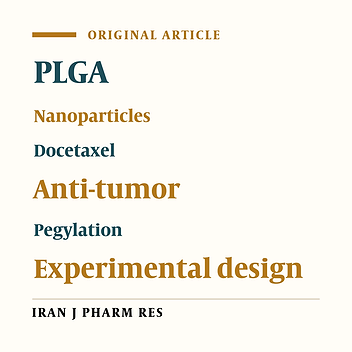
Docetaxel Loaded PEG-PLGA Nanoparticles: Optimized Drug Loading, In-vitro Cytotoxicity and In-vivo Antitumor Effect
Noori Koopaei M, Khoshayand MR, Mostafavi SH, Amini M, Khorramizadeh MR, et al. Docetaxel Loaded PEG-PLGA Nanoparticles: Optimized Drug Loading, In-vitro Cytotoxicity and In-vivo Antitumor Effect. Iran J Pharm Res. 2014;13(3):e125503. doi: https://doi.org/10.22037/ijpr.2014.1533
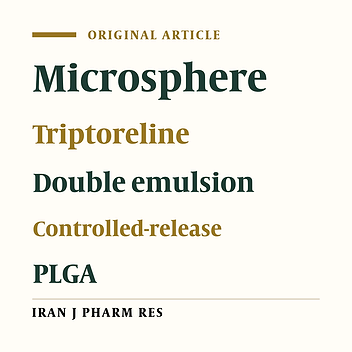
Preparation and In-vitro Evaluation of Controlled Release PLGA Microparticles Containing Triptoreline
Mahboubian A, Hashemein SK, Moghadam S, Atyabi F, Dinarvand R. Preparation and In-vitro Evaluation of Controlled Release PLGA Microparticles Containing Triptoreline. Iran J Pharm Res. 2010;9(4):e126086. doi: https://doi.org/10.22037/ijpr.2010.902
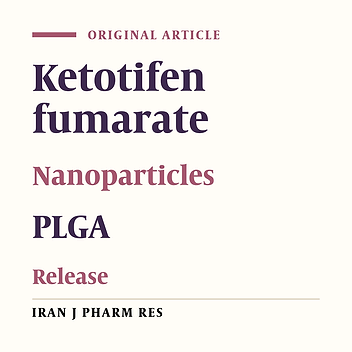
Fabrication and in-vitro Evaluation of Ketotifen Fumarate-loaded PLGA Nanoparticles as a Sustained Delivery System
Soltani S, Zakeri-Milani P, Barzegar-Jalali M, Jelvehgari M. Fabrication and in-vitro Evaluation of Ketotifen Fumarate-loaded PLGA Nanoparticles as a Sustained Delivery System. Iran J Pharm Res. 2017;16(1):e124944. doi: https://doi.org/10.22037/ijpr.2017.2007
More by these authors
- Scopus by DOI: 0
Last Update: 1 month ago
- Scopus by Title: 1
Last Update: 1 month ago
- Scopus by Title (Ref): 1
Last Update: 1 month ago
- CrossRef: 0
Last Update: 5 hours ago
- OpenAlex: 0
Last Update: 7 hours ago
- OpenCitations: 0
Last Update: 4 days ago
