Journal of Semnan University of Medical Sciences
Structure and internal consistency evaluation of personality inventory for DSM-5 in an Iranian population
Authors

Abstract
Introduction: The DSM-5 Personality Disorder Questionnaire (PID-5) is a diagnostic tool created for the purpose of diagnostic-based diagnosis in the fifth edition of the Diagnostic and Statistical Manual of Mental Disorders (DSM-5).Considering the need for valid instruments in the field of diagnosis of personality disorders in Farsi, the present study was designed to translate and evaluate the structure and internal consistency of the Personality Inventory for Diagnostic and Statistical Manual of Mental Disorders-5th Edition (PID-5). Materials and Methods: This cross-sectional study had done in 2017. After translating PID-5 via forward and backward translation method, the data gathering have been started. Participants were 285 (66% women) Community-dwelling adults. Results: The mean alpha coefficient for PID-5 in the current study was .74 ranging from .52 (Suspiciousness) to .90 (Eccentricity). The majority of scales (i.e., 18) had alphas above .70. The range of Cronbach's alpha coefficient for Domains were 0.70 (Antagonism) to 0.84 (Psychoticism). Additionally, five factors tructure of PID-5 was replicated in Iranian culture. Conclusion: This study provided initial support for the structural validity, internal consistency and cross-cultural similarity of The Persian version of PID-5. So, the PID-5 can be used in research and diagnosis of personality traits in Iranian society confidently.
Highlights
Copyright
© 2019, Author(s). This open-access article is available under the Creative Commons Attribution 4.0 (CC BY 4.0) International License (https://creativecommons.org/licenses/by/4.0/), which allows for unrestricted use, distribution, and reproduction in any medium, provided that the original work is properly cited.
Similar Articles
Psychometric Properties of the Persian Version of Personality Inventory for DSM-5 (PID-5) in Psychiatric Patients
Shojaei Z, Mohammadi A, Zarei M. Psychometric Properties of the Persian Version of Personality Inventory for DSM-5 (PID-5) in Psychiatric Patients. Iran J Psychiatry Behav Sci. 2020;14(4):e87974. doi: https://doi.org/10.5812/ijpbs.87974
Psychometric Properties of Persian Version of Structured Clinical Interview for DSM-5-Research Version (SCID-5-RV): A Diagnostic Accuracy Study
Mohammadkhani P, Forouzan AS, Hooshyari Z, Abasi I. Psychometric Properties of Persian Version of Structured Clinical Interview for DSM-5-Research Version (SCID-5-RV): A Diagnostic Accuracy Study. Iran J Psychiatry Behav Sci. 2020;14(2):e100930. doi: https://doi.org/10.5812/ijpbs.100930
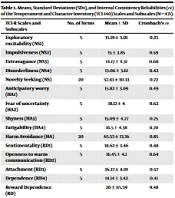
Psychometric Properties of the Persian Version of the Revised Temperament and Character Inventory (TCI-140) in a Psychiatric Outpatient Sample in Iran
Hajirezaei S, Mohammadi A, Cloninger R, Cummings J, Abasi I, et al. Psychometric Properties of the Persian Version of the Revised Temperament and Character Inventory (TCI-140) in a Psychiatric Outpatient Sample in Iran. Iran J Psychiatry Behav Sci. 2023;17(4):e127391. doi: https://doi.org/10.5812/ijpbs-127391
Translation and Evaluation of the Reliability and Validity of Eating Disorder Inventory -3 Questionnaire Among Iranian University Students
Dadgostar H, Nedjat S, Dadgostar E, Soleimany G. Translation and Evaluation of the Reliability and Validity of Eating Disorder Inventory -3 Questionnaire Among Iranian University Students. Asian J Sports Med. 2017;8(2):e13950. doi: https://doi.org/10.5812/asjsm.13950
Psychometric Validation and Development of the Persian Short Form of the Big Three Perfectionism Scale for Iranian Adults
Arefnia R, Haji Alizadeh K, Seddigh SH. Psychometric Validation and Development of the Persian Short Form of the Big Three Perfectionism Scale for Iranian Adults. Middle East J Rehabil Health Stud. 2025;12(2):e153656. doi: https://doi.org/10.5812/mejrh-153656
- Scopus by DOI: 0
Last Update: 1 month ago
- Scopus by Title: 5
Last Update: 1 month ago
- Scopus by Title (Ref): 5
Last Update: 1 month ago
- CrossRef: 0
Last Update: 2 hours ago
- OpenAlex: 0
Last Update: 5 hours ago
- OpenCitations: 0
Last Update: 4 days ago