
1. Background
Perfectionism is a complex personality trait characterized by the setting of excessively high personal standards, engaging in critical self-assessment, and striving for impeccable performance (1, 2). This multifaceted construct is observed across diverse cultural contexts and is associated with a broad range of psychological outcomes. On one hand, perfectionism is linked to adverse consequences, including anxiety, depression, and disordered eating behaviors, all of which undermine psychological and physical well-being (3, 4). On the other hand, specific components of perfectionism, often referred to as "perfectionistic strivings", can foster personal growth, motivation, and goal achievement under certain conditions (5, 6). This duality underscores the importance of a nuanced understanding and precise measurement of the construct.
Research on perfectionism, especially among adults, is of great importance as it can enhance the understanding and management of this trait (7). Studies have shown that the link between perfectionism and increased levels of anxiety and depression is particularly strong among adults facing job challenges and family responsibilities (8). Additionally, perfectionism can negatively impact social and family relationships, as perfectionists may have unrealistic expectations of themselves and others, leading to tensions and conflicts (9).
Moreover, research on perfectionism can contribute to the development of effective strategies for managing this trait (10). A deeper understanding of perfectionism and its effects can aid in creating intervention and treatment programs that help individuals cope more effectively with their perfectionistic tendencies (11). For instance, cognitive-behavioral therapy programs can assist individuals in identifying and altering their perfectionistic thought and behavior patterns, fostering more realistic expectations of themselves and others (12).
Ultimately, research on perfectionism can raise public awareness about this trait and its impacts (13). Increased public awareness can help reduce the stigma and discrimination associated with psychological issues and encourage individuals to seek help and support (14). Such research can also inform the development of supportive policies and programs that help individuals cope more effectively with perfectionism-related challenges and improve their quality of life (15).
Accurate assessment of perfectionism is essential for advancing research and clinical practice. Over the years, various psychometric instruments have been developed, with the Frost Multidimensional Perfectionism Scale (FMPS) and the Hewitt and Flett Multidimensional Perfectionism Scale (HMPS) being the most widely recognized tools (16). While these instruments have robust psychometric properties, they are not without limitations. The FMPS, although comprehensive, is time-intensive and contains items that may be perceived as overly detailed or ambiguous, posing challenges for large-scale studies. Similarly, the HMPS, designed primarily within western cultural frameworks, may lack sensitivity to cultural nuances, limiting its applicability in non-western contexts such as Iran (17, 18).
To address these gaps, researchers in Iran have developed and adapted culturally relevant tools. Notably, Besharat introduced the Tehran Multidimensional Perfectionism Scale (TMPS), which demonstrated reliability and validity across three dimensions of perfectionism (19). Similarly, Besharat and Atari translated and validated the Persian version of the Big Three Perfectionism Scale (BTPS), a comprehensive instrument designed to assess rigid, self-critical, and narcissistic perfectionism (20). Despite their strengths, these Persian tools, including the full version of the BTPS with 45 items, suffer from practical limitations. Their length can be prohibitive, reducing response rates and compromising their utility in large-scale studies or time-sensitive settings. This underscores the critical need for efficient, shorter instruments that maintain psychometric rigor while enhancing usability (21).
One promising solution is the BTPS, a concise 16-item version of the BTPS. This abbreviated tool retains the multidimensional structure of its parent scale, capturing the key dimensions of perfectionism: Rigid, self-critical, and narcissistic. Preliminary validations conducted in Canadian populations have demonstrated the Big Three Perfectionism Scale-Short Form (BTPS-SF)'s strong psychometric properties, including high reliability, a robust factor structure, and excellent test-retest consistency (22). Its brevity makes it particularly advantageous for studies involving large samples or settings where participant time is limited (23). By offering a succinct yet comprehensive assessment, the BTPS-SF bridges the gap between detailed evaluation and practical application.
In the Iranian context, the validation of the BTPS-SF offers a critical opportunity to advance research and clinical practice (24). Despite the availability of Persian versions of the FMPS, HMPS, and BTPS, their length and complexity hinder widespread application, particularly in studies requiring high participation rates or clinical environments with time constraints (25). The BTPS-SF, with its balance of efficiency and psychometric integrity, addresses these challenges, making it a valuable tool for researchers and practitioners in Iran (26).
2. Objectives
This study aimed to translate and validate the Persian version of the BTPS-SF. By providing a culturally adapted, reliable, and efficient measure of perfectionism, this work seeks to facilitate robust research and clinical interventions, ultimately contributing to a deeper understanding of perfectionism and its implications for psychological well-being in Iranian populations.
3. Methods
3.1. Study Design and Setting
This psychometric validation study employed advanced validation methods to evaluate the factor structure and psychometric properties of the short form of the BTPS among Iranian adults. The study design followed the methodological framework outlined by Beaton et al. (27), which is a widely recognized standard for instrument translation, cultural adaptation, and psychometric evaluation.
The study primarily focused on construct validity, reliability, and content validity assessments, using both qualitative (e.g., expert panel reviews) and quantitative [e.g., exploratory and confirmatory factor analysis (CFA)] approaches. These methods are characteristic of validation studies and align with global best practices in psychometric research.
This research was conducted in compliance with ethical guidelines, as approved by the Ethics Committee of the Islamic Azad University, Bandar Abbas Branch, under code IR.IAU.BA.REC.1402.084. The ethical principles adhered to the Helsinki Declaration, emphasizing participant rights, confidentiality, and informed consent.
3.2. Translation and Cultural Validation
The translation and cultural adaptation process of the instrument was conducted based on the five main stages outlined by Beaton et al. (27) and included obtaining consent from the original developers of the survey instrument.
3.2.1. Initial Translation to Persian
Two translators proficient in English and familiar with psychological concepts independently translated the original BTPS-SF Scale into Persian to ensure comprehensive coverage of the concepts. Translator A, a 35-year-old with a PhD in psychology and 10 years of translation experience, and translator B, a 40-year-old with a master's degree in applied linguistics and 15 years of experience, undertook this task.
3.2.2. Synthesis of Translations
The two translators, along with a 45-year-old Persian-speaking psychometrician holding a PhD with over 20 years of experience in psychometrics, reviewed and synthesized the translations into a single, unified version, addressing all potential ambiguities (28).
3.2.3. Back-translation to English
A bilingual linguist, aged 50, with a PhD in psychology and 25 years of experience, who was proficient in both languages and familiar with psychological concepts, back-translated the Persian version into English to check for consistency with the original instrument (29).
3.2.4. Expert Review and Validation
The back-translated Persian version and the original instrument were compared by two psychology experts (both aged 55, with PhDs and over 30 years of experience each in the field) and a psychometrician (the same expert from stage 2). Suggested modifications were made to enhance translation accuracy and cultural relevance.
3.2.5. Pilot Testing
The translated instrument was administered to a small sample of the target population (30 individuals) for a pilot test. Feedback on clarity, comprehensibility, and appropriateness of the items was collected, and final adjustments were made based on this feedback (30).
The final version of the scale was prepared for implementation with consensus from the research team and expert validation. The original developers were contacted and provided their consent for the translation and adaptation of the BTPS-SF for this study.
3.3. Study Population and Sampling
The target population for this study included adults aged 18 to 50 residing in Karaj in 2023, who had lived in the city for at least one year. The selected age range was determined to align fully with the psychometric properties of the instrument used (BTPS-SF) and to focus on the adult age group. This range not only encompasses age-related differences among adults but also ensures the minimum cognitive and psychological maturity required for accurate responses to the instrument.
To ensure robust content validity for the Persian adaptation of the BTPS-SF, a panel of ten experts was engaged prior to participant recruitment. The panel included three psychologists specializing in psychometric assessments and perfectionism research, two psychometricians with expertise in validation studies, one educational technology specialist familiar with culturally adaptive tools, one educational manager experienced in academic assessments, and three counselors with a clinical focus on mental health. All panel members held doctoral degrees and had a minimum of ten years of experience in their respective fields.
The sample size was determined based on established criteria from the literature for validation research:
(1) Concurrent validity assessment: A minimum of 100 participants was required, which was increased to 200 participants for this study to ensure adequate representation (31, 32).
(2) Exploratory factor analysis (EFA): A minimum of 20 participants per item was necessary. Therefore, with 16 items on the BTPS-SF, 500 participants were included to enhance the robustness of the findings (33).
(3) Confirmatory factor analysis: The recommended sample size ranged from 200 to 1000 participants. For this study, 400 participants were included to ensure the statistical power needed for CFA (34).
(4) Reliability assessment: A minimum of 40 participants was recommended, and 200 participants were included for this study to assess the internal consistency of the scale (35).
Overall, more than 1,300 participants were recruited as the final sample for the study, ensuring a sufficiently large and representative sample to cover all psychometric analyses required for validation.
3.3.1. Sampling Method
A multi-stage cluster sampling method was employed to select participants:
Stage 1- selection of municipal districts: Four out of the ten municipal districts in Karaj were randomly selected. These included districts 2, 5, 6, and 9. This ensured a geographical spread across diverse urban settings within the city.
Stage 2- selection of streets: From each of the randomly selected districts, two streets were chosen, making a total of eight streets. This selection process ensured that each district contributed proportionately to the required sample size for various analyses. One street was randomly allocated for the concurrent validity assessment, three streets were designated for EFA, three additional streets were chosen for CFA, and one street was reserved specifically for the reliability assessment.
Stage 3- systematic sampling: Systematic sampling was used within each selected street to choose residential houses based on the required sample size. The number of households sampled in each street was proportional to the total number of households in that street. Every nth house (determined by the ratio needed for each analysis) was approached. All men and women aged 18 to 50 years living in these households were included as participants.
Inclusion criteria for the study required participants to have lived in Karaj for at least one year and to be between the ages of 18 and 50. Written informed consent was obtained from each participant, ensuring they were fully aware of the study’s purpose, procedures, and their rights within the study.
Exclusion criteria were applied to maintain the quality and completeness of the data, including participants who did not complete more than 20% of the questionnaire, as well as those who had not resided in Karaj for at least one year. Additionally, any participant who withdrew their consent during the survey process was excluded to maintain consistency and reliability in the collected data.
The use of cluster sampling ensured a representative sample from the diverse urban areas of Karaj, enhancing the generalizability of the study’s findings across different demographic segments. This sampling strategy provided the necessary diversity to meet the criteria for concurrent validity, EFA, CFA, and reliability assessment, resulting in a robust and comprehensive dataset.
3.4. Ethical Considerations
This study was conducted in accordance with all ethical principles and was approved by the Ethics Committee of the Islamic Azad University. Participants were provided with comprehensive information about the research objectives and methods before entering the study, and their informed consent was obtained in writing. Confidentiality of information and the possibility of withdrawal at any time were fully guaranteed.
3.5. Data Collection Tools
3.5.1. The Big Three Perfectionism Scale-Short Form
The BTPS-SF is a 16-item self-report instrument developed to measure multidimensional perfectionism efficiently. This tool evaluates three core dimensions: Rigid perfectionism (questions 1 - 4; max score 20, min score 4), self-critical perfectionism (questions 5 - 10; max score 30, min score 6), and narcissistic perfectionism (questions 11 - 16; max score 30, min score 6). Derived from the original 45-item BTPS, the BTPS-SF has demonstrated robust psychometric properties. Confirmatory factor analysis validated its three-factor structure in a sample of 607 Canadian university students, confirming a strong model fit. The tool also showed satisfactory test-retest reliability (rigid: r = 0.79, self-critical: r = 0.75, narcissistic: r = 0.71) and internal consistency (coefficient alpha values ranging from 0.78 to 0.90). The BTPS-SF’s correlations with depression, anxiety, stress, emotional intelligence, personality traits, resilience, and subjective well-being provided evidence for its criterion validity (22).
3.5.2. The Big Three Perfectionism Scale
The BTPS is a 45-item self-report measure that offers a comprehensive assessment of multidimensional perfectionism. It evaluates three overarching factors: Rigid perfectionism, self-critical perfectionism, and narcissistic perfectionism, each comprising multiple facets. For instance, rigid perfectionism includes self-oriented perfectionism and self-worth contingencies, while self-critical perfectionism encompasses facets such as concern over mistakes and doubts about actions. Narcissistic perfectionism addresses traits like hypercriticism and entitlement. The BTPS demonstrates excellent psychometric properties, with Cronbach’s alpha values for the main factors ranging from 0.92 to 0.93, and strong test-retest reliability. This scale’s validity is further supported by its associations with psychological constructs such as depression, anxiety, emotional intelligence, and resilience. Despite its robustness, the BTPS’s length can limit its practicality in large-scale or time-sensitive settings. In the present study, the Persian adaptation of the BTPS was utilized to complement the BTPS-SF in validating its structure and reliability (36). In this study, a Cronbach's alpha of 0.91 was obtained, indicating high internal consistency.
3.6. Data Collection
Data collection was carried out from January to February 2024. The researcher personally administered the questionnaires to the participants, allocating 20 minutes for their completion. The collected data were reviewed and cleaned weekly to ensure the completeness of the information. Ultimately, 1,271 valid responses were included in the final analysis.
3.7. Statistical Analysis
Descriptive statistics: The mean, standard deviation, frequency, and percentage were calculated to describe the demographic profile of the participants.
3.7.1. Content Validity
The Content Validity Index (CVI) and content validity ratio (CVR) were calculated to assess the relevance of each item in the instrument. Items with a CVR above 0.62 and a CVI above 0.70 were retained, ensuring that the items adequately reflect the intended content domain of the construct being measured (37).
3.7.2. Concurrent Validity
This was evaluated by correlating the new instrument (BTPS-SF) with an established instrument (BTPS). Pearson and Spearman correlation coefficients were used to determine the strength and direction of these relationships. Strong correlations indicate good concurrent validity, meaning the new instrument produces results consistent with those obtained by the existing measure (38).
3.7.3. Construct Validity
Construct validity was assessed using EFA and CFA. These methods were applied to evaluate the underlying structure of the measurement items and to confirm the adequacy and fit of the extracted factors to the data.
3.7.4. Exploratory Factor Analysis
The EFA was conducted using principal axis factoring with varimax rotation to identify the latent factor structure. The Kaiser-Meyer-Olkin (KMO) measure of sampling adequacy was used to assess the suitability of the data for factor analysis, with values above 0.60 indicating adequacy (39). Additionally, Bartlett’s test of sphericity was employed to test the null hypothesis that the variables are uncorrelated, with a significant result (P < 0.05) confirming the appropriateness of factor analysis (33).
3.7.5. Confirmatory Factor Analysis
The CFA was performed to validate the factor structure obtained from EFA. The model fit was evaluated using the following indices: Root mean square error of approximation (RMSEA) (< 0.08 indicates good fit), Comparative Fit Index (CFI) (> 0.90 indicates good fit), Normed Fit Index (NFI) (> 0.90 indicates good fit), Non-normed Fit Index (NNFI) (> 0.90 indicates good fit), Incremental Fit Index (IFI) (> 0.90 indicates good fit), standardized root mean square residual (SRMR) (< 0.08 indicates good fit), Goodness-of-Fit Index (GFI) (> 0.90 indicates good fit), and Adjusted Goodness-of-Fit Index (AGFI) (> 0.90 indicates good fit) (40). These thresholds were used to assess the adequacy of the model in representing the data.
3.7.6. Reliability Testing
The scale's reliability was evaluated through multiple methods to ensure robust internal consistency. Cronbach’s alpha was used, with values above 0.70 considered acceptable and those above 0.80 indicating good reliability (41). Split-half reliability was measured using the Spearman-Brown and Guttman split-half coefficients, with values exceeding 0.80 demonstrating strong reliability (26). Additionally, six Guttman lambda coefficients (λ1 to λ6) were computed, with values closer to 1.0 indicating greater internal consistency, providing comprehensive evidence of the scale’s reliability (28).
Analyses were performed using statistical software packages SPSS 18 and Lisrel 8.8, with a significance level set at 0.05 to determine the statistical significance of results. This ensures a standardized approach to the analysis, allowing for consistent interpretation of the findings.
A participant flow diagram was created to visually represent the recruitment, screening, and selection process of participants. This diagram illustrates the flow from the initial recruitment of eligible participants to the final sample used for analysis. It provides a clear overview of participant inclusion and exclusion criteria, showing the number of individuals screened, those who did not meet the criteria or withdrew, and the final number of valid participants included in the study (Figure 1).
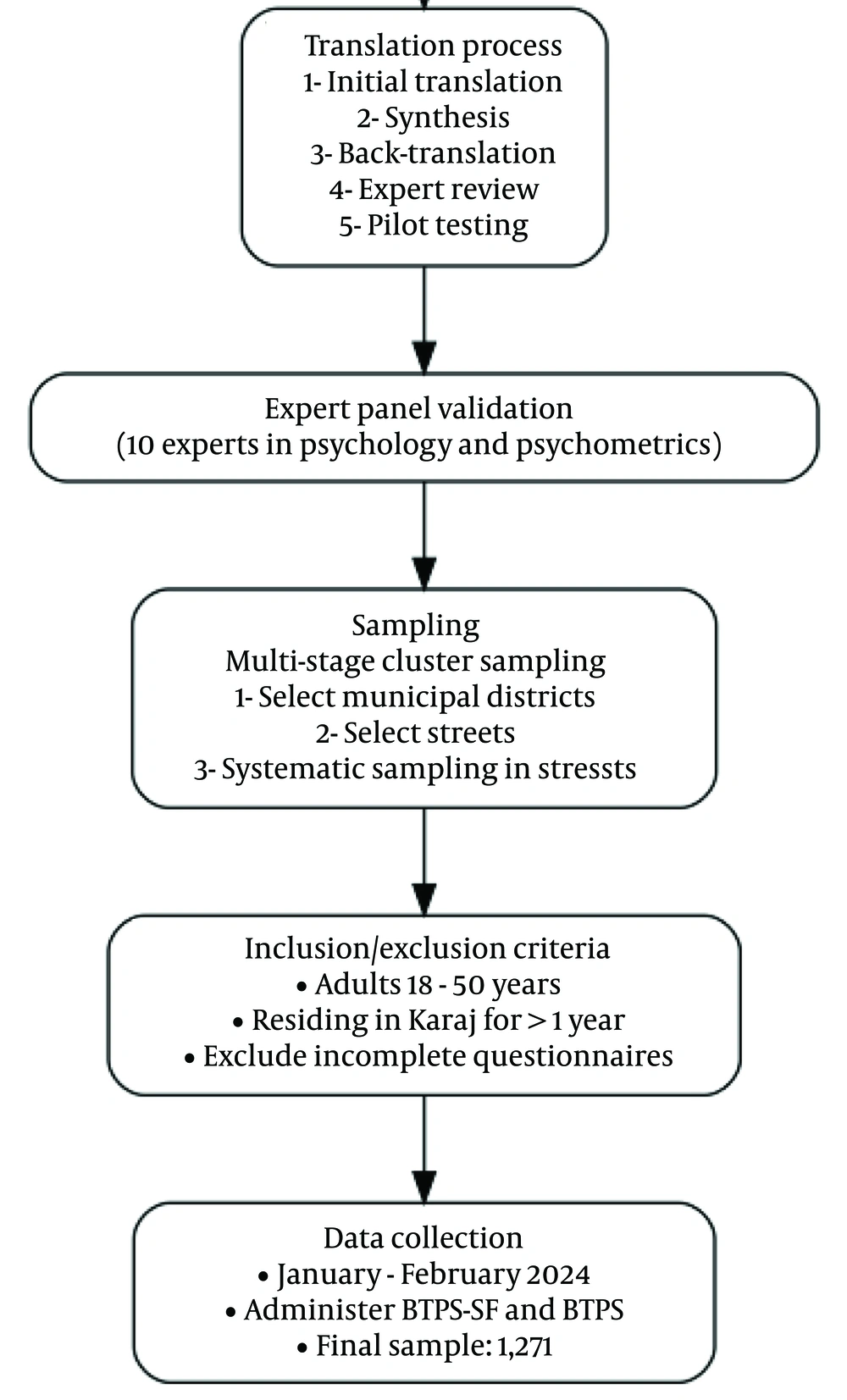
Figure 1.
Participant flow diagram
4. Results
4.1. Demographic Characteristics
In the demographic section, 51.2% of the 1,271 participants were female, and 48.8% were male. Of the participants, 61.5% had non-university education, while 38.5% held university degrees. Regarding employment status, 64.1% were employed, 20% were unemployed, and 10.5% were retired. A total of 59% were married, and 41% were single. Additionally, 61.8% were under 30 years old, while 38.2% were over 30 years old (Table 1).
Table 1.
Demographic Characteristics of Participants Across Different Phases of the Study a
| Variables | Total (n = 1,271) | Concurrent (n = 194) | Exploratory (n = 490) | Confirmatory (n = 389) | Reliability (n = 198) |
|---|---|---|---|---|---|
| Gender | |||||
| Female | 641 (51.2) | 104 (53.6) | 247 (50.4) | 196 (50.4) | 94 (47.5) |
| Male | 620 (48.8) | 90 (46.4) | 243 (49.6) | 193 (49.6) | 104 (52.5) |
| Education | |||||
| Non-university | 797 (61.5) | 119 (61.3) | 299 (61.0) | 243 (62.5) | 136 (68.7) |
| University | 499 (38.5) | 75 (38.7) | 191 (39.0) | 146 (37.5) | 62 (31.3) |
| Employment | |||||
| Student | 121 (9.7) | 20 (10.3) | 48 (9.8) | 32 (8.2) | 21 (10.6) |
| Homemaker | 130 (10.0) | 20 (10.3) | 49 (10.0) | 40 (10.3) | 21 (10.6) |
| Unemployed | 257 (20.0) | 41 (21.1) | 90 (18.4) | 78 (20.1) | 48 (24.2) |
| Employed | 827 (64.1) | 86 (44.3) | 248 (50.6) | 202 (51.9) | 91 (46.0) |
| Retired | 136 (10.5) | 27 (13.9) | 55 (11.2) | 37 (9.5) | 17 (8.6) |
| Marital status | |||||
| Married | 764 (59.0) | 111 (57.2) | 289 (59.0) | 234 (60.2) | 130 (65.7) |
| Single | 508 (41.0) | 83 (42.8) | 201 (41.0) | 155 (39.8) | 68 (34.3) |
| Age (y) | |||||
| Under 30 | 798 (61.8) | 119 (61.3) | 299 (61.0) | 243 (62.5) | 137 (69.2) |
| Over 30 | 493 (38.2) | 75 (38.7) | 191 (39.0) | 146 (37.5) | 61 (30.8) |
a Values are expressed as No. (%).
4.2. Content Validity
The CVR values ranged from 0.80 to 1.00, and the CVI values also ranged from 0.80 to 1.00. These results exceeded the threshold values established by Lawshe's criteria, which set 0.62 as the threshold for CVR and 0.78 for CVI with a ten-member panel (Table 2).
Table 2.
Rotated Component Matrix for the Study Items
| No. | Factor | CVR | CVI | ||
|---|---|---|---|---|---|
| Narcissistic Perfectionism | Self-Critical Perfectionism | Rigid Perfectionism | |||
| i1 | 0.22 | 0.18 | 0.77 | 0.80 | 0.80 |
| i2 | 0.14 | 0.18 | 0.78 | 0.80 | 0.90 |
| i3 | 0.17 | 0.15 | 0.78 | 0.80 | 0.80 |
| i4 | 0.17 | 0.15 | 0.78 | 1.00 | 0.90 |
| i5 | 0.17 | 0.76 | 0.14 | 0.80 | 0.90 |
| i6 | 0.16 | 0.74 | 0.16 | 1.00 | 1.00 |
| i7 | 0.17 | 0.75 | 0.15 | 1.00 | 1.00 |
| i8 | 0.18 | 0.76 | 0.14 | 0.80 | 0.90 |
| i9 | 0.19 | 0.77 | 0.10 | 0.80 | 0.90 |
| i10 | 0.14 | 0.76 | 0.16 | 0.80 | 1.00 |
| i11 | 0.78 | 0.13 | 0.20 | 0.80 | 0.90 |
| i12 | 0.76 | 0.17 | 0.18 | 1.00 | 1.00 |
| i13 | 0.79 | 0.18 | 0.11 | 1.00 | 0.80 |
| i14 | 0.77 | 0.20 | 0.14 | 0.80 | 0.90 |
| i15 | 0.76 | 0.14 | 0.13 | 0.80 | 1.00 |
| i16 | 0.73 | 0.22 | 0.15 | 0.80 | 0.80 |
Abbreviations: CVR, content validity ratio; CVI, Content Validity Index.
4.3. Concurrent Validity
The concurrent validity analysis revealed a strong positive correlation between BTPS-SF and BTPS scores (r = 0.82, P = 0.001).
4.4. Exploratory Factor Analysis
The KMO measure of sampling adequacy was 0.92, indicating excellent suitability of the data for factor analysis. Bartlett's test of sphericity was significant (χ² (120) = 4871.77, P < 0.001), confirming the appropriateness of conducting factor analysis. Initial communalities ranged from 0.55 to 0.63, and extraction communalities ranged from 0.60 to 0.67, suggesting that a substantial portion of variance for each item was accounted for by the extracted factors. The analysis identified three factors with eigenvalues greater than 1, explaining 70.77% of the cumulative variance. The first factor accounted for 42.46%, the second for 15.46%, and the third for 12.86% of the variance. The rotated factor matrix showed clear loadings for the three dimensions of perfectionism: Rigid perfectionism (items 1 - 4, loadings 0.77 - 0.78), self-critical perfectionism (items 5 - 10, loadings 0.74 - 0.77), and narcissistic perfectionism (items 11 - 16, loadings 0.73 - 0.79) (Table 2 and Figure 2).
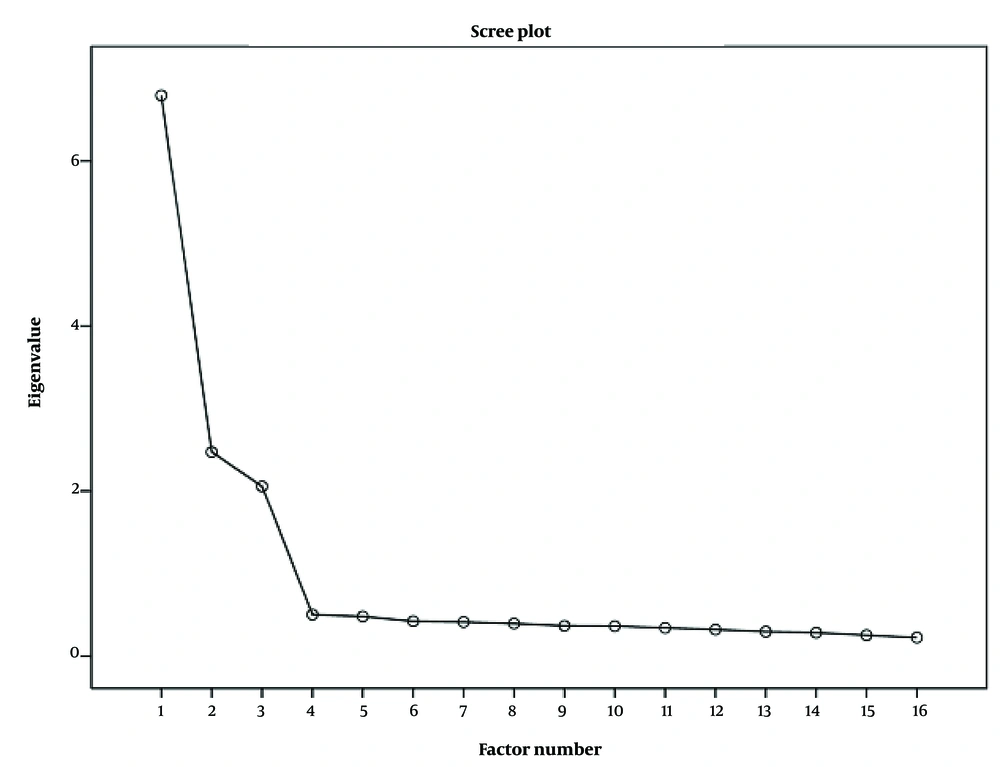
Figure 2.
Scree plot of the eigenvalues of the factors
4.5. Confirmatory Factor Analysis
The CFA confirmed the factor structure with excellent model fit indices: Root mean square error of approximation = 0.035 (90% CI: 0.022 - 0.047), CFI = 0.99, NFI = 0.98, NNFI = 0.99, IFI = 0.99, SRMR = 0.030, GFI = 0.95, and AGFI = 0.94. The chi-square statistic was significant (χ² (101) = 153.50, P = 0.00059). The minimum fit function chi-square was 153.50, and the normal theory weighted least squares chi-square was 149.28. The estimated non-centrality parameter (NCP) was 48.28 (90% CI: 19.52 - 85.02). Factor loadings ranged from 1.09 to 1.20, and squared multiple correlations for items were between 0.56 and 0.69, further supporting the validity of the model (Figure 3).
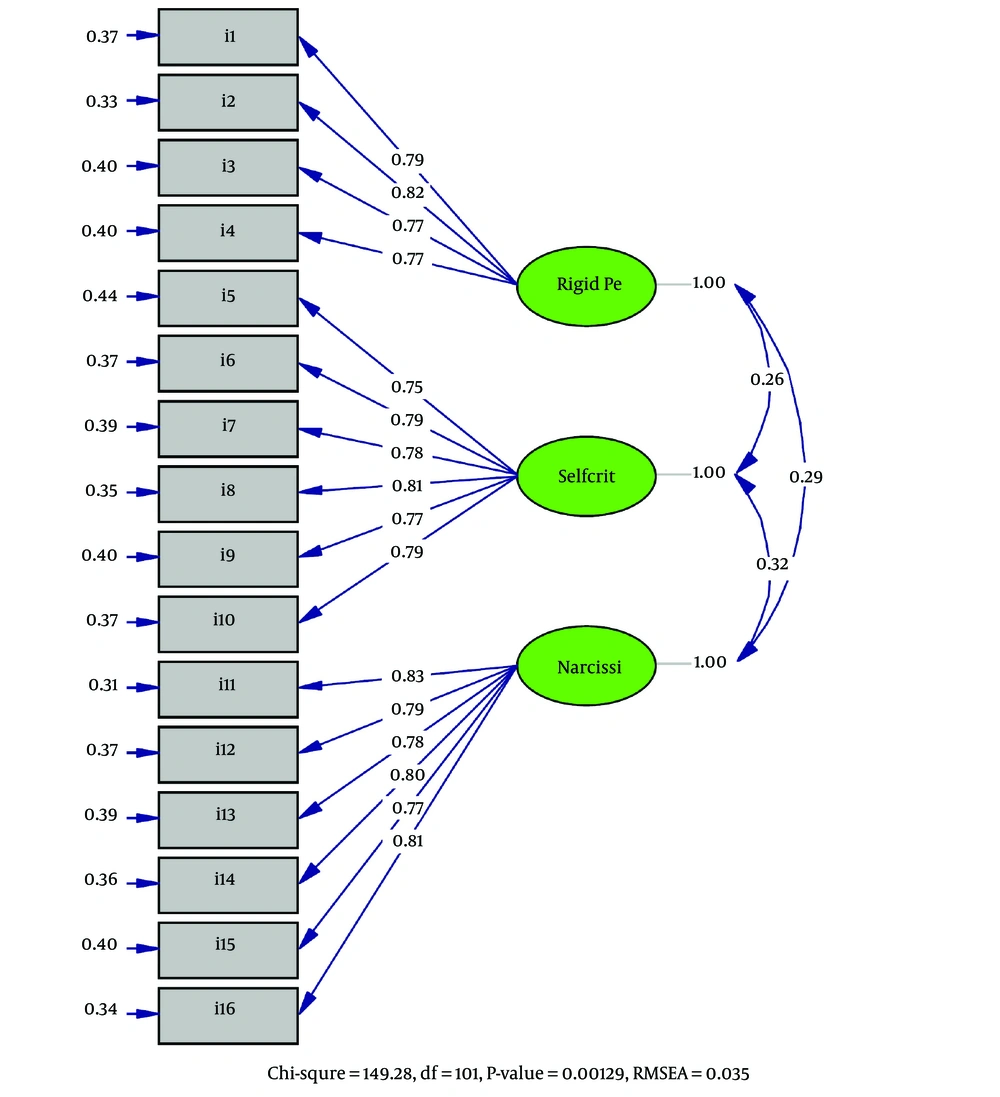
Figure 3.
Factor loadings and model fit indices of the confirmatory factor analysis (CFA) for the student brief self-report measure of multidimensional perfectionism
4.6. Reliability
The BTPS-SF exhibited strong internal consistency across all measures. Cronbach's alpha values were 0.887 for rigid perfectionism (4 items), 0.889 for self-critical perfectionism (6 items), and 0.916 for narcissistic perfectionism (6 items), with an overall alpha of 0.890 for the 16-item scale. Split-half reliability analysis showed robust results, with both the Spearman-Brown and Guttman split-half coefficients at 0.940. Cronbach's alpha for the first half of the scale was 0.793, and for the second half, it was 0.778. Furthermore, Guttman’s lambda coefficients (λ1 to λ6) ranged from 0.673 to 0.935, providing additional confirmation of the scale's high reliability and robustness.
5. Discussion
Psychometric questionnaires play a crucial role in assessing complex psychological constructs. In this study, the Persian short version of the BTPS-SF was evaluated for its validity and reliability. The findings indicated that this tool could serve as a valid and reliable instrument within the Iranian population. The results related to content validity, concurrent validity, structural validity, and reliability are discussed, along with the scientific rationale for their alignment with findings from other studies.
In this research, the short version of the questionnaire met the necessary standards for content validity. The selected items were consistent with the core concepts of perfectionism, and expert opinions from psychologists and counselors confirmed the tool's validity (22). The content validity of this questionnaire aligns with studies indicating that standardized tools based on comprehensive psychological theories often maintain their validity across different cultures (22, 36, 42-44). The use of standard survey methods and qualitative analysis of expert opinions, particularly emphasizing comprehensive coverage of all dimensions of perfectionism, contributed to its high content validity. This tool is well-suited for psychological research involving adolescents and young adults, especially in the Iranian cultural context.
The findings also demonstrated that the short version of the questionnaire exhibits high concurrent validity, establishing meaningful correlations with other standardized tools. The concurrent validity of this instrument is consistent with studies conducted on similar short-form tools. This consistency is attributed to the precise selection of items based on their theoretical significance and predictive power. Properly designed short-form tools can measure constructs as accurately as their longer counterparts, making them valuable for studies requiring quick and efficient instruments.
The factor structure of the questionnaire corresponded to the theoretical model of perfectionism, with statistical analyses indicating strong structural consistency. The structural validity of this tool aligns with international research findings, which have shown that questionnaires based on comprehensive theoretical models typically exhibit a well-defined and stable factor structure. In this study, the use of CFA successfully identified and confirmed the dimensions of perfectionism. This alignment highlights the success of the questionnaire in accurately reflecting theoretical constructs within the Iranian context.
In comparison to other perfectionism questionnaires, this instrument shows both similarities and differences in its dimensions and factor structure. For example, the FMPS (Frost et al., 1990) and the HMPS (Hewitt & Flett, 1991) focus on self-oriented and socially prescribed perfectionism. In contrast, the BTPS-SF emphasizes rigid perfectionism, self-critical perfectionism, and narcissistic perfectionism, offering a more precise and specialized structure. The findings of this study indicate that the strong factor loadings and high reliability coefficients of this scale are consistent with results reported in international studies on this tool. This consistency not only confirms the instrument's high validity but also demonstrates its potential for cross-cultural applications.
The results also revealed that the questionnaire exhibits satisfactory internal consistency and temporal stability in terms of reliability. These findings are consistent with similar studies conducted on comparable psychometric tools. The primary reason for this consistency lies in the meticulous design and selection of items based on initial reliability analyses. Test-retest methods further validated these results. The high reliability of this tool suggests that it can be effectively utilized in longitudinal and cross-cultural research.
5.1. Limitations and Potential Biases
The study has several limitations. Furthermore, while the translation and cultural adaptation process followed rigorous guidelines, subtle nuances in the cultural interpretation of perfectionism-related constructs may have affected item comprehension and responses.
To address these biases and limitations, several measures were implemented. For example, steps were taken to ensure translation fidelity and cultural adaptation, and pilot testing was conducted to refine the instrument. However, further studies should employ longitudinal designs to capture temporal changes in perfectionism traits and their effects on psychological outcomes. Additionally, incorporating objective measures, such as behavioral assessments or peer evaluations, may complement self-reported data and reduce response biases.
5.2. Generalizability of Findings
The findings from this study are promising but should be interpreted with caution regarding their applicability to broader populations. While the multi-stage cluster sampling method ensured a diverse sample within Karaj, it is unclear whether the results would hold true for populations in rural areas or other cities with different socio-economic or cultural characteristics. Moreover, the age range of participants (18 - 50 years) provides insights primarily into the adult population but does not account for adolescents or older adults, who may exhibit different perfectionism profiles.
Future research should aim to expand the sample to include participants from varied geographic regions and socio-economic backgrounds to enhance external validity. Additionally, cross-cultural studies comparing the Persian BTPS-SF with its versions in other languages could provide further evidence of its applicability and robustness across different cultural contexts.
5.3. Conclusions
In conclusion, the psychometric validation of the BTPS-SF for Iranian adults demonstrates that the scale is a valid and reliable tool for assessing multidimensional perfectionism. The study's comprehensive approach to evaluating content, concurrent, and construct validity, along with internal reliability, supports the robustness of the BTPS-SF. Despite limitations related to self-report measures, geographic restriction to Karaj, and the cross-sectional study design, the findings provide a strong foundation for future research. Expanding the sample to diverse regions and incorporating longitudinal designs could further enhance the understanding and application of the BTPS-SF in different contexts.