
1. Background
There have been many changes in the healthcare system in recent years. These changes include advances in medical technologies and interventions, in addition to alterations in the quality and number of clients and users. These changes have led to the increasing complexity and likelihood of risks and errors in the healthcare system. The review of the literature suggests that medical, systemic, and management errors in hospitals and medical care centers impose high costs on the healthcare system and increase the mortality and morbidity rates around the world (1-3). The United States has reported roughly 98,000 deaths annually due to medical errors, incurring heavy costs on the healthcare systems and communities. On the other hand, the emphasis on quality-improvement standards and models in the healthcare system, such as clinical governance standards and patient safety, indicates the importance of studies that apply scientific techniques to identify, analyze, control, and reduce errors in the health system (4).
Cardiovascular diseases, as the leading cause of mortality in industrialized countries and the second leading cause of mortality in Iran, have always been a controversial issue among medical researchers. Considering the potential risks of these diseases, any small error is a risk that can endanger the patients’ lives and impose costs both on patients and hospitals. Patients who undergo open heart surgery are more prone to errors; in most cases, these errors are irreversible. An important part of open heart surgery is anesthesia, and anesthetic risk management is an important component of patient safety systems. Since anesthesia care is usually considered as a facilitating process, the traditional concept of anesthesia undermines the side-effects of anesthesia care. Accordingly, anesthesia is at the forefront of clinical risk management (5).
Proper techniques for analyzing the failure modes include prioritization, discovering the causes, and proposing solutions to provide or improve grouping of errors, registration of information, flexibility, and convenient implementation and institutionalization in hospitals (6). The failure modes and effects analysis (FMEA) technique was developed by NASA in 1963 and was then used in the automotive industry (7). Engineers have used FMEA to improve the reliability and quality of products and reduce the potential risks (8). In 2001, healthcare FMEA (HFMEA) was introduced by the Joint Commission on Accreditation of Healthcare Organizations (JCAHO) as a means of improving health services and preventing errors. In the 1970’s, FMEA was used in industries, such as the automotive, aerospace, and nuclear energy industries (9, 10).
Some of the HFMEA measures implemented in the United States include the use of new technologies, use of intact devices, improvement of patient care processes for high-risk surgeries, improvement of blood transfusions and MRI scans, and identifying the safety issues for patients and healthcare workers (11). In 2001, the National Center for Patient Safety (NCPS) modified HFMEA, which is an adoption of FMEA for healthcare (12). After establishing the success of FMEA in different fields, this technique has been implemented in medical processes (13). Also, the FMEA risk assessment indicators have been majorly modified for HFMEA. Generally, the HFMEA technique involves the technical concepts of FMEA. According to the hazard analysis critical control points (HACCP) for healthcare, many studies on hospital improvement have investigated the service quality, using different techniques (14). In recent years, several studies have been conducted in healthcare using FMEA, some of which are described below.
In 2003, Benjamin conducted a study on how to reduce medication errors and increase patient safety. Their results showed that implementing safer methods requires the development of more secure systems. Overall, many errors occur as a result of poor oral or written communication. Therefore, advanced communication skills and improved interactions between members of the healthcare system and the medical team are essential (15). Simultaneously, Spath conducted a study using the FMEA to improve patient safety (16).
In 2017, Martin et al. examined the failure modes and effects of medication errors in pediatric anesthesia. The results of their study showed improvements in syringe labeling, standardization of medication organization in the anesthesia workspace, and two-provider infusion checks (17). Also, in 2017, Kavosi et al. evaluated the failure modes and effects of the operating room in six steps using the FMEA tool. Their study showed that most errors in the operating room were due to the lack of human skills (18). In 2019, Gaur evaluated FMEA systematically and quantitatively to reduce the non-productive time in the operating rooms. The results of their study showed that list management, re-planning and updating, strengthening the surgical plan, and holding a pre-anesthesia session increased the surgical efficiency (19).
2. Objectives
In the present study, we aimed to evaluate the process of anesthesia in open heart surgeries and apply a standard technique, consistent with the hospital needs, in an attempt to classify, evaluate, and prioritize the failure modes and design processes for anesthesia in cardiac surgeries and finally develop measures to reduce and control these failure modes. The final objective of this study was to design and propose a prospective risk analysis system. Therefore, HFMEA was applied for efficient scalability, reliability, accuracy, usability, and flexibility.
3. Methods
The present study was conducted at a cardiovascular subspecialty center in west of Iran in 2017. The HFMEA was used for the identification and analysis of potential risks and errors in the anesthesia process of open heart surgeries. The fishbone diagram was used to identify the cause and effect relationships. The steps of HFMEA were as follows: (1) define the HFMEA topic; (2) assemble the team; (3) graphically describe the process; (4) conduct a hazard analysis; (5) actions and outcome measures; and (6) follow-up on actions taken.
After determining the process of cardiac anesthesia (step 1), a multidisciplinary team of 6 - 8 experts and management specialists, including anesthesiologists, cardiac surgeons, quality improvement experts, industrial engineers, anesthesia nurses, surgical technologists and nurses, and secretaries, was recruited, and the final results were recorded in the HFMEA worksheet (step 2). Next, a graphic representation of all anesthesia processes and activities in open heart surgeries was prepared and numbered. Overall, four major processes were identified: (1) preoperative assessment for general anesthesia; (2) induction of anesthesia; (3) maintenance of anesthesia; and (4) transfer of patient to the intensive care unit (ICU) (step 3).
Next, the sub-processes and activities were determined. In step 3, all failure modes for each activity were identified. In step 4, the modes were prioritized, as shown in Table 1. The mode of failure was determined and recorded in the worksheet. With respect to the severity and occurrence of failure, a rating of one to four was considered; the minimum score of each failure mode was one, and the maximum score was 16 (Table 2). For example, in the second process (induction of anesthesia), the first sub-process is “non-invasive monitor connection”; one of the activities is “connecting the pulse oximeter”; and one of the failure modes is “inappropriate location of the pulse oximeter probe”. In this case, the severity score is one, and the probability score is two; by multiplying the score, the risk score can be determined, which is equal to two in this case. This stage of risk analysis is known as quantitative risk assessment.
Table 1.
Hazard Scores and Probability Rating
| Scores | Dscription | |
|---|---|---|
| Hazard score | ||
| Catastrophic | 4 | Death or major permanent loss of function, suicide, rape, hemolytic transfusion reaction, and surgery/procedure on the wrong patient or wrong body part. |
| Major | 3 | Permanent lessening of bodily function, disfigurement, surgical intervention required, and increased length of stay for three or more patients. |
| Moderate | 2 | Increased length of stay or increased level of care for one or two patients. |
| Minor | 1 | No injury, no increased length of stay, and no increased level of care. |
| Probability rating | ||
| Frequent | 4 | It may happen several times in one year. |
| Occasional | 3 | It may happen several times in one to two years. |
| Uncommon | 2 | It may happen sometime in two to five years. |
| Remote | 1 | It may happen sometime in five to 30 years. |
Table 2.
The Hazard Decision Matrix
| Probability | Severity of effect | |||
|---|---|---|---|---|
| Catastrophic | Major | Moderate | Minor | |
| Frequent | 16 | 12 | 8 | 4 |
| Occasional | 12 | 9 | 6 | 3 |
| Uncommon | 8 | 6 | 4 | 2 |
| Remote | 4 | 3 | 2 | 1 |
In the next step, the failure modes were investigated, using a decision tree algorithm by asking three questions about criticality “is the failure mode a disadvantage in the process?”, controlled mechanisms “does an effective control measure exist for the failure mode?”, and detectability “can it be discovered by an operator under a normal system operation?”.
After identifying major failure modes, the root causes were searched; otherwise, the failure mode was not further examined (qualitative analysis).
At the end of the fourth step, if the results showed that the process must be continued, we identified and addressed the causes of numbering them. By further data collection and analysis of the cause and effect, the root causes of the failure modes were identified and divided into six groups of “manpower”, “equipment”, “method of action”, “measure”, “environment”, and “systems and materials”. The fifth step included the design and solutions. According to previous studies, medical teams try to make appropriate decisions to eliminate, control, and determine the causes of failure modes, and appropriate corrective measures are designed to control or eliminate the failure modes. Finally, in the sixth step, a follow-up of the previous steps was carried out.
4. Results
Based on the present results, the following ten errors were considered as important failure modes: (1) not asking the physician the right questions (the first process); (2) displacement of the syringe for medication administration (the first process); (3) laryngoscopy in an inappropriate time (the second process); (4) non-sterile practices (the second process); (5) placement of the catheter tip in an inappropriate location (the second process); (6) improper dosing of tranexamic acid (the third process); (7) misinterpretation of information (the third process); (8) inaccuracy of monitoring (the third process); (9) anesthetic drug interactions (the third process); and (10) injury to an organ during transportation (the fourth process) (Table 3).
Table 3.
The Results of the Qualitative Analysis of Failure Modes a
| Hazard Score | Critical | Controlled | Detectable | Process | ||||
|---|---|---|---|---|---|---|---|---|
| Yes | No | Yes | No | Yes | No | Continue | Stop | |
| (Hz ≥ 8) = 15 | ← | 7 | 8 | 2 | 5 | 7 | 8 | |
| (Hz < 8) = 191 | 103 | 88 | 40 | 44 | 21 | 23 | 14 | 177 |
| Sum | 21 | 185 | ||||||
a Number of failure modes is 206.
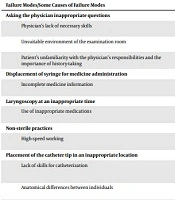
Based on the present results, the following ten errors were considered as important failure modes (Table 4). The research team discovered the causes of failure modes with respect to knowledge, skills, experience, documented incidents, reports, and other factors. Because of the multiplicity of failure modes (Table 3), here, we only present the second process analysis (Table 5). The solutions were proposed through brainstorming; some of the causes and the proposed solutions are described in Table 5. Overall, the errors can be classified as follows: (1) errors caused by insufficient skills and knowledge; (2) errors caused by inadequate monitoring and working conditions; (3) errors due to inadequate documentation and reckless haste at work; (4) lack of accurate protocols for prescribing drugs; and (5) errors due to individual differences between patients.
Table 4.
Some Causes of Four Important Processes and the Proposed Solutions
| Failure Modes/Some Causes of Failure Modes | Practical Solutions |
|---|---|
| Asking the physician inappropriate questions | |
| Physician’s lack of necessary skills | Continuing education on semiology; Periodic exams; Providing a checklist for examination. |
| Unsuitable environment of the examination room | Using a special room for examination; Providing appropriate tools for examination. |
| Patient’s unfamiliarity with the physician’s responsibilities and the importance of history-taking | Patient education; Providing patient education brochures; Evaluating the results of implanted catheters. |
| Displacement of syringe for medicine administration | |
| Incomplete medicine information | Using permanent ink; Using colored labels; Implementation of the physician’s orders by another person; Evaluation of medications by another person. |
| Laryngoscopy at an inappropriate time | |
| Use of inappropriate medications | Preparing the medications on the surgery day; Accurate calculation of medicine dosage; Considering the patient’s weight; Planning for anesthesia induction. |
| Non-sterile practices | |
| High-speed working | Having adequate time for sterilization; Using fast-acting disinfectants; Using a timer in the operating room. |
| Placement of the catheter tip in an inappropriate location | |
| Lack of skills for catheterization | Continuing medical education (CME) for catheterization; Evaluation of catheterization; Use of educational models; Evaluating the results of implanted catheters. |
| Anatomical differences between individuals | Identification of difficult cases; Taking pictures of patients before surgery; Using special catheters; Catheterization in the ward. |
| Inappropriate dosing of tranexamic acid | |
| Occasional use of tranexamic acid | Preparing a drug chart and installing it in the operating room. |
| Misinterpretation of monitoring data | |
| Careless anesthetist | Using the ideas of a second person; Using predesigned templates. |
| Anesthesiologist’s inadequate knowledge | Consulting with CME professionals; Review of monitoring education; Practical workshops for monitoring training; Simplifying monitoring; Using warning devices. |
| Inattention to monitoring | |
| Complexity of monitoring | Reducing the number of monitors; Increasing the size of images in some monitors; Setting alarms for specific monitors; Task management for monitoring; Incorporating more monitor checkups. |
| Anesthetic drug interactions | |
| Carelessness of the anesthesia team | Using only one vein for injection; Tandem injection; Lack of knowledge about drug interactions. |
| Organ injury during transportation | |
| Failure in timely detection of organ injury | Physical examination within the first hour after anesthesia; Preparation of an examination checklist; Patient education about the warning signs of organ damage. |
Table 5.
The Second Process (Induction of Anesthesia)
| Non-invasive Monitoring Actions/ Failure Modes | Severity | Probability | Hazard Score | Critical | Controlled | Detectable | Results |
|---|---|---|---|---|---|---|---|
| Pulse oximetry | |||||||
| Problems during operation | 2 | 2 | 4 | Y | Y | - | Stop |
| Inappropriate location of the pulse oximeter | 1 | 2 | 2 | N | - | - | Stop |
| Inaccuracy of the results | 2 | 2 | 4 | Y | Y | - | Stop |
| Non-invasive arterial blood pressure | |||||||
| Inappropriate selection of the cuff | 2 | 3 | 6 | N | - | - | Stop |
| EKG connection | |||||||
| Problems during operation | 2 | 1 | 2 | Y | Y | - | Stop |
| Noising | 2 | 3 | 6 | Y | Y | - | Stop |
| Inappropriate selection of the lead | 2 | 2 | 4 | Y | Y | - | Stop |
| Disconnected monitor | 2 | 2 | 4 | Y | Y | - | Stop |
5. Discussion
Solutions and recommendations are proposed with regard to the conditions of the operating rooms in Iran. Generally, reasonable expectations of corrective proceedings and implementation strategies after identification, design, and selection of actions are the main requirements for achievement. The detailed design guidelines for implementation, feasibility, and prioritization of appropriate strategies based on essential needs, gradual implementation, and proper stepwise planning are activities that should be taken into consideration. Authorities should also commit to accurate implementation of these strategies. Suitable risk management strategies include sharing clear strategies and policies for the employees, training the employees and managers, and a simple and convenient strategy for error detection. It should be noted that a quantitative analysis or scoring of errors and causes requires caution and takes a considerable amount of time.
To compare the present results with similar studies, Burgmeier confirmed that FMEA is a time-consuming, difficult, and tedious method and recommended it for high-priority issues (20). However, Martin et al. studied the outcomes of failure modes and effects analysis for medication errors in pediatric anesthesia and concluded that actions, such as improvement of syringe labeling, standardization of medication organization in the anesthesia workspace, and two-provider infusion checks, can be useful in reducing the effects of errors; the results of their study are in agreement with the results of the present study (17). Moreover, Kavosi et al. identified 204 failure modes in 36 activities in five processes in the surgery ward, using the FMEA. The most and least common causative factors were human and organizational errors and technical errors, respectively; these results are consistent with the present study (18).
The HFMEA allows for the classification and categorization of errors and their causes in healthcare systems. Also, substantial evidence regarding the frequency and severity of these errors allows planning authorities to propose more accurate strategies; however, if no operational strategy can eliminate or reduce the error, the next error is prioritized. Although this method is very accurate, it is very time-consuming and requires access to extensive and detailed information; therefore, it can be implemented in centers with accurate archiving and rapid access. On the other hand, if enough attention is not paid to the details, or if the medical team does not have adequate knowledge to detect errors, major errors will be definitely missed, and no plans will be designed to fix them; also, many consecutive staff meetings are required to eliminate these errors.
According to the mentioned findings, the circumstances, available resources, financial resources, and social/cultural conditions can change the failure modes and their solutions from one country to another. For example, factors, such as specific instructions or equipment, conduct of periodic tests, and allocation of an appropriate place for examination may vary between developed and developing countries. Overall, according to the findings of the present study, the following changes were made in our center: (1) the protocol for administration of tranexamic acid was modified; (2) a new monitoring device was purchased and used for the center; (3) a worksheet was prepared and used for documenting anesthesia care; (4) after a few briefing sessions for anesthesia technicians, the speed and accuracy of anesthesia process were improved.
5.1. Conclusion
In this study, anesthesia failures in open heart surgery were fully identified and classified. By quantitative analysis and use of a decision-making algorithm, cases of significant failure in the treatment process were determined and prioritized. The results indicated the importance of proper implementation of strategies after identifying, designing, and selecting improvement measures to achieve success. Overall, the use of HFMEA allows for the accurate identification of failure cases; detailed implementation of feasible solutions; prioritization based on essential needs; step-by-step implementation; and proper planning for implementation. Despite the poor conditions of developing countries in this area and the variety of technical and human errors, with direct financial and health consequences, little attention has been paid to environmental and ethical errors and their consequences.