
1. Background
Nowadays, injuries and patient harm are considered among the major concerns of global health systems (1). Achieving an accurate statistic of such errors is difficult and differs from one study to another (2). Most of these numbers and figures are related to developed countries (1). One of the studies estimating adverse events reported a low prevalence of these events in developing countries (3). However, this statistic may be due to these countries’ lack of appropriate infrastructures and information resources. Although some statistics are available on the extent and type of errors in the hospital area in Iran, experts and some indicators guess these to be very high (4, 5).
So, hospitals must investigate adverse events that result in unexpected patient harm and extract their root causes. Notably, Insufficient attention has been paid to this issue in some cases (5-7). The root cause is the cause that, if resolved, the problem is identified, fully resolved, and eliminated, or its incidence rate and likelihood severity will reduce as much as possible (8).
The root cause analysis (RCA) method is a systematic cause and effect analysis trying to determine the contribution of issues related to patients, employees, policies, environments, and processes to medical errors (9). Preliminary data indicate that the RCA of errors not only leads to the analysis of unintentional events toward systemic failures; it also improves the patient’s safety (10). In addition, RCA in Iran’s healthcare environment can improve commitment to patient safety issues (11, 12).
2. Objectives
The present study was conducted to analyze the root of adverse events in one of the biggest general hospitals in Western Iran.
3. Methods
This analytic retrospective study was conducted using a qualitative approach in 2019 in western Iran’s largest general teaching hospital (a referral hospital for women and children’s diseases). The hospital has 400 inpatient beds with a bed occupancy rate of 85%. First, the records of the past year’s potential error cases were referred to the committees for adult mortality (10 cases), child mortality (23 cases), and complaint management (28 cases). Then, necessary data about each error, including the type of error, the month of the error incidence, the related wards, and the specialties, were obtained and entered into the Excel Software and reported descriptively.
The process of root cause analysis was done following the National Patient Safety Agency (NPSA) protocol through seven steps:
(1) The first step: Initialization of the process:
This step includes event identification, team selection, and event description. In team selection, the working group included fixed members attended the meetings with various occupational positions (head of quality improvement unit, hospital expert, patient safety expert, and complaints management officer) and variable members depending on the event. It is worth noting that the fixed members participated in a one-day workshop about the root cause analysis of errors. Event description by interviewing the involved people, patients’ cases, and other relevant documents (processes, guides, and hospital policies) were examined, and the event occurrence environment was visited and reported narratively.
(2) The second step: Collecting and mapping (retrieving) information:
At this stage, the team depicted the event based on the event description through the table-based timeline.
(3) The third step: Identifying issues related to CDP or SDP:
This step employed the nominal group method to determine the most important problem.
(4) The fourth step: Event analysis, identifying the involved factors in the event, root causes:
After identifying the problems in the third step, the root cause of the problem was determined using the fishbone diagram.
(5) The fifth step: Providing solutions:
The team developed solutions and suggestions to avoid duplicate errors and eliminate errors. At this stage, the suggested solutions were listed using brainstorming, and the best solution was selected using the prioritization table.
(6) The sixth step: Implementing solutions (operational plan):
The operational plan table was developed for the selected solution at this stage.
(7) The seventh step: Submission of reports:
It should be mentioned that about 6 hours were spent investigating each case, including case review, interviewing the involved people, and meeting with expert people.
The ethical code of the research is IR.IUMS.REC.1399.558.
4. Results
The team diagnosed real errors in 22 of the 61 reported potential errors; however, the hospital committees only accepted the error in 11 cases. Therefore, the RCA was done following the NPSA protocol through seven steps for 11 cases (Table 1 and Figure 1).
Table 1.
The Proposed Cases in Adult Mortality, Child Mortality, and Complaint Investigation Committees
| Committee | Total |
|---|---|
| Adult mortality | |
| Number of cases | 10 |
| Number of errors | 6 |
| Accepted errors | 3 |
| Child mortality | |
| Number of cases | 23 |
| Number of errors | 4 |
| Accepted errors | 2 |
| Complaint management | |
| Number of cases | 28 |
| Number of errors | 12 |
| Accepted errors | 6 |
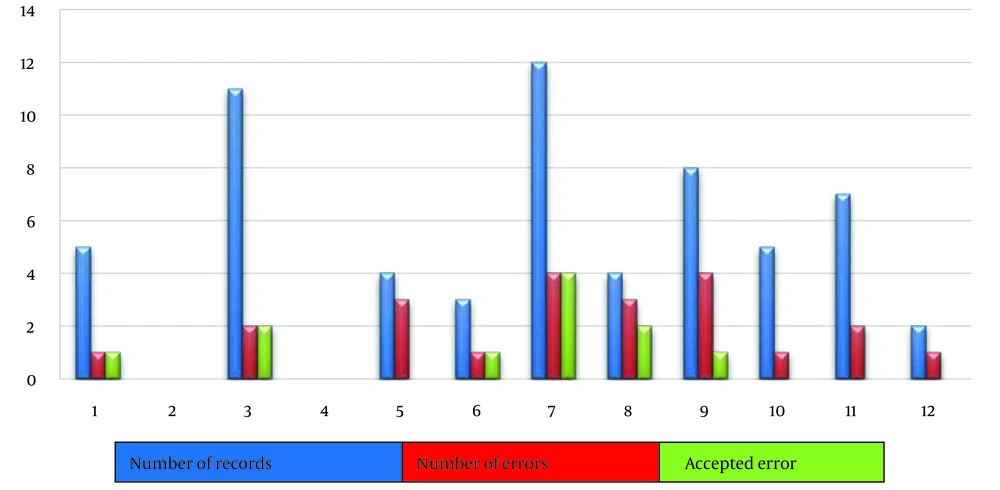
Figure 1.
The frequency of errors investigated in hospital committees per month
A summary of the 11 cases examined by RCA is shown in Table 2 (5 deaths and 6 serious injuries to the patient). Forty-nine CDPs and 13 SDPs were identified for the selected 11 events, while CDPs were present in all events.
Table 2.
Quantitative Analysis of the Root Causes of Adverse Medical Events
| Event | Involved Ward(s) | Involved Profession(s) | Care Delivery Problems | Service Delivery Problems | Selected Contributory Factors | Causes | Root Causes | Solutions |
|---|---|---|---|---|---|---|---|---|
| Lack of accurate examination and child’s death | Pediatric emergency, pediatric internal ward, and PICU | Specialist physician | 5 | 1 | History taking and clinical examination of the patient have not been properly done by the assistant (care delivery problems) | Management-related causes, causes related to the work environment and conditions, task-related causes, training-related causes, individual causes | Lack of proper monitoring of assistants by attending physician | Direct contact of the shift supervisor nurse to the senior assistant about the emergency patients |
| The seizure is followed by aspiration of the infant when feeding | Pediatric Emergency Departments and PICU | General practitioner | 1 | 3 | Lack of taking proper history and hurrying inpatient discharge at the outpatient visit (care delivery problems) | Task-related causes (2), individual causes (2), management-related causes, patient-related causes | Not observing the history-taking principles | Creating triage in children’s emergency ward |
| The unexpected death of a child referring to the outpatient emergency ward | Pediatric emergency departments and PICU | Specialist physicians and general practitioners | 7 | 2 | Lack of accurate examination and adequate history taking by the emergency physician; Ignoring the test results for negative poisoning and continued treatment with naloxone (care delivery problems) | Task-related causes (2), management-related causes, training-related causes, causes related to the work environment and conditions | Not observing the history-taking principles; Lack of monitoring- excessive trust of physicians in residents and lack of thorough and accurate examination; The absence of a lung pediatrician for counseling | Observing the proper principles of taking history and adequate monitoring of the performance of emergency physicians |
| Multiple infant intubation and death of the patient | Pediatric emergency departments and PICU | Management | 3 | 2 | Lack of adequate skill of assistants to perform intubation and knowledge about its indication (care delivery problems) | Management-related causes, training-related causes, task-related causes (2), individual factors | Lack of a specific process for intubation | Adjustment of the intubation process |
| Arresting the emergency patient in the waiting room of the operating room | Emergency department and operating room | Emergency medicine specialist | 5 | 0 | Delayed placement of chest tube in emergency ward regarding the bilateral pneumothorax (care delivery problems) | Individual-related causes (2), task-related causes (2) | Lack of placement of chest tube by the emergency medicine specialist | Establishing a legal solution in case of emergency for placement of chest tube |
| Missing pathology samples and receiving chemotherapy | Internal ward and operating room | Nurse | 4 | 0 | Lack of reporting of the receiving of the pathology sample by the circulating nurse (care delivery problems) | Communicative causes (2), management-related causes (2), task-related causes, individual causes (2) | Lack of communication system between the operating room and the pathology unit for sending the samples | Developing the correct process for sending samples to the pathology unit |
| Grade 3 rupture due to normal delivery | Delivery ward | Shift supervisor or head nurse | 5 | 1 | Wrong patient sharing and entrusting them to the midwifery students | Task-related causes (2), individual causes (2), management-related causes, causes related to the work environment and conditions | Not observing the job description by the shift supervisor | Monitoring the performance of shift supervisors |
| Mother’s uterus rupture | Delivery ward | Manager- specialist physician | 5 | 0 | Rapid intervention in the physiological delivery process of the patient (care delivery problems) | Task-related causes (2), training-related causes (3), individual causes (4), communicative causes, management-related causes (3) | Not considering the normal delivery and physiological protocols; lack of proper education for midwifery residents | Considering the institutionalization of principles of physiological care when childbearing; Holding regular retraining courses for residents and midwives of the ward |
| Patient’s fall in emergency and trauma and chin cuts with early diagnosis of cold | Emergency Department | General practitioner and nurse | 6 | 0 | Lack of proper monitoring of the patient’s general status by the injection nurse after completion of serum therapy (care delivery problems) | Task-related causes (2), individual causes (2), management-related causes (2), and causes related to the work environment and conditions. | Not performing the task properly, the nurse; not performing the task properly, the physician | Training shift supervisors |
| Irregular suturing of the patient’s elbow and lack of attention to the result of the Doppler ultrasound | Emergency Department | Emergency medicine specialist | 5 | 1 | Lack of accurate examination by the emergency medicine specialist (care delivery problems) | Task-related causes (3), communicative causes, management-related causes, causes related to the work environment and conditions | Lack of attention to the extent and depth of the wound; cancellation of orthopedic counseling; unclear order of doppler nosography of hand in the record; lack of monitoring of the documents | Improving monitoring system; Holding workshops or training seminars; Improving the performance-based payment system for physicians |
| Lack of accurate diagnosis of dislocation and fracture of the neck vertebrae | Emergency Department | Emergency medicine specialist | 3 | 3 | Inadequate accuracy of the emergency medicine specialist when observing CT scans (care delivery problems) | Training-related causes (2), task-related causes, management-related causes, and causes related to the work environment and conditions. | Lack of enough knowledge for CT scan | Holding training workshops |
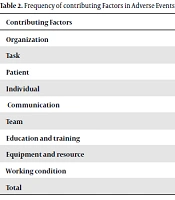
Moreover, for the 9 events, task-related causes (20 cases), individual causes (17 cases), management-related causes (14 cases), training-related causes (8 cases), and causes related to the work environment and conditions (7 cases) were specified (Table 2).
5. Discussion
Task-related, management-related, training-related, individual-related, and communication-related causes (based on the nine-item error actors of the NPSA protocol) were the major causes of adverse events, which were also reported in (13). In addition, Morrison et al., applying a retrospective and comparative RCA, showed that administration error was the most common medication error (14).
The most common type of error was related to the hospital’s emergency and delivery wards. According to the studies, many factors (e.g., too many patients, lack of medical equipment and nurses, and the presence of acute and life-threatening diseases) make the emergency ward prone to medical errors (15). According to the results of a study, patients were afraid of medical errors among students in the hospital emergency room (16). Also, the identification of “excessive trust of specialists in residents and lack of full and accurate examination”, “failure to properly monitor the assistants by the attending supervisor”, and “not placing the chest tube by the emergency medicine specialist” were claimed as examples of adverse event root causes.
Improper history-taking was one of the most common causes of adverse events. In another study, many therapists showed problems with communicating with patients and taking histories during medical examinations. The causes of this error included lack of adequate knowledge, lack of ability to structure the history, lack of attention, poor communication with the patient, lack of motivation, lack of examination facilities and insufficient time, and an inappropriate environment (17).
Among the solutions suggested to eliminate error duplication is direct contact between the shift supervisor and the senior assistant for emergency patients. According to a study performed in Denmark, the lack of organizational methods and guidelines for determining who, what, when transfers, and to whom are important factors in preventing the incidence of the events (18).
Ignoring protocols was identified among the causes of adverse events. Using packages and protocols to reduce medical errors has been confirmed in certain studies (19, 20). According to the present study and other similar studies, attracting the collaboration of doctors to change behavior and follow protocols and guidelines has always been a challenging issue (21, 22).
In most cases, the suggested strategies include training the personnel, strengthening the monitoring system, developing and standardizing processes, and other studies (23). In addition, “organizing regular retraining courses for midwife residences and midwives”, “training shift supervisors”, “paying attention to institutionalization of physiological care principles during delivery”, and “holding workshops or training seminars” were among the strategies presented in the current study. Education and learning have solved many preventable adverse events (13, 24). Determining the educational and planning requirements for in-service training may play a role in implementing this strategy (13).
“Development of the correct process of sending samples to the pathology unit” and “development of the intubation process” were among the solutions provided in other studies (25). “Not observing job descriptions by the shift supervisor”, “not doing the right tasks by the nurse and the physician”, and “lack of a communication system between sectors” were the causes of the occurrence of adverse events (26).
The personnel of this hospital was not familiar with the RCA. Also, the overall evidence suggests that hospitals potentially require organizational learning and employing RCA-trained staff (27). Thus, the present study successfully implemented this method by holding a workshop.
The limitations of this study were the relatively low participation of physicians in RCA groups and the nurses’ fear of expressing the facts. To reduce these restrictions, we invited doctors at a time when they had enough time and convinced nurses about the anonymity of their names and information. In this study, 100% of the events accepted by the hospital committees were analyzed through an RCA. In future studies, it is suggested to investigate all causes of death and serious injury in hospitals.
In this hospital, about one-fifth of preventable adverse events were admitted as errors, of which half were fatal. These statistics are very worrying. Using the results of this study and applying strategies will not only reduce mortality and complaints but also reduce other medical errors. In addition to the solutions presented in this study, it is recommended to conduct a fundamental analysis of events and share the results. Moreover, the Ministry of Health, as the stewardship, is recommended to make a plan to encourage the team to report errors and conduct such studies. Finally, future studies are suggested to assess the proposed solutions’ effectiveness or implementation.