
1. Background
Medical errors are among the most significant challenges facing health systems worldwide and are recognized as one of the leading causes of preventable mortality, with studies estimating that surgical errors contribute to mortality rates ranging from 2% to 5% in high-risk procedures such as cardiac surgery (1-3). In the field of cardiac surgery, which is considered one of the most complex and sensitive branches of medicine, the occurrence of errors can have irreversible consequences for patients and their families (2). Studies have shown that medical errors in cardiac surgery not only affect the quality of healthcare services but also impose substantial costs on health systems (3).
In Iran, as in many other countries, patient safety and the reduction of medical errors — particularly in cardiac surgery units — have gained increasing attention (4). Evidence indicates that patient safety culture in Iranian hospitals is still weak, and many medical errors — arising from both organizational shortcomings and individual factors — are not reported, which prevents learning and improvement (5, 6). This underreporting results in missed opportunities for learning from errors and perpetuates cycles of repeated mistakes (6).
International research emphasizes the role of human factors in the occurrence of surgical errors. Fatigue among surgeons, the complexity of treatment processes, workload pressures, and poor team communication are among the most critical contributors to errors (7). In cardiac surgery, which requires precise coordination among multiple teams, even minor disruptions in communication or decision-making can lead to serious consequences (8).
Qualitative studies in this domain are particularly valuable because, unlike quantitative research, they can reveal the lived experiences of specialists and uncover hidden dimensions of medical errors (9). Semi-structured interviews, as a primary tool in qualitative research, enable in-depth exploration of perspectives and experiences of professionals (10). This approach allows researchers to gain a deeper understanding of the social, organizational, and individual contexts of medical errors (11). Furthermore, the application of Lincoln et al.’s (5) trustworthiness criteria in qualitative studies ensures the credibility and validity of findings (12). These criteria — credibility, transferability, dependability, and confirmability — help researchers present results that are scientifically rigorous and reliable (13). Recent studies in Iran have also highlighted the importance of these criteria in qualitative data analysis (14).
Despite scientific and technological advances in cardiac surgery, significant gaps remain in understanding the factors contributing to medical errors. Many studies have relied primarily on quantitative approaches and have paid limited attention to qualitative dimensions and the real-world experiences of specialists (15).
This research aims to qualitatively explore the factors contributing to medical errors in cardiac surgery from the perspectives of Iranian specialists, including cardiac surgeons, anesthesiologists, operating room nurses, and hospital administrators. The significance of this study lies in its focus on the lived experiences of cardiac surgery teams, which can uncover hidden and underexplored aspects of medical errors. The findings are expected to contribute not only to improving patient safety and the quality of cardiac surgery services but also to informing national health policy and hospital management strategies.
2. Objectives
The primary objective of this study is to identify and analyze the underlying factors of medical errors in cardiac surgery and to propose practical solutions for their reduction.
3. Methods
This study was designed as a qualitative research project conducted in 2025 in Iran. The qualitative approach was chosen because medical errors in cardiac surgery are complex, multifactorial, and deeply embedded in organizational and human contexts. Quantitative methods alone cannot capture the lived experiences of surgeons or the subtle dynamics that contribute to errors. By using qualitative inquiry, the study aimed to explore the perspectives of cardiac surgeons in depth and to uncover hidden dimensions of medical errors that are often overlooked in statistical reports.
The research setting consisted of cardiac surgery departments in six hospitals (two public, two social security, and two private) across Iran. These departments were selected because they represent diverse organizational structures and patient populations. Cardiac surgery wards are characterized by high technical demands, multidisciplinary teamwork, and significant patient risk, making them an appropriate environment for studying medical errors. The inclusion of hospitals from different sectors ensured maximum variation in experiences and contexts.
Participants were selected based on strict inclusion and exclusion criteria. Inclusion criteria required that surgeons had at least five years of professional experience as subspecialists in cardiac surgery. They were also required to have direct experience performing open-heart or closed-heart procedures and to possess sufficient knowledge of medical errors and patient safety. Participants needed to demonstrate willingness to share their experiences openly and to provide informed consent. Exclusion criteria included refusal to allow audio recording, lack of written informed consent, less than five years of professional experience, or any physical or psychological condition that prevented effective participation. Participants who withdrew at any stage were also excluded from the final analysis.
Sampling was conducted using snowball and maximum variation techniques, with justification provided for combining these approaches. Snowball sampling was used to initiate recruitment through referrals, while maximum variation ensured diversity across hospital types and participant backgrounds. This combination allowed both depth and breadth in capturing experiences. The process began with one highly experienced cardiac surgeon, who then referred other colleagues with relevant expertise. This chain referral continued until data saturation was achieved. Saturation was defined as the point at which three consecutive interviews yielded no new codes or themes. The use of maximum variation ensured that surgeons from different hospital types and with diverse backgrounds were included, thereby enhancing the richness and transferability of the findings.
Data collection was carried out through semi-structured interviews. An interview guide was developed to ensure consistency while allowing flexibility. Key topics included personal experiences of medical errors in cardiac surgery, individual factors such as fatigue and workload, team-related factors such as communication and coordination, organizational factors such as hospital policies and resource limitations, consequences of errors for patients and staff, and suggestions for reducing errors. These criteria for data collection were informed by prior qualitative studies in surgical safety (7, 8, 15). Each interview lasted a minimum of 30 minutes and a maximum of 90 minutes. Interviews were conducted face-to-face in quiet settings chosen by participants to ensure comfort and confidentiality. Interviews were conducted between March and September 2025.
The interview process followed a structured sequence. Before interviews, coordination with hospitals and participants was established, study objectives were explained, and informed consent forms were provided either in person or electronically. During interviews, participants were reminded of confidentiality and their right to withdraw at any time. With permission, all interviews were audio-recorded using digital devices, and detailed field notes were taken simultaneously. After interviews, transcripts were prepared verbatim and returned to participants for validation. This member-checking process allowed participants to confirm accuracy and to correct any misinterpretations.
Data analysis was performed using MAXQDA 2022 software. Transcripts were read repeatedly to achieve familiarity, and meaningful units were identified. Initial codes were generated from raw data and then grouped into categories and themes through iterative comparison. Multiple researchers were involved in the analysis process. At least two researchers independently coded a subset of interviews, and discrepancies were discussed until consensus was reached. This triangulation enhanced the reliability of the coding process. The final themes were developed collaboratively by the research team and refined through continuous discussion.
Trustworthiness of the findings was ensured by applying Lincoln et al.’s criteria. Credibility was established through member checking, prolonged engagement with participants, and expert review (5). Transferability was enhanced by including participants from diverse hospitals and backgrounds. Dependability was supported by external auditing of data and documentation of all analytic steps. Confirmability was achieved through peer debriefing, transparent reporting, and maintaining an audit trail of decisions.
Ethical considerations were strictly observed throughout the study. Confidentiality of participants was guaranteed, and all identifying information was removed from transcripts. Written informed consent was obtained from all participants, who were informed of their right to withdraw at any stage without consequence. The study protocol was reviewed and approved by the ethics committee of Abadan University of Medical Sciences, with the code of ethics IR.ABADANUMS.REC.1402.034.
Table 1 provides demographic and professional information about the participants, including age, gender, years of experience, hospital type, and participant identifiers used in quotations. This table enhances methodological clarity and allows readers to evaluate the diversity of the sample.
Table 1.
Participant Characteristics
| Participant ID | Age (y) | Gender | Years of Experience | Hospital Type | Role |
|---|---|---|---|---|---|
| P1 | 45 | Male | 15 | Public | Cardiac surgeon |
| P2 | 39 | Female | 12 | Private | Cardiac surgeon |
| P3 | 50 | Male | 20 | Social security | Cardiac surgeon |
| P4 | 42 | Male | 14 | Public | Cardiac surgeon |
| P5 | 37 | Female | 10 | Private | Cardiac surgeon |
| P6 | 48 | Male | 18 | Public | Cardiac surgeon |
| P7 | 41 | Male | 13 | Social security | Cardiac surgeon |
| P8 | 36 | Female | 9 | Private | Cardiac surgeon |
| P9 | 47 | Male | 16 | Public | Cardiac surgeon |
| P10 | 44 | Male | 15 | Social security | Cardiac surgeon |
| P11 | 38 | Female | 11 | Private | Cardiac surgeon |
| P12 | 52 | Male | 22 | Public | Cardiac surgeon |
| P13 | 40 | Male | 12 | Social security | Cardiac surgeon |
| P14 | 35 | Female | 8 | Private | Cardiac surgeon |
| P15 | 46 | Male | 17 | Public | Cardiac surgeon |
| P16 | 43 | Male | 14 | Social security | Cardiac surgeon |
| P17 | 39 | Female | 11 | Private | Cardiac surgeon |
| P18 | 49 | Male | 19 | Public | Cardiac surgeon |
| P19 | 42 | Male | 13 | Social security | Cardiac surgeon |
| P20 | 37 | Female | 9 | Private | Cardiac surgeon |
| P21 | 45 | Male | 15 | Public | Cardiac surgeon |
| P22 | 41 | Male | 12 | Social security | Cardiac surgeon |
| P23 | 36 | Female | 8 | Private | Cardiac surgeon |
| P24 | 50 | Male | 20 | Public | Cardiac surgeon |
4. Results
4.1. General Description of Data
In this study, data were collected through semi-structured interviews with 24 cardiac surgeons. A total of 38 interviews were conducted, each lasting between a minimum of 30 minutes and a maximum of 90 minutes. All interviews were carried out face-to-face in quiet environments, with prior coordination and written informed consent obtained from participants. Following the completion of data collection, all interviews were transcribed verbatim. Each transcript was returned to the respective participant for validation to ensure accuracy and credibility. After reviewing the quality and completeness of the transcripts, 24 interviews were confirmed as valid and included in the final analysis. This number was sufficient to achieve data saturation, as no new information emerged from subsequent interviews. See Table 1 for participant characteristics.
4.2. Coding Process and Theme Extraction
After transcription, all interview texts were read several times to ensure familiarity with the data. Meaning units were identified and transformed into initial codes. These codes were then grouped into categories, and through iterative comparison, the main themes and subthemes were developed. To enhance reliability, a subset of interviews was independently coded by two researchers, and discrepancies were resolved through consensus. The overall coding process is summarized in Table 2.
Table 2.
Steps of Coding and Theme Extraction
| Step | Description |
|---|---|
| Initial reading of data | Repeated reading of transcripts for full familiarity |
| Identification of meaning units | Extracting key concepts from raw data |
| Generation of initial codes | Recording meaning units as preliminary codes |
| Categorization of codes | Organizing similar codes into initial categories |
| Reliability check | Independent coding by two researchers and consensus on differences |
| Formation of themes | Converting categories into main themes and subthemes |
4.3. Main Themes and Subthemes
The analysis of the interviews resulted in the identification of four main themes and a total of ten subthemes that reflect different dimensions of medical errors in cardiac surgery. These themes emerged systematically from the initial codes and categories, and each theme represents a distinct domain of the surgeons’ experiences (Table 3).
Table 3.
Main Themes and Subthemes
| Main Theme | Subthemes |
|---|---|
| Individual factors | Fatigue and workload; Momentary decision-making; Limited experience in critical conditions |
| Team-related factors | Weak communication; Insufficient coordination with anesthesiologists; Role of nurses in error prevention |
| Organizational factors | Shortage of equipment; Hospital policies; Poor reporting culture; Managerial pressures |
| Consequences and solutions | Patient outcomes; Psychological effects on staff; Suggested strategies for error reduction |
4.4. Direct Participant Quotations
To enrich the findings and demonstrate the authenticity of the themes, direct verbatim quotations from participants are presented. These quotations illustrate the lived experiences of cardiac surgeons and provide deeper insight into the identified themes.
4.4.1. Individual Factors
- “When we perform several surgeries consecutively, severe fatigue reduces our accuracy.” (P3)
- “In critical situations, momentary decision-making sometimes leads to errors.” (P7)
- “Lack of experience in complex cases lowers confidence and increases mistakes.” (P11)
- “Sometimes the workload is so heavy that concentration is lost.” (P14)
- “After hours in the operating room, both physical and mental capacity decline.” (P19)
4.4.2. Team-related Factors
- “Weak communication between surgeons and anesthesiologists can turn a small mistake into a major incident.” (P12)
- “If nurses give timely warnings, many errors can be prevented.” (P15)
- “Insufficient coordination among team members results in duplication or incomplete tasks.” (P20)
- “Sometimes vital information is not communicated on time, which causes errors.” (P23)
- “When the team lacks shared experience, the likelihood of errors increases.” (P24)
4.4.3. Organizational Factors
- “The absence of adequate equipment forces us to make risky decisions.” (P16)
- “The reporting culture is weak; many errors are not documented, which leads to repetition.” (P17)
- “Hospital policies sometimes restrict us and reduce flexibility.” (P20)
- “Managerial pressures to cut costs can compromise the quality of care.” (P10)
- “A shortage of specialized staff is one of the most serious problems.” (P7)
4.4.4. Consequences and Solutions
- “When an error occurs, the patient is the first victim, but the surgical team also suffers psychologically.” (P24)
- “Regular training sessions and transparent discussion of errors can reduce their occurrence.” (P9)
- “Errors undermine patients’ trust in the healthcare system.” (P16)
- “If errors are reported, we can learn from them and prevent recurrence.” (P20)
- “Using new technologies can minimize the risk of errors.” (P7)
4.5. Relationships Between Themes
The four main themes — individual, team-related, and organizational factors — are closely interconnected and collectively shape the consequences and proposed solutions. Individual fatigue affects team coordination; team dynamics are influenced by organizational policies; and organizational conditions set the stage for both individual and team performance. These interactions form a circular system, where each domain reinforces the others and contributes to the overall impact on patient outcomes and staff well-being. Figure 1 illustrates this conceptual model.
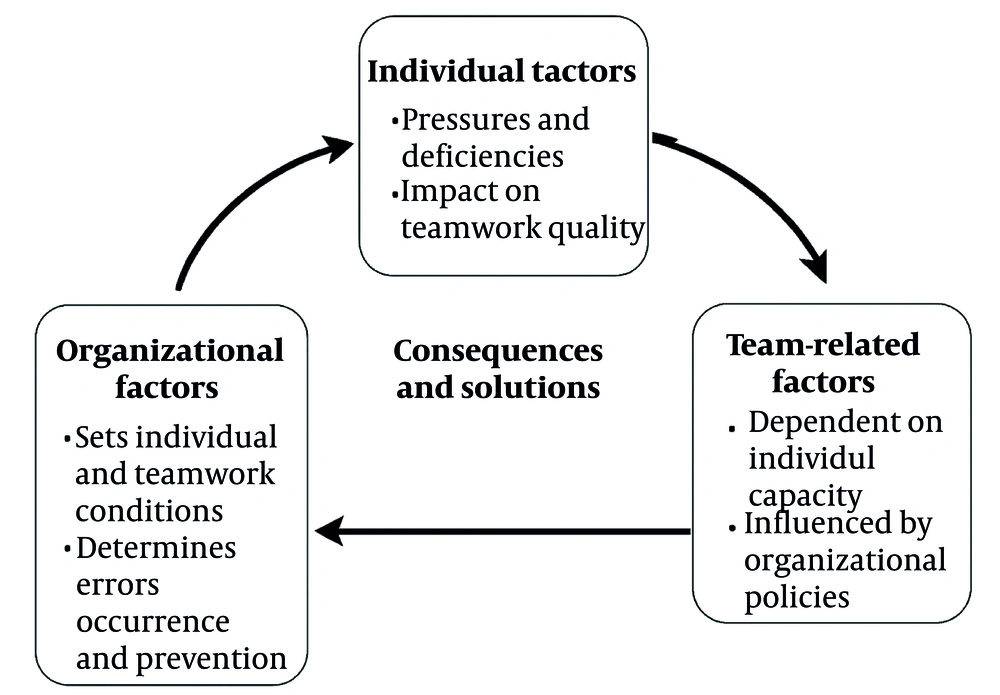
Figure 1.
Circular conceptual model of theme relationships
4.6. Final Interpretation and Analytical Summary
The findings of this study revealed that medical errors in cardiac surgery arise from a complex, multilayered interaction among individual, team-related, and organizational factors. These errors are not merely the result of personal weaknesses or momentary mistakes; rather, they are embedded within organizational structures and workplace culture.
Participants emphasized that preventing errors requires a multidimensional approach — one that addresses individual training, strengthens team communication, and reforms organizational policies and infrastructures. This interpretation highlights that reducing surgical errors demands a systemic and cultural transformation within hospitals, rather than focusing solely on individual performance.
5. Discussion
5.1. Individual Factors
Several studies have highlighted fatigue, psychological stress, and cognitive overload as major contributors to errors in cardiac surgery (16, 17). Our findings align with these results, as participants frequently described exhaustion and momentary decision-making as precursors to mistakes. Other research has emphasized the role of simulation-based training in reducing such risks (18). These insights suggest that individual empowerment alone is insufficient without systemic support. In our study, the lived experiences of surgeons confirmed that personal vulnerabilities are inseparable from organizational and team contexts, reinforcing the need for holistic interventions.
5.2. Team Dynamics and Communication
Team-related factors emerged as a critical dimension. Previous qualitative studies have shown that communication breakdowns between surgeons, anesthesiologists, and nurses are among the most common causes of adverse events (19, 20). Our findings resonate with these observations, as participants highlighted weak coordination and delayed information sharing. Conversely, some studies argue that standardized checklists and protocols significantly reduce communication errors (21). While such tools are valuable, our data suggest that cultural barriers and hierarchical structures often limit their effectiveness. This indicates that beyond technical solutions, fostering a culture of openness and shared responsibility is essential.
5.3. Organizational Structures and Culture
Organizational factors, including resource shortages, restrictive policies, and weak reporting systems, were consistently identified in our study. Similar results have been reported in both Iranian and international contexts, where institutional constraints exacerbate the risk of errors (22, 23). Yet, some investigations emphasize that organizational reforms, such as transparent reporting and investment in infrastructure, can substantially reduce error rates (24). Our findings confirm that without systemic support, individual and team efforts remain insufficient. This highlights the importance of embedding error-prevention strategies into hospital governance and policy frameworks.
5.4. Non-reporting of Errors
A notable theme in our study was the reluctance to report errors. Previous qualitative research in Iran has documented similar barriers, including fear of blame and punitive consequences (25). International literature also supports this, showing that underreporting is a global issue (26). However, some institutions have successfully implemented non-punitive reporting systems that encourage disclosure (27). Participants in our study stressed that unless reporting is normalized and protected, learning from mistakes will remain limited. This reinforces the need for cultural transformation toward transparency and collective learning.
5.5. Consequences and Solutions
The consequences of errors, as described by participants, extended beyond patient harm to include psychological distress among surgical teams. This is consistent with studies highlighting the “second victim” phenomenon (28, 29). While some research suggests that peer support programs can alleviate this burden (30), our findings indicate that such initiatives are largely absent in the studied context. Proposed solutions in our study — such as regular training, open discussion of errors, and adoption of new technologies — mirror recommendations in the literature (31, 32). Additional international studies also emphasize the importance of multidisciplinary simulation training (18), structured communication protocols such as the World Health Organization Surgical Safety Checklist (21), and systems-based approaches to error reduction (33, 34). Furthermore, recent work on medication safety highlights how integrating digital technologies and electronic reporting systems can minimize risks (32, 35). Nevertheless, participants emphasized that solutions must be tailored to local realities, rather than imported wholesale from other systems.
5.6. Integrative Perspective
Taken together, our findings support a systems-based understanding of medical errors in cardiac surgery. This perspective is echoed in recent reviews advocating for integrated interventions across individual, team, and organizational levels (33, 34). However, some scholars argue that focusing too broadly risks diluting accountability (35). Our study demonstrates that while accountability is crucial, isolating responsibility at one level fails to capture the complexity of error genesis. A balanced approach that combines personal responsibility with systemic reform appears most effective. Moreover, the circular conceptual model developed in this study can be linked to existing frameworks such as Reason’s Swiss Cheese Model (34), illustrating how multiple layers of defense interact and sometimes fail, leading to adverse events.
5.7. Limitations
This study was conducted in a limited number of hospitals and relied on qualitative interviews, which may restrict the generalizability of the findings. Moreover, possible interviewer bias cannot be excluded, and perspectives were limited to cardiac surgeons only, without triangulation with operating room observations. Hierarchical structures within hospitals may also have influenced participants’ willingness to disclose certain experiences. Nevertheless, the depth of participants’ narratives provides meaningful insights into the systemic nature of medical errors in cardiac surgery.
5.8. Conclusions
The study demonstrated that medical errors in cardiac surgery arise from the complex interaction of individual, team-related, and organizational factors. Preventing such errors requires a multidimensional approach that combines personal training, improved team communication, and organizational reforms. The proposed circular conceptual model highlights how these domains converge toward consequences and solutions, emphasizing that sustainable improvement depends on systemic and cultural transformation within hospitals. Positioning these findings within international patient-safety literature underscores the global relevance of surgical team dynamics and human-factors engineering.