Fulltext
Full Text Available is PDF
Image Credit:Multidiscip Cardio Annal
Authors
Children's Medical Center, Tehran University of Medical SciencesChildren with diminished pulmonary blood flow (different forms of severe pulmonary stenosis or atresia) suffer from severe life-threatening cyanosis and need interventions to increase this flow. The classic way is a surgical modified BT shunt. However, this operation carries a 10% risk of death and a higher risk of morbidities like chylothorax, phrenic nerve palsy, and others .
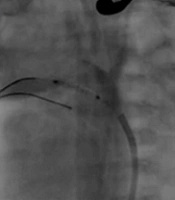
A substitute to the surgery is ductal stenting. In many neonates, ductus arteriosus can be left open with the aid of prostaglandins and then by coronary or small peripheral stents to provide enough pulmonary blood flow. The procedure is less traumatic and equally successful. Based on the angle of ductus to the aorta and cardiac anatomy, it can be done via venous or arterial approach. The most fearing complication of the arterial approach is vascular injury which can be reduced almost to nil using small radial sheaths. Heart block is a frequent complication of the venous approach which may fail the procedure. Turtuosity of the ductus with acute angles may hamper its stenting. The whole length of the ductus should be stented; otherwise the unstented areas will contract and diminish the flow. Origin stenosis of the branch pulmonary arteries is a relative contraindication as ductal stenting may obliterate one or both branches.
In summary, ductal stenting is a reliable substitute to surgical shunt in many neonates with diminished pulmonary flow.
© 2015, Multidisciplinary Cardiovascular Annals. This open-access article is available under the Creative Commons Attribution-NonCommercial 4.0 (CC BY-NC 4.0) International License (https://creativecommons.org/licenses/by-nc/4.0/), which allows for the copying and redistribution of the material only for noncommercial purposes, provided that the original work is properly cited.
Edraki M, Jouhari L, Naghshzan A, Amoozgar H, Mohammadi H, et al. Ductus Arteriosus Stenting in Neonates with Pulmonary Valve Atresia: Outcomes and Considerations. Inn J Pediatr. 2022;32(5):e119742. doi: https://doi.org/10.5812/ijp-119742

Kamiab Z, Derakhshan R. A Case Report of the Repair of Coarctation of the Aorta by Stenting in an Infant with Ventricular Septal Defect Due to Placement of a Large Amplatzer During Ductus Arteriosus. Zahedan J Res Med Sci. 2023;25(2):e118620. doi: https://doi.org/10.5812/zjrms-118620
Behnaz F, Chegini A, Rafieyian S, Rasouli M. Complications of Transcatheter Closure in Patent Ductus Arteriosus Patients. Int Cardiovasc Res J. 2017;11(4):e11300. doi:
Malleshi Betigeri V, Vithalkumar Betigeri A, Armugum V, SatyaVenkataKumar SubbaRao K. Circulatory Arrest: A Surgical Option for Adult Window Ductus Closure. Int Cardiovasc Res J. 2017;6(1):e12846. doi:
Kamiab Z, Derakhshan R. A Case Report of Embolized Stent and Rashkind Septostomy that Suffer Hemolysis Due to Stent in 2-Days Neonate with Pulmonary Atresia and Single Ventricle. Zahedan J Res Med Sci. 2023;25(4):e129421. doi: https://doi.org/10.5812/zjrms-129421
Last Update: 4 days ago
Last Update: 4 days ago
Last Update: 4 days ago
Last Update: 5 hours ago
Last Update: 8 hours ago
Last Update: 4 days ago