
1. Background
In recent decades, evidence-based practice (EBP) is considered as a philosophy to improve clinical care and practice in health-related professions (1, 2). EBP is defined as “integration of best research evidence with clinical expertise and patient values and circumstances” (3). The best research evidence, respectively, includes clinical practice guidelines, meta-analyses, systematic reviews, randomized control trials, cohort studies, case-control studies, case series, and expert opinions (4, 5). There is a consensus on the need to make more use of EBP in daily clinical practice in health-related professions (5-7). For example, rehabilitation sciences, occupational therapy, and physiotherapy scientific associations encourage therapists around the world to use EBP (8, 9). As members of the health professions, speech, and language pathologists (SLPs) need to apply EBP in their daily clinical decision-making to deliver high-quality clinical services (5, 10, 11). There are some conditions in speech and language pathology that make the need for EBP use more prominent in this discipline. Some of these conditions are as follows: the need for obtaining new evidence, the high volume of up-to-date evidence, the presence of highly specialized fields in speech and language pathology, the need for improving patient care due to the best new evidence, and uncertainties about treatment efficacy in some fields (12).
Despite the great need and significance for documentation of knowledge and attitudes of SLPs as well as other health-related professions about EBP, few studies have been performed in this field among SLPs, especially Iranian SLPs (13). Zipoli and Kennedy (13) investigated EBP among SLPs as the members of the American Speech-Language-Hearing Association (ASHA). In other studies, O’Connor and Pettigrew (14) and Alhaidary (2) investigated EBP among SLPs in Southern Ireland and Saudi Arabia, respectively. So far, two studies have examined EBP among Iranian SLPs (physiotherapists) (15, 16) using a questionnaire developed by Jette et al. (17). Thus, this questionnaire is not specific to the speech and language pathology discipline. It should be noted that each discipline or healthcare profession has some conditions and properties that can be effective in this regard (18). One of these studies was carried out in Isfahan, Iran, with a limited sample size (40 participants) (16). Tahmasebifard et al. (16) reported that over 80% of SLPs in the Isfahan City had positive attitudes toward EBP, and their participants admitted their lack of knowledge and skills regarding EBP because they did not receive sufficient education about EBP. In another study, Tohidast et al. (15) investigated EBP among 127 Iranian SLPs and reported that Iranian SLPs had good attitudes toward EBP, did not receive appropriate training regarding EBP, and did not have proper knowledge about EBP. It seems that these two studies, which investigated EBP among Iranian SLPs, may not be indicative of the EBP status among the Iranian speech and language pathology community. Therefore, further studies are needed for better documentation of EBP among Iranian SLPs.
2. Objectives
The present study aimed at investigating the knowledge, attitude, and practice of Iranian SLPs toward EBP in 2019.
3. Methods
3.1. Study Design and Participants
This cross-sectional survey was conducted from October to December 2019, in Iran. The purposive sampling was carried out to obtain the target population. Participants had an academic degree in speech and language pathology, at least one year of professional experience in speech and language pathology, and the willingness to participate in this project. Several lists of Iranian SLPs with their contact information were taken from the Iranian Speech and Language Pathology Association, public clinics, universities, private clinics, and other organizations. Organizations only gave us contact information of those who had previously expressed their consent to the organization for releasing contact information. Then, a total of 600 SLPs were invited to include in this study through electronic mails and social networks (Telegram and WhatsApp). The electronic version of the questionnaire was attached to the invitation letter. Moreover, we sent a follow-up notification to SLPs who did not complete and return the questionnaire about ten days after the initial submission of the questionnaire. The questionnaire included three sections: the information letter, demographic questions, and the main questionnaire. The information letter included an explanation of the study objectives and the conditions of participation in the study. We requested Iranian SLPs to read the information letter, fill out the questionnaire carefully, and then return it. Participation in the study was based on the willingness of the respondents. All the participants were assured of the confidentiality of their information, and a code was assigned to each participant for data analysis. The Ethics Committee of Semnan University of Medical Sciences approved this study (approval no.: IR.SEMUMS.REC.1398.94).
3.2. Study Instrument
The Speech and Language Pathology Evidence-Based Practice questionnaire (SLP-EBPQ) was used in the present study. The SLP-EBPQ is a valid and reliable tool to investigate EBP in speech and language pathology. The scale-level content validity index of the SLP-EBPQ is 0.95. Moreover, the internal consistency of the different sections of the SLP-EBPQ is within the range of 0.63 to 0.88, and its intra-class correlation in the test-retest reliability is within the range of 0.81 to 0.96 (19). The SLP-EBPQ includes five main sections and comprises a total of 77 items. These five sections include attitude, knowledge, use of evidence (practice), barriers, and facilitators. In the present study, we used three sections (attitude, knowledge, and use of evidence) of the SLP-EBPQ to investigate the knowledge and attitude of Iranian SLPs about EBP and also to examine the extent to which they may use it. The attitude section includes 11 items that are scored on a 5-point Likert scale: strongly disagree (1), disagree (2), neutral (3), agree (4), and strongly agree (5). Given that each item has a score between 1 and 5, and this section contains 11 items, the score of this section is between 11 and 55. A score below 22 in attitude section indicates poor attitude, scores ranged from 22 to 33 indicate average attitude, and a score above 33 indicates a good attitude (19). The knowledge section includes ten multiple-choice questions related to EBP and has a total of 10 scores. Each correct answer has one score, whereas the wrong or no answer has no score. Therefore, each person’s knowledge score is between zero and ten. A score below four in this section indicates poor knowledge, scores ranged from four to seven indicate average knowledge, and a score above seven indicates good knowledge (19). The use of the evidence section comprises of two sections (internal and external evidence) and includes a total of 14 items scoring on a 5-point Likert scale (never, rarely, sometimes, often, and always) (19).
3.3. Statistical Analysis
The SPSS software version 21.0 (SPSS Inc., Chicago, IL, USA) was used for data analysis. The Kolmogorov-Smirnov test was applied to evaluate the normality of the data, and the Mann-Whitney test was used to compare the variables between different groups. Further, the Spearman test was used to investigate the correlation between the variables.
4. Results
From 600 questionnaires sent to the Iranian SLPs, 422 questionnaires were returned (with the response rate of 70.3%). Eleven questionnaires were ignored due to incomplete information, and finally, a total of 411 questionnaires were investigated in the study.
4.1. Participants’ Characteristics
Most of the respondents were female (71.54 %). Over 50% of the respondents had a bachelor's degree, and also most of them worked in both private and public clinics (44.5%). The maximum and minimum clinical experiences of the respondents were respectively 36 years and one year. The demographic characteristics of the participants are summarized in Table 1.
Table 1.
Demographic Characteristics of the Participantsa
| Values | |
|---|---|
| Gender (N = 411) | |
| Male | 117 (28.46) |
| Female | 294 (71.54) |
| Age (N = 411) | 28.15 ± 5.8 |
| Min | 22 |
| Max | 60 |
| Education level (N = 411) | |
| BSc | 206 (50.2) |
| MSc student | 68 (16.5) |
| MSc | 93 (22.6) |
| PhD student | 37 (9) |
| PhD | (1.7) |
| Years practicing SLP (N = 411) | 5.13 ± 5.16 |
| Min | 1 |
| Max | 36 |
| Place of practice (N = 411) | |
| Private | 147 (35.8) |
| Public organs | 81 (19.7) |
| Either | 183 (44.5) |
Abbreviations: BSc, Bachelor of science; Max, maximum; Min, minimum; MSc, master of science; SLP, speech and language pathology; SD, standard deviation.
aValues are expressed as No. (%) or mean ± SD.
4.2. Knowledge About EBP
The mean figure of the knowledge score of the SLPs was 3.85 (± 2.8). There was a significant difference between the knowledge scores of SLPs with postgraduate and undergraduate degrees (P < 0.001). SLPs with postgraduate degrees had a mean score of 5.52 (± 2.59) compared with 2.19 (± 1.87) for SLPs with an undergraduate degree. Moreover, there was a significant positive correlation between the knowledge score and years of practicing (Spearman, r = 0.26, P < 0.001). Table 2 presents more details about the results of the knowledge score analysis.
Table 2.
Comparison of the Attitude and Knowledge Scores Between SLPs with Undergraduate Degree and SLPs with Postgraduate Degrees (N = 411)
| Section | Undergraduate SLPs (N = 206) | Postgraduate SLPs (N = 205) | P Value |
|---|---|---|---|
| Attitude | 45.44 (4.12) | 48.49 (4.47) | < 0.001 |
| Knowledge | 2.19 (1.87) | 5.52 (2.59) | < 0.001 |
Abbreviation: SLPs, speech and language pathologists.
4.3. Attitudes Toward EBP
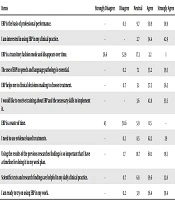
The mean figure of the attitude score of the SLPs was 46.97 (± 4.55). Also, responses related to attitudes of SLPs toward EBP are presented in Table 3. Based on the results, it was obvious that Iranian SLPs had positive and favorable attitudes toward EBP. As presented in Table 3, for example, Iranian SLPs agreed or strongly agreed with the following items: “EBP is the basis of professional performance” (89.8%), “I am interested in using EBP in my clinical practice” (97.3%), and “I need to use evidence-based treatments” (91.2%). Moreover, the participants disagreed or strongly disagreed that “EBP was a waste of time” (93.6%), and “EBP was a transitory fashion, which would disappear over time” (79.5%). Besides, the results indicated that SLPs with a postgraduate degree had higher attitude scores than SLPs with an undergraduate degree, and this difference was significant (P < 0.001) (Table 2).
Table 3.
SLPs’ Attitudes Toward EBP (N = 411)
| Items | Strongly Disagree | Disagree | Neutral | Agree | Strongly Agree |
|---|---|---|---|---|---|
| EBP is the basis of professional performance. | - | 0.5 | 9.7 | 50.9 | 38.9 |
| I am interested in using EBP in my clinical practice. | - | - | 2.7 | 54.4 | 42.9 |
| EBP is a transitory fashion mode and disappears over time. | 26.6 | 52.9 | 17.3 | 2.2 | 1 |
| The use of EBP in speech and language pathology is essential. | - | 0.2 | 7.1 | 53.2 | 39.5 |
| EBP helps me to clinical decisions making to choose treatment. | - | 0.7 | 5.1 | 57.5 | 36.3 |
| I would like to receive training about EBP and the necessary skills to implement it. | - | - | 3.6 | 42.8 | 53.5 |
| EBP is a waste of time. | 43 | 50.6 | 5.9 | 0.5 | - |
| I need to use evidence-based treatments. | - | 0.2 | 8.5 | 62.2 | 29 |
| Using the results of the previous researches findings is so important that I have a timeline for doing it in my work plan. | - | 1.7 | 18.7 | 60.1 | 19.5 |
| Scientific texts and research findings are helpful in my daily clinical practice. | - | 0.7 | 6.8 | 59.6 | 32.8 |
| I am ready to try on using EBP in my work. | - | 0.2 | 3.9 | 56.4 | 39.4 |
Abbreviations: EBP, evidence-based practice; SLPs, speech and language pathologists.
4.4. Use of Evidence
Table 4 shows the percentages of the SLPs’ responses related to the use of external and internal evidence for making clinical decisions. More than two-thirds of the SLPs often and always used their clinical experiences (69.3%) and the client’s needs and preferences (84.2%) as internal evidence. Moreover, more than half of SLPs often and always used opinions of colleagues (57.2%) and expert consultation (55.5%). In terms of external evidence, Iranian SLPs relied on textbooks and cybernetic communication paths (such as Telegram and WhatsApp) more than articles and workshops. Over 70% of the SLPs stated that they often or always used textbooks as external evidence. Furthermore, nearly 40% of the participants reported that they often or always used educational video or audiotapes, as well as Internet resources.
Table 4.
SLPs’ Use of Evidence Resources (N = 411)
| Items | Never | Rarely | Sometimes | Often | Always |
|---|---|---|---|---|---|
| My own clinical experience | 1 | 2.7 | 27 | 50.9 | 18.4 |
| Opinions of colleagues (speech-language therapists) | 0.7 | 7 | 35.1 | 46 | 11.2 |
| Expert consultation | 1.5 | 10 | 33.1 | 40.8 | 14.7 |
| Consultation with team members from other fields | 3.2 | 20.9 | 37.6 | 27.9 | 10.4 |
| Client’s needs and preferences | 0.7 | 3 | 12.1 | 54.2 | 30 |
| Workshops and continuing educational programs | 7.7 | 20.1 | 31.3 | 31.5 | 9.4 |
| Clinical guidelines | 3.7 | 12.2 | 34.9 | 39.4 | 9.7 |
| Textbooks | 1 | 4.7 | 22.2 | 48.6 | 23.4 |
| Educational video or audiotapes | 8.2 | 20.3 | 31.5 | 31.3 | 8.7 |
| Case reports articles | 11.7 | 31.2 | 33.4 | 19 | 4.7 |
| Randomized controlled trials or single-subject articles | 16.4 | 29.1 | 34.6 | 15.2 | 4.7 |
| Systematic review articles | 15.8 | 26.6 | 32.1 | 18.5 | 7 |
| Internet resources | 5.5 | 17.5 | 35.9 | 30.4 | 10.7 |
| Telegram groups and channels or other similar social networks | 6.5 | 13.2 | 26.9 | 34.4 | 19 |
Abbreviation: SLPs, speech and language pathologists.
5. Discussion
The present study was done to investigate the knowledge and attitude of Iranian SLPs about EBP and also to examine the extent to which they may use it using a valid and reliable tool. Since the field of speech and language pathology has a limited history in Iran, the findings of this study may be helpful for the adoption of EBP among Iranian SLPs. A score above 33 in the attitude section of the SLP-EBPQ indicates a good attitude toward EBP. Given that the mean score of Iranian SLPs participating in this study was higher than 33; therefore, the present study showed that SLPs in Iran had positive and favorable attitudes toward EBP. Through the studies on SLPs, similar findings were reported in previous studies regarding attitudes toward EBP (2, 16, 17, 20-23). For example, Zipoli and Kennedy (13) reported that SLPs, as members of the ASHA, had positive attitudes toward EBP, but they were more dependent on traditional sources for decision making than evidence-based sources. Vallino-Napoli and Reilly (24) reported that SLPs were aware of EBP and the great importance of the research. In another study, Alhaidary (2) reported that SLPs in Saudi Arabia had proper attitudes toward EBP. In two previous studies carried out among Iranian SLPs, Tahmasebifard et al. (16) and Tohidast et al. (15) mentioned that Iranian SLPs had positive attitudes toward EBP. These results are similar to other studies carried out among other healthcare professionals, such as nurses, physicians, occupational therapists, and physiotherapists (20, 21).
Our findings showed that Iranian SLPs did not have proper knowledge about EBP. These results in agreement with previous studies on the knowledge of SLPs toward EBP (15, 16, 25-27). For example, Alhaidary (2) reported that SLPs in Saudi Arabia did not have proper skills and knowledge about EBP. To increase and improve the adoption of EBP among SLPs, strong knowledge, and proper attitudes regarding EBP are essential (6). Thus, given the importance of acquiring appropriate knowledge in this field at universities, speech, and language pathology teachers are the most influential factors accordingly.
Moreover, teaching EBP to improve the competence of SLPs in this regard should be properly included in continuing educational programs. It should be noted that the knowledge of SLPs about EBP was investigated in previous studies using self-evaluation questions. However, we determined the knowledge of Iranian SLPs in the present study using multiple-choice questions. Also, the present study showed that Iranian SLPs, despite having a good attitude toward EBP, had limited knowledge about it. Thus, it appears that Iranian SLPs have not received proper training about EBP at universities and in various educational programs.
Our study revealed that Iranian SLPs relied on both internal and external evidence resources. However, the use of internal evidence was observed to be more common than external evidence among SLPs. Among external evidence resources, SLPs used articles less frequently compared with other resources; however, articles provide more up-to-date evidence. Zipoli and Kennedy (13) reported that SLPs, as members of the ASHA, were more dependent on traditional resources for decision making than evidence-based resources. Moreover, Alhaidary (2) reported that SLPs with a history of receiving education about EBP were more likely to use EBP in their clinical practice. Therapists can keep them up to date by studying the best resources, such as meta-analyses and systematic reviews (28). Identifying barriers and facilitators of Iranian SLPs can help them make greater use of best evidence resources in their clinical practice. It appears that further investigations are needed to find appropriate ways for the further adoption of EBP and its practice by Iranian SLPs. Besides, future studies should pay more attention to uncover barriers and facilitators concerning the use of EBP among SLPs.
5.1. Limitations
The present study had few unavoidable limitations, including the evaluation of the participants’ attitudes and practice using a self-assessment questionnaire. The knowledge scores of the participants in this study were determined using multiple-choice questions that did not have self-evaluation limitations. Since SLPs with more knowledge about EBP and history of practicing it may have participated in the present study, the respondents’ bias should be considered. Therefore, SLPs with less knowledge and practice about EBP may not have participated in the study.
5.2. Conclusions
The present study showed that Iranian SLPs had good attitudes toward EBP. Regarding the knowledge about EBP, the findings of the study showed that Iranian SLPs did not have proper knowledge about EBP. However, SLPs with a postgraduate degree had better knowledge in this regard compared with SLPs with an undergraduate degree. Further, the use of internal evidence resources was more common among Iranian SLPs compared with external evidence resources. It appears that Iranian SLPs should pay more attention to learn about EBP and give more importance to EBP activities. Finally, this study may indicate the status of EBP in the community of SLPs in Iran because it was conducted across the country and was not restricted to a certain city.