
1. Background
Cryotherapy has been used for the treatment of acute soft tissue injuries of the knee joint (1, 2). Cryotherapy reduces skin and muscle temperature, total tissue damage, metabolism, inflammation, pain, circulation, tissue stiffness, muscle spasm, and symptoms of delayed-onset muscle soreness (2). However, cooling the soft tissue also has some negative effects, including the reduction in nerve conduction velocity (NCV) (3). In addition, cooling the soft tissues can alter the biomechanical properties of the joint and surrounding soft tissue resulting in a greater lesion predisposition of the joint when the exercise is resumed (4). The potential negative effects of cryotherapy on proprioception and knee extensor muscle torque are unknown, despite several reports supporting its effectiveness.
Proprioceptive precision is the ability of individuals to sense their joint position of the limbs in the space (5, 6). Consequently, proprioception is an essential component of injury prevention and rehabilitation (4, 5), but it is often ignored with devastating consequences because proprioceptive deficits may be responsible for many acute ankle and knee injuries. Several techniques for clinically examining proprioceptive precision are described in the literature, including the joint position sense (JPS) (4, 6). JPS receptors are located in the joint capsule, muscles, tendons, ligaments, and skin to detect stimuli, such as pain, pressure, and movement (6). Therefore, their role is essential for sport and daily activities. Assessing the JPS is performed by how much the joint position differs from the target angle in the space (absolute error) (6, 7). Some studies have demonstrated that the repositioning error was increased after cooling the ankle (8, 9), knee joint, and hamstring muscle (2, 10). However, other studies have revealed that the JPS did not change after cryotherapy (4, 5). Recently, some studies have indicated that local cooling does not affect proprioceptive acuity of the healthy knee joint (11, 12); however, other studies have demonstrated that the application of crushed ice to the knee and shoulder has an adverse effect on knee joint repositioning during the descent phase of a small knee bend (13) and shoulder joint repositioning (14). Therefore, data regarding the effects of cryotherapy on the repositioning error has remained contradictory.
The knee extensor is one of the commonly injured muscles in athletes (5). The effect of cryotherapy on knee extensor muscle torque has been less studied (6). Despite the potential utility of cryotherapy after an acute injury, some studies have shown that cooling the skin reduces the isokinetic knee extensor and plantar flexor muscle torque (15-18), contractile properties, muscle power of triceps (16, 19, 20), and maximum handgrip strength (21, 22). Some studies have reported that the muscle torque can be increased after cooling (23, 24). However, in a recent study (2018), no change was reported in the knee isometric muscle torque after cryotherapy (12). On the other hand, other recent studies have revealed that Isokinetic peak torque values of the quadriceps diminish after cryotherapy application to the knee joint and are not fully recovered at 20 minutes post-application on the knee (18). To the best of the authors’ knowledge, the effect of cryotherapy on the knee extensor torque has remained controversial. In addition, there is no consensus on the effects of cryotherapy on the knee joint repositioning error.
2. Objectives
The study objectives were to (i) evaluate the effect of cryotherapy using an ice pack on the knee joint repositioning error and, (ii) evaluate the effect of cryotherapy on the knee extensor strength.
3. Methods
3.1. Study Design
This double-blinded controlled trial study was designed to investigate the effect of cryotherapy on the repositioning error and knee extensor strength. This study was approved by the ethical committee of the Semnan University of Medical Sciences (SUMS) (Ethics code: IR.SEMUMS.REC 1394.185).
3.2. Participants
A total of 40 participants (20 males and 20 females) who were healthy non-athlete were enrolled in the study between August 2016 and November 2016 from the student of SUMS and selected by convenience sampling method. Participants were recruited through posters displayed in the frequently visited areas of the university, and from the surrounding locality. Informed consent was obtained from each participant on the examination day. Sample size was calculated according to a previous relevant study by Almeida Lins et al. (4). They evaluated 30 participants (15 cases and 15 controls) to examine the effect of cryotherapy on knee joint proprioception. Therefore, to achieve an 80% power and a confidence level of 95% with an alpha level of P ≤ 0.05 as significant, and to increase precision and allow non-attenders (participants who they inevitably excluded from the study), 40 participants were randomly assigned following simple randomization procedures (computerized random numbers) to the experimental and control groups. The experimental group consisted of 20 healthy participants (10 males and 10 females, age: 22.975 ± 2.913 yrs, weight: 58.65 ± 6.515 kg, height: 164.65 ± 5.294 cm) and the control group included 20 healthy participants (10 males and 10 females, age: 22.6 ± 1.187 yrs, weight: 66.05 ± 9.08 kg, height: 162.65 ± 3.85 cm). The inclusion criterion was the age of 18 - 30 years. Exclusion criteria were (a) any pain or musculoskeletal disorders in the lower limbs, rheumatoid arthritis, a history of surgery or fractures in the lumbar spine or other bony structures, (b) allergy to the cooling or Reynaud’s phenomena, and the history of trauma to the knee joint or ligaments or meniscus injury (4), (c) any discomfort during cryotherapy, and (d) any pain or discomfort during the assessment protocols. The lack of performing any exercise at least one week before the intervention was considered for the participants.
This study was double-blinded research, in which the participants and analyzer were blinded to group assignment. In the control and experimental groups, a similar pack was used on the knee region; therefore, the participants were not aware of their groups.
3.3. Equipment
Maximal isotonic knee extensor torque and the joint position sense were evaluated using the Biodex IV Pro Dynamometer System (BDS) (Biodex System, USA). Skin temperature was assessed using the digital thermometer (Extech, Flair, USA). The cooling intervention was applied using the ice pack of 25 × 25 cm2 and the weight of 1 kg. A similar pack of 25 × 25 cm2 and the weight of 1kg was used for the control group.
3.4. Procedures
3.4.1. Cold Application
The participants were asked to sit at the table and extend the knees. The hip was positioned in 85 - 90 degree flexion, and the other limb resting on another chair in front of him to prevent any heat resistance from contacting the person with the chair (4). Two ice packs were placed on the quadriceps muscle and knee joint for 15 minutes, simultaneously. A strap was used to hold the position of the ice packs without any compression. To assess the participant’s skin temperature, the sensor of a thermometer was applied over the knee on the anteromedial aspect (4). The cooling pad temperature was fixed at 4°C. To maintain the temperature of the ice packs at 4°C, ice packs were used in coolers. Therefore, during 15 minutes of cold therapy, cold packs were regularly replaced with a new pack to keep the packet temperature constant. This replacement was carried out 3 - 4 times. The skin temperature was recorded at 5 and 15 minutes while applying cryotherapy, and after 30 - 60 minutes of the cryotherapy, the procedure was terminated (2, 10).
In the control group, the participants were asked to sit at the table, and the knees and hip joints were placed in the same positions as the experimental group. Then, two similar packs of 25 × 25 cm2 and the weight of 1kg were used at the quadriceps muscle and medial part of the knee joint for 15 minutes. A thermometer was used for the measurement of temperature at the anteromedial aspect of the knee joint. The skin temperature was recorded at 5 and 15 minutes during the procedure, and after 30 - 60 minutes, the pad was removed. To ensure that all steps are identical, the pack in the control group was replaced exactly as the experimental group for 3 - 4 times as mentioned for the experimental group.
3.4.2. Participant Testing
All participants attended one session at the isokinetic laboratory of the neuromuscular rehabilitation research center, where all muscle torque assessments were completed in the morning to minimize any potential influence of fatigue on the isokinetic measures. Participant demographic characteristics were first obtained in the assessment session (i.e., height, body mass, and training history). Before the intervention, all participants performed five minutes of warm-up on a stationary cycle at 11 - 12 (light) rate of perceived exertion on a 6 - 20 scale, where 6 denotes “no exertion” and 20 denotes “maximal exertion” (25). Then, participants were asked to perform dynamic stretching of the lower limbs. The dominant limb was used for all torque assessments. Dominance was determined as the “leg used to kick a ball.” Testing protocols were applied in the same order for both the control and the experimental groups.
3.4.3. Isotonic Maximal Voluntary Contraction of the Knee Extensors Using a Biodex Dynamometer System (BDS)
The protocol used for belt stabilized BDS has been explained previously (26). For the isotonic MVC of the quadriceps, participants were asked to have two warm-up trials. One minute after warm-up trials, participants were asked to perform the knee extension at a range of 90° of knee flexion through 10° of knee flexion. Isotonic extension torque test protocols were performed for two velocities of 30 (degree/second) and 120 (degree/second), three times with 30 seconds of resting between the two trials. Verbal encouragement was given during maximal effort exertions. Only peak torque scores were used for data analysis. Testing joint positions, stabilization, and position of the BDS were standardized for all participants. For the BDS assessment, participants were asked to sit on the table while their arms were placed close beside their trunk, with the knee in 90 degrees flexion, and the BDS was fixed using a belt on the participant’s distal leg anchored to the back of the chair (2). Dynamometer orientation was set at 90 degrees, and seat orientation was set at 90 degrees (26). If the pain or discomfort in and around the area where the force pad encountered the skin on the limb had been reported, the test was repeated.
3.4.4. Joint Position Sense Assessment Using Biodex System IV Pro Dynamometer.
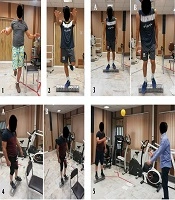
To measure the absolute repositioning error, participants were asked to sit on the table with the leg hanging about 40 cm from the ground (2). The sensors were attached to the bony landmarks as follows: the dynamometer's arm was positioned so that the axis of rotation was located just outside the lateral condyle of the femur, at a distance of 5 cm. The lower arm of the dynamometer was tied to the lower leg by a strip. In the beginning, the knee joint was placed at 90 degrees. Then, the participant's eyes were closed by blindfold. The knee was taken to the new range, holding for 5 seconds, and then returned to the starting position. Participants were asked to reposition the knee joint to the target positions (45° and 60°) three times. In the next step, the leg was passively moved by the dynamometer at an angular velocity of 5 degrees per second in the range of 90 to 10 degrees. Participants were asked to stop the movement once the knee joint reached the target angles (45° and 60°) (Figure 1).
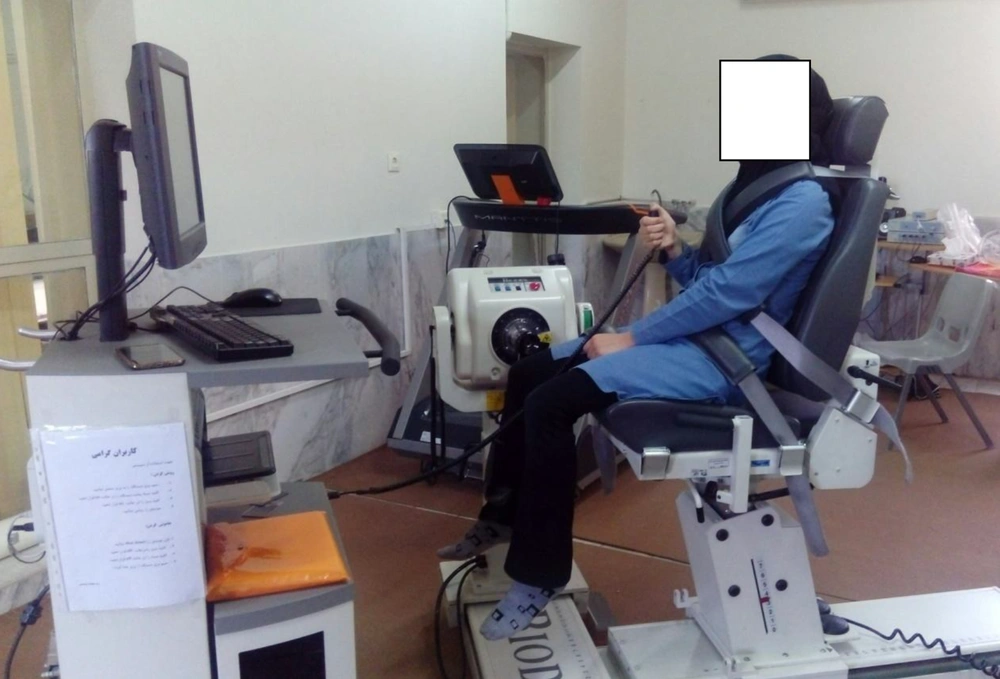
Figure 1.
Repositioning error testing
The test was repeated 3 times actively for each target angle as the passive test. Finally, the mean error of the measurements was recorded for further analysis.
The examination was performed in the morning from 9 PM to 12 PM. After warm-up and first testing protocols, the knee extensor torque, and knee JPS were measured 5, 30, and 60 minutes after the cryotherapy.
3.5. Statistical Analysis
All statistical analyses were performed using SPSS version 16.0 (SPSS Inc, IBM Corp., Armonk, NY, USA). The Kolmogorov-Smirnov (K-S) test was used to assess the normal distribution of variables. A two-way mixed analysis of variance (ANOVA) model was used to assess the effects of the group and time on the dependent variables.
4. Results
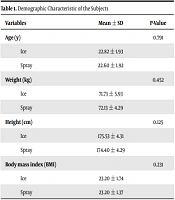
The baseline characteristics of the participants are depicted in Table 1. The normal distribution of the data was confirmed. An Independent t-test showed that there were no significant differences in the baseline values of the repositioning error and the knee extensor torque between groups (Table 1).
Table 1.
Demographic Characteristic of the Participants and Comparison Between Groups According to Their Baseline Values in Session 1
| Variable | Mean ± Std. Deviation | P-Value |
|---|---|---|
| Age (y) | 0.5 | |
| Experimental | 22.975 ± 2.913 | |
| Control | 22.6 ± 1.187 | |
| Weight (kg) | 0.1 | |
| Experimental | 58.65 ± 6.515 | |
| Control | 66.05 ± 9.08 | |
| Height (cm) | 0.1 | |
| Experimental | 164.65 ± 5.294 | |
| Control | 162.65 ± 3.85 | |
| BMI (kg/m2) | 0.2 | |
| Experimental | 21.711 ± 2.97 | |
| Control | 22.886 ± 2.87 | |
| Active | ||
| 45° | 0.3 | |
| Experimental | 45.2 ± 3.44 | |
| Control | 46.4 ± 4.11 | |
| 60° | 0.4 | |
| Experimental | 58.5 ± 3.46 | |
| Control | 57.1 ± 6.16 | |
| Passive | ||
| 45° | 0.3 | |
| Experimental | 46.3 ± 4.75 | |
| Control | 45.06 ± 4.15 | |
| 60° | 0.8 | |
| Experimental | 58.8 ± 3.21 | |
| Control | 58.5 ± 6.77 | |
| Isokinetic | ||
| 30° | 0.6 | |
| Experimental | 81.8 ± 5.02 | |
| Control | 83.6 ± 4.9 | |
| 120° | 0.2 | |
| Experimental | 43.3 ± 4.06 | |
| Control | 41.9 ± 4.9 |
In the experimental group, the skin temperature of the knee in the medial aspect before the cryotherapy was 27.3° ± 9°C, which decreased to 23.6° ± 1.1°C during cryotherapy (P ≤ .01), and gradually increased after the cryotherapy. In the control group, the skin temperature of the knee before the placebo cooling intervention was 26.3° ± 2.1°C. The skin temperature was found to be 27.1° ± 1.4°C during the intervention (P ≥ .05) (Table 2).
Table 2.
Changes in Skin Temperature, Before, During, and After Cooling
| Variables | Before Cooling | During Cooling | 30 min After Cooling | 60 min After Cooling | |
|---|---|---|---|---|---|
| 5 | 15 min | ||||
| Experiment | 27.3° ± 1.6° | 23.6° ± 1.1° | 23.1° ± 2.1° | 24.2° ± 1.3° | 26.5° ± 1.9° |
| Control | 26.3° ± 2.1° | 27.1° ± 1.4° | 26.1° ± 1.1° | 26.9° ± 1.0 ° | 26.7° ± 1.3° |
A two-way ANOVA with a Greenhouse-Geisser correction demonstrated that the effect of time and the interaction between the group and time were not significant for both active and passive repositioning error tests of the knee joint angles (Table 3).
Table 3.
The Effect of Time, Group, and the Interaction Between Time and Group Was Obtained from the Repositioning Error in Test Conditions. P-Values Were Calculated and Reported Before and After Cryotherapy.
| Condition | F | P-Value | Partial Eta Squared | Observed Power |
|---|---|---|---|---|
| Active | ||||
| 45° | ||||
| Time | 1.23 | 0.2 | 0.031 | 0.26 |
| Group | 0.52 | 0.4 | 0.1 | 0.01 |
| Time × group | 1.13 | 0.3 | 0.029 | 0.24 |
| 60° | ||||
| Time | 0.47 | 0.6 | 0.012 | 0.13 |
| Group | 0.06 | 0.8 | 0.002 | 0.05 |
| Time × group | 1.89 | 0.1 | 0.047 | 0.41 |
| Passive | ||||
| 45° | ||||
| Time | 1.39 | 0.2 | 0.035 | 0.33 |
| Group | 0.1 | 0.7 | 0.001 | 0.06 |
| Time × group | 0.49 | 0.6 | 0.013 | 0.14 |
| 60° | ||||
| Time | 1.56 | 0.2 | 0.039 | 0.33 |
| Group | 0.04 | 0.8 | 0.001 | 0.05 |
| Time × group | 0.33 | 0.7 | 0.009 | 0.10 |
A two-way ANOVA test was used to assess the effects of cryotherapy on the knee extensor's muscle torque for both velocities of 30°/s and 120°/s, and it was found that the effect of time and the interaction between the group and time on this parameter were significant (Table 4).
Table 4.
The Effect of Time and Group and the Interaction Between Them Obtained from the Isokinetic Knee Extensor Torque in Test Conditions. P-Values Were Calculated and Reported Before and After Cryotherapy.
| Condition | F | P-Value | Partial Eta Squared | Observed Power |
|---|---|---|---|---|
| Isokinetic knee extensor strength | ||||
| 30º/s | ||||
| Time | 2.830 | 0.049 | 0.069 | 0.580 |
| Group | 1.3 | 0.2 | 0.03 | 0.24 |
| Time × group | 5.414 | 0.004 | 0.125 | 0.868 |
| 120º/s | ||||
| Time | 3.992 | 0.015 | 0.095 | 9.947 |
| Group | 9.05 | 0.05 | 0.1 | 0.8 |
| Time × group | 5.186 | 0.004 | 0.120 | 12.922 |
Repeated measures ANOVA with a Greenhouse-Geisser correction demonstrated that the knee extensor's muscle torque increased significantly during both velocities of 30°/s and 120°/s, immediately, and 30 minutes after the cryotherapy in the experimental group (P ≤ 0.01) (Table 5).
Table 5.
The Mean ± Standard Deviation of the Variables Obtained from the Isokinetic Knee Extensor Torque in Test Conditions. P-Values Were Calculated and Reported Before and After Cryotherapy.
| Before | After (5 min) | Mean Difference | P-Value | After (30 min) | Mean Difference | P-Value | After (1 h) | Mean Difference | P-Value | |
|---|---|---|---|---|---|---|---|---|---|---|
| 30°/s | ||||||||||
| Cryotherapy | 81.8 ± 5.02 | 95.1 ± 3.2 | - 13.3 | 0.005 | 100.3 ± 4.1 | - 18.5 | 0.011 | 91.4 ± 3.892 | - 9.6 | 0.3 |
| Control | 83.655 ± 4.9 | 87.355 ± 5.8 | 3.7 | 0.6 | 89.255 ± 4.9 | 1.9 | 1.0 | 86.355 ± 3.9 | 2.9 | 1.0 |
| 120°/s | ||||||||||
| Cryotherapy | 43.3 ± 4.06 | 51.4 ± 4.2 | - 8.09 | 0.000 | 58.3 ± 3.4 | - 15.0 | 0.001 | 46.2 ± 3.2 | - 2.9 | 1.0 |
| Control | 41.9 ± 4.9 | 42.2 ± 5.1 | -0.3 | 1.0 | 40.1 ± 4.3 | 1.8 | 1.0 | 40.4 ± 4.1 | 1.3 | 1.0 |
5. Discussion
We aimed at evaluating the effects of cryotherapy on the repositioning error and knee extensor torque in healthy participants. Our results demonstrated that the repositioning error was not changed after the cryotherapy when active and passive flexions of the knee were asked. However, the knee extensor torque was improved from immediately to 30 minutes, after the cryotherapy was applied to the knee joint and returned to the pre-cryotherapy state after 60 minutes.
This study demonstrated that cryotherapy did not change the repositioning error of the knee joint. Ten studies have evaluated three definite joints after a cryotherapy intervention: the ankle (8, 9, 27, 28), knee (1, 2, 5, 29), and shoulder. (7, 29) Cryotherapy had a negative effect on JPS in four studies (1, 2, 8, 10, 28), whereas it had no effect on JPS in six studies (4, 5, 7, 9, 27). Our results are in line with the studies, which found no change in JPS after cryotherapy. In a study by Uchio et al. (2), the knee temperature was maintained at 21 - 23°C, and the JPS was also evaluated at different joint angles, including 5 - 25° of knee flexion. We used higher temperatures (about 23 - 25°C), and the repositioning error test was done at different knee angles, including 45° and 60°. One explanation for this difference in the results is that the cryotherapy used in our study was applied in the extended knee position, and the JPS was evaluated in different angles. Moreover, the joint afferents could be more stimulated in the middle range of the joint (45 - 60°). Therefore, the afferents, which are stimulated by cryotherapy, may not be involved as feedback sources for the JPS in the angles where the repositioning error was evaluated (i.e.45° and 60°). In addition, the effect of cryotherapy on proprioception is closely dependent on the skin temperature, at which it reduces after cryotherapy. Accordingly, lee et al. (16) reported that the conduction velocity of subcutaneous nerves is significantly reduced when the skin temperature is at approximately ≤ 25°C. Below the temperature of 15°C, nerve conduction can be failed. Our study showed that skin temperature after a 15-minute cooling intervention ranged from 23° to 25°C. These findings suggest that the cooling protocol for 15 minutes on the knee and anterior thigh did not induce the inaccuracy in the JPS. Therefore, cooling before exercise for about 23 - 25°C for approximately 15 minutes may not change peripheral feedback of the position sense while starting exercises.
Our study revealed that the cryotherapy increased the knee extensor torque immediately and 30 minutes after the cryotherapy was applied. Cooling the skin and a decrease in skin receptors activity after cryotherapy can facilitate motor neurons' excitability (30-32). Agostinucci et al. (33) and Arsenault et al. (34) demonstrated that the skin receptors have an inhibitory effect on the motor neuron pool and cooling of the skin increases the H-reflex amplitude. However, Sabbahi et al. showed that the effect of cooling on the motor neuron excitability returned after 30 minutes, and the facilitation of motor neuron pool was higher in the fast motor neuron (30, 31). It seems that the altered muscle reflexes and an increase in the motor neuron pool excitability caused by cooling of the skin might contribute to the increase in knee extensor torque in healthy knees. Thus, we think that cooling the skin for 15 minutes does not disturb the JPS and increases the knee extensor torque when the knee is extending at velocities of 30°/s and 120°/s.
Another issue is that after cryotherapy of the skin overlying the knee joint, although the JPS was not affected by cooling, the extensor torque increased. It can be stated that primary afferent fibers innervating muscle spindles provide the principal receptors for both JPS and kinaesthesia. Therefore, cooling does not seem to penetrate deeply into the muscle where the spindle receptors are located. Moreover, cutaneous receptors, including Ruffini endings, Pacinian corpuscles, and free nerve endings, have little responsibility for the JPS. Besides, cooling has a positive effect on muscle torque by affecting the motor neuron pool excitability through the skin receptors.
To the best of our knowledge, it is accepted that the increased torque of the knee extensors contributes to sports performance. The neurophysiologic and torque changes, which occur after cold application might be essential for athletes. We believe that cryotherapy for 15 minutes before exercise may not alter the JPS, associated with an increase of the muscle torque may enhance the athlete’s performance when exercise is resumed.
Our study had some limitations. We did not evaluate the injured knee or operated-on knee proprioception and knee extensor torque after the cryotherapy. In addition, different angles of repositioning error and knee torque testing were not included. Further studies are necessary to evaluate the effects of cold application to an injured or operated-on knee to demonstrate the effectiveness and safety of this therapy.
5.1. Conclusions
Cooling for 15 minutes made knee extensor torque higher and does not disturb the knee JPS. Therefore, 15 minutes of cryotherapy might be considered as an effective way to increase the knee muscle torque using the used method in this study.