1. Background
Patellofemoral pain syndrome (PFPS) is one of the most common knee injuries, especially during puberty and youth (1). It is described as patellofemoral pain, and its main characteristics are a vague and diffuse pain sensation in the peripatellar and retropatellar areas, without any specific pathology (2). Despite the prevalence of PFPS, the cause is not clear (3). Various risk factors have been suggested for PFPS (3-5). The vastus medialis obliquus, as a dynamic patellar stabilizer, helps to correct the direction of patellar movement in the range of 20 to 30° of final knee opening (6). Proprioception deficiency causes dysfunction of this muscle and external displacement of the patella (7).
Scientific evidence shows that injuries, diseases, pain, and muscle weakness cause changes in the proprioceptive afferents or changes in proprioceptive information that negatively affect performance (8). Proprioception includes any positional or motor information that is sent to the central nervous system by sensory receptors in the muscle, tendon, joint, and even skin (8, 9). Proprioception is involved in muscle reflexes, dynamic joint stability, and motor planning for neuromuscular control (9). Any factor reducing proprioception can lead to mechanical instability and ultimately damage the joint by increasing pressure on it. Ligament lesions and elements of joint are among the factors that can increase the risk of injury by negatively affecting proprioceptive function and impairing muscle coordination (10). Among the joints of the body, the knee joint is of particular importance due to its weight-bearing capacity and variety of movements. This joint, with the help of soft tissues and ligaments around it, provides movement and strength to the knee joint. Accuracy in the function of proprioceptive receptors in the knee joint is critical in maintaining proper function of this joint, especially during exercise (9). Impairment of joint proprioception alters motor coordination and programs, such as delaying the onset of contractile activity around the muscles around the joint, and by increasing the range of contraction of these muscles, it increases abnormal pressure and reaction forces, which cause sprain and strain in the joint (10).
Cryotherapy techniques are used as immediate, effective, and inexpensive interventions to reduce pain and swelling in many acute sports injuries (11). Decreased inflammation, blood flow, metabolism, tissue edema, muscle temperature, hypertension, and nerve conduction velocity are other known effects of cryotherapy (12). In many sports, acute injuries are the most common (89.6%), and the remaining percentage is allocated to injuries with gradual (chronic) and unknown onset (13). However, during acute sports injuries, injured athletes often return to competition after local cooling to reduce pain (11). Although athletes may be ready to return to competition after a local cooling, their motor function may be impaired, and they may be at risk for re-injury (11, 14). According to the results of research, the use of local cooling methods causes dysfunction of the joint proprioception (14, 15). Therefore, these factors can re-expose the athlete who returns to competition after cryotherapy to re-injury.
2. Objectives
Since limited research has been done on the effect of topical cooling on the knee position sense, the aim of this study was to evaluate the effect of topical cooling with ice and cold spray on the knee joint position sense of athletes with PFPS. The results of this study can help the correct use of cooling methods in sports scenes.
3. Methods
3.1. Participants
The present study is quasi-experimental research that was conducted in June 2019 at the Isar Mazandaran Sports Rehabilitation Academy. The statistical population of the present study consisted of male athletes aged 23 to 26 years with PFPS in the city of Sari. According to G. power software (G*Power, Franz Faul University of Kiel, Germany, version 3.1.9.2.) with an alpha type I error of 0.05 and a beta type II error of 0.15, based on the independent t-test, 30 subjects were selected as an available sample based on previous studies (16), and they were divided into two groups.
3.2. Inclusion and Exclusion Criteria
Inclusion criteria included: The age range of 23 to 26 years, no cold sensitivity, normal body mass index (ranging 20 to 25), no neuromuscular problems, no history of orthopedic injuries and no peripheral nervous diseases, no history of knee surgery for at least the past year, pre-patellar and retro-patellar pain and pain around the patella, and a positive Clark test.
3.3. Procedure
In order to evaluate joint position sense, 30° knee flexion of target reconstruction in the standing position was used. In order to measure the target angle and reconstruction angles, a system consisting of skin marking, digital imaging, and AutoCAD software were used. For marking, each person wore only sports shorts. Each person lied on a treatment bed in a supine position and was completely comfortable. Then four red skin markers in the shape of a circle with a diameter of 4 cm were placed on the test organ area in four points (17) (Figure 1). Finally, all test angles and reconstruction angles were calculated by AutoCAD (18).
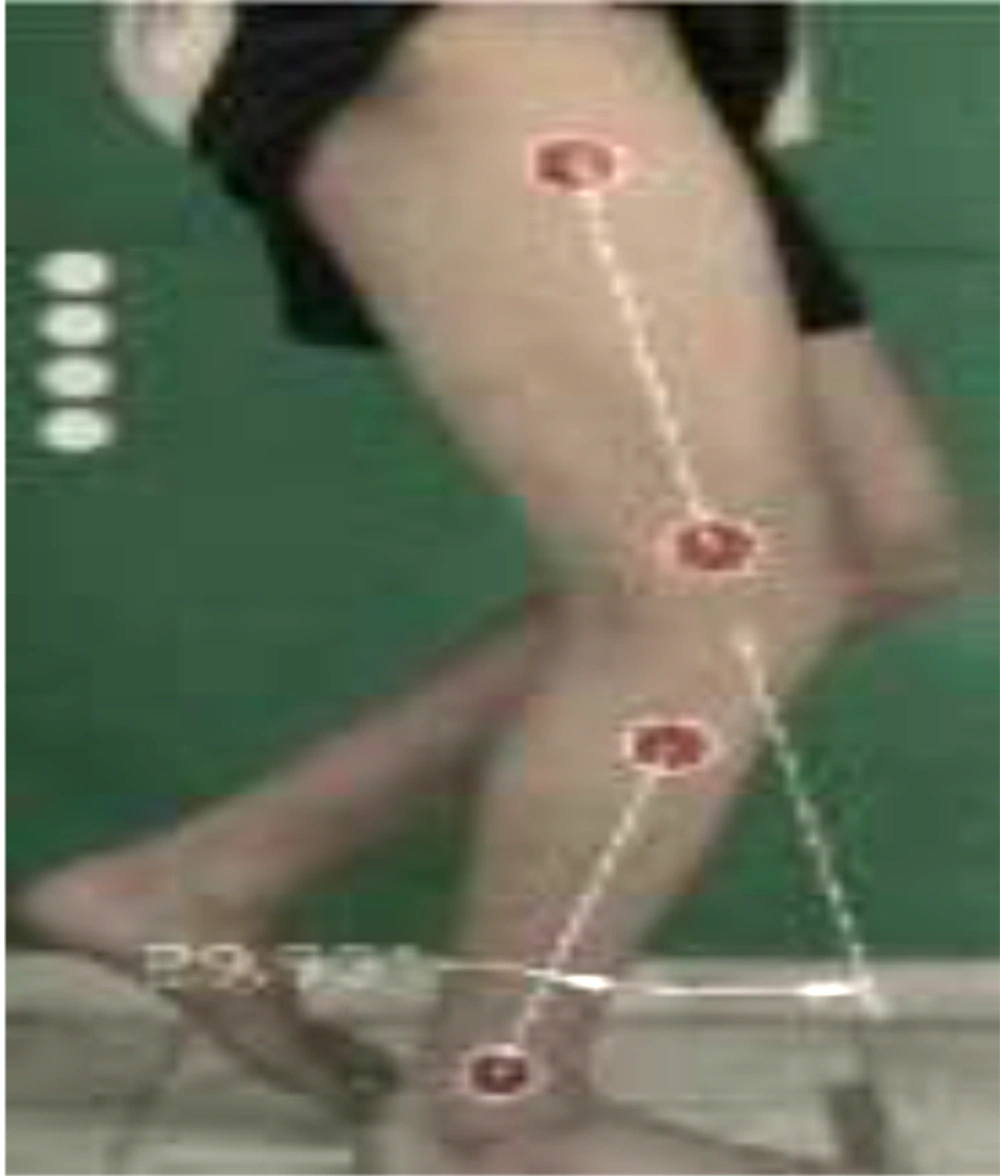
Figure 1.
Test angle and reconstruction angle calculated by AutoCAD software
A goniometer, at a 30° angle, was mounted on the wall behind the subjects so that only the examiner could see them. The subject was then asked to remain in a standing position, and at the beginning of the test, he was asked to lift the other foot from the ground just a little and to place his hand on his torso to prevent markers from hiding. In this study, reconstructing an angle of approximately 30° (while standing and weight-bearing) was used because in previous studies on anterior cruciate ligament injuries, the maximum proprioceptive deficiency was reported at this angle; in other words, in the terminal range of extension. In this study, an ice pack and a cold spray (DiscoTech spray made in Italy) were used to cool the peripatellar and retropatellar areas of the subjects. Ice bags and cold sprays are widely used in sports competitions due to their low cost and high availability. In addition, the ice pack has been shown to have the fastest effect on lowering soft tissue temperature compared to any other product (19). In the spray group, to create equal conditions in the application of cold spray, the distance of the spray to each person's knee was 30 cm, the angle of application of cold spray was 90° on the peripatellar area, and the duration of spray was 5 seconds for all subjects (Figure 2A) (20). The application of cryotherapy in the ice group was in the form of an ice pack that was placed on the knee for 10 minutes (21). The ice pack was used as a crushed ice pack that was placed on the subject's peri-patellar area for 10 minutes (Figure 2B), and then the test of position sense of the knee joint was performed immediately after removing the ice pack from the knee. Finally, the difference between the target angle (30° knee flexion) and the reconstruction angle was considered as an absolute error. Absolute error means the degree of deviation from the target angle in angular reconstruction of motion without taking into account the direction of deviation (+ or -).
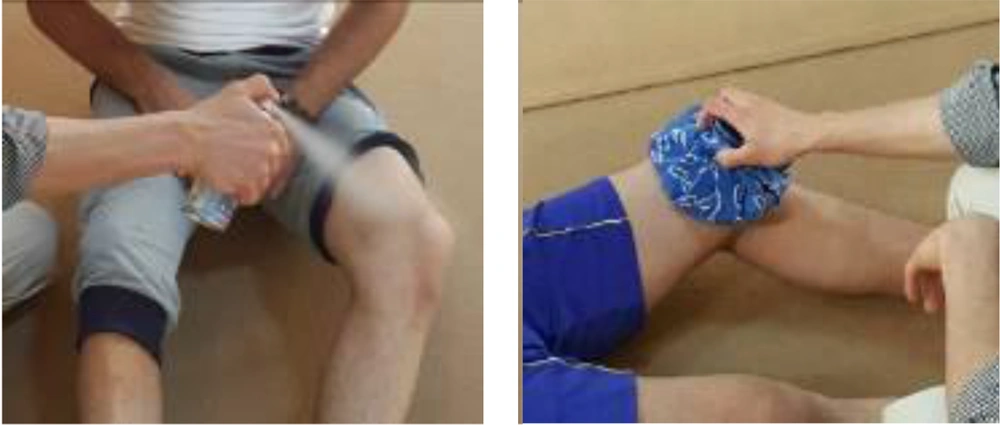
Figure 2.
(A) How to use cooling spray; (B) How to use an ice pack
3.4. Statistical Analysis
Descriptive analysis was performed on all the variables. The Shapiro-Wilk test was used to ascertain whether the data showed normal distribution. Paired Sample t-test analysis was used to assess the methods before and after the protocol administration. Also, independent t-test was used to compare the two cooling methods before and after the protocol administration.
Statistical significance set a priori at α < 0.05. The Statistical Package for the Social Sciences was used for all statistical analyses.
4. Results
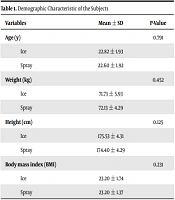
Subject group characteristics are summarized in Table 1. No significant differences were observed across groups for demographic characteristics of the subjects.
Table 1.
Demographic Characteristic of the Subjects
| Variables | Mean ± SD | P-Value |
|---|---|---|
| Age (y) | 0.791 | |
| Ice | 22.82 ± 1.93 | |
| Spray | 22.60 ± 1.92 | |
| Weight (kg) | 0.452 | |
| Ice | 71.73 ± 5.93 | |
| Spray | 72.13 ± 4.29 | |
| Height (cm) | 0.125 | |
| Ice | 175.53 ± 4.31 | |
| Spray | 174.40 ± 4.29 | |
| Body mass index (BMI) | 0.231 | |
| Ice | 23.20 ± 1.74 | |
| Spray | 23.20 ± 1.37 |
Table 2 presents the results of the paired t-test to compare the reconstruction errors of the 30° angle of knee flexion during, before, and after the interventions. The results of comparing the mean of the reconstruction error of 30° knee flexion angle in pre-test and post-test show that the reconstruction error value increased after spraying and ice pack application, which is statistically significant. In other words, there was a significant difference between the mean scores of the knee joint position sense test before performing the cooling protocol and after performing the cooling protocol using each of the cooling methods (cold spray or application of an ice pack for 10 minutes).
Table 2.
Mean ± SD of Ankle Joint Position Sense in Ice Bag and Spray Groups
| Variables | Pre-test | Post-test | Paired t-Test |
|---|---|---|---|
| Ice bag (°) | 0.67 ± 0.48 | 6.10 ± 0.97 | 0.001 a |
| Spray (°) | 0.80 ± 0.41 | 2.33 ± 0.43 | 0.001 a |
| Independent t-test | 0.426 | 0.001 a |
a Significant in P ≤ 0.05 level
The results showed that there was a significant difference between the two methods of cooling after the implementation of the protocol, while before the implementation of the protocol there was no significant difference between the two methods. This indicates that the value of target angle reconstruction error (30° knee flexion), after 10 minutes of applying the ice pack, was higher than the cooling spray value (Table 2).
5. Discussion
Analysis of the findings showed that the application of topical cooling using cold spray and ice on the knee joint of patients with PFPS had a significant effect on the position sense of this joint in the reconstruction of the target angle. In fact, the absolute error value of joint angle reconstruction in both cooling methods was significantly higher than pre-cooling or pre-test mode. Similarly, the value of reconstruction error of the target angle in applying the ice pack was significantly higher than the cold spray. It seems that long-term cooling (in this study, 10 minutes) using an ice pack compared to the cold spray, not only affects the skin receptors, but also affects the muscle spindles and joint receptors, which play a major role in affecting the joint position sense. Cold also appears to alter the conduction velocity of neural messages and the synaptic activity of the peripheral nerve, eventually leading to the inability of the nerve to conduct neural messages. As tissue temperature decreases, the conduction velocity of neural messages decreases with respect to the degree and duration of the temperature change. This is not the same in nerve fibers with different diameters, but research shows that cold has the greatest effect on myelinated fibers with small diameters, and it has the least effect on non-myelinated and large fibers. A-delta nerve fibers, which are small in diameter, have the greatest decrease in the conduction velocity of neural messages in response to a cooling agent (22). However, the afferent nerves that are responsible for transmitting proprioceptive information from the muscle spindle to the central nervous system are of type Iα and II, meaning that the fibers are large in diameter and they are responsible for the rapid transmission of information (23). Therefore, it is possible that these nerves are more affected when using ice, than using the cold spray, so the reconstruction error of the joint angle in the ice group was greater than that of the cold spray group (24).
The findings of the present study are consistent with the findings of Schmid et al., who reported significant long-term differences after cooling (11). Surenkok et al. also showed an impairment in the accuracy of the position sense of the knee joint after cooling with cooling pads and cold bags (14, 15). Oliveira et al., in a study that examined the effect of cold as an ice pack application on the position sense of the knee joint, reported that the error rate of reconstruction of target angle after the application of cold in the joint increased (25). The results of Chang and Wu showed that cryotherapy affects ankle joint proprioception and dynamic balance in people with chronic ankle instability (26). In addition, the findings of Alexander et al. showed that there is a significant reduction in the accuracy of reconstruction of the knee joint angle in the sagittal plane (27). The results of the present study are consistent with the reports presented in this category of research.
Someh et al. did not observe a significant difference in the joint position sense in the mid-dorsal and plantarflexion range before and after immersing the ankle in cold water (24). In addition, Sharma and Noohu observed that the ability to recognize the weight and accuracy of the hamstring proprioception did not change significantly after a 5-minute ice massage on the hamstring tendon (28). In this regard, the use of different cooling agents with different application durations can be one of the reasons for these contradictions. This is because when the tissue temperature decreases, the conduction velocity of neural messages will decrease depending on the degree and duration of the temperature change (29). On the other hand, since each modality of cold causes certain temperature changes, different temperature interventions can also affect the research results so that the crushed ice pack has the fastest effect on lowering the soft tissue temperature (19).
5.1. Conclusions
In conclusion, these findings indicate the negative effects of cold on the knee joint proprioception in these people. Since a decrease in proprioception can lead to a decrease in mechanical stability and thus increase the likelihood of joint injury, it is necessary to use different types of cooling for sports injuries carefully. Therefore, it is recommended to use crushed ice application to topical cooling to reduce the knee joint position sense. However, more research is required to provide more objective and accurate results.