
1. Background
In the technology-driven era, people depend on technology to carry out various daily activities, leading to many technology-related disorders such as technology addiction, technostress due to information overload, poor academic performance, anxiety disorders, and depression (1-3). In recent years, the way of communication has drastically changed due to easy access to the internet that brings technology-related addiction known as irrational use of social networking sites, which can be defined as web-services that permit individuals to communicate electronically through different sites for networking and microblogging. Literature suggests that generally, users have enrolled with online communities or sites to share their information, ideas, photos, personal messages, and other content such as videos (4). Globally, social media has often been used for socialization and is also recognized as a powerful tool for information (5, 6). Besides, different populations are using social media for different purposes, as it is also prevalent among students because they consider it an essential communication tool, especially in higher education. As reported in the middle east that overall, 90% of medical students were using social networking sites, but only less than 40% were used for educational purposes (7). Studies have shown a significant increase in social media use and have identified approximately 12% of the reported impact of social networking sites among individuals (8, 9). Indeed, an excessive use of social networking sites has been linked as a cause of many problems such as emotional state, health, and performance (10, 11). Excessive participation on social media through sites affects not only mental health but also reduces physical activity and increases the risk of developing non-communicable diseases such as diabetes, obesity, and hypertension (12, 13).
Preliminary studies have shown adverse effects on associated factors such as low grades and performance (1, 14). A study in the United States reported through the larger sample that students who spent more time on Facebook were significantly negatively associated with their total academic performance (15).
Similarly, non-academic activities and multitasking on social media also predicted negative growth in academic learning (16). Likewise, medical students in Saudi Arabia have also reported a negative impact of excessive enrolment in social networking on their academic grades (17). However, it is also noteworthy to understand and explore further factors such as preferences and motives behind the use of social networking sites as a key correlation (18) with other elements to identified the gaps and possible associations. Studies showed that individuals preferred to use social networking sites to expand their network and intrapersonal reasons (19). Enjoyment and usefulness are the most influential factors to motivate users (male and female) to continue the intentions to use social networking sites (20). However, perceived usefulness might affect the user’s intention concerning to using social networking sites (21, 22). In this context, it is essential to have insight into uses, preferences, and motives of social networking. This potential association will draw the attention of educators, researchers, and other community members to look at social networking sites from different perspectives. Thus, the primary aim of this study was to explore the association of social networking sites’ preferences and motives with mental well-being and academic performance of medical students in the College of Medicine at King Faisal University, Saudi Arabia.
2. Objectives
(1) To determine the usage of different social networking sites per frequency, hours, specific time, and how long have students been using them.
(2) To examine the intention of the users of social networking sites and their association with other factors.
(3) To investigate the association between demographic characteristics, academic performance and mental well-being of medical students.
(4) To study the association of students’ mental well-being with social networking sites’ preferences and motives as per gender.
(5) To examine the relationship between academic achievement and behavior toward social networking sites’ preferences and motives.
3. Methods
3.1. Sample and Procedure
A cross-sectional study was carried out among medical students at the College of Medicine in Al Ahsa, King Faisal University, Saudi Arabia. Sampling formula with an error of 5%, the level of significance (type 1 error) of 5%, and a 95% confidence interval indicated that 278 participants were needed and invited. However, a total of 167 students participated electronically. They were requested to fill online questionnaire via Google form as it was a valid approach for data collection (23). The Research Ethics Committee, College of Medicine, King Faisal University, Al Ahsa, Kingdom of Saudi Arabia, was provided ethical approval for the study with approval no (35). In addition, ethical concerns subjected to this study were informed consent, confidentiality, withdrawal rights, anonymity, privacy protection, and maintaining the dignity of all the participants.
3.2. Inclusion Criteria
Medical students, male and female age range 18 - 26 years, active and familiar with social networking sites.
3.3. Exclusion Criteria
Non-medical students over the age of 26, inactive and without knowledge of social networking sites.
3.4. Measures
3.4.1. Demographic Information
The researchers prepared a background sheet to gather personal information (age, gender, academic year, marital status, residency, family related information).
3.4.2. Social Media Networking
Based on the research questions that will be addressed and hypotheses in which the questionnaire needs to be designed, this study has developed a structured questionnaire to measure social networking sites’ usages, frequencies, types, and intentions of use. During the process, the researchers followed the following steps to gather the required information based on the target sample, such as selecting the content, identifying the question’s wording, suitability of questions order, format, and length of the questionnaire. An external expert opinion and peer feedback was also accounted for the face and content validity to assess the degree of relevance of each items. Besides, the final pre-test was done to make the necessary adjustment to the questionnaire. Overall, this section had six questions with multiple options. Cronbach’s alpha of the questionnaire was estimated as 0.86. The internal consistency coefficient of the scale in this current study was found suitable.
3.4.3. Warwick-Edinburgh Mental Well-being Scale
The Warwick-Edinburgh Mental Well-being Scale (WEMWBS) has 14 items and is answered based on a Likert-point scale (1 = none of the time; 5 = for all of the time). It has good content validity, high internal consistency (Cronbach’s alpha = 0.89), and high test-retest reliability in student samples. It demonstrated a high level of correlation with mental health and well-being parameters (24).
3.4.4. Academic Grade
The academic grade was measured based on grade point average (GPA) scores reported by medical students. Academic performance was categorized as “excellent” (GPA ≥ 90 - 95), “above average” (GPA < 80 - 89), “average” (GPA < 70 - 79), or “below average” (GPA < 60 - 69) or “fail” (GPA < 60 - 0) as per the norms of the college of medicine, King Faisal University, Saudi Arabia.
3.5. Statistical Analysis
Descriptive statistics were presented by frequency (n), proportions (%), mean, and standard deviation. The relationship between the dependent and independent variables was assessed using the chi-square test. We used the independent t-test, Mann-Whitney U test, or Kruskal Wallis test for skewed data to compare medical students’ mental well-being and socio-demographic characteristics. Normality tests were conducted using the Shapiro-Wilk test; a P-value ≤ 0.05 was considered skewed data. A P-value of < 0.05 (two-sided) indicated statistical significance. All data analyses were performed using the statistical package for social sciences, version 21 (SPSS, Chicago, IL, USA).
4. Results
Demographical information of the participants is presented in Table 1, the common age group was 21 - 22 years (49.1%) with females slightly more (56.9%) than males (43.1%). Concerning the academic years, approximately one-third of them (34.7%) were in the third-year, followed by first-year (23.4%) and fourth year (21.6%). The majority of students were single (92.8%) and mostly living inside Al Ahsa (92.8%). Concerning the occupational status of parents, the majority of the mothers were not working (68.3%), whereas it was the opposite of fathers, as most of them were working (73.1%). The most common academic grade was very good (42.5%), followed by excellent (35.3%) and good (18.6%).
Table 1.
Demographic Characteristics of Medical Students (n = 167)
| Study Variables | No. (%) |
|---|---|
| Age group (y) | |
| 18 – 20 | 50 (29.9) |
| 21 – 22 | 82 (49.1) |
| 23 – 25 | 35 (21.0) |
| Gender | |
| Male | 72 (43.1) |
| Female | 95 (56.9) |
| Academic year level | |
| First year | 39 (23.4) |
| Second year | 23 (13.8) |
| Third year | 58 (34.7) |
| Fourth year | 36 (21.6) |
| Fifth year | 07 (04.2) |
| Intern | 04 (02.4) |
| Marital status | |
| Single | 138 (82.6) |
| Married | 29 (17.4) |
| Residence | |
| Inside Al Ahsa | 155 (92.8) |
| Outside Al Ahsa | 12 (07.2) |
| Mother occupational status | |
| Working | 53 (31.7) |
| Not working | 114 (68.3) |
| Father occupational status | |
| Working | 122 (73.1) |
| Not working | 45 (26.9) |
| Academic grade | |
| Fail | 03 (01.8) |
| Acceptable | 03 (01.8) |
| Good | 31 (18.6) |
| Very good | 71 (42.5) |
| Excellent | 59 (35.3) |
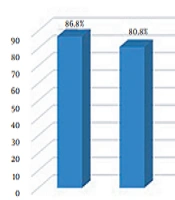
Behavioral characteristics of all-year medical students toward social networking sites’ preferences and motives were explained in Table 2. It was found that the use of Facebook was significantly higher among medical students, specifically among the 3rd-year. At the same time, the intern was significantly less users of Facebook. For the reason of using social networking sites, we have found that the 3rd-year level had significantly more usage of social networking sites for fun whereas the intern had the least. Figure 1 reveals the most commonly cited motive was about knowledge and education (86.8%), followed by staying in touch with family, friends, and relatives (80.8%) and fun (78.4%) while making a new friend (15%) was the slightest motive.
Table 2.
Social Media Behavior by Academic Year Level, 1st Year (n = 39), 2nd Year (n = 23), 3rd Year (n = 58), 4th Year (n = 36), 5th Year (n = 7), and Intern (n = 4) in the Types of Social Networking Sites and Motives for Using the Social Networking Site a
| Variables b | 1st Year | 2nd Year | 3rd Year | 4th Year | 5th Year | Intern | P-Value c |
|---|---|---|---|---|---|---|---|
| Type of social networking site | |||||||
| Google scholar | 10 (25.6) | 06 (26.1) | 25 (43.1) | 17 (47.2) | 04 (57.1) | 01 (25.0) | 0.203 |
| YouTube | 33 (84.6) | 20 (87.0) | 49 (84.5) | 32 (88.9) | 07 (100) | 04 (100) | 0.814 |
| 29 (74.4) | 15 (65.2) | 38 (65.5) | 29 (80.6) | 06 (85.7) | 03 (75.0) | 0.578 | |
| 10 (25.6) | 06 (26.1) | 28 (48.3) | 25 (69.4) | 06 (85.7) | 02 (50.0) | 0.001 d | |
| 39 (100) | 22 (95.7) | 56 (96.6) | 35 (97.2) | 07 (100) | 04 (100) | 0.863 | |
| 33 (84.6) | 15 (65.2) | 40 (69.0) | 33 (91.7) | 06 (85.7) | 03 (75.0) | 0.073 | |
| Snapchat | 32 (82.1) | 16 (69.6) | 39 (67.2) | 32 (88.9) | 07 (100) | 03 (75.0) | 0.093 |
| Reason for using social networking site | |||||||
| Stay in touch with family, friends, and relatives | 30 (76.9) | 18 (78.3) | 49 (84.5) | 29 (80.6) | 07 (100) | 02 (50.0) | 0.404 |
| Knowledge and education | 35 (89.7) | 17 (73.9) | 50 (86.2) | 33 (91.7) | 07 (100) | 03 (75.0) | 0.311 |
| Spend time | 21 (53.8) | 10 (43.5) | 32 (55.2) | 25 (69.4) | 04 (57.1) | 03 (75.0) | 0.447 |
| Fun | 31 (79.5) | 12 (52.2) | 47 (81.0) | 32 (88.9) | 05 (71.4) | 04 (100) | 0.021 d |
| Make new friend | 05 (12.8) | 02 (08.7) | 07 (12.1) | 08 (22.2) | 01 (14.3) | 02 (50.0) | 0.254 |
| For relaxation | 19 (48.7) | 11 (47.8) | 31 (53.4) | 22 (61.1) | 02 (28.6) | 02 (50.0) | 0.681 |
a Values are expressed as No. (%).
b Variable with multiple responses
c P-value has been calculated using the chi-square test.
d P < 0.05

Figure 1.
Motives for using social networking sites.
The participants’ demographic variables and academic performance associated with mental well-being show that the middle age group (21 - 22 years) was significantly lower than the other age group. We also observed that males had significantly higher mental well-being when compared to females, while the intern also showed substantially better mental well-being than their counterparts. In contrast, marital status, residence, and academic grade did not differ from mental well-being significantly (Table 3).
Table 3.
Statistical Association Between Mental Well-being and the Socio-Demographic Characteristics of Medical Students (n = 167)
| Factor | Mental Well-being (Mean ± SD) | t/F Test | P-Value |
|---|---|---|---|
| Age group (y) a | F = 2.479 | 0.050 b | |
| 18 – 20 | 49.9 ± 7.64 | ||
| 21 – 22 | 46.7 ± 8.36 | ||
| 23 – 25 | 48.1 ± 7.20 | ||
| Gender c | t = 2.574 | 0.003 d | |
| Male | 49.7 ± 7.96 | ||
| Female | 46.6 ± 7.78 | ||
| Academic year level a | F = 3.066 | 0.025 b | |
| First year | 50.7 ± 6.36 | ||
| Second year | 48.1 ± 8.41 | ||
| Third year | 47.7 ± 8.07 | ||
| Fourth year | 44.7 ± 8.08 | ||
| Fifth year | 46.7 ± 5.06 | ||
| Intern | 55.7 ± 12.0 | ||
| Marital status c | t = 0.526 | 0.433 | |
| Single | 48.1 ± 8.04 | ||
| Married | 47.2 ± 7.85 | ||
| Residence c | t = -1.719 | 0.218 | |
| Inside Al Ahsa | 47.7 ± 7.87 | ||
| Outside Al Ahsa | 51.7 ± 8.98 | ||
| Academic grade a | F = 0.573 | 0.851 | |
| Fail | 44.0 ± 5.29 | ||
| Acceptable | 43.0 ± 15.6 | ||
| Good | 47.4 ± 9.21 | ||
| Very good | 48.2 ± 7.61 | ||
| Excellent | 48.4 ± 7.55 |
a P-value has been calculated using the Kruskal Wallis test.
b P < 0.05
c P-value has been calculated using the Mann-Whitney U test.
d P < 0.01
As shown in Table 4, the mental well-being of female Instagram users was significantly better as opposed to non-Instagram users. For the motives of using social networking sites, the mental well-being of females who had a reason to spend time, make a new friend, and for relaxation were significantly lower when compared to those with other reasons. In contrast, those females, who used social networking sites to stay in touch with family, friends, and relatives showed significantly better mental well-being. Males also showed a significant difference for relaxation as motives for using social networking sites.
Table 4.
| Variables | Mental Well-being | |||||
|---|---|---|---|---|---|---|
| Male (n = 72) | Female (n = 95) | |||||
| Mean ± SD | t | P-Value | Mean ± SD | t | P-Value | |
| Type of Social networking site c | ||||||
| Google scholar | 50.8 ± 8.03 | 0.784 | 0.699 | 46.6 ± 7.97 | 0.038 | 0.760 |
| YouTube | 49.4 ± 8.22 | -1.042 | 0.283 | 46.5 ± 7.92 | -0.395 | 0.536 |
| 49.3 ± 7.83 | -0.690 | 0.526 | 47.2 ± 8.23 | 1.380 | 0.249 | |
| 49.1 ± 8.37 | -0.556 | 0.604 | 46.8 ± 7.78 | 0.250 | 0.617 | |
| 49.7 ± 7.95 | -0.350 | 0.979 | 46.5 ± 7.81 | -0.568 | 0.484 | |
| 49.6 ± 8.31 | -0.187 | 0.962 | 47.3 ± 7.59 | 2.426 | 0.007 d | |
| Snapchat | 50.0 ± 7.97 | 0.387 | 0.553 | 46.6 ± 7.37 | -0.042 | 0.690 |
| Reason for using social networking sites c | ||||||
| Stay in touch with family, friend and relatives | 50.5 ± 7.21 | 1.608 | 0.080 | 47.6 ± 7.52 | 2.621 | 0.044 e |
| Knowledge and education | 50.1 ± 7.71 | 0.753 | 0.545 | 50.1 ± 7.71 | 0.753 | 0.070 |
| Spend time | 48.9 ± 7.82 | -0.958 | 0.317 | 45.0 ± 7.45 | -2.448 | 0.026 e |
| For fun | 49.5 ± 7.38 | -0.361 | 0.659 | 46.2 ± 7.90 | -1.185 | 0.169 |
| Make new friend | 46.6 ± 9.94 | -1.420 | 0.191 | 43.1 ± 5.59 | -1.855 | 0.043 e |
| For relaxation | 48.0 ± 8.96 | -1.957 | 0.048 e | 44.7 ± 8.18 | -2.625 | 0.007 d |
a P-value has been calculated using the Kruskal Wallis test.
b P-value has been calculated using the Mann-Whitney U test.
c Variable with multiple answers.
d P < 0.01
e P < 0.05
Table 5 indicated that the females were significantly more Instagram users and Snapchat users than males. It was also observed that females were significantly more of having excellent academic grades than males. Other behaviors related to using social networking have no significant relationships compared to males and females.
Table 5.
Relationship Between Male (n = 72) and Female (n = 95) Among the Academic Grade and the Behavior of Medical Students Toward Social Networking Sites a
| Factor | Male | Female | P-Value b |
|---|---|---|---|
| Type of social networking site c | |||
| Google scholar | 23 (31.9) | 40 (42.1) | 0.180 |
| YouTube | 63 (87.5) | 82 (86.3) | 0.823 |
| 47 (65.3) | 73 (76.8) | 0.100 | |
| 27 (37.5) | 50 (52.6) | 0.052 | |
| 69 (95.8) | 94 (98.9) | 0.192 | |
| 48 (66.7) | 82 (86.3) | 0.002 d | |
| Snapchat | 49 (68.1) | 80 (84.2) | 0.014 d |
| Reason for using social networking sites c | |||
| Stay in touch with family, friends, and relatives | 58 (80.6) | 77 (81.1) | 0.936 |
| Knowledge and education | 60 (83.3) | 85 (89.5) | 0.245 |
| Spend time | 39 (54.2) | 56 (58.9) | 0.537 |
| For fun | 52 (72.2) | 79 (83.2) | 0.089 |
| Make new friend | 11 (15.3) | 14 (14.7) | 0.923 |
| For relaxation | 37 (51.4) | 50 (52.6) | 0.874 |
| Academic grade | 0.048 d | ||
| Good or below | 18 (25.0) | 19 (20.0) | |
| Very good | 36 (50.0) | 35 (36.8) | |
| Excellent | 18 (25.0) | 41 (43.2) |
a Values are expressed as No. (%).
b P-value has been calculated using the chi-square test.
c Variable with multiple responses.
d P < 0.05
5. Discussion
This study reveals several significant findings to the body of knowledge. First, nearly all medical students were browsing social networking sites daily (98.2%) and regularly doing this for every hour (77.2%). Moreover, more than half of them (57.5%) were using social networking sites in both night and day and most students were using networking sites for than two years (97.6%).
WhatsApp, YouTube, Instagram, and Snapchat were frequently-visited sites by medical students. Second, the essential motive for using social networking sites was knowledge and education, staying in touch with family, relatives, friends, and fun. Third, age, sex, and academic year were the associated factors of mental well-being. Besides, female’s motives to connect with family, friends, and relatives through social networking sites showed significantly better mental well-being. Lastly, females were more Instagram and Snapchat users and having excellent academic grades than male students.
An in-depth analysis of social networking usage shows that medical students were using more WhatsApp (97.6%), followed by YouTube (86.8%) and Instagram (77.8%). In comparison, Google scholar (37.7%) was the least visited, and the third-year students significantly used Facebook more than the rest. Our results are similar to the finding that shows WhatsApp and Snapchat are the most commonly used sites by medical students (25). On the contrary, it has also been highlighted in some studies that YouTube, Facebook, and Twitter were the most used sites by the medical students, not WhatsApp; thus, the differences reflecting the transformative changes according to demand and interest.
Similarly, 3rd-year students significantly used social networking sites for fun compared to other motives, as studies have shown that variations in usage and motives generally determine social networking behaviors (26). Another study revealed that 75% of medical and allied health science students used social networking sites for general purposes and 20% for sharing academic information (27). The finding of mental well-being with the socio-demographic characteristics of medical students showed that the mental well-being of the middle age group (21 - 22 years) was significantly lower than the other group. Similar to our findings, psychological distress among students was reported as double in the initial years (28), and significant risk factors for medical students are emphasized as high stress, academic stress, physical problems, and personal matters (29). In addition, results also highlighted that males had significantly higher mental well-being when compared to females and interns also showed substantially better mental well-being than their counterparts. Other studies also reports that psychological distress may vary by gender and different course levels (30).
Study findings also depict that female Instagram users had significantly better mental well-being; unlike previous results that revealed violence and taunting are being observed as a new trend in youth while using social networking sites (31). However, our finding is compatible with the results indicating that intention-based behavior, positive interaction; social presence through social networking sites could enhance the well-being of students. Greater self-esteem, reduced loneliness, and life satisfaction were also reported as associated factors with social networking sites (32). In addition, our study concept is also supported by the “hyper-personal model”, which reflects that selective self-presentation positively enhances the impression of the self (33) and is more favorable to mental health. As a whole, positive online activities may be beneficial for emotion regulation.
Further, the results show females who used social networking sites to spend time, make a new friend, and for relaxation were significantly lower than those females who used social networking sites to stay in touch with family, friends, and relatives showed significantly better mental well-being. Potential mental health benefits of social networking sites were reported as socialization, improved relationships, self-esteem, connection, and learning (34). On the contrary, the male also showed significantly less mental well-being for relaxation as a motive for using social networking sites.
Besides, the finding on the association between males and females concerning academic grade and the behavioral characteristics toward social networking sites reveals that compared to males, the females were significantly more Instagram and Snapchat users and had substantially more excellent academic grades than male students. However, as per literature, the relationship between the use of social networking sites and its association with academic grades is contradictory. A significant contribution to students’ motivation in learning reported a positive relationship between social networking sites and their academic performance (35). Other studies, on the contrary, found no effect, as few studies have shown the association to a minor extent (17, 35, 36). Moreover, it has suggested that educational institutions could benefit their students with the combination of pedagogy and online social networking as this connection was found to be positive with cognitive, affective, and skill-based learning outcomes (36).
5.1. Conclusions
The study concludes that intrinsic and extrinsic factors such as intention, purpose, satisfaction, pleasure, and usefulness play a significant role in students’ continuous use of social networking sites. As social networking technology allows users to build and enhance relationships between close people and strangers to show their existence and approach one another. Possibly, this pleasure-oriented method promotes mental health and associated factors such as users’ well-being or grades to some extent. However, the role of personality, level of motivation, gender perceptive, lifestyle changes, effects on physical health, and other maladaptive behaviors resulting from social networking sites involvements should be a concern and gripping points for further research.
5.2. Limitations
This study has some limitations. One of the important limitations of this study is the data collection. The small sample size collected from a single college and convenient sampling was employed by focusing only on medical students, which may increase the possibility of errors. Participants from other colleges who may use social networking sites for different intentions and through various alternatives may have increased the generalizability of research findings to represent different socio-economic backgrounds and diversity of interest, which this study lacks.