1. Background
Today, gymnastics is a professional discipline that involves scientific principles. It has frequently been observed that most of the coaches resort to various training methods to improve athletes’ explosive power but they waste the gymnast energy and only obtain little development. Stretching is one of the main components of gymnastics (1, 2). Stretching is often done in various forms during gymnastics warm-up phase and during other training activities (3). One of the most common stretching types in gymnastics is static stretching. In this regard, a study showed that static stretching protocol resulted in a significant decrease in vertical jump, by about 8.2%, in female gymnasts (4).
Another alleged effect of stretching exercises is decline of balance and reaction time that destroys quick decision during physical activities and places the body in risky situations (5). The quality of balance control in gymnastics is often used for assessing lower extremity function (6), and is important in athletes (5). In addition to developing the power and performance of athletes, balance also prevents sports injuries in sports activities (7). Therefore, if the athlete obtains good balance, they could maintain good performance and achieve the best results while preventing the occurrence of sport injuries (5, 8). Vault is also one of the abilities of gymnastics in which several factors such as sprinting, motion control and balance are important and a significant relationship exists between these factors and better performance on vault (9). Siatras et al., (2003) reported that speed performance before jump on the vault is significantly reduced by static stretching (10).
However describing any activities that affect the balance of athletes can also be effective on their performance. One of these activities that has already been highly regarded by academic and sporting communities is stretching exercises and discussion of short and long term effects of these exercises on balance (11, 12). Although, today various studies have been done on stretching practices before training and competitions, yet they have had contradictory results (11, 13). Some of these studies showed that static stretching can reduce muscle performance during dynamic exercises (14, 15).
Bakhtiary et al., (2013) in a study examined the acute and long-term effects of static stretching on static and dynamic balance in healthy non-athlete girls. Results of this study revealed that the dynamic balance index in the long stretch group, compared to the acute stretching group and the control group, declined (16). Behm et al., (2004) showed that static stretching exercises with a long-term period reduces balance indexes and reaction time in athletes and puts them at risk of sports injuries (17). These results were rejected by another study, and the researchers showed that 45-second stretching exercises didn't impair balance performance while, even 15-second stretching exercises improved balance performance and decreased postural instability in athletes as well (11).
There are a few studies for comparison of the short term and long-term effects of warm-up protocols on the index of gymnast balance and performance, and according to these studies there is inconsistency in the functional effects of the stretching exercises before sport activities. It seems that the beneficial effects of stretching exercises is currently facing a big challenge.
2. Objectives
Gymnastics is a sport in which static stretching is used in all practice sessions and could include short and long term stretches, so the present research attempted to examine the acute and long-term effects of static warm-up protocol on index of static and dynamic balance and the balance whip performance in skilled gymnast girls.
3. Methods
This research was carried out at the center for research on neuromuscular rehabilitation of Semnan University of Medical Sciences.
This study involved a group of 16 trained females between the ages of 9 and 13 with three years of gymnastic training experience (Table 1).
Table 1.
Mean and Standard Deviation of Registered Indexes
| Group | Number | Age (years) | Height (cm) | Weight (kg) | BMI (kg/m2) |
|---|---|---|---|---|---|
| All subject | 16 | 9.62 ± 1.45 | 130.12 ± 12.37 | 28.58 ± 8.60 | 16.48 ± 2.49 |
| GW | 8 | 9.5 ± 1.51 | 130.5 ± 15.35 | 28.3 ± 8.83 | 16.17 ± 1.57 |
| SW | 8 | 9.75 ± 1.48 | 129.75 ± 9.58 | 28.86 ± 8.97 | 16.78 ± 3.25 |
Also, the participants first filled out a consent form and then completed the health questionnaire. The participants who had a joint disease, rickets, and bone fractures in the past year and diseases affecting the results of the research were excluded.
3.1. Evaluation of Balance in Static and Dynamic Conditions
Since the functional purpose of this study was to compare acute and long-term effects of stretching exercises on balance indices and generalizing the effects to sports activities and since sports activities are also done with open eyes, thus to assess the balance indices, all static and dynamic balance tests were performed with open eyes. Body sway in static standing was measured using the force plate. The Kistler force plate was used for analysis of subjects’ balance in the static and dynamic status. Kistler Force Plate Model B9286 was controlled through Qualisys and is able to measure the center of pressure on three axes, X, Y and Z.
People were asked to stand barefoot in a flat and natural position while their hands were loosely hanging. The legs were placed so that they were symmetrically placed on either side of the center line of the balance plate. The subjects were also asked to put their hands besides their body, and while focusing and looking forward avoid talking, laughing, deep breathing and switching legs. The tests were conducted randomly under the following conditions:
1. Eyes: Open (open eyes: while the person looked at an eye-level target at a distance of about 1.5 m).
2. The area under the candidate’s feet when standing: hard - soft (soft surface: a piece of high density sponge with a thickness of 10 cm on the force plate, while no sponge was used for hard surface condition). The hard surface was used to evaluate static balance and the soft surface to evaluate dynamic balance.
3. Standing posture: on the dominant leg (standing position on one leg: the inner edge of the up foot touched the inner side of the front leg and fingers of the medial malleolus). Four tests of static and dynamic balance included: Static Double-leg Eye Open (SDEO), Static Single-leg Eye Open (SSEO), Dynamic Double-leg Eye Open (DDEO), and Dynamic Single-leg Eye Open (DSEO).
These tests were randomly selected for each individual to prevent the effects of fatigue on the individual in test conditions. The test was done with three replications. To assess the body balance system on the force plate, the ground reaction forces or foot pressure center were used (18). It is noteworthy to mention that were introduced as, center of antroposterior pressure (CAPP), center of mediolateral pressure (CMLP), anteroposterior path length (APPL), mediolateral path length (MLPL).
3.2. Balanced the Vault Test
Depending on the requirements of the competition phase, the gymnast was required to perform one or two vaults from the Table of Vaults; run distance was a maximum of 25 meters.
- The vault began with a run, an arrival and take-off from the board with two feet, from either a forward position or backward position. All vaults must have been performed with repulsion from both hands off the vaulting table (19, 20).
- The gymnast was required to properly use the "safety collar" supplied by the Organizing Committee for round-off entry vaults (19).
Description:
Arms bent
Small pike in body
Large pike in body
Excessive Pike (90° or more)
Body tucked
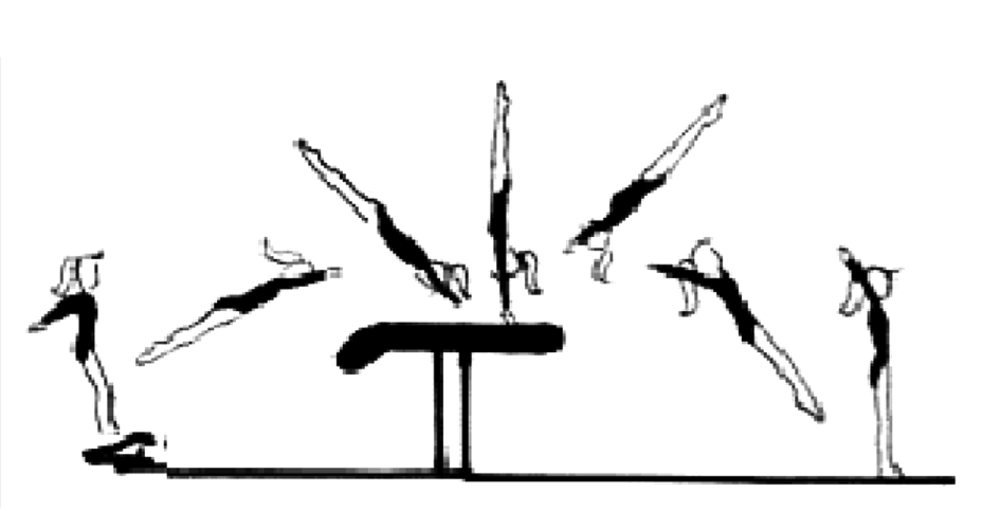
Figure 1.
Schematic of Balance the Vault
For evaluation of how to score and balance the vault, two experienced referees certified by the Board of Gymnastic evaluated and scored the vault performance of participants. Each subject performed the activity two times and her highest score was recorded. The first referee recorded the points related to start, how to run and hit the board, and the second referee recorded the points related to the first flight, the second flight and the separation of the hand from vault and landing, and the mean scores of both referees showed the score of each subject out of 10 (21).
3.3. Acute Warm Up Protocols
3.3.1. General Warm Up Group
In this protocol, subjects performed a general warm-up including ten minutes of jogging and warming up neck joints, scapula, elbows, wrists, torso, thighs, knees and ankles.
Warm-up with static stretching group:
Static warm-up protocol involved a general warm-up and static stretching on the ground. In this protocol, the subjects first performed the general warm-up, including 10 minutes of jogging and warm-up of joints, neck, scapula, elbows, wrists, torso, thighs, knees and ankles. Also static stretching involved 13 stretching exercises carried out in two consecutive 15-second sets and switching time and a five-second preparation for the next exercise. From a total of 13 exercises, one was related to the stretch of the body, four exercises related to stretching the upper limbs, five exercises related to lower limb stretch, and three to stretch of the trunk. After a two-minute rest, the subjects were pre-tested (Table 2) (22).
Table 2.
Static Warm-Up Stretches
| Exercise | Week | |||
|---|---|---|---|---|
| 1 | 2 | 3 | 4 | |
| Crossover reverse lunge | 2 set | 2 set | 3 set | 3 set |
| 15 sec | 15 sec | 15 sec | 15 sec | |
| Each side | Each side | Each side | Each side | |
| One Half Locust Exercise | 2 set | 2 set | 2 set | 3 set |
| 15 sec | 15 sec | 15 sec | 15 sec | |
| Each side | Each side | Each side | Each side | |
| The Straddle | 2 set | 2 set | 3 set | 3 set |
| 15 sec | 15 sec | 15 sec | 15 sec | |
| Both side | Both side | Both side | Both side | |
| Short Adductor Stretch | 2 set | 2 set | 2 set | 3 set |
| 15 sec | 15 sec | 15 sec | 15 sec | |
| Both side | Both side | Both side | Both side | |
| Gluteus Stretch | 2 set | 2 set | 3 set | 3 set |
| 15 sec | 15 sec | 15 sec | 15 sec | |
| Each side | Each side | Each side | Each side | |
| Abdominal Stretch | 2 set | 2 set | 2 set | 3 set |
| 15 sec | 15 sec | 15 sec | 15 sec | |
| Both side | Both side | Both side | Both side | |
| Latissimus Dorsi Stretch | 2 set | 2 set | 3 set | 3 set |
| 15 sec | 15 sec | 15 sec | 15 sec | |
| Both side | Both side | Both side | Both side | |
| Standing Outer Hip Stretch | 2 set | 2 set | 2 set | 3 set |
| 15 sec | 15 sec | 15 sec | 15 sec | |
| Each side | Each side | Each side | Each side | |
| Triceps Stretch | 2 set | 2 set | 3 set | 3 set |
| 15 sec | 15 sec | 15 sec | 15 sec | |
| Each side | Each side | Each side | Each side | |
| Standing Biceps | 2 set | 2 set | 2 set | 3 set |
| 15 sec | 15 sec | 15 sec | 15 sec | |
| Both side | Both side | Both side | Both side | |
| Standing Toe | 2 set | 2 set | 3 set | 3 set |
| 15 sec | 15 sec | 15 sec | 15 sec | |
| Both side | Both side | Both side | Both side | |
3.3.2. Chronic Warm-Up Protocols
Frequency and duration of participation ranged from three days per week and 30 minutes per session. Subjects also performed a general warm-up, including 10 minutes of jogging and warming up neck joints, scapula, elbows, wrists, torso, thighs, knees and ankles. The participants in the four-week static warm-up protocol with the appropriate intensity and duration as the using different protocols exercised.
3.3.3. Statistical Analysis
To determine the difference between the various stages of sampling, after examining the normality of data distribution using the Shapiro-wilk test, Analysis of Variance (ANOVA) with repeated measures and Bonferroni post hoc test at the significance level were used (P ≤ 0.05).
4. Results
Results examined the acute and chronic effects of static stretching protocol on static and dynamic balance in four static conditions; double-legs and single-leg and dynamic double-leg and single-leg and the performance of balance whip.
Acute and long-term effects of static warm-up on balance indices, SDEO, SSEO, DDEO, DSEO and balance whip performance:
The results of analysis of variance with repeated measures showed that SDEO in the static warm-up group in the long term compared to the acute phase of balance indices of CAPP (F (13,2) = 2.87 and P = 0.37), CMLP (F (13,2) = 2.54 and P = 0.29), APPL (F (13,2) = 2.77 and P = 0.47) and MLPL (F (13,2) = 2.63 and P = 0.41) had no significant difference with static double leg. Also, Bonferroni test results showed no significant difference in indices of balance CAPP, CMLP, APPL and MLPL among the groups in the acute and long-term phases for static balance double legs (P ≥ 0.05).
The results of analysis of variance with repeated measures showed that SSEO in static warm-up group in the long term compared to the acute phase for balance indicators of CAPP (F (13,2) = 1.73 and P = 0.40) and APPL (F (13,2) =3.47 and P = 0.46) static with single leg has no significant difference; but in the indices of static balance of CMLP (F (13,2) = 4.41 and P < 0.001) and MLPL (F (13,2) = 4.41 and P < 0.001) with single leg showed no significant difference (Table 3). Bonferroni post hoc test results also showed no significant difference in indices of balance of CAPP, APPL and among groups in the acute and long-term static balance with single foot (P ≥ 0.05) but a significant difference was observed between the control and static in balance indices CMLP and MLPL (P = 0.001).
Table 3.
Mean and Standard Deviation of Recorded Parameters of Static Warm-Up at Different Stages of Measurement for SSEO and DSEO
| Variable | Test | Balance Indices | GW (Mean ± SD) | SW (Mean ± SD) | P Value |
|---|---|---|---|---|---|
| SSEO | Pre-Test | CAPP | 7.38 ± 2.06 | 6.51 ± 2.25 | 0.615 |
| CMLP | 9.89 ± 3.94 | 9.15 ± 3.32 | 0.576 | ||
| APPL | 36.69 ± 11.69 | 30.49 ± 12.40 | 0.843 | ||
| MLPL | 60.58 ± 28.74 | 48.79 ± 24.58 | 0.916 | ||
| 4-weeks after of activity | CAPP | 6.60 ± 1.92 | 5.73 ± 0.57 | 0.407 | |
| CMLP | 8.44 ± 2.84 | 6.35 ± 1.29 | 0.001a | ||
| APPL | 32.32 ± 10.55 | 26.50 ± 2.81 | 0.466 | ||
| MLPL | 41.70 ± 15.14 | 33.34 ± 6.03 | 0.001a | ||
| DSEO | Pre-Test | CAPP | 7.64 ± 2.00 | 8.85 ± 2.92 | 457 |
| CMLP | 9.08 ± 2.08 | 9.93 ± 2.90 | 0.459 | ||
| APPL | 35.14 ± 10.02 | 41.74 ± 15.97 | 0.854 | ||
| MLPL | 50.72 ± 16.35 | 50.02 ± 14.24 | 0.985 | ||
| 4-weeks after of activity | CAPP | 7.42 ± 2.26 | 8.56 ± 3.51 | 0.615 | |
| CMLP | 8.36 ± 3.11 | 8.71 ± 2.19 | 0.001a | ||
| APPL | 34.94 ± 12.07 | 43.25 ± 18.36 | 0.001a | ||
| MLPL | 39.35±13.61 | 43.98 ± 11.59 | 0.001a |
Abbreviation: CAPP: Center of anteroposterior pressure, CMLP: Center of mediolateral pressure, APPL: Anteroposterior path length, MLPL: Mediolateral path length, SSEO: Static dingle-leg eye open, DSEO: Dynamic single-leg eye open, GW: general warm-up, SW: static warm-up.
aA Significant (P < 0.001) difference was observed between warm-up treatment mean values.
The results of analysis of variance with repeated measures showed that DDEO in the static warm-up in the long term compared to the acute phase for indices of balance of CAPP (F (13, 2) =1.81 and P = 0.19), CMLP (F (13, 2) =1.85 and P = 0.09) APPL (F (13, 2) = 2.67 and P = 0.98) and MLPL (F (13, 2) =1.79 and P = 0.28) was not significantly different. Bonferroni post hoc test results also showed no significant difference in indices of CAPP, CMLP, APPL and MLPL among the groups in the acute and long-term phases for dynamic double leg balance (P ≥ 0.05).
The results of analysis of variance with repeated measures showed that DSEO in the static warm-up group in the long term compared to the acute phase for CAPP (F (13, 2) = 4.60 and P < 0.001), CMLP (F (13, 2) = 8.79 and P < 0.001), APPL (F (13, 2) = 6.06 and P < 0.001) and MLPL (F (13, 2) = 2.81 and P < 0.001) caused a significant reduction in DSEO (Table 3). Bonferroni post hoc test results also showed no significant differences in CAPP, CMLP, APPL and MLPL among the groups in the acute and long-term phases for dynamic balance with single leg (P = 0.001).
The results of analysis of variance with repeated measures showed that balance-whip performance with static warm-up in the long-term compared to the acute phase was significantly decreased (F (5,5) = 19.02 and P < 0.001) (Table 4). On the other hand, Bonferroni post hoc test results showed that balance whip performance with static warm-up protocol in the long-term significantly decreased compared to the general warm-up protocol in the acute phase (P = 0.001) (Figure 2).
Table 4.
Mean and Standard Deviations of Fitness Performance Following Assessment
| Variable | Test | GW (Mean ± SD) | SW (Mean ± SD) |
|---|---|---|---|
| Balance The Vault | Pre-test | 6.43 ± 0.77 | 7 ± 1.03 |
| Acute after of activity | 6.43 ± 0.66 | 6.57 ± 1.03 | |
| 4-weeks after of activity | 6.10 ± 0.33 | 5.83 ± 0.86a |
Abbreviations: GW, general warm-up; SW, static warm-up.
aA Significant (P < 0.001) difference was observed between warm-up treatment mean values.
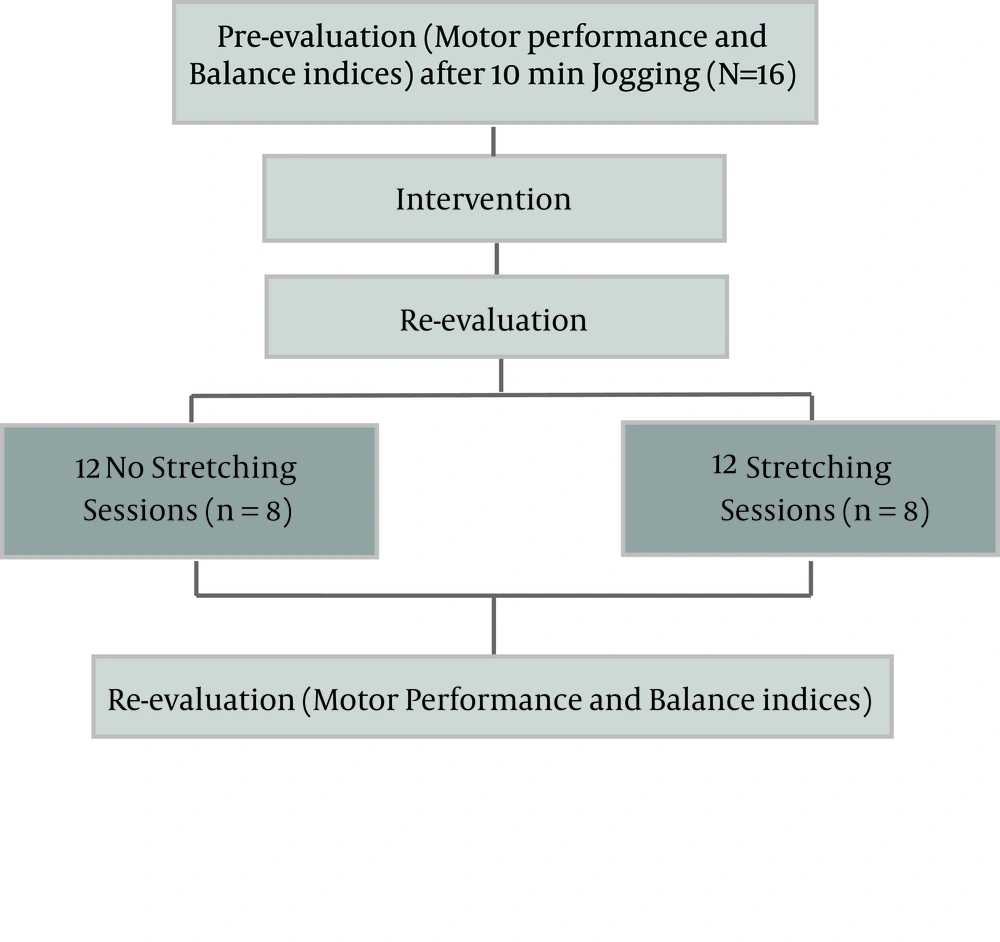
Figure 2.
Schematic Diagram of the Experimental Design
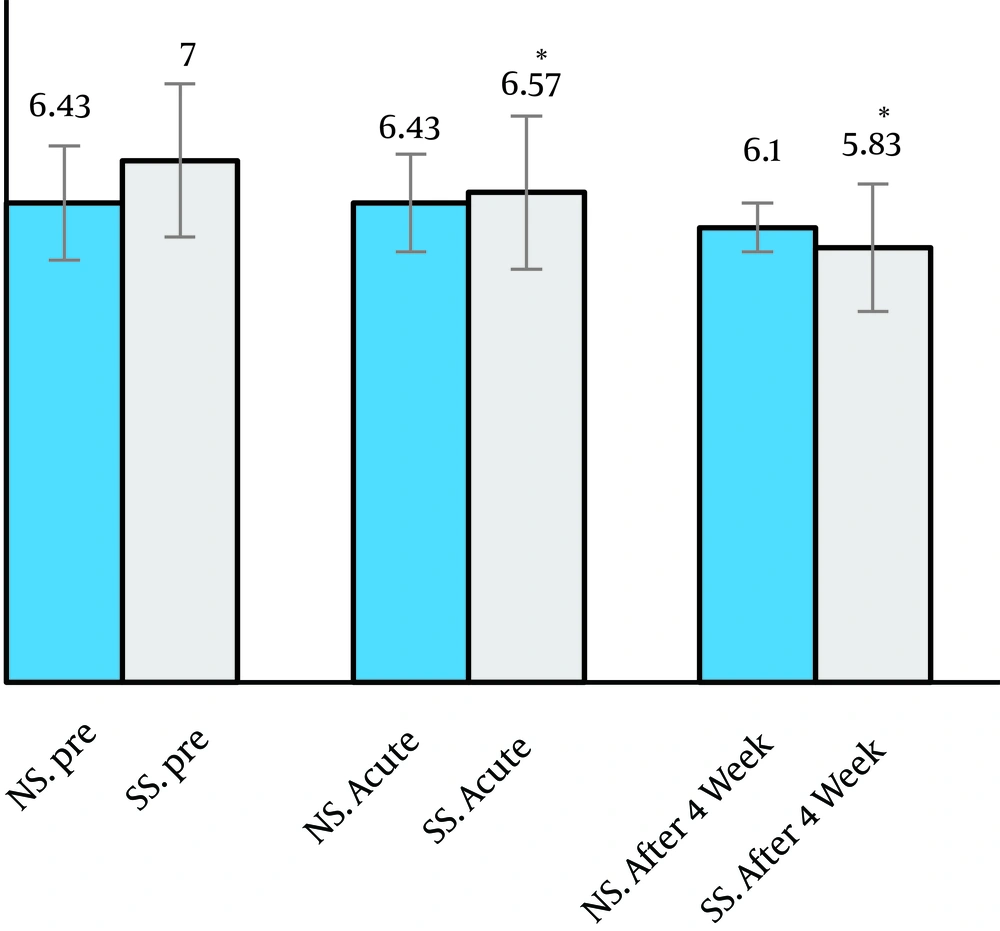
Figure 3.
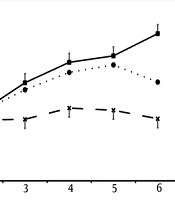
*Significant difference with jog; NS = No stretch, SS = Static Stretch.
5. Discussion
The aim of this study was to investigate the short and long-term effects of static warm-up protocol on static and dynamic balance in skilled female gymnasts. The results of static and dynamic balance with static warm-up protocol showed that the balance whip performance with static warm-up protocol in the long-term compared with the acute phase were significantly decreased in the groups. Static double leg balance with static warm-up protocol in the acute and long-term phases in balance indices showed no significant difference between the groups. However, the static single-leg balance for mediolateral path length and mediolateral center of pressure, in the static warm-up group resulted in significant increase in the long-term phase than the acute phase. Static warm-up protocol significantly reduced the dynamic single leg balance in the long term compared to the acute phase, yet no significant difference was observed in the dynamic balance with static warm-up protocol in the other indices.
The importance of balance during sports activities plays an important role in the prevention of sports injuries. Studies have shown that poor performance balance during physical activity significantly increased the risk of associated ankle and knee injuries (8).
In line with the results of this study, Donti et al. (2014), using different acute and long-term static stretching protocols, examined the basic levels of flexibility and vertical jump in gymnasts. They came to the conclusion that with increasing duration of stretching, range of motion of joints and jump performance will be significantly reduced (23). Also Ozengin (2011), observed no significant effect on vertical jump performance after different warm-up protocols (general warm-up and warm-up with static stretching) in gymnasts (24).
The lower amount of performance improvement experienced by the static stretching group is consistent with the results of past research studies. Although the exact mechanisms by which static stretching may have elicited less improvement in performance is not known, two explanations provided by Evetovich et al. (2003) may apply (25). In this study, it was suggested that decreases in torque performance might be a result of lower levels of musculotendinous stiffness, or a reduced ability to recruit motor units.
The first suggestion might apply to the present research, because it is possible that the static stretching led to less musculotendinous stiffness. According to Wilson et al. (1994), greater stiffness in the musculotendinous unit allows for more effective production of force in the contractile component of the muscle (26). This is due to the length of the muscles and how rapidly the contractile system can generate force. Also, a stiffer musculotendinous system should conceivably improve the initial transmission of force, facilitating the initial rate of force development (26). Therefore, if static stretching reduced the stiffness of the musculotendinous system, the length of the muscle and velocity conditions would be less optimal for force production. In addition, the initial transmission of force and the initial rate of force development would be reduced.
The second explanation for decreases in force production was that they were a result of a reduced ability to recruit motor units, which could be a function of an inhibited neural mechanism. One potential neural mechanism that may be inhibited is myoelectric potentiation.
A few studies in the recent years have examined the long-term and acute effects of stretching exercises on balance (11, 17). The findings of this research are confirmed by the study of Behm et al., which showed that static stretching exercises with a prolonged period disrupted the balance control and increased the time of action and reaction (17). Costa et al. also showed that short-term static stretching has no harmful effect on the balance (11). Bakhtiary et al. in a study conducted on 45 healthy non-athlete girls reported that warm-up using longer static stretching causes yield loss and balance in athletes (16). Also Adelsberger et al. reported that using 10 minutes routine stretching has a more efficient impact on improving stability and balance than 10-minute general warm-up (27). Probably one of the reasons for the difference in the results of the conducted studies is the acute and chronic time spent on the static stretching. The duration varies from 15 to 120 seconds in different researches and this causes several physiological reactions in the body and can cause performance degradation or improvement.
Another potential neural mechanism that could have been inhibited by static stretching is the acute response of muscle proprioceptors like the Golgi tendon organs and low threshold pain receptors. According to Moore (1984), the Golgi tendon organs respond to muscle tension by initiating a reflex inhibition in the muscle and its synergists. In a similar fashion, the stimulation of pain receptors located in the muscles and tendons can inhibit muscle activation by inhibiting the responsible neural pathways (28). The static stretches used in the present study were done two times for duration of fifteen seconds. The participants were stretched to a point of discomfort that was painful yet tolerable; thus, the stretching could have produced a level of inhibition that diminished the number of available motor units. This limitation in available motor units could have resulted in limited power production in performance balance of the vault. Unfortunately, the results of this experiment permit only speculative explanations.
There were some limitations that must be taken into account when interpreting the results of the present study. One such limitation was the small number of participants in each warm-up group (N = 8). Another limitation was history effects, which are outside events that take place during the course of the experimental treatment. For example, there were inconsistencies in testing conditions that could not be prevented. Such inconsistencies included participants being tested at different times of the day, at different times in the conditioning program. Therefore, history was a possible threat to the internal validity of the present study.
Another limitation of the present study was the degree to which the results may be generalized. The sample consisted of skilled female athletes in gymnastics. Therefore, it is possible that the findings are not generalizable to other types of female athletes, male athletes, and non-athletes.
Further research could determine whether the results of this study could be replicated with a larger sample size, different populations of athletes, and more consistent testing conditions. Also, future research should be geared toward establishing the underlying mechanisms involved in the decrements in performance that result from static stretching. Future research may also focus on the effect of static stretching on other skills, and examine the effectiveness of dynamic warm-ups on other athletic skills.
According to the results of this study and to avoid possible sports injuries during sports activities, it is suggested that static stretching before extreme dynamic exercise to be limited to short-term stretch. Further studies in this area will help determine the best dynamic and static stretches according to the type of exercise and sports, and also according to the balance control factor in the prevention of sports injuries.
5.1. Conclusion
Study of the results showed that long-term static stretching could improve static balance with single leg in gymnastics but also results in impaired dynamic balance and performance of the balance-whip, which can endanger the individual when performing sport activities. Further studies are needed to clarify the specific role of static stretching in different sports activities.