
1. Background
Warm-ups are a popular and widely accepted practice as pre-exercise routine for athletes to maximize performance (1). Most warm-up protocols are designed to affect the temperature related mechanisms that induce metabolic and cardiovascular changes which provide ergogenic benefits (1-3). Traditionally, a typical warm-up has long consisted of a submaximal element, to increase core and/or muscle temperature to optimal levels, followed by bouts of static, ballistic or proprioceptive neuromuscular (PNF) stretching (4-6). More recently, athletes and coaches have started incorporating dynamic stretches as part of their structured warm-up routines (3, 5, 7, 8). Findings from studies assessing the acute effects of various warm-up techniques that incorporate stretching routines are usually unclear, contradictory and predominantly based on individual experiences as opposed to scientific evidence (1). Therefore, the outcome of performance is highly dependent on the type of stretching method utilized as part of a warm-up.
Studies incorporating some form of ballistic, PNF and/or static stretching during warm-up have generally found no benefit in many human performance measures (8-11), although PNF stretching has shown to improve human performance when performed either after or without exercise (12-14). A convincing body of more current research shows that many human performance variables, muscle flexibility and the prevention of muscle injury are positively associated with dynamic stretching as part of a structured warm-up (2, 3, 15-17). Several studies have reported that dynamic stretching shows improvements in lower body strength/power (11.7%) (6), upper body strength/power (3.4%) (8), vertical jump performance (10.7%) (18, 19), and agility (2.2%) (8) using dynamic stretching. Short-term anaerobic performance (< 6 seconds) or singular sprints (10 - 20 m), also display significant increases in performance (1.1% - 1.6%) (20-25). Nevertheless, some reports in the literature have found some human performance variables to be negatively affected with dynamic stretching (25-28). The contradictions in findings have been attributed to numerous aspects such as: the duration of stretch, the intensity of stretch, the muscle group being stretched and the type of contraction (4, 5, 9).
In team sports, the capability of producing the greatest short-term performance over a number of high-intensity runs (< 6 seconds) with small recovery intervals (< 60 seconds) between bouts is a fundamental fitness component (29-31). It has been proposed as being one of the most critical elements of the result of a match in team-sports (29, 32, 33). Studies have previously investigated dynamic stretching effects on the ability of performing repeated sprints (8, 21, 34, 35), although they have mainly focused on static stretching effects (16, 36) or a combination of both (37). Findings have consistently reported that repeated-sprint performance decreases when static stretching is included in the warm-up, even in combination with dynamic stretching (10, 26, 27). The large differences in repeated-sprint protocols, warming strategies and training status of subjects make comparisons between studies in the literature difficult. These differences contribute to the lack of well-controlled studies conducted available in the literature. Few studies have looked at establishing how different volumes of dynamic stretching affect repeated-sprint performance. Turki et al. (25) found 1 and 2 sets of dynamic stretching to have a detrimental effect on a single 20-m sprint performance, while 3 sets were beneficial. However, studies looking at repeated-sprint performance conducted by Ishak et al. (8) and Turki-Belkhiria et al. (21) also using 20-m distances did not find improvements in sprint performance when performing different volumes of dynamic stretching or a dynamic stretching protocol of a longer duration (8-week), respectively.
It is worth establishing whether a linear repeated-sprint protocol in a population of well-trained, familiarized individuals yields the same results. It is believed that a well-controlled study incorporating 30-m repeated sprints as opposed to 20-m repeated sprints could enhance the possibility of finding changes due to increased fatigue elements in a longer distance. Numerous studies have focused on the duration, the mode of exercise and the intensity of the warm-up, but relatively few studies have looked at the recovery interval separating the warm-up from the actual warm-up exercise performed (5, 20, 37). Findings from Behm and Chaouachi (5) reveal that longer durations of dynamic stretching could provide the best results for performance enhancement. Considering the effects of different volumes of dynamic stretching on repeated-sprint performance is not concrete, and previous findings are conflicting. Therefore, determining how many sets of dynamic stretches are required to improve 30-m linear repeated-sprint performance is of great interest (10, 38-41).
2. Objectives
No information can be found on how many sets of dynamic stretching should be used during warm-ups to improve linear repeated-sprint performance in team sport athletes over 30-m. More research is required before definitive conclusions can be made. Therefore, integrating various volumes of dynamic stretching within a warm-up protocol can help clarify whether a specific dynamic stretching volume is most beneficial to enhance and maintain sprint times and potentially reduce fatigue. Thus, this study aimed to examine the effect of different volumes of dynamic stretching protocols on 30-m linear repeated-sprint performance.
2.1. Hypothesis
We hypothesized that no significant differences will be established between different volumes of dynamic stretching in 30-m linear repeated sprints in team-sport players.
3. Methods
3.1. Selection and Description of Participants
Using statistical power software (G*Power version 3.1.10, Germany), the sample size required for this study was estimated to be fourteen. This estimation was based on detecting a meaningful difference of 5% in repeated-sprint performance variables, a statistical power of 0.8 and an alpha level of 0.05 (Morris et al. 2009) between dynamic stretching conditions.
Fifteen male University team-sport players were recruited for the study [age (mean ± SD) 22.1 ± 0.6 year, stature 166.9 ± 6.6 cm, body mass 67.5 ± 8.0 kg and body mass index (BMI) 24.1 ± 2.5 kg.m-2]. All players were students pursuing an undergraduate degree in Sport Science and Physical Education at Sultan Idris Education University, Malaysia. Players regularly trained three times per week and played one match per week. None of the players had a history of recent musculoskeletal injuries before participating in this study. No one was taking any dietary supplements or pharmaceutical drugs that may affect performance during the study. All of them were free from illness during the study period. All players gave their written informed consent. The study was approved by the Human Ethics Committee of the Sport Science Department, Sultan Idris Education University, Malaysia and conformed to the Helsinki Declaration.
3.2. Design
All sessions took place under standard laboratory conditions (lighting and room temperature were 200 - 250 lux, 19 - 23°C). Before taking part in the main experiment, each participant completed a familiarization session of the warm-up and repeated-sprint protocol used in the study. This session ensured that participants were fully familiarized with the experimental conditions required for the study. Minimum one week after the familiarization process, each participant completed three experimental sessions counterbalanced in order of administration to minimize and statistically distribute any learning effects and conducted at the same time-of-day (from 7:00 to 11:00 hours) to eliminate circadian influence on exercise performance, previously reported following stretching. A minimum of 3 days separated each testing condition. All players performed a 5-min general warm-up, followed by one, two or three sets of a dynamic stretching protocol (DSS1, DSS2 and DSS3). After this, they performed a 30-m linear repeated-sprint test.
The subjects lived a “normal life” between sessions, slept at home at night and attended lectures and/or did light office work in the day. They were told to refrain from caffeinated beverages and from other training or heavy exertion for the 48 hours before the experiments or during them. Subjects recorded the type, amount and timing of the food they ingested over 24 hours before and during the day of an experimental session and were asked to eat similarly before and during the other experimental sessions. Upon arrival, participants strapped on a heart rate monitor (Polar FT1; Polar Electro Oy, Kempele, Finland) and undertook a 5-min general warm-up. After completion of the warm-up, participants were asked to perform one of the three different volumes of the dynamic stretching protocols, followed by a task-specific warm-up and repeated-sprint test.
A 0.5 µL fingertip blood sample was collected via fingerpick at rest for the determination of blood lactate (La) levels pre-repeated-sprint test as a baseline and three minutes after the end of each repeated-sprint set. La concentration levels (mmol-1) were measured using a portable analyzer (Lactate Pro, Arkray, Japan). Heart rate was measured throughout the test and ratings of perceived exertion (6 - 20) were measured after each sprint.
3.3. Dynamic Stretching Protocols
After completion of a 5-min self-paced general warm-up, participants were asked to perform one of the three different volumes of the dynamic stretching. The dynamic stretching protocol incorporated five active dynamic exercises, related to sprinting by stretching the lower body musculature. The areas of focus were the gastrocnemius, gluteals, hamstrings, quadriceps and hip extensor. All the dynamic stretching exercises were performed over a 20-m distance while walking. Participants performed 20 repetitions for each exercise with gentle and smooth movements and were assisted by two strength and conditioning coaches throughout. The participants were instructed to maintain a vertical torso, with knee toward chest to ensure to control the postural stability. A rest period of 30-seconds was allowed between sets. The dynamic stretches were based on the stretching protocol previously used by Turki et al. (25). The participants underwent either one (DSS1), two (DSS2) or three (DSS3) sets of dynamic stretching, which were randomized and counterbalanced in order of administration.
3.4. Task Specific Warm-up
During all sessions, following the dynamic stretching protocol participants undertook a task-specific warm-up procedure, which consisted of 5-minutes of incremental intermittent sprints. Players were required to perform 3 runs of 30-m at 50%, 2 runs of 20-m at maximal effort, and a further 2 runs of 30-m of maximal effort with a walk back to starting point for recovery. The task-specific bursts of activity were brief enough not to cause significant fatigue.
3.5. Repeated-Sprint Test
The sprint protocol used for this study consisted of 6 maximal 30-m repeated sprints with 30-seconds of active recovery. All sprints were performed from a standing start with the dominant foot placed at the front. Standardized strong verbal encouragement was given during all familiarization and experimental sessions. Sprint times were recorded through timing gates (Microgate, Bolzano, Italy), set 1-m apart, 1-m in height and 1-m from the pre-marked starting point. The position of the timing gates was standardized in accordance with the guidelines set by the manufacturers. Sprint data for total sprint time (TST), mean sprint time (MST), best sprint time (BST) and average sprint time (AST) were recorded and used in the subsequent analysis.
Another key performance outcome from repeated sprints is the ability to resist fatigue and maintain a high-performance level throughout the test. As there is no “gold standard” criterion for this, fatigue index (FI) was calculated through the method used by Glaister et al. (42) following his reliability and validity study. This method is the most suitable method as it considers data from each sprint and provides consistent reliability, showing a good construct and logical validity (42) in multiple sprint performance tests. FI during each test was calculated using the following formulae:
Where: Y = time; total = sum of Y for all sprints; ideal = the number of sprints (6) × the best value for Y.
3.6. Statistical Analysis
All data were analyzed by means of Statistical Package for Social Sciences (SPSS) for Windows (SPSS, Chicago, IL, USA) for all parameters. Differences between conditions were evaluated using a general linear model with repeated measures for all variables. To correct violations of sphericity, the degrees of freedom were corrected in a normal way, using Huynh-Feldt (Σ > 0.75) or Greenhouse-Geisser (Σ < 0.75) for Σ, as appropriate. Graphical comparisons between means and Bonferroni pairwise comparisons were made where main effects were present. The alpha level of significance was set at 5%. Effect sizes (ES) were calculated from the ratio of the mean difference to the pooled standard deviation. The magnitude of the ES was classified as trivial (> 0.2), small (0.2 - 0.6), moderate (> 0.6 - 1.2), large (> 1.2 - 2.0) and very large (< 2.0) as based on the guidelines from Batterham and Hopkins (43). The results are presented as the mean ± the standard deviation throughout the text unless otherwise stated. Ninety-five percent confidence intervals are presented where appropriate and where corrected for between-subject differences. The approach involves the conceptualization of the trends over time for the “average person” by normalizing subject means and expressing all changes relative to the same mean.
4. Results
4.1. Repeated-Sprint Measures
Sprint measures showed a main effect for condition and sprint number for AST with slower averages of 4.1 % following DSS1 (mean difference = 0.19 ± 0.06 seconds, P = 0.018, 95% CI: 0.03 - 0.35 seconds; ES = 0.68, moderate) and 2.8% following DSS3 (mean difference = 0.14 ± 0.05 seconds, P = 0.028, 95% CI: 0.01 - 026 seconds; ES = 0.65, moderate) compared to DSS2. Profiles for all AST showed sprints times decreased from sprint 1 to sprint 6 irrespective of condition (P < 0.005; Figure 1). There was also a significant interaction in AST between condition and sprint number (P > 0.005).
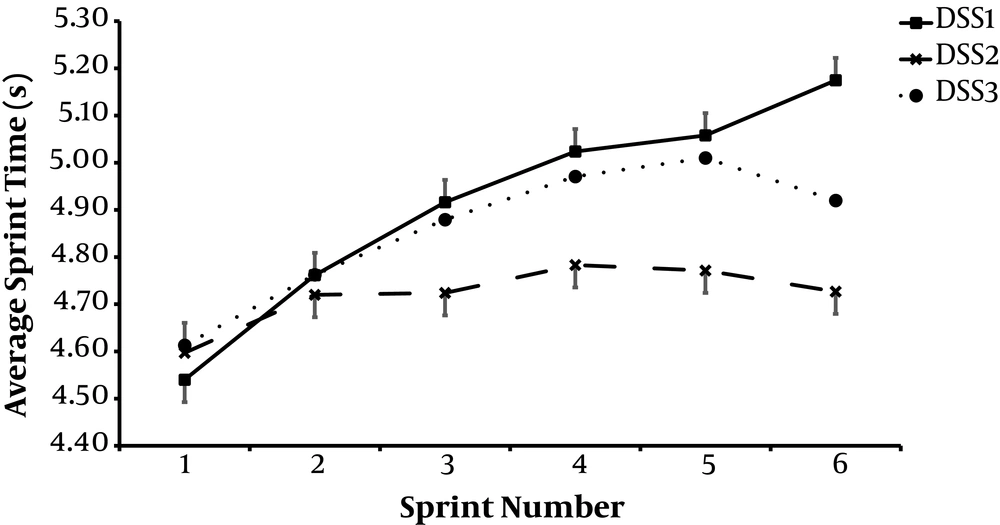
Figure 1.
Mean and 95% confidence intervals (corrected for between-subject variability) for AST (s) from sprint 1 to 6 for DSS1 (■), DSS2 (×) and DSS3 (●)
A main effect for condition was also found for TST and FI (Table 1). TST was significantly higher by 4.1 % following DSS1 (mean difference = 1.15 ± 0.35 seconds, P = 0.018, 95% CI: 0.19 - 2.11 seconds; ES = 0.69, moderate) and 2.8% following DSS3 (mean difference = 0.14 ± 0.05 seconds, P = 0.028, 95% CI: 0.09 - 1.58 seconds; ES = 0.55) compared to DSS2. Decrements of 110.0% following DSS1 (mean difference = 4.29 ± 0.94 seconds, P = 0.002, 95% CI: 1.68 - 6.91 seconds; ES = 1.51, large) and 30.4% following DSS3 (mean difference = 1.71 ± 0.58 seconds, P = 0.035, 95% CI: 0.11 - 3.03 seconds; ES = 0.80, moderate) compared to DSS2 were observed for FI. Values for FI were also lower following DSS3 by 46% compared to DSS1 (mean difference = 2.59 ± 0.85 seconds, P = 0.031, 95% CI: 0.22 - 4.96 seconds; ES = 0.81, moderate).
Table 1.
Mean ± SD Values for RSA Test Variables, Subjective Measures and Bloods for DSS1, DSS2 and DSS3 Conditionsa
| Variable | DSS1 | DSS2 | DSS3 | Significance of Main Effects for Condition | Significance of Main Effects for Time | Interaction | Effect Size (1 - 2, 2 - 3) |
|---|---|---|---|---|---|---|---|
| RPE | 12.69 ± 2.95 | 11.96 ± 2.77 | 12.66 ± 2.35 | 0.528 | < 0.0005 | 0.043 | 0.26, 0.27 |
| Heart rate, beats/min-1 | 173.31 ± 7.88b | 166.00 ± 10.82 | 169.86 ± 7.98 | 0.012 | < 0.0005 | 0.763 | 0.75, 0.39 |
| Lactate, mmol.L-1 | 0.036 | < 0.0005 | 0.001 | ||||
| Pre-RSA | 1.48 ± 0.27 | 1.86 ± 1.03 | 1.52 ± 0.63 | 0.335 | 0.55, 0.40 | ||
| Post-RSA | 14.45 ± 1.56b | 11.40 ± 3.27 | 13.23 ± 2.93b | 0.006 | 1.26, 0.59 | ||
| RSA test | |||||||
| AST, s | 4.91 ± 0.32b | 4.72 ± 0.22 | 4.86 ± 0.27b | 0.005 | < 0.0005 | < 0.0005 | 0.68, 0.65 |
| TST, s | 29.47 ± 1.92b | 28.32 ± 1.31 | 29.16 ± 1.61b | 0.005 | 0.69, 0.55 | ||
| MST, s | 27.23 ± 1.20 | 27.27 ± 1.38 | 27.60 ± 1.24 | 0.322 | 0.03, 0.24 | ||
| BST, s | 4.53 ± 0.20 | 4.54 ± 0.24 | 4.60 ± 0.21 | 0.322 | 0.03, 0.24 | ||
| FI | 8.20 ± 3.75b | 3.90 ± 1.72 | 5.61 ± 2.38b | < 0.0005 | 1.51, 0,80 |
Abbreviations: AST, average sprint time; BST, best sprint time; DSS1, dynamic stretching set 1; DSS2, dynamic stretching set 2; DSS3, dynamic stretching set 3; FI, fatigue index; MST, mean sprint time; RPE, Rate of perceived exertion; TST, total sprint time.
aStatistical significance (P < 0.05) is indicated in bold. The magnitude of the ES was classified as trivial (≤ 0.2), small (> 0.2 - 0.6), moderate (> 0.6 - 1.2), large (> 1.2 - 2.0) and very large (> 2.0).
bValues significantly different compared to the DSS2 condition.
There was no main effect for condition in BST and MST (P > 0.05).
4.2. Subjective Measures and Blood
Physiological responses of heart rate during the repeated-sprint test showed a main effect for condition and sprint number. Responses were significantly lower by 4.4 % following DSS1 (mean difference = 7.31 ± 2.31 beats.min-1, P = 0.025, 95% CI: 1.82 - 8.71 beats.min-1; ES = 0.75, moderate) compared with DSS2. Values for heart rate increased as time went on with higher values observed throughout the repeated-sprint test for all conditions (P < 0.005).
La values were significantly higher by 26.8% following DSS1 (mean difference = 3.05 ± 0.99 mmol/L-1, P = 0.030, 95% CI: 0.28 - 5.83 mmol/L-1; ES = 1.26, large) and 13.8% following DSS3 (mean difference = 1.83 ± 0.59 mmol/L-1, P = 0.028, 95% CI: 0.19 - 3.47 mmol/L-1; ES = 0.59, small) compared to DSS2. Lacatate values at rest were no different (P = 0.335) between the 3 conditions.
There were no differences between conditions for RPE (P > 0.05), however RPE values increased as time went on with higher values observed throughout the repeated-sprint test for all conditions (P < 0.005).
5. Discussion
The present study aims to determine the effect of three different volumes of dynamic stretching on linear repeated-sprint performance over thirty-meters in team-sport athletes. The main finding of this study showed that performing two sets of dynamic stretching (DSS2), incorporating five active dynamic exercises (lower body musculature), significantly improves linear repeated sprint performance compared to one set (DSS1) or three sets (DSS3), respectively. It has long been established that performing a warm-up prior to competition is crucial to maximizing and optimizing performance (2, 3, 9). Many research studies looking at the effect of various active warm-up protocols, that include stretching (such as passive, active, PNF and ballistic), on athletic performance have been conducted. However, the literature does not provide a clear consensus regarding the effects of stretching on performance and findings are often contradictory (9, 25). Although findings in the literature are confounding, completing an active warm-up prior to physical activity has a positive impact on the subsequent exercise performed if it has been structured appropriately (2, 3). A lot of available evidence suggests that incorporating dynamic stretching within the warm-up positively influences numerous aspects of athletic performance (6, 12, 19, 23), as opposed to other forms of stretching (36, 44). However, aspects such as the warm-up intensity, the specificity of the warm-up, the duration of the warm-up and the duration of recovery all appear to affect whether optimal performance can be achieved through dynamic stretching (3-5, 9).
Previous findings have tended to show improvements in singular sprint performance following dynamic stretching compared to passive stretching or no stretching or a combination of both (20, 24, 25). It has been found that performing static or passive stretching has a detrimental effect on singular sprints due to a decrease in neural transmission (20) and/or insufficient increase in muscle and/or rectal temperature pre-exercise (2, 3). When looking at repeated-sprint performance similar findings can be observed. Static stretching on its own or in combination with dynamic stretching negatively impairs repeated-sprint performance (10, 36, 45). However, some studies have found this not to be the case (37, 46). The large methodological variations in repeated-sprint protocols, warm-up strategies and training status of subjects make comparisons between studies in the literature difficult. Considering many studies find repeated-sprint performance to be positively associated with dynamic warm-up, there is a need to determine the most effective volume of dynamic stretching on subsequent performance to make valid comparisons and provide more detailed information for practitioners and coaches.
Findings in the literature have shown that 1 or 2 sets of dynamic stretching improved 20-m sprint performance compared to 3 sets, but no differences were found for 10-m sprint performance (25). When looking at repeated-sprint performance, prior activity highly influences the ability to perform repeated sprints because of impaired rates of muscle power output ability and its association with neural adjustments (29). A study performed by Ishak et al. (8) found no differences in repeated-sprint performance over 20-m when performing a volume of 1, 2 or 3 sets of dynamic stretching. Our study found that linear repeated-sprint performance in team-sport athletes consisting of 6 maximal 30-m sprints with 30s of active recovery, is affected by the volume of dynamic stretching performed in the warm-up. We established a decrease of 4.1% following 1 set of dynamic stretching and 2.8% following 3 sets of dynamic stretching in AST and TST compared to 2 sets of dynamic stretching. Our outcomes therefore suggest that to improve or achieve optimal linear repeated-sprint performance over 30-m, it is advised to structure a warm-up incorporating 2 sets of dynamic stretching prior to activity. A single set protocol yielded the most negative findings and may not have provided enough stimulus for recovery or increased rectal and/or muscle temperatures to an adequate level prior to linear repeated-sprint performance (30). In addition, performing 3 sets of dynamic stretching also reported linear repeated-sprint performance to be significantly worse compared to 2 sets and is deemed to be too intense as a warm-up procedure prior to this mode of exercise. Interestingly, no differences were established between any of the conditions when comparing BST (P > 0.05).
Furthermore, fatigue responses also varied between conditions. Fatigue indexes, a concept which has previously been used to investigate the development of fatigue during repeated-sprint performance, varied across the different conditions. The higher the FI, the lower an individual’s ability to maintain power over a series of sprints. It was found that DSS2 displayed the lowest FI when compared to DSS1 and DSS3 (P < 0.05). Our athletes were unable to repeat the same maximum power outputs after DSS1 and DSS3. We believe that not enough/too much stimulus was provided for recovery or adequate levels of rectal and/or muscle temperatures were reached prior to the repeated-sprint performance (38). DSS3 was deemed to be too intense as a warm-up. This potentially resulted in a decrease in the availability of high-energy phosphates and resulted in reduced contraction velocity capability of the muscles involved (40). A longer rest period prior to repeated-sprint performance test would be necessary to establish whether DSS3 could result in an increase in repeated sprints, to allow for the re-synthesis of high energy phosphates, while ensuring muscle temperature and rectal temperature is still elevated (47). It can be suggested that two sets of dynamic stretching resulted in the most “optimal” increase in muscle and rectal temperature, which is closely associated with an increase in the speed of nerve impulses and sensitivity of nerve receptors (10). However, whether performing DSS2 resulted in muscle contractions to be more rapid and forceful due to higher core and muscle temperatures is unknown. It should further be noted that our specific DSS2 warm-up protocol may not produce the most beneficial physiological and performance changes. We are unable to confirm whether the players commenced the repeated-sprint performance test in a non-fatigued state and with an elevated baseline VO2, which would result in repeated-sprint performance to further improve. In addition, enhanced repeated-sprint performance after dynamic stretching could also be attributed by an enhanced musculotendinous unit (MTU) stiffness. The gains in flexibility have been primarily attributed to a decrease of musculotendinous unit (MTU) stiffness (12, 41). The key attributes of dynamic stretching include enhanced motor unit excitability and improved kinesthetic sense, leading to improved proprioception and pre-activation (42).
We also found heart rate responses and La values to be higher in DSS1 and DSS3. The La values observed post linear repeated-sprint performance were closely related to FI, displaying lower La values in the DSS2 condition. In agreement with previous findings that have also found levels of La > 10 mmol.L-1 following repeated sprints, it can be suggested that this is associated with inducing muscle deoxygenation and increased ventilatory measures (38, 39). The marked decrease in repeated-sprint performance during DSS1 and DSS3 is potentially associated with the inability to maintain a high-power output due to a reduction in oxygen availability, is closely associated with a higher accumulation of blood lactate and related to several mechanisms that contribute to fatigue.
Our study provides novel information and shows that if appropriate warm-up prior to repeated-sprint performance is not undertaken, an adverse effect is present. The exact underlying mechanisms responsible for an improvement in performance in repeated-sprint following two sets of dynamic stretching still needs to be thoroughly documented and would provide pertinent information for coaches and athletes. Whether or not our specific dynamic stretching protocol incorporating five active dynamic exercises, related to sprinting by stretching the lower body musculature is the optimal warm-up is unknown and requires more research. Considering no differences were found in BST between the three conditions, this would suggest that this warm-up would not be beneficial for singular sprints. Additionally, performance in team-sports is highly dependent on a myriad of factors such as skill proficiency in addition to physiological and cognitive capabilities. Although it was found that linear repeated-sprint performance was improved, more research is required to gain a better understanding regarding warm-up effects on team sport performance.
It must also be noted that there are limitations to this study. Although a lot of the previous research has used a repeated-sprint protocol with sprints lasting 5 or 6-seconds or 20 to 30-m in distance (8, 25, 33), recent studies related to field-based team sports have suggested or used sprints 3- seconds in duration or less, or 15-m in distance (30, 31, 48-53). Therefore, it would be beneficial to establish whether two sets of dynamic stretching would incorporate the same results over this shorter distance. Further, incorporating other forms of warm-up to compare between different warm-up modes will help provide us with a clearer picture as to which protocol is the most beneficial.
5.1. Conclusions
In conclusion, the results from this study suggest that performing two sets of 5 dynamic stretches of the lower body musculature positively effects linear repeated-sprint performance in team-sport athletes. It could be suggested that increased muscle and rectal temperatures result in an increase in the speed of nerve impulses and sensitivity of nerve receptors and as a result improve linear repeated-sprint performance. Furthermore, two sets of dynamic stretching enhances musculotendinous unit (MTU) stiffness and improves kinesthetic sense, leading to proprioception and pre-activation to be significantly better. Although two sets of dynamic stretching provided beneficial effects on linear repeated-sprint performance, more in-depth research is still required to establish the intensity, duration and recovery period is needed to yield the most positive results.