1. Background
1.1. Hand Grip Strength
Hand grip strength (HGS) is crucial to the human body for controlling objects. It is used to assess skeletal muscle functions and, over the years, it has also received notable attention from industrial engineers and ergonomics researchers (1). Recently, it has been used as an indicator of nutritional status, especially for hospitalized patients. Bohannon summarized the literature addressing the value of grip strength as a predictor of important outcomes (2). For example, the HGS of cirrhotic patients was found to be significantly low compared to predicted values based on age (3). Many studies have correlated grip strength to various other physical variables including nutritional status, rotator cuff weakness, fatigue, and overall physical function (4-6). Fry et al. also found a correlation between grip strength and performance in American men’s junior weightlifting (6). Reduced grip strength was independently associated with dementia in an older Korean population (7). Recently, HGS has also received attention from the industrial sector. Although economic and industrial development has increased the use of automated systems, operations requiring manual skills cannot be completely avoided. Therefore, workers are continually required to learn how to operate various types of hand tools and equipment.
The hand exerts three main types of force: grip, pinch, and torque. Of these, grip, with relevant control-of-force applications, is the most frequently used? HGS is a critical source of power for work-related operations. Ergonomics and patient diagnostic research on HGS have focused particularly on the grip’s maximum volitional contraction (MVC). For example, Liao demonstrated that MVC is relevant to the performance of tasks involving hand-eye coordination (8), which is a crucial skill that allows humans to grasp, grip, and manipulate. A stronger HGS indicates a firmer grasp or grip. Research has also focused on the mechanisms of HGS in relation to industrial safety and tool design. Kong et al. showed HGS to be related to the distance between an individual’s fingers, the length of the fingers, and their interaction (9). Grant et al. indicated that a tool handle’s diameter affects force application (10). Carey and Gallwey showed that the level of HGS varies significantly according to factors such as age, sex, physique, posture, and duration (11). Hallbeck and McMullin showed that the HGS of females is weaker (approximately 74% in their study) than that of males (12). Abu-Ali et al. demonstrated that carpal tunnel syndrome (CTS) and other cumulative trauma disorders (CTDs) are affected by HGS (13). Lu et al. argued that the pipette task is affected by hand strength (14). HGS, therefore, has significant implications in rehabilitation outcomes and is a predictor of work capacity. Results of studies on HGS can provide useful information for patient filtering, selection of personnel, and work designs.
1.2. Hand Grip Strength and Anthropometric Variables
Most prior studies have attempted to associate HGS with anthropometric variables to predict the outcome of the former (15). Several factors affect HGS performance, including sex, age, height, weight, and handedness (16-18). Body weight and stature (body height) are primary indicators of human growth, particularly for children. There are highly significant relationships between maximal HGS of the dominant hand and general anthropometric variables in all age groups (19). The adolescent growth curve peaks at 15 years of age for both males and females in Taiwan (16). Shih et al. also indicated that grip strength was related to the heights of hand elbows (20). Luna-Heredia et al. found that grip strength in healthy people correlated positively with stature (21), while Liao reported that HGS corresponded effectively to stature and weight (18). However, only a few studies have focused on the correlation between the ratio of weight and stature squared (meter2), or between BMI and HGS. Since understanding the relationship between BMI and HGS can benefit hospitalized patients and industrial operators (18, 21, 22), this study statistically analyzes the relationship between these two variables.
1.3. Body Mass Index and Hand Grip Strength
BMI is a statistical measure of body weight based on a person’s weight and height. Although it does not actually measure body fat, it is used to estimate healthy body weight based on height. Because BMI is easy to measure and calculate, it is the most widely used diagnostic tool for determining whether an individual is underweight, overweight, or obese (23, 24). BMI is defined as a person’s body weight divided by the square of his or her height [BMI (kg/m2) = weight (kg) ÷ height (m2)]. The formula that is universally used in medicine produces a unit measure of kg/m2. The relationship between BMI and grip strength is unclear. Although several studies have focused on the correlation between grip strength and stature, or grip strength and body weight, the covariance effect among sex, BMI, height, and weight has rarely been analyzed statistically (7, 18, 25). Therefore, using the ANCOVA model, this study analyzes the statistical relationship between HGS and BMI. Specifically, the purpose of this study is to determine whether HGS is affected by BMI when the co-variable of sex is excluded. The results can be used as a reference for HGS prediction in physical exercise, as well as in hospital patients.
2. Objectives
The current study aimed to compare HGS among low, medium, and high BMI males and females in both hands under normal and sex effect conditions. In addition, the study sought to investigate the correlation between HGS and anthropometric characteristics among the three groups.
3. Patients and Methods
3.1. Participants
As HGS depends on age, and in general, people attain their maximum value in grip strength during their youth (20 years of age for males and 17 years of age for females in Taiwan) (16, 26), we selected young participants as subjects for HGS evaluation. A total of 200 participants, randomly selected from Taiwan Shoufu university grades 1 to 4 and aged between 18 and 27, participated in the experiments; they were divided into three groups based on their BMI (60 low, 58 medium, and 82 high). Anthropometric data for the three groups shown in Table 1. The participants did not have any muscle- or joint-related injuries. Informed consent was obtained from each participant.
Table 1.
Anthropometric Data of Low, Medium, and High BMI Participants
| Variable | Low (n = 60), Mean ± SD | Medium (n = 58), Mean ± SD | High (n = 82), Mean ± SD | Total (n = 200), Mean ± SD |
|---|---|---|---|---|
| Age, y | 19.90 ± 1.0 | 20.14 ± 0.10 | 20.22 ± 0.98 | 20.10 ± 1.00 |
| Weight, kg | 44.00 ± 5.77 | 60.15 ± 5.03 | 78.42 ± 5.33 | 62.80 ± 15.42 |
| Height, m | 1.59 ± 0.07 | 1.64 ± 0.05 | 1.73 ± 0.05 | 1.66 ± 0.08 |
| BMI, kg/m2 | 17.29 ± 1.64 | 22.29 ± 1.60 | 26.32 ± 1.75 | 22.44 ± 4.12 |
| LHGS, kgf | 24.69 ± 6.20 | 32.96 ± 7.84 | 40.40 ± 5.52 | 33.53 ± 9.19 |
| RHGS, kgf | 28.92 ± 5.89 | 36.13 ± 8.17 | 44.21 ± 5.67 | 37.28 ± 9.15 |
3.2. Procedures and Measurements
3.2.1. Experimental Design
We conducted an experiment to evaluate HGS. A hand grip dynamometer in minute style (Japanese style, Tkk 5001; see Figure 1) was used as the examination tool. The handle diameter was set to 50.8 mm (10, 20) to properly assess HGS and to prevent muscle fatigue (8, 27).
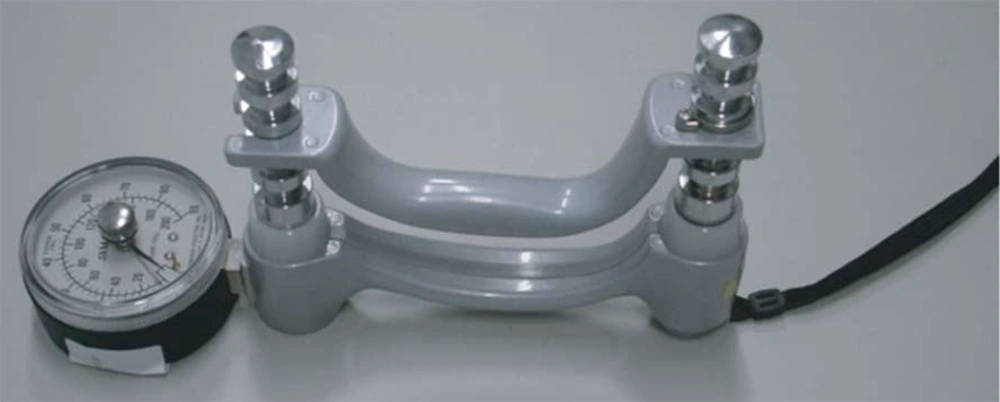
Figure 1.
Hand Grip Dynamometer in Minute Style
The experimental models used in this study were as follows: the dependent variable was HGS (left and right hand), the independent variable was BMI (low, medium, and high), the moderating variable was sex (male/female), the model used was ANCOVA, and sex was set as the co-variable.
3.2.2. Assessment of Hand Grip Strength
The experimental steps and procedures were refined and implemented according to the methods of previous researchers (18, 28). The participants were tested for HGS in a sitting position, with arms straight out and inclined downward. Participants were sufficiently rested and informed of the experimental procedures prior to being tested individually for HGS. Each participant was then asked to hold the hand grip dynamometer tightly for approximately three seconds and then relax; this operation was repeated five times, with 10-second pauses between each operation. After consecutively performing this operation for 30 minutes, the participant was allowed to pause for at least five minutes.
3.3. Data Analysis
Data was summarized using descriptive statistics of mean and standard deviation. Inferential statistics of independent ANOVA and ANCOVA were used to compare HGS among low, medium, and high BMI in males and females. Pearson’s product moment correlation analysis was used to test the relationship between HGS and physical characteristics. Regression analysis used sex and BMI as independent variables for predicting the dependent variable HGS. Analysis was carried out using SPSS version 21.0 (SPSS Inc., Chicago, IL, USA). P < 0.05 was considered as the level of significance.
4. Results
The results were based on four evaluative models: correlation analysis, ANOVA, ANCOVA, and regression analysis.
4.1. Pearson Correlation Analysis
The mean and standard deviations of HGS in five consecutive trials are listed in Table 2.
Table 2.
Mean and Standard Deviations of Five Trial Assessments of Hand Grip Strengtha
| Variable | First Trial | Second Trial | Third Trial | Fourth Trial | Fifth Trial |
|---|---|---|---|---|---|
| All participants | |||||
| LHGS(kgf) | 35.44 ± 9.93 | 34.18 ± 9.51 | 33.35 ± 9.56 | 32.68 ± 9.56 | 32.00 ± 9.07 |
| RHGS(kgf) | 39.57 ± 10.13 | 38.55 ± 9.69 | 37.00 ± 9.77 | 36.03 ± 8.98 | 35.24 ± 9.32 |
| Low | |||||
| LHGS(kgf) | 25.71 ± 6.69 | 25.08 ± 6.12 | 24.70 ± 6.28 | 24.06 ± 6.80 | 23.88 ± 6.85 |
| RHGS(kgf) | 29.60 ± 5.97 | 29.65 ± 5.48 | 29.30 ± 6.45 | 28.63 ± 6.96 | 27.41 ± 6.69 |
| Medium | |||||
| LHGS(kgf) | 34.73 ± 8.62 | 33.75 ± 8.48 | 32.64 ± 8.23 | 32.45 ± 8.02 | 31.24 ± 7.51 |
| RHGS(kgf) | 38.59 ± 9.18 | 37.16 ± 8.69 | 35.73 ± 8.71 | 35.06 ± 8.11 | 34.12 ± 7.78 |
| High | |||||
| LHGS(kgf) | 43.06 ± 5.32 | 41.13 ± 5.84 | 40.18 ± 6.72 | 39.14 ± 6.57 | 38.47 ± 6.03 |
| RHGS(kgf) | 47.55 ± 5.36 | 46.03 ± 6.26 | 43.54 ± 7.90 | 42.14 ± 6.12 | 41.75 ± 6.99 |
aN = 200.
The average of five consecutive trials of HGS in the left hand was 33.53 kgf, and the average in the right hand was 37.28 kgf. The average for both hands was 35.41 kgf. The HGS value of the left hands of young people in Taiwan was approximately 90% that of the right hand (33.53/37.28). This is possibly because most people in Taiwan use their right hand more often than their left hand (16).
The relationship between HGS and physical characteristics of the low, medium, and high BMI participants are presented in Table 3. The results showed that the physical characteristics correlated with HGS with a co-efficient (r) ranging from 0.000 - 0.775 for both left and right hands. This result is in accordance with the studies by Luna-Heredia et al. (21) and Liao (18).
Table 3.
Pearson’s Product Moment Correlation Test of Relationship Between Hand Grip Strength and Physical Characteristics of Low, Medium, and High Bmi Participants
| Variables | Low | Medium | High | All Participants | ||||
|---|---|---|---|---|---|---|---|---|
| LHGS | RHGS | LHGS | RHGS | LHGS | RHGS | LHGS | RHGS | |
| r | r | r | r | r | r | r | r | |
| Age, y | -0.029 | 0.195 | 0.021 | 0.037 | -0.031 | -0.029 | 0.086 | 0.131 |
| Weight, kg | 0.618a | 0.606 a | 0.483a | 0.543a | 0.240b | 0.234b | 0.775a | 0.765a |
| Height,m | 0.571a | 0.456a | 0.608a | 0.634a | 0.185 | 0.245b | 0.709a | 0.711a |
| BMI,kg/m2 | 0.172 | 0.018 | 0.267b | 0.244 | -0.031 | 0.036 | 0.689a | 0.669a |
aP < 0.01.
bP < 0.05.
4.2. ANOVA Model
The study used ANOVA to investigate the participants’ HGS. Participants with a BMI lower than 18.82 were assigned to the “low BMI” group, while participants with a BMI higher than 24.51 were assigned to the “high BMI” group. Those with a BMI between 18.82 and 24.51 were assigned to the “medium BMI” group. The basic statistical data of the three groups is shown in Table 1.
The one-way ANOVA results for HGS are shown in Table 4. The three groups demonstrated significant differences in LHGS, RHGS, and L-RHGS (P < 0.001). The LSD post-hoc multiple comparisons method showed that the high BMI group was stronger than the medium BMI group (H > M) and the low BMI group (H > L). The medium BMI group was stronger than the low BMI group (M > L).
Table 4.
Comparing the Hand Grip Strength of Low, Medium, and High BMI Participants Using One-Way ANOVA and LSD Post-Hoc Test
| Variables | Low, Mean ± SD | Medium, Mean ± SD | High, Mean ± SD | F-Ratio | P Value | Post-Hoc |
|---|---|---|---|---|---|---|
| LHGS (kgf) | 24.69 ± 6.20 | 32.96 ± 7.84 | 40.40 ± 5.52 | 102.50 | < 0.001 | H > M > L |
| RHGS (kgf) | 28.92 ± 5.89 | 36.13 ± 8.17 | 44.21 ± 5.67 | 95.52 | < 0.001 | H > M > L |
| L-RHGS (kgf) | 26.80 ± 5.83 | 34.55 ± 7.38 | 42.30 ± 5.35 | 105.42 | < 0.001 | H > M > L |
4.3. ANCOVA Model
For ANCOVA, gender was used as the moderator variable; this selection followed the recommendations of Bryman and Cramer (29). The homogeneity test of ANCOVA was mainly adopted with homogeneity of with-in regression. For the test results, in the group of “BMI × gender,” the homogeneity of with-in regression of the three groups had a P value greater than 0.05 (F = 0.443, P = 0.643). Therefore, the null hypothesis is accepted (30). This means that the slope of the regression line for each group was the same. In other words, after eliminating the interference of gender, the HGS of each group did not change despite differences in the handling level of each independent variable. Therefore, the ANCOVA test could be performed, and the basic assumption test for HGS is suitable for ANCOVA (31).
The results of the ANCOVA test for HGS are listed in Table 5. After excluding the interference of gender, only a significant difference in LHGS (P < 0.05) was demonstrated.
Table 5.
Comparing the Hand Grip Strength of Low, Medium, and High BMI Participants Using One-Way ANCOVA and LSD Post-Hoc Testa
| Variables | Low, Mean ± SD | Medium, Mean ± SD | High, Mean ± SD | F-Ratio | PValue | Post-Hoc |
|---|---|---|---|---|---|---|
| LHGS (kgf) | 31.67 ± 0.81 | 33.66 ± 0.62 | 34.79 ± 0.67 | 3.237 | 0.041 | H > L, M > L |
| RHGS (kgf) | 35.98 ± 0.82 | 36.84 ± 0.63 | 38.53 ± 0.68 | 2.246 | 0.109 | |
| L-RHGS (kgf) | 33.82 ± 0.76 | 35.26 ± 0.59 | 36.66 ± 0.64 | 2.892 | 0.058 |
aCo-variable = gender.
There were no significant differences in RHGS and L-RHGS (P > 0.05). This indicates that none of the groups reached significant levels in their right-hand and both-hands HGS. The result does not show the same trend as when ANOVA was used. The results of L-RHGS of the three groups under the ANOVA and ANCOVA methods are shown in Figure 2.
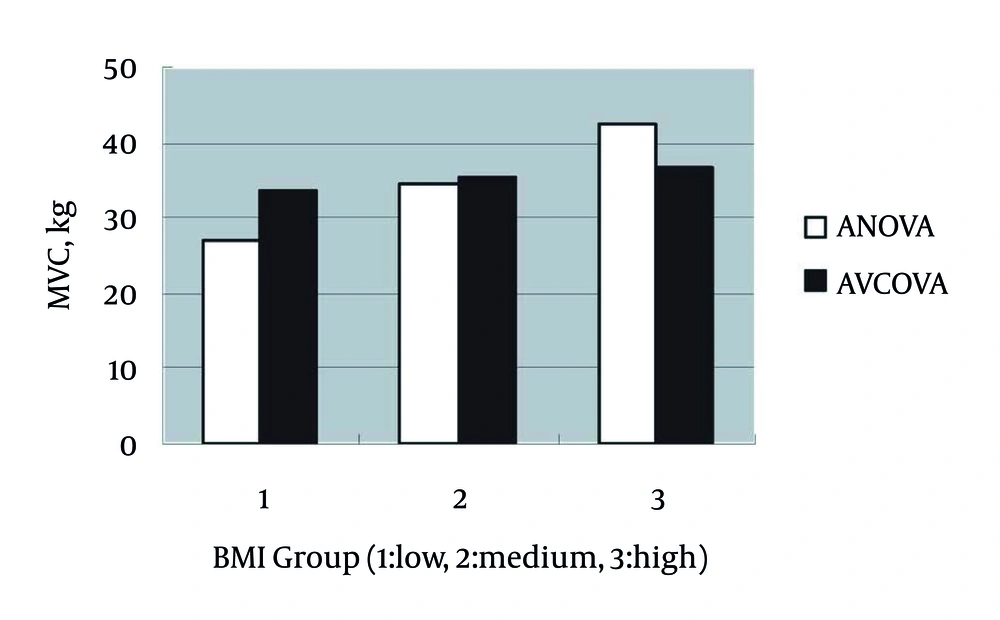
Figure 2.
Comparison of MVC Based on ANOVA and ANCOVA
4.4. Regression Analysis
Regression analysis used gender and BMI as independent variables for predicting the dependent variable HGS. Based on the findings shown in Table 6, the coefficient of the determinant R2 was 0.756, and the adjusted R2 was 0.753. In terms of L-RHGS, the F-ratio value was 304.585 (P < 0.001). This was clearly significant, based on the assessment of the determinants against HGS.
Table 6.
Regression Analysis Using Gender and BMI as Independent Variables for Predicting the Dependent Variable L-RHGSa
| Variable | B | Beta | T-value | P Value |
|---|---|---|---|---|
| Constant | 51.365 | 13.688 | < 0.001 | |
| Gender | -14.556 | -0.797 | -15.025 | < 0.001 |
| BMI (kg/m2) | 0.207 | 0.094 | 1.778 | 0.770 |
aR = 0.869, R2 = 0.756, adj. R2 = 0 .753, F = 304.585, P < 0.001.
Beta coefficients were used to assess the relative importance; higher beta coefficients equate to more significance for each factor. Gender was found to be the most critical factor influencing HGS, with a beta value of - 0.797 (P < 0.001). BMI, with a beta value of 0.094 (P = 0.77), was found to be the least significant factor. The result shows the same trend as that of ANCOVA.
The standardized regression equation can be written as follows:
1) L-RHGS (kgf) = 51.365 - 0.797 × gender (male = 1, female = 2) + 0.094 × BMI (kg/m2)
5. Discussion
This study used several methods, including correlation analysis, ANOVA, ANCOVA, and regression analysis, to explore the statistical relationship between hand grip strength (HGS) and body mass index (BMI). The relationship between HGS and BMI was clearly and positively correlated (P < 0.01). However, we ultimately discovered that when sex as the co-variable was expelled from ANCOVA, the HGS was not affected by the BMI. This means that the three BMI groups showed no significant differences in RHGS and L-RHGS (P > 0.05). Pearson’s correlation and regression equation may explain the reasons for this. Table 3 shows that HGS was significantly correlated with several variables, such as weight, height, and BMI. These results support the findings of Chang (16), Deepak et al. (17), and Liao (18). Gender is a peculiar factor; it not only majorly affected the HGS, but also, in terms of weight and height, the BMI. Consequently, when BMI and gender were brought together, the regression analysis showed that gender mainly affected the HGS. Finally, in the ANCOVA analysis, the fact that gender canceled the BMI effect led to the three BMI groups showing no significant differences in RHGS and L-RHGS. The gender factor, therefore, affected both HGS and BMI groups. This finding is in accordance with the study by Liao (18).
Based on these results and discussion, the following conclusions can be drawn. A positive correlation exists between HGS and weight (P < 0.01), height (P < 0.01), and BMI. When applying the ANOVA tool, the three BMI groups showed significant differences in HGS (P < 0.001). The post-hoc multiple comparisons test showed that the high BMI group was stronger than the medium group (H > M) and the low group (H > L), and that the medium group was stronger than the low group (M > L). These finding support the studies of Shin et al. (7), Liao (18), and Ibegbu et al. (25).
However, for ANCOVA, gender was selected as the moderator variable, and the results indicated no significant differences (P > 0.05) among the three BMI groups in RHGS and L-RHGS. This result is not in agreement with the study of ANOVA.
Regression analysis results indicated that the two independent variables, gender and BMI, can explain the variances of the dependent variable HGS reaching 75.3%. The most significant factor affecting HGS was found to be gender, followed by BMI. It can therefore be concluded that gender was found to be a critical determinant of HGS. The standardized regression equation, Equation 1, suggested in this study can be used as a reference for measuring HGS.
In conclusion, the study found that the personal anthropometric variables, weight, height, and BMI, have a significant correlation on HGS, with gender being the most significant factor. Gender not only affected the HGS, but also, through weight and height, indirectly affected the BMI. The findings of the study were in tandem with the study indicating that gender was an important factor affecting maximum HGS (18). In general, if the gender effect is disregarded, the high BMI group had a stronger HGS than the medium and low groups, and the medium group had a stronger HGS than the low group. HGS was closely related to BMI.
The finding of this study is that when evaluating a person’s HGS, or when assigning manual tasks to workers, BMI is a good predictor. If one wants to use personal anthropometric variable factors such as gender, height, body weight, and BMI to predict HGS, different statistic methods will produce diverse results. When HGS was used as a reference by patient filtering and training personnel, gender was an important factor to be considered. The research data obtained in this study can be used as a reference by predictors of work capacity, in health diagnoses, and by designers of hand tools and equipment. It can also be applied to the selection of physical athletes in cases wherein grip strength can be used to determine physical status. In both cases, gender must be considered an influencing factor.
It would be of great benefit to repeat this study to measure and compare findings over two or more occurrences. In addition, although in this study we did not consider factors such as age and handedness, understanding the effects of such factors on HGS could provide additional insight for implementing the model constructed in this study.