
1. Background
Anxiety is an inseparable part of human life, and as a physiological phenomenon, it can cause adverse impacts on one’s behaviors, thoughts, and reactions (1). A vague feeling, worry, concern, or apprehension is among the most common problems of cardiac patients (2). Its symptoms include restlessness, irritability, difficulty concentrating, muscle tension, sleep disturbances, and being easily fatigued (3).
There is not much known about the influence of anxiety on cardiovascular diseases (3). However, the most recent meta-analysis conducted by Batelaan et al. (4) demonstrated a 52% increased risk of CVD onset for patients with anxiety symptoms and disorders. According to a study by Ronaghi et al. (5), the anxiety level of cardiac patients is 26% higher than that of psychiatric patients. Following a cardiovascular event, patients often experience anxiety, which remains unresolved among 50% of the patients during the following year (6, 7). The most important causes that can lead to anxiety in these patients include separation from family members, being in an unfamiliar environment, lack of knowledge about diagnostic and therapeutic methods and their consequences, costs of treatment, concerns about the ability to accomplish self-care and return to work, and risk of mortality (8, 9).
Anxiety causes not only non-cardiac complications in these patients but also aggravates cardiac complications such as cardiac dysfunction, hypertension, tachycardia, dysrhythmia, ischemia, and heart failure (10). Thus, nurses working in the Coronary Care Unit (CCU) should pay attention to patients’ anxiety as well as other aspects of the patient to provide better care (11). Up to now, many treatments have been suggested to reduce anxiety, including pharmacological and non-pharmacological therapies, but the former is more common while causing many complications and heavy costs (12). Thus, nowadays, non-pharmacological management of anxiety is more popular (13). Listening to music and listening to religious carols are among these non-pharmacological managements for anxiety (14).
Maleki and Kamali (15) stated that various studies have been conducted using the Holy Quran recitation because of its various psychological effects. A study of Ildarabadi et al. on the Holy Quran recitation effects on patients’ heart rate and respiratory rate (16), and another study by Keshavars et al. (17) on the positive effects of Holy Quran recitation on oxygen saturation, heart rate and respiratory rate of premature infants are among these various studies. Sound waves of Quran recitation have specific frequency and wavelength that produce undulations that allow cells to restore balance and coordination (18).
Similarly, listening to music and rhythmic sounds can reduce heart rate, adjust breathing, and cause muscle relaxation. In addition, listening to music can reduce the effect of harmful sound stimuli and decrease stress responses by drawing attention in patients (17). Listening to music also decreases acute coronary syndrome (ACS) patients’ anxiety levels (19). One form of music is speechless music or instrumental music that can transmit human feelings, emotions, perceptions, and cognitions only through sound with no need for speech and language (20). Listening to instrumental music has many positive effects, including reducing the anxiety level in patients with ACS (21).
Even though both interventions have been shown to be useful methods to decrease patients’ problems, according to our literature review, no study has been conducted to compare the effects of these interventions on the anxiety level of patients with ACS to date.
2. Objectives
The aim of this study was to compare the effects of listening to instrumental music with listening to Quran recitation on the anxiety level of patients with ACS.
3. Methods
This semi-experimental study was part of a larger study of an MSc student’s thesis. The thesis was approved by the Vice-Chancellor of Research, Information and Technology, and the Ethics Committee of Shahrekord University of Medical Sciences (ID: IR.SKUMS.REC.1397.297).
The present study was conducted among 96 patients admitted from February to April 2019 to Hajar Hospital, Shahrekord, Iran. Considering the mean and standard deviation (S1 = 3.14 and S2 = 2.61; x1 = 34.2 and x2 = 43.3) of the anxiety score reported by Heidari et al., 95% confidence interval, and power of 80%, the authors allocated 32 individuals to each group, who were chosen by the convenience sampling method. Then, they were randomized by cards into three groups, including listening to Quran recitation group (n = 32), instrumental music group (n = 32), and control group (n = 32). The inclusion criteria included completing and signing the informed consent form, age between 18 and 65 years, complete consciousness, no history of neurological illnesses leading to hospitalization or taking antipsychotic drugs, lack of a history of deafness, and stable vital signs (22). The exclusion criteria were having any stress or physiological changes that need medical or nursing attention, any alteration in the level of consciousness, critical conditions, and withdrawal from the study. All the eligible patients were provided the necessary explanations about the interventions and their harmlessness, and they were assured of the confidentiality of their information. Then, they read the informed consent form and completed it.
Sampling was continued until the target sample size reached. The data collection tools were a demographic data form and the 20-item Spielberger state-trait anxiety inventory (STAI) that measures apparent anxiety or state anxiety. The answers were rated on a four-point Likert scale (1 - 4) with 20 and 80 being the minimum and maximum scores, respectively. The respondents with a score below 43 were classified as non-anxious, and those with a score above 43 were considered as anxious (23). The main questionnaire was a standard two-part inventory developed by Mahram in 1995 (24). Also, the validity of the first part was confirmed by Nazemian et al. (25), in 2008. In our study, its reliability was calculated to be 0.90 using Cronbach’s alpha.
Questions were answered by all the patients themselves. Then, both interventions were carried out by the first author, and the patients were not visited during the audio broadcast. In the Quran recitation group, the patients listened to verses 78 - 111 of Surah Al-Isra recited by the Master Sa’ad al Ghamdi as hymns and according to the Nahavand style by using audio headphones at night while the CCU lights were turned off. The verses were selected considering the previous studies and the cleric of the Islamic education's advice. In the instrumental music group, the patients listened to the sound of the ocean by using audio headphones at night while the CCU lights were turned off. According to a similar previous study (23), the length of both interventions was 10 minutes, and upon the viewpoints of the experts, after three sessions, the anxiety inventory was filled out by all the patients again. Considering the ethical issues of care and research, the routine treatments and cares continued in the three groups. Data were analyzed using descriptive and analytical tests, including mean and standard deviation, mean difference, chi-square, one-way ANOVA, and post hoc with SPSS version 16. P value less than 0.05 was considered significant.
4. Results
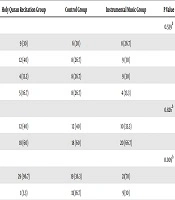
The mean age of the Quran recitation, instrumental music, and control groups was 42.4, 43.5, and 52.6, respectively. According to the one-way ANOVA test, the three groups were significantly different (P < 0.001). However, the chi-square test indicated no significant difference between the three groups regarding the remaining demographic characteristics (Table 1).
Table 1.
Baseline Demographic Characteristics of Patients in Three Groupsa
| Holy Quran Recitation Group | Control Group | Instrumental Music Group | P Value | |
|---|---|---|---|---|
| Educational level | 0.539b | |||
| Illiterate | 9 (30) | 6 (20) | 8 (26.7) | |
| High-school | 12 (40) | 8 (26.7) | 9 (30) | |
| Diploma | 4 (13.3) | 8 (26.7) | 9 (30) | |
| Academic | 5 (16.7) | 8 (26.7) | 4 (13.3) | |
| Gender | 0.826b | |||
| Male | 12 (40) | 12 (40) | 10 (33.3) | |
| Female | 18 (60) | 18 (60) | 20 (66.7) | |
| Marital status | 0.005b | |||
| Single | 29 (96.7) | 19 (36.3) | 21(70) | |
| Married | 1 (3.3) | 11(36.7) | 9(30) | |
| Employment status | 0.008b | |||
| Housewife | 10 (33.3) | 9 (30) | 7 (23.3) | |
| Self-employed | 13 (43.3) | 7 (23.3) | 17 (56.7) | |
| Civil-servant | 5 (16.7) | 3 (10) | 5 (16.7) | |
| Retired | 2 (6.7) | 3 (10) | 0 (0) | |
| Jobless | 0 (0) | 8(26.7) | 1 (3.3) | |
| History of ACS | 0.407b | |||
| Yes | 9 (30) | 11 (36.7) | 14 (46.7) | |
| No | 21 (70) | 19 (63.3) | 16 (53/3) | |
| Age | 52.6 ± 2.30 | 42.4 ± 10.8 | 43.5 ± 9.37 | < 0.001c |
aValues are expressed as mean ± SD or No. (%).
bChi-Square.
cOne-way ANOVA.
In order to investigate the effect of holy Quran recitation and instrumental music on the anxiety level of the patients, the difference in anxiety score before and after the intervention was calculated in each group, and comparison was made between the three groups. One-way ANOVA showed a significant difference between the three groups. The lowest anxiety score was calculated in the Holy Quran recitation group, and the highest score was determined in the control group. Post-hoc test demonstrated a significant difference in anxiety scores between the Holy Quran recitation group and the control group and between the instrumental music group and the control group (P < 0.001; Table 2).
Table 2.
Comparison of Mean ± SD of Anxiety Score Before and After the Intervention in the Three Groupsa
| Group | Before Intervention | After Intervention | Before-After |
|---|---|---|---|
| Holy Quran recitation | 43.1 ± 6.15 | 38.5 ± 3.82 | -5.133 ± 3.451 |
| Instrumental music | 44.2 ± 1.21 | 39.1 ± 4.17 | -4.966 ± 4.197 |
| Control | 46.3 ± 3.84 | 44.7 ± 6.21 | -2.233 ± 5.587 |
| P value | 0.023b |
aValues are expressed as mean ± SD.
bOne-way ANOVA.
5. Discussion
The findings of the present study indicated that both interventions were effective in reducing anxiety in patients with ACS. However, listening to the Holy Quran recitation was more effective than instrumental music in decreasing anxiety. The study of Bechtold et al. (26) reported stress reduction in patients undergoing colonoscopy after listening to music. Since anxiety is highly dependent on stress (27), we can conclude that their finding was consistent with our results as to the effects of music.
In the study of Raffieian et al. (28), music therapy was reported to reduce pain, anxiety, and nausea of patients undergoing cesarean section. Yousefinezhad et al. (29) also reported that music was effective in reducing stress and pain in patients as much as body relaxation techniques do. This may explain the effect of music on anxiety reduction in these studies.
On the other hand, Bradt et al. (30), through a systematic review showed that music had few benefits against psychological distress and moderate effects on the anxiety of patients with coronary heart disease that supports the above studies.
Mirbagher et al. (31) compared music and Quran recitation. They found that both had a significant effect on decreasing blood pressure, pulse rate, and respiratory rate as well as reducing patients’ anxiety; however, Quran recitation was more effective, which is in line with the results of the present study. Perhaps one of the reasons for the relatively greater influence of Quran recitation is that all the participants in both studies were Muslims. Thus, religion, especially Holy Quran, had an influence on all aspects of their lives, including health.
In a more recent study, Babaii et al. (32) stated that listening to Quran decreased anxiety before cardiac catheterization, and this therapy could be used in combination with other cares and treatments to decrease patient anxiety. Majidi (33) found Holy Quran recitation effective to decrease anxiety level before and after coronary angiography, and Ildarabadi (34) found it to be effective in lowering anxiety before cardiac surgery. They also found that those who listened to the recitation of Quran had more normal vital signs than the control group (33, 34). Recently, Musavi et al. (35) reported that the Holy Quran recitation decreased anxiety, but it had no effect on depression after cardiac surgery. All these are in line with the results of the current study.
God states in Surah Isra, verse 2: and we send down a Quran, which is healing and mercy for all believers and adds nothing to the transgressors except their harm. Therefore, the reason for the positive effect of Quran on reducing anxiety can be found in the book itself.
Barrett et al. (36) found that mortality rate after open-heart surgery decreased from 9% to 5% by using spirituality as a complementary medicine by a group of nurses trained in this field. Considering religion as a part of spirituality (37), it can be stated that listening to the Holy Quran recitation can act as a complementary medicine and reduce patients’ problems, including anxiety.
This study proved that a non-pharmacological, simple, inexpensive, and short-term intervention offered in only two 10-minute sessions can reduce the anxiety level of the patients with ACS. The results of this study showed that Quran recitation was more effective than instrumental music in reducing anxiety. The mean age of the three groups varied, which may affect the results of the study and was one of the limitations of current research.
5.1. Conclusions
This method of care and its importance can be taught through holding nursing education sessions. In addition, the results of this study can serve as a prelude to further studies. The influence of religion was one of the most important limitations of this study because the entire patients in this study were Muslims who believed in the Holy Quran as they said. Thus, we recommend conducting similar studies on populations with different religions and beliefs.