
1. Background
The ABO blood group system is determined based on the genetic presence or absence of a series of carbohydrate molecules called agglutinogens on the surface of the red blood cell membranes. Studies show that this system plays a role in the pathogenesis of some human diseases, such as cardiovascular diseases (1). People with mental disorders may have inherited behavioral disorders, so the hereditary factors that change the nervous system function have been of great interest (2).
The literature indicates that blood groups not only represent personality traits but also are significantly related to mental disorders (3). Investigations also showed that depression was higher in blood groups A and O than in other blood groups (4).
Human resources, as the most important productivity factor in organizations and the whole society, play a significant role in the prosperity and improvement of any society (5). Nursing services are among the important critical components of hospital services, and the quality of health care depends largely on how nurses work. With the advancement of the nursing profession, nurses are expected to provide more complex care based on the patients' needs (6). According to the nature of their work, the nursing staff is exposed to many stresses, including long and continuous communication with sick and dying patients, great loads of responsibility, excessive personal requests from the patient and others, high speed of technological advancements, frequent confrontation with the reality of death, etc. (7). Subsequently, destructive physiological and psychological effects lead to other negative consequences such as illness, absenteeism, reduced job performance (8), disorders in the regulation of emotions, and reduced productivity, which increases the risk of diseases, such as anxiety (9), depression, headache, sleep problems, and sometimes suicidal thoughts (10). Health anxiety is an important dimension that affects the lives of nurses and their jobs (11). Research findings showed that nurses experience higher anxiety levels than normal people (12). Marital satisfaction and compatibility, as results of a successful marriage, play a significant role in the lives of nurses since they are employed in one of the most stressful jobs in society. These factors also have a moderating role in mitigating the psychological pressures caused by the job (13).
The investigation into marital coping skills and the role of spousal support in reducing stress has become more prosperous during the last two decades (14). This approach provides a new understanding of how spouses face stressful events in daily life. Each couple's coping reactions to the other's stress originate from conditions outside the relationship. When faced with stressful events within the relationship (such as marital conflicts, betrayal, etc.), spouses usually use their coping strategies and sometimes rely on the couple's coping strategies; they intend to support each other in facing external stressful situations (15). In order to achieve marital compatibility in a couple's coping skills, the following dimensions have been mentioned: sharing stress with the spouse, supporting the spouse in times of stress, dealing responsibly with the spouse's stress, dealing negatively with the spouse's stress, sharing the stress with the spouse, supporting the spouse during times of stress, coping with spouse's stress responsibly and/or negatively, and having couple-coping skills and requirements to evaluate these skills (14). The results also showed that marital coping skills, including sharing stress, supporting each other in times of stress, and having a sense of mutual responsibility against stress in one's spouse, had a significant positive correlation with marital satisfaction (16).
Nurses are at significant risk of reduced quality of life due to their type of education and difficult working conditions in the hospital (17-19), such as long hours of training and classrooms, little rest and sleep, lack of leisure time and regular exercise, irregular meals, anxiety, and pressure related to direct communication with patients. The assumption that nursing students do not lead a suitable lifestyle due to external stressors has caused concerns about their quality of life during their academic studies (20). Therefore, their health, quality of life, and influential factors should be seriously addressed (21).
Since little research has been conducted on the relationship between physical diseases and mental disorders, especially between mental disorders and different blood groups, the present study was carried out.
2. Objectives
We aimed to measure the etiology of mental disorders from a new point of view to investigate the relationship between mental disorders and biological factors by specifically studying the relationship of blood groups with health anxiety, marital compatibility, and the quality of life in married nurses in Iranshahr.
3. Methods
In this descriptive-analytical, scientific-comparative study, the population included all married nurses in Iranshahr medical centers who worked in different medical departments for six months, from January 2016 to July 2017. The number of study participants required to complete the questionnaire was determined as 200 using the modified Cochran formula. As a result, the convenience sampling method was performed, and the questionnaires were administered among the studied community using Cochran's sample size formula.
The eligibility criteria for nurses to enter the study included having at least one year of work experience and signing the informed consent forms. Then, the included participants were provided with comprehensive explanations about the study objectives and were ensured of the confidentiality of their information. Consequently, nurses were asked to complete the questionnaire individually and meticulously. Exclusion criteria were psychiatric disorders, unwillingness to participate in the study, and incomplete questionnaires.
The main research questionnaire consisted of several parts, including the respondents' demographic characteristics (age, gender, and blood type), the Short Health Anxiety Inventory (SHAI) (22), the Dyadic Adjustment Scale (DAS), and the Quality of Life Questionnaire.
The SHAI, a revised version of the Health Anxiety Inventory, is an 18-item self-assessment scale designed to specifically examine respondents' mental health concerns and anxieties. It is an 18-item self-assessment questionnaire containing three factors: Disease incidence, disease consequences, and general health concerns.
Participants were required to answer each item based on a four-point Likert scale ranging from 0 to 3 so that higher scores indicate greater severity of symptoms and illness. Attainable scores can range from 0 to 54; a score ≥ 18 indicates suffering from anxiety, and a score ≥ 37 shows health anxiety disorder. Salkovski et al. (22) corroborated that scores received from SHAI have appropriate levels of validity and reliability in diagnosing health anxiety. The internal consistency coefficients reported in the literature ranged from 71% to 95%. Furthermore, the reliability coefficient of SHAI was calculated as 85% in the present study.
The DAS, developed by Spanier (23), is a 32-item tool for assessing the quality of a marital relationship from the viewpoint of a couple. This scale contains four subscales of dyadic satisfaction (the degree of satisfaction from different dimensions of the relationship), dyadic cohesion (the degree of participation in shared activities), dyadic consensus (the degree of agreement between the spouses in matters related to the marital relationships, such as finances, raising children, etc.), and affection expressions. This scale has different scoring methods. To calculate the score of each subscale, the scores received from all items of that subscale must be added. The attainable scores can range from zero to 151; scores ≥ 100 represent the individuals' compatibility, and scores < 100 indicate a problem in marital relations and family incompatibility. The validity and credibility of DAS were reported as 0.96 by the designer. Mollazadeh et al. noted that the test-retest coefficient of this scale is 0.86, and its Cronbach's alpha is 0.86. Furthermore, the concurrent validity of DAS with the Locke-Wallace Marital Adjustment Scale was calculated as 0.90 (24).
The 36-item Quality of Life Questionnaire was developed by Ware and Sherbourn (25) in the United States. Its validity and reliability were evaluated and confirmed in different groups of patients. This questionnaire aims to assess the respondent's state of physical and mental health conditions using eight subscales of health, including general health, physical function, limitation in role-playing due to physical problems, limitation in role-playing due to emotional reasons, physical pain, social function, fatigue or vitality, and mental health. The lowest and highest attainable scores are zero and 100, respectively. The reliability test of the questionnaire using internal consistency analysis showed that except for the fatigue or vitality subscale, other subscales had the minimum standard coefficients of 0.77 - 0.95. The convergent validity test performed to examine the measurement hypotheses using the correlation of each question with the hypothesized scale also showed good results confirming that all correlation coefficients exceeded the recommended value of 0.4.
For data analysis, descriptive (mean and standard deviation) and inferential [one-way analysis of variance (ANOVA), and multivariate analysis of variance (MANOVA)] statistical analyses were employed to calculate the difference between the study groups with SPSS version 23 software.
4. Results
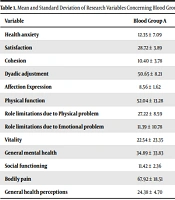
Out of 200 nurses in this study, 36% had blood group A, 25.5% blood group B, 12% blood group AB, and 26.5% blood group O. Table 1 represents the mean scores and standard deviation of the research variables concerning blood groups (A, B, O, and AB). It also showed that the health anxiety score in blood group B (16.31), marital compatibility in blood group O (99.79), and quality of life in blood group A (251.80) had the highest averages.
Table 1.
Mean and Standard Deviation of Research Variables Concerning Blood Groups
| Variables | Blood Group A | Blood Group B | Blood Group O | Blood Group AB | Total |
|---|---|---|---|---|---|
| Health anxiety | 12.35 ± 7.09 | 16.31 ± 8.64 | 14.00 ± 5.81 | 14.58 ± 4.92 | 14.15 ± 7.03 |
| Satisfaction | 28.72 ± 3.89 | 27.67 ± 5.98 | 28.83 ± 3.70 | 28.06 ± 6.10 | 28.29 ± 5.09 |
| Cohesion | 10.40 ± 3.78 | 12.96 ± 5.16 | 12.08 ± 4.82 | 12.91 ± 4.76 | 11.92 ± 4.67 |
| Dyadic adjustment | 50.65 ± 8.21 | 49.43 ± 6.96 | 50.50 ± 7.51 | 49.32 ± 6.94 | 49.97 ± 7.46 |
| Affection expression | 8.56 ± 1.62 | 8.67 ± 1.35 | 8.38 ± 1.37 | 8.74 ± 1.38 | 8.61 ± 1.64 |
| Physical function | 52.04 ± 13.28 | 5045 ± 12.26 | 53.43 ± 12.68 | 52.27 ± 12.67 | 51.58 ± 12.87 |
| Role limitations due to physical problem | 27.22 ± 8.59 | 23.22 ± 10.32 | 24.17 ± 8.29 | 23.40 ± 8.97 | 24.85 ± 9.24 |
| Role limitations due to emotional problem | 11.39 ± 10.78 | 4.71 ± 7.57 | 10.24 ± 10.41 | 6.60 ± 9.18 | 8.30 ± 9.93 |
| Vitality | 22.54 ± 23.35 | 27.34 ± 25.72 | 24.68 ± 26.34 | 25.52 ± 22.99 | 24.81 ± 24.14 |
| General mental health | 34.89 ± 33.83 | 37.12 ± 29.96 | 33.47 ± 32.03 | 33.38 ± 26.14 | 34.89 ± 30.54 |
| Social functioning | 11.42 ± 2.36 | 10.59 ± 2.81 | 12.29 ± 2.65 | 10.99 ± 2.41 | 11.20 ± 2.56 |
| Bodily pain | 67.92 ± 18.51 | 65.93 ± 16.27 | 64.17 ± 18.87 | 69.39 ± 16.65 | 67.35 ± 17.47 |
| General health perceptions | 24.38 ± 4.70 | 21.47 ± 6.10 | 25.00 ± 5.05 | 23.21 ± 6.26 | 23.40 ± 5.66 |
A one-way between-group analysis of variance was conducted to explore the impact of blood groups on health anxiety levels compared to the Health Anxiety Inventory. Participants were divided into four blood groups: Blood group A, blood group B, blood group O, and blood group AB. There was a statistically significant difference at the P < 0.05 level in Health Anxiety Inventory scores between the four blood groups (P = 0.019) (Table 2). Post hoc comparisons using the Tukey HSD test indicated that the mean scores significantly differed between blood group A (M = 12.35, SD = 7.09) and blood group B (M = 16.31, SD = 8.64). However, there was no significant difference between other blood groups (Table 3).
Table 2.
Results of One-way ANOVA on Health Anxiety Concerning Blood Groups
| Variable and Source of Variations | Sum of Squares | df | Mean Squares | F | Sig. |
|---|---|---|---|---|---|
| Health anxiety | 3.376 | 0.019 | |||
| Between groups | 483.33 | 3 | 161.11 | ||
| Within groups | 9354.17 | 196 | 47.72 | ||
| Total | 49882.00 | 200 |
Table 3.
Results of Post hoc Test of Tukey HSD on Health Anxiety Concerning Blood Groups
| Dependent Variable | Blood Group (i) | Blood Group (j) | Mean Difference (i-j) | Sig. |
|---|---|---|---|---|
| Health anxiety | A | B | -3.97* | 0.011 |
| O | -1.65 | 0.741 | ||
| AB | -2.24 | 0.281 | ||
| B | O | 2.31 | 0.53 | |
| AB | 1.73 | 0.579 | ||
| O | AB | -0.58 | 0.986 |
To evaluate the differences in dyadic adjustment between blood groups, one-way MANOVA was performed, and results are given in the below tables (Tables 4 and 5).
Table 4.
Results of Wilk's Lambda on Marital Adjustment Concerning Blood Groups
| Effect | Value | F | Df1 | Df2 | Sig. | η2 |
|---|---|---|---|---|---|---|
| Blood groups | 0.895 | 10.815 | 4 | 195 | 0.043 | 0.838 |
Table 5.
Results of One-way MANOVA on Marital Adjustment Concerning Blood Groups
| Dependent Variables | Type III Sum of Squares | Df | Mean Squares | F | Sig. | η2 |
|---|---|---|---|---|---|---|
| Satisfaction | 43.24 | 1 | 14.41 | 0.552 | 0.648 | 0.162 |
| Cohesion | 273.12 | 1 | 91.04 | 4.387 | 0.005 | 0.868 |
| Dyadic adjustment | 77.44 | 1 | 25.81 | 0.460 | 0.711 | 0.142 |
| Affection expression | 2.54 | 1 | 0.85 | 0.393 | 0.758 | 0.127 |
A one-way between-group multivariate analysis of variance was performed to investigate blood groups' differences in marital adjustment. Four dependent variables were used: Satisfaction, cohesion, dyadic adjustment, and affection expression. The independent variable was the blood group. There was statistical significance among blood groups on the combined dependent variable(s) (P = 0.043) (Table 4).
When the results for the dependent variables were separately considered, the only statistically significant difference, using a Bonferroni adjusted alpha level of .0125, was in cohesion (P = 0.005) (Table 5). An inspection of the mean scores indicated that blood group B reported slightly higher levels of cohesion (M = 12.9, SD = 5.16) than blood group A (M = 10.40, SD = 3.78), blood group O (M = 12.08, SD = 5.16), and blood group AB (M = 12.91, SD = 4.76).
To evaluate the differences in quality of life in different blood groups, one-way MANOVA was performed, and the results are given in the below tables.
A one-way between-group multivariate analysis of variance was performed to investigate blood groups' differences in terms of quality of life. Eight dependent variables were used: Physical function, role limitations due to physical problems, role limitations caused by emotional problems, vitality, general mental health, social functioning, bodily pain, and general health perceptions. The independent variable was the blood group. There was statistical significance among blood groups on the combined dependent variable(s) (P = 0.029) (Table 6).
Table 6.
Results of Wilk's Lambda on Quality of Life Concerning Blood Groups
| Effect | Value | F | Df1 | Df2 | Sig. | η2 |
|---|---|---|---|---|---|---|
| Blood groups | 0.818 | 1.638 | 8 | 191 | 0.029 | 0.973 |
When the results for the dependent variables were separately considered, the only statistically significant difference, using a Bonferroni adjusted alpha level of .00625, was in role limitations due to emotional problems (P = 0.001) (Table 7). An inspection of the mean scores indicated that blood group A reported slightly higher levels of role limitations due to emotional problems (M = 11.39, SD = 10.78) than blood group B (M = 4.71, SD = 7.57), blood group O (M = 10.24, SD = 10.41), and blood group AB (M = 6.60, SD = 9.18).
Table 7.
Results of One-way MANOVA on Quality of Life Concerning Blood Groups
| Dependent Variables | Type III Sum of Squares | Df | Mean Squares | F | Sig. | η2 |
|---|---|---|---|---|---|---|
| Physical function | 175.60 | 1 | 58.53 | 0.354 | 0.786 | 0.119 |
| Role limitations due to physical problem | 645.71 | 1 | 215. 24 | 2.58 | 0.055 | 0.628 |
| Role limitations due to emotional problem | 1605.79 | 1 | 535.26 | 5.823 | 0.001 | 0.949 |
| Vitality | 724.66 | 1 | 241.55 | 0.411 | 0.745 | 0.131 |
| General mental health | 366.422 | 1 | 140.79 | 0.149 | 0.93 | 0.077 |
| Social functioning | 53.614 | 1 | 17.87 | 2.784 | 0.042 | 0.665 |
| Bodily pain | 588.84 | 1 | 196.28 | 0.639 | 0.591 | 0.182 |
| General health perceptions | 321.702 | 1 | 107.23 | 3.465 | 0.017 | 0.770 |
5. Discussion
The present study was conducted to determine the role of blood groups in health anxiety, marital adjustment, and quality of life of married nurses in Iranshahr hospitals. According to the findings, the mean health anxiety of blood group A was lower than that of blood group B.
Based on the findings, the average health anxiety of blood group A was lower than that of blood group B, showing that the blood group positively affected health anxiety. These results agree with the findings of another study indicating that nurses experience higher health anxiety than other people (12). Similarly, a survey of the relationship between anxiety before surgery and blood type showed that anxiety before surgery was higher in the AB blood group than in other blood types (23).
The present study's findings showed that among the subscales of marital compatibility (satisfaction, solidarity, agreement, and expression of affection), there was a significant difference in the average scores of the couple's correlation among the three blood groups. The average marital compatibility of couples was higher in blood group O, followed by blood groups A, B, and AB, in sequence. According to the results, blood type had a significant positive relationship with the subscales of marital adjustment, which supports the results of a study reporting a significant positive relationship between the couple's coping skills (including sharing stress, supporting each other in times of stress, and feeling mutual responsibility against the spouse's stress) and marital satisfaction (16). Also, this research showed that among the subscales of quality of life, only emotional role-playing, social functioning, and general health significantly differed among the three blood groups. Tukey's test showed that the average emotional role-playing was higher in blood group A than in blood groups B and AB. The average social performance was lower in blood group B than in blood group O. The average general health was higher in blood group A than in blood group B.
According to the findings, the blood group has a significant relationship with the quality-of-life subscales. Given general health, including the subscales of physical symptoms, symptoms of anxiety and sleep disorders, social functioning, and symptoms of depression, the results of the present study are in line with those of another study that showed cancer, cardiovascular, infectious, and blood disorders, cognitive diseases, metabolic disorders, and malaria had a significant relationship with the blood group type. In other words, they found that people with the AB blood type were at high risk for cognitive impairment. In general, a higher risk of diseases was found in the A and AB blood groups than in others (26). Furthermore, a significant relationship was found between depression and blood groups A and O. According to these findings, a strong relationship was probable between depressive disorder and blood group, so that blood groups A and O were found to be more susceptible to diseases such as depression. The other two blood groups (B and AB) had reduced the possibility of disorders due to the presence of blood group B. In other words, blood group B is less susceptible to mental disorders than other blood groups because of the hormonal level and the level of resistance to diseases compared to other blood groups. Moreover, a relationship was observed between blood group B and social introversion (27), which aligns with our results. However, the results of the research conducted by Romiani et al. among university students represented that the type of blood group had no significant relationship with their stress, anxiety, and depression levels (28).
5.1. Conclusions
The present research results confirmed the relationship of health anxiety, marital compatibility, and quality of life of married nurses with their blood type. Considering the goals of psychopathology, which is to find the causes and provide solutions, nurses and their spouses are suggested to improve their life skills to face and manage job stress in their family more efficiently. In addition, authorities should hold educational programs and courses in universities and hospitals using psychologists in mental health workshops, create sports activity programs, and perform counseling sessions regarding diet and nutrition to enhance the nurses' quality of life. Nurses are also required to develop their knowledge by learning strategies to deal with their everyday emotions, talk about their feelings with their spouses, create a safe marital relationship to share their daily stresses, be aware of their spouse's views on the emotions experienced, and receive support from the spouse based on participation in facing psychological pressures. These skills can protect against the professional stresses required by nurses.
The present research results can also help increase individuals' awareness. As a result, people with at-risk blood group types can be screened and trained to change their lifestyles, conduct healthy behaviors, and develop a healthy environment to increase their general health.