
1. Background
The operating room is a complex environment in which errors can take place (1). Operating rooms are the most common places in hospitals in which adverse events take place (41%) (2). This risky environment is the most commonplace for occurring surgical patient harm (3), with about 10% of surgery-related complications (4). Multidisciplinary team dynamics in the operating room are challenging, which can cause adverse events (5). It is important to pay attention to operating room adverse events and their primary roots (6).
Defect in nontechnical skills is the main reason for operating room adverse events (7). Nontechnical skills are cognitive and interpersonal skills that contribute to safe task performance and complement technical skills (8). Teamwork is one of the vital nontechnical skills for operating room practitioners (6), which can be defined as the interaction of two or more professionals about cognitions, attitudes, and behaviors that contributes to achieving shared goals (9). All surgical team members should have good knowledge and skills in teamwork to secure team performance (10). Failure in teamwork skills is the main contributor to adverse events in operating rooms (11). Defects in teamwork are not rare in operating rooms and can threaten patients’ safety (12). Therefore, operating room teamwork is essential for preventing errors, achieving good patient outcomes, and optimizing workflow during surgery (13).
Teamwork in the operating room has been studied in previous studies. This concept has been previously studied in several surgery types. In a study, Kalantari et al. reported higher-than-average teamwork levels in surveying orthopedic surgeries (6). In another study, teamwork scores were good in urological surgery (14). However, no study has been conducted on surgical teams’ teamwork skills in pediatric surgery; however, this type of surgery is one of the most sensitive surgery types, which needs special psychological skills (15). Recently, only one study has been conducted to determine the feasibility of teamwork assessment and improvement methods in pediatric operating rooms (5). As successful surgery depends on effective teamwork (16), it is important to assess teamwork in surgical teams to be aware of the strengths and weaknesses and increase their teamwork capabilities.
2. Objectives
This study aimed to assess surgical teams’ teamwork skills in pediatric surgery.
3. Methods
This cross-sectional study was conducted on 154 surgical teams in the same number of surgeries in the pediatric operating rooms of two public hospitals in Shiraz, Iran, during the summer of 2021 using convenience sampling. All of the pediatric surgeries within the mentioned time which were allowed were studied (154 out of 164). In this way, selection bias was prevented. This study was approved by the Ethics Committee of Shiraz University of Medical Sciences. The inclusion criterion was a willingness to participate in the study; therefore, a total of 473 operating room practitioners participated in the study. The composition of the studied teams was different, at least in one member; therefore, the same teams were not studied again (14 surgeries excluded).
The data collection tool was the Mayo High-Performance Teamwork Scale (MHPTS). This tool included 16 items and was designed by Malec et al. based on crew resource management principles. Items 1 - 8 should always be rated; nevertheless, items 9-16 might be marked as “not applicable” regarding the operating room and surgery situations. Each item could be rated on a four- or three-point rating scale from “never” (score of 0) to “consistently” (score of 2). This tool was already used in simulated scenarios and showed enough validity and reliability (17). The mean score of each item and all the items can be calculated. Higher scores show better teamwork skills. A score of lower than 1 shows poor teamwork skills.
Before data collection, the MHPTS was translated into the Persian language. Accordingly, the standard forward-backward translation method was used. The scale was translated into Persian by two independent experts in human factors and operating room technology; then, the tool was back-translated into English. Finally, a coordinator prepared the Persian version of the MHPTS by comparing and adapting the translations. The content validity of the tool was conducted by content validity index (CVI) and content validity ratio (CVR). The items were given to 20 operating room practitioners, including operating room nurses, anesthesiologists, and surgeons. The CVI and CVR of all the items were at an acceptable level. The concurrent validity of the tool was examined by the intraclass correlation coefficient (ICC) and Pearson correlation coefficient. For this purpose, two observers (including experts in operating room nursing and human factors) observed 10 surgeries and rated the surgical teams separately. The values of the Pearson correlation coefficient and ICC were 0.902 and 0.911, respectively. The reliability of the tool was examined by internal consistency. The Cronbach’s alpha was calculated, and this index for the tool was 0.79. All of the items had a Cronbach’s alpha of higher than 0.7.
The MHPTS in this study was used as an observational tool, as all the research team members confirmed that the items were observable. After asking for the necessary permissions, the data were collected by an experienced operating room technologist via observation. He entered the operating room and presented himself to the surgical team members before the surgery. After explaining the study aims and asking the surgical team members to sign an informed consent form, he stayed in the room and observed the behaviors of the surgical team members till the end of surgery. Then, he rated the surgical teams’ teamwork skills. The data were analyzed by descriptive statistics using SPSS software (version 22).
4. Results
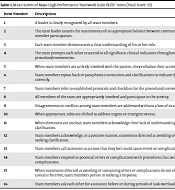
The mean values of age and work experience were 34.52 ± 9.86 and 11.02 ± 8.12 years, respectively. The mean value of teamwork skills for the studied surgical teams was 1.57 ± 0.20 (out of 2). The total score of the items was 25.20 ± 3.31 (out of 32). The majority of the items had a score higher than average. The team members had the highest score in recognizing a leader (1.87 out of 2). The team members did not do well in items 5 and 6, including verbalizing their activities (0.59 out of 2) and repeating back the instructions (0.68 out of 2). Table 1 shows the scores of each item separately.
Table 1.
Mean Scores of Mayo High-Performance Teamwork Scale Skills’ Items (Total Score: 32)
| Item Number | Description | Mean ± Standard Deviation |
|---|---|---|
| 1 | A leader is clearly recognized by all team members. | 1.87 ± 0.43 |
| 2 | The team leader assures the maintenance of an appropriate balance between command authority and team member participation. | 1.62 ± 0.63 |
| 3 | Each team member demonstrates a clear understanding of his or her role. | 1.84 ± 0.36 |
| 4 | The team prompts each other to attend to all significant clinical indicators throughout the procedure/intervention. | 1.58 ± 0.58 |
| 5 | When team members are actively involved with the patient, they verbalize their activities aloud. | 0.59 ± 0.67 |
| 6 | Team members repeat back or paraphrase instructions and clarifications to indicate that they heard them correctly. | 0.68 ± 0.76 |
| 7 | Team members refer to established protocols and checklists for the procedure/intervention. | 1.70 ± 0.52 |
| 8 | All members of the team are appropriately involved and participate in the activity. | 1.82 ± 0.40 |
| 9 | Disagreements or conflicts among team members are addressed without a loss of situation awareness. | 1.40 ± 0.62 |
| 10 | When appropriate, roles are shifted to address urgent or emergent events. | 1.72 ± 0.48 |
| 11 | When directions are unclear, team members acknowledge their lack of understanding and ask for repetition and clarification. | 1.48 ± 0.68 |
| 12 | Team members acknowledge, in a positive manner, statements directed at avoiding or containing errors or seeking clarification. | 1.31 ± 0.70 |
| 13 | Team members call attention to actions that they feel could cause errors or complications. | 1.85 ± 0.37 |
| 14 | Team members respond to potential errors or complications with procedures that avoid the errors or complications. | 1.77 ± 0.43 |
| 15 | When statements directed at avoiding or containing errors or complications do not elicit a response to avoid or contain the error, team members persist in seeking a response. | 1.65 ± 0.50 |
| 16 | Team members ask each other for assistance before or during periods of task overload. | 1.86 ± 0.35 |
Table 2 shows the detailed scores for each item based on the rating scale. Items number 5 and 6 had the lowest percentage of consistency; however, item number 1 had the highest percentage in behavior consistency.
Table 2.
Frequency and Percentage of Teamwork Scores for Each Item a
| Item Number | Never or Rarely | Inconsistently | Consistently | Not Applicable |
|---|---|---|---|---|
| 1 | 6 (3.9) | 7 (4.5) | 141 (91.6) | 0 |
| 2 | 13 (8.4) | 32 (20.8) | 109 (78) | 0 |
| 3 | 0 | 24 (15.6) | 130 (84.4) | 0 |
| 4 | 7 (4.5) | 50 (32.5) | 90 (63) | 0 |
| 5 | 79 (51.3) | 59 (38.3) | 16 (10.4) | 0 |
| 6 | 77 (50) | 49 (31.8) | 28 (18.2) | 0 |
| 7 | 5 (3.2) | 35 (22.8) | 114 (74) | 0 |
| 8 | 1 (0.6) | 25 (16.2) | 128 (81.3) | 0 |
| 9 | 11 (7.1) | 69 (44.8) | 74 (48.1) | 0 |
| 10 | 5 (3.2) | 21 (13.6) | 122 (79.2) | 6 (3.9) |
| 11 | 17 (11) | 45 (29.2) | 92 (59.7) | 0 |
| 12 | 21 (13.6) | 64 (41.6) | 69 (44.8) | 0 |
| 13 | 1 (0.6) | 21 (13.6) | 132 (85.8) | 0 |
| 14 | 1 (0.6) | 32 (20.8) | 121 (78.6) | 0 |
| 15 | 2 (1.3) | 49 (31.8) | 103 (66.9) | 0 |
| 16 | 1 (0.6) | 18 (11.7) | 134 (87) | 1 (0.6) |
a Values are expressed as No. (%).
5. Discussion
The results showed that the studied surgical teams had good teamwork skills. However, in some of the items, the studied surgical teams had low scores due to poor team communication skills. The result of good teamwork skills in this study is consistent with the results of several previous studies on surgical teams (7, 14, 18). In recent years, special attention has been paid to nontechnical skills, such as teamwork, in the operating room, as good levels of these skills have a critical role in preventing surgical adverse events (8). Therefore, hospital managers and operating room staff might be aware of teamwork benefits in providing safe patient care. This could be the reason for the good teamwork skills in this study. Moreover, the high sensitivity of pediatric surgeries could be another reason for these results. Patient safety culture in the studied pediatric surgical care units was acceptable (19). Reported positive attitudes toward the use of surgical safety checklists in pediatric surgeries (20) also show that operating room staff does well in showing their nontechnical skills in these operating rooms. Several studies have shown some poor teamwork skills in operating room practitioners in Iran (21-24). However, all of these studies were conducted at the individual level and on different surgery types than pediatric.
The studied teams had a low mean score in two items, including verbalizing their activities and repeating back the instructions. It seems that they did not do well in behaviors that were related to team communication. Clinical communication is known as a complex issue (25). In a previous study, it was revealed that verbal communication problems, such as not responding, are not rare and happen during surgeries (26). Low scores in these behaviors can be due to the importance of silence in the operating room, as several team members might need to be silent to stay focused. Trying to prevent the dispersion of oral bacteria can be another reason. However, the necessary information should be exchanged in an operating room to avoid errors. Probably, the teams with familiar members ignore some essential communications, which can cause problems in surgery. The use of standardized communication can be helpful in improving the scores in the related items. Implementing a pediatric surgical safety checklist is a useful way in this regard (27). Repeating back the instructions is more expected from surgical nurses; therefore, improving their communication skills can also help (28).
Improved teamwork skills are important in operating rooms. The benefits include shorter delays, improved effectiveness, less job stress, and more patient satisfaction (29). The surgical teams of the studied pediatric surgeries had good teamwork skills. Interventions, such as retraining courses, can help maintain the overall teamwork level. Educational programs and setting policies related to communication (26) can be helpful in improving communication.
This study had limitations. As all of the observations were made during pediatric surgeries, the results are not generalizable to other types of surgery.
5.1. Conclusions
The overall teamwork score in the studied teams in the pediatric operating rooms was at a good level. However, the studied teams did not do well in team communication behaviors. Interventions, such as educating, standardizing communications, and implementing the pediatric surgical safety checklist, can improve team communication skills.