
1. Background
Postpartum hemorrhage (PPH) is one of the leading causes of maternal morbidity and mortality worldwide (1) and remains a major public health concern in Iran, particularly in high-burden provinces such as Sistan and Baluchistan (2). Beyond its immediate physical risks, severe PPH may be experienced as a traumatic event and can increase the risk of post-traumatic stress disorder (PTSD) after childbirth (3). In many health systems, including Iran, postpartum care primarily focuses on physical recovery and the management of obstetric complications, whereas psychological consequences are less systematically assessed or addressed. This gap is particularly important in resource-limited settings, where access to mental health specialists is restricted and midwives are often the main providers of postpartum care.
Current practice does not include routine screening or structured counseling for women who experience trauma-related distress after PPH, and many midwives have limited training in trauma-informed psychosocial support. Cultural barriers and stigma may further reduce the disclosure of emotional distress, leading to under-recognition of postpartum PTSD and delays in providing support for affected women. Recent evidence from a quasi-experimental study conducted in Zahedan in 2023 suggests that structured midwife-led counseling based on Gamble's approach may reduce PTSD symptoms following PPH and may be feasible within routine postpartum services (4).
2. Objectives
Based on this evidence, this brief examines whether integrating structured midwife-led counseling into postpartum care could provide a practical response to an unmet maternal mental health need. It focuses on early postpartum support within existing maternity services and does not address specialist psychiatric treatment or long-term mental health interventions (5).
3. Methods
This policy brief is informed solely by findings from a quasi-experimental intervention study conducted in 2023 at Ali Ibn Abi Talib (AS) Hospital, Zahedan, Iran, and approved by the Research Ethics Committee affiliated with Zahedan University of Medical Sciences (code of ethics: IR.ZAUMS.REC.1402.152). The study included 60 primiparous women who experienced postpartum hemorrhage and were allocated to intervention and control groups. The intervention consisted of two structured, midwife-led counseling sessions based on Gamble's counseling model: one face-to-face session within 48 - 72 hours after childbirth and one follow-up telephone session 2 weeks postpartum. Post-traumatic stress symptoms were assessed before the intervention and 4 weeks after follow-up using the PCL-5 and PPQ-II. The policy recommendations in this brief were derived directly from these findings and their implications for postpartum care.
4. Results
4.1. Key Policy Options
The proposed policy options are as follows:
1) Develop intensive midwife-led counseling protocols based on the Gamble model, ensuring at least one session within 72 hours postpartum and follow-up at weeks 2 and 4.
2) Introduce structured postpartum PTSD screening in maternity units using validated tools (e.g., PCL-5 and PPQ-II) and open-ended clinical questions.
3) Train midwives to identify and manage PTSD symptoms by incorporating communication, screening, and cognitive restructuring techniques into midwifery curricula.
4) Enhance postpartum follow-up in underserved areas through telephone-based counseling and by prioritizing midwifery training in rural and nomadic regions.
5) Strengthen monitoring and implementation support by embedding follow-up indicators and referral tracking into routine postpartum registry systems.
6) Increase investment in operational research to evaluate mid-term counseling outcomes up to 12 weeks and conduct national cost-benefit analyses.
4.2. Description of the Policy Options and Their Advantages and Disadvantages
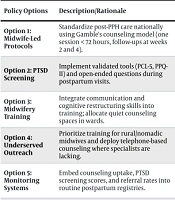
The following policy options constitute a complementary package designed to integrate psychosocial support into existing maternal health services. Rather than representing competing alternatives, they combine protocol development, screening, workforce capacity building, targeted outreach in underserved areas, and data-driven monitoring. By using the existing midwifery workforce and leveraging remote follow-up pathways, this package maximizes feasibility and resource efficiency in resource-constrained settings. These six complementary options are summarized in Table 1.
Table 1.
Policy Options for Integrating Psychosocial Support into Postpartum Care After Postpartum Hemorrhage, Including Advantages, Disadvantages/Risks, Feasibility/Cost Considerations, and Key Implementers
| Policy Options | Description/Rationale | Main Advantages | Main Disadvantages/risks | Feasibility/Cost Considerations | Key Implementers |
|---|---|---|---|---|---|
| Option 1: Midwife-Led Protocols | Standardize post-PPH care nationally using Gamble's counseling model (one session < 72 hours, follow-ups at weeks 2 and 4). | Promotes evidence-based, structured follow-up; ensures clinical consistency. | Requires policy approval; implementation may vary by facility. | High feasibility; low cost (incorporates into existing postnatal protocols). | Ministry of Health, Medical Universities, Hospital Managers |
| Option 2: PTSD Screening | Implement validated tools (PCL-5, PPQ-II) and open-ended questions during postpartum visits. | Enables early trauma detection; supports objective referral pathways. | Screening without referral capacity limits utility; potential patient stigma. | High feasibility; low cost (requires brief training and simple tools). | Maternity Units, Health Centers, Midwives |
| Option 3: Midwifery Training | Integrate communication and cognitive restructuring skills into training; allocate quiet counseling spaces in wards. | Upskills the existing workforce; provides sustainable, trusted first-line support. | Increased staff workload; requires dedicated physical space in busy wards. | High feasibility; moderate cost (curriculum updates and space reallocation). | Ministry of Health, Midwifery Schools, Professional Boards |
| Option 4: Underserved Outreach | Prioritize training for rural/nomadic midwives and deploy telephone-based counseling where specialists are lacking. | Overcomes geographic barriers; improves equity of care for remote populations. | Dependent on mobile coverage; potential privacy concerns during calls. | High feasibility; low cost (uses existing phone/telehealth lines). | Provincial Health Authorities, Rural Clinics |
| Option 5: Monitoring Systems | Embed counseling uptake, PTSD screening scores, and referral rates into routine postpartum registries. | Ensures clinical accountability; tracks service coverage and quality gaps. | Reporting burden on staff; risk of incomplete or inconsistent data. | Moderate feasibility; low-to-moderate cost (uses current IT platforms). | Ministry of Health Information Units, Quality Teams |
| Option 6: Operational Research | Invest in research on counseling outcomes up to 12 weeks and national cost-benefit analyses. | Builds local evidence for scale-up; justifies long-term resource allocation. | Research timelines may delay wider programmatic decisions. | Moderate feasibility; moderate cost (funded through research grants). | Ministry of Health, Research Councils, Universities |
The evidence suggests that, when implemented together, these six options create a resilient safety net for women after PPH. The primary focus remains on capacity building within the midwifery workforce and on standardizing follow-up protocols to ensure that no woman is left without support after surviving a life-threatening obstetric event. These strategies are particularly well suited to resource-limited settings, where maximizing existing infrastructure is essential for sustainable health outcomes.
5. Discussion
5.1. Further Important Considerations
Postpartum care should extend beyond maternal physical recovery alone. Integrating structured, midwife-led counseling into routine care is a feasible approach to reducing post-traumatic stress symptoms. Without systematic screening and stepwise counseling, there remains a critical risk of chronic psychological harm, early breastfeeding cessation, and disrupted mother–infant bonding. Priority should be given to establishing early and follow-up counseling sessions within national maternal mental health policies to prevent long-term morbidity.
The next step is to translate this evidence into practice. Health authorities should initiate phased adoption in selected facilities, supported by brief midwife training, standardized screening protocols, and simple monitoring systems. Early implementation should track counseling coverage, follow-up completion, and referral of women with persistent symptoms while identifying barriers such as limited staff time and follow-up challenges in underserved areas. Further evidence from larger studies will guide national scale-up.