
1. Background
Postpartum hemorrhage (PPH), defined as blood loss exceeding 500 mL following vaginal delivery or ≥ 1,000 mL after cesarean section, remains the leading cause of maternal mortality globally, accounting for more than 20% of all maternal deaths (1, 2). Timely detection and treatment of PPH have been shown to reduce severe maternal outcomes in randomized trials (3), underscoring that clinical competence in recognizing and managing PPH directly affects survival. In Indonesia, the national maternal mortality ratio was 305 per 100,000 live births in 2023, significantly exceeding the national target of 183 per 100,000, with PPH accounting for approximately 28% of maternal deaths (4). These figures underscore the urgent need to strengthen the clinical competence of frontline midwifery providers in managing obstetric emergencies.
Evidence-Based Medicine (EBM), defined by Sackett and colleagues as the conscientious, explicit, and judicious use of the best current evidence in making decisions about individual patient care (5), has been widely endorsed as a foundational approach to improving clinical practice. In practice, EBM is not a single behavior but comprises several subcomponents—evidence access, critical appraisal, guideline utilization, and interprofessional collaboration around evidence (6)—within midwifery and obstetric education. EBM is theorized to enhance clinical competence across three core learning domains: Cognitive (medical knowledge), affective (professional behavior), and psychomotor (clinical skills). This three-domain structure follows Bloom’s Taxonomy of Educational Objectives, which has been applied directly to the development of clinical competence through simulation-based nursing and midwifery education (7). Despite widespread advocacy for EBM, studies examining the specific mediating pathways through which EBM influences clinical competence remain limited.
Prior studies have demonstrated that EBM-based training improves healthcare providers’ knowledge and procedural skills in obstetric emergencies (8-11) and that simulation-based learning aligned with EBM principles significantly enhances midwives’ clinical performance (12). Studies of evidence-based practice among nurse-midwives further show that knowledge, attitude, and behavioral use of evidence do not always change in parallel (13), supporting their treatment as related but distinguishable constructs rather than a single undifferentiated outcome. However, few studies have rigorously tested the simultaneous mediating roles of knowledge, professional behavior, and clinical skills within a structural model (14, 15). Notably, implementation science frameworks suggest that professional behavior is governed predominantly by organizational and contextual factors—such as institutional culture, supervisory climate, and peer norms—rather than by individual EBM competency alone (16-18).
Specifically, while prior work has examined EBM’s association with knowledge or skills in isolation, no study to our knowledge has simultaneously modeled medical knowledge, professional behavior, and clinical skills as parallel mediators of the EBM–clinical competence pathway within a single structural model for postpartum hemorrhage management. This has practical implications: curriculum designers operating under limited training time and resources need to know which pathway—cognitive, affective, or psychomotor—contributes most to clinical competence so that EBM-integrated training can be prioritized accordingly, rather than being distributed evenly across all three domains by default.
This study addresses this gap by employing SEM-PLS (19), a technique suited for complex multi-mediation models with small-to-moderate samples, to examine both direct and indirect structural pathways between EBM and clinical competence in PPH management.
2. Objectives
To determine whether Indonesian midwifery students’ knowledge and clinical skills mediate the association between evidence-based medicine (EBM) and clinical competence in postpartum hemorrhage (PPH) management.
3. Methods
3.1. Research Design
A quantitative cross-sectional explanatory design was used to examine the structural relationships among EBM practice, medical knowledge, professional behavior, clinical skills, and clinical competence at a single time point. Because data were collected at one time point, the SEM-PLS path coefficients in this study describe the strength and direction of structural associations among latent constructs and should be interpreted as predictive/explanatory rather than causal; reverse causality (e.g., more clinically competent students engaging more readily with EBM) cannot be ruled out by this design and is revisited in the limitations. This design is appropriate for characterizing the simultaneous relationships among multiple theoretically specified latent constructs using structural equation modeling. Reporting follows the STROBE checklist for observational cross-sectional studies (20).
3.2. Setting and Sample
The study was conducted at a private health sciences college offering an advanced midwifery bridging program (S1 Kebidanan Alih Jenjang) in Jombang District, East Java, Indonesia. Data were collected from October to November 2025.
A census approach was used to survey all 157 students. Inclusion criteria were: (1) enrollment in the S1 Kebidanan Alih Jenjang program; (2) being a registered midwife or midwifery practitioner with at least six months of active clinical experience in PPH management; (3) completion of the EBM-integrated curriculum modules; and (4) provision of written informed consent. Exclusion criteria were: (1) being on approved leave of absence during data collection; (2) an incomplete questionnaire (> 10% missing items).
3.3. Measurement and Data Collection
Data were collected using a standardized, self-administered questionnaire developed and validated by the research team based on established theoretical constructs and prior literature. The instrument comprised 30 items across five constructs: Evidence-Based Medicine (8 items), Medical Knowledge (5 items), Professional Behavior (6 items), Clinical Skills (7 items), and Clinical Competence (4 items). All items were measured on a 5-point Likert scale (1 = strongly disagree to 5 = strongly agree). Higher composite scores indicate higher levels of each construct.
EBM items were adapted from Sackett and colleagues (5) and Barzkar and colleagues (21) and were designed to cover four sub-behaviors: evidence access, critical appraisal, guideline utilization, and interprofessional EBM collaboration, consistent with recent scoping-review evidence on how EBM/EBP knowledge and skills are operationalized in health care professional instruments (6) and with consensus statements on core EBP competencies for nurses (22). Medical knowledge items addressed PPH etiology, intervention selection, guideline application, effectiveness analysis, and patient response evaluation. Clinical skills items covered patient preparation, initial diagnosis, hemorrhage management, monitoring, advanced intervention, team coordination, and documentation. For clarity and consistency throughout this manuscript, clinical skills refer specifically to the 7-item psychomotor/procedural mediator construct, whereas clinical competence refers to the 4-item integrated outcome construct assessing the combined application of knowledge, skills, and professional behavior in PPH management; the unqualified term “competence” is not used as shorthand for either construct elsewhere in this manuscript. Clinical competence items assessed the integrated application of knowledge, skills, and professional behavior in PPH management, consistent with FIGO recommendations (23).
Content validity was established through expert panel review by five academic and clinical midwifery educators with EBM expertise. Pilot testing was conducted in 30 students not included in the main study. All Cronbach’s alpha values exceeded 0.877, and composite reliability exceeded 0.897, confirming strong internal consistency. Questionnaires were administered anonymously by research assistants independent of course instructors to minimize social desirability bias. Common method variance was assessed using two complementary procedures: Harman’s single-factor test, in which the first unrotated factor accounted for less than 30% of the total variance, and a full collinearity variance inflation factor (VIF) test, in which all construct-level VIFs were below the conservative threshold of 3.3 (19), jointly indicating that common method bias is unlikely to be a dominant influence on the results.
3.4. Data Analysis
Data were analyzed using SEM-PLS in SmartPLS 4.0 (24), following a two-stage approach. Stage 1 — outer (measurement) model evaluation: convergent validity (factor loading ≥ 0.5; average variance extracted [AVE] ≥ 0.5), discriminant validity (heterotrait-monotrait ratio [HTMT] < 0.85; cross-loading dominance), and construct reliability (Cronbach’s α ≥ 0.70; composite reliability ≥ 0.70) (19). Stage 2 — inner (structural) model evaluation: coefficient of determination (R2), Stone-Geisser predictive relevance (Q2 > 0 via blindfolding), and path coefficient significance via bootstrapping (5,000 resamples, two-tailed, t statistic > 1.96, P < 0.05). Mediation was assessed by testing the statistical significance of indirect path coefficients from bootstrapping with 95% confidence intervals. Because EBM showed no significant association with professional behavior in the primary model, a post hoc sensitivity analysis excluding academic-setting participants (n = 137) was conducted to assess the robustness of this null structural relationship rather than to establish causality.
3.5. Ethical Considerations
Ethics approval was obtained from the Institutional Review Board of STIKes Jombang (Reference No.: IRB/STIKes-JBG/2025/012). All participants provided written informed consent prior to data collection. Participation was voluntary and anonymous. No personal identifiers were recorded. The study was conducted in accordance with the Declaration of Helsinki.
4. Results
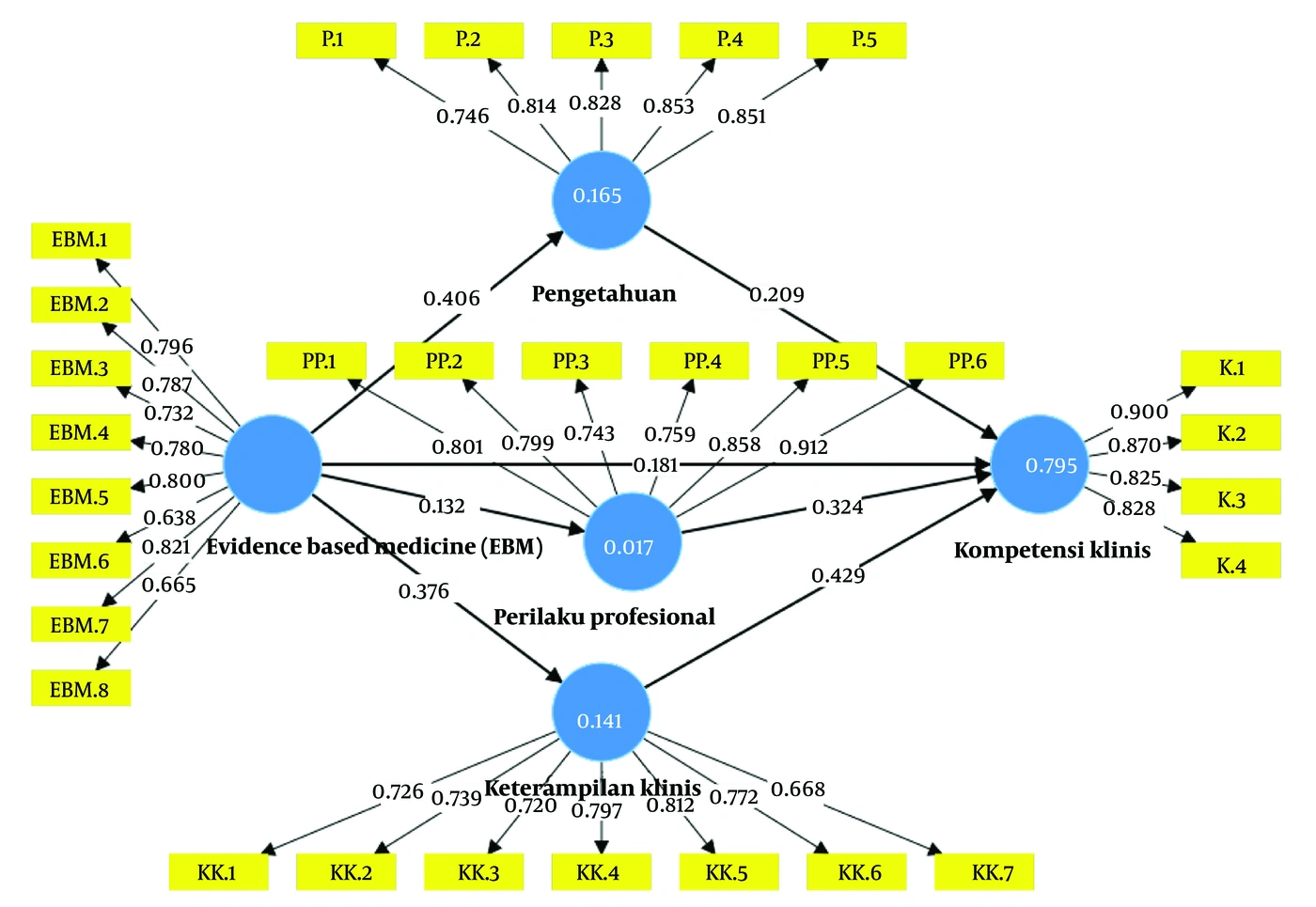
Figure 3.
Final Integrative Structural Model for Postpartum Hemorrhage Clinical Competence: Evidence-Based Medicine–Medical Knowledge–Clinical Skills–Clinical Competence. Solid arrows = significant paths; dashed arrows = non-significant paths. Coefficient of determination (clinical competence) = 0.795. *P < 0.05.
4.1. Participant Characteristics
Of the 157 students originally invited, 150 met the eligibility criteria, provided consent, and completed the questionnaire in full (response rate 95.5%); 7 students were excluded before data collection (3 on approved leave; 4 declined consent). The mean age was 29.7 years (SD = 5.44; range 21 - 42 years). Most participants were employed in hospital settings (51.3%), followed by community health centres/Puskesmas (25.3%), private clinics (14.7%), and academic settings (8.7%).
4.2. Measurement Model Evaluation
All indicator factor loadings exceeded the 0.50 threshold (range 0.638 - 0.912), and all AVE values exceeded 0.50 (range 0.561 - 0.733), confirming convergent validity (Table 1). All HTMT ratios were below 0.85 (highest value: clinical skills–clinical competence = 0.844), confirming discriminant validity. All Cronbach’s alpha (≥ 0.877) and composite reliability (≥ 0.897) values exceeded the 0.70 thresholds (Table 1), indicating strong internal consistency. The outer model is presented in Figure 1.
Table 1.
Measurement Model for PPH Clinical Competence: Factor Loadings, AVE, Cronbach’s Alpha, and Composite Reliability a
| Constructs and Indicators | Loading | AVE | α | CR | |
|---|---|---|---|---|---|
| EBM | 0.570 | 0.892 | 0.913 | ||
| Access to scientific evidence | 0.796 | ||||
| Technology use in practice | 0.787 | ||||
| Integration of evidence | 0.732 | ||||
| Critical appraisal of evidence | 0.780 | ||||
| Use of evidence-based guidelines | 0.800 | ||||
| Monitoring and outcome evaluation | 0.638 | ||||
| Continuing education in EBM | 0.821 | ||||
| Interprofessional EBM collaboration | 0.665 | ||||
| Medical Knowledge | 0.671 | 0.877 | 0.911 | ||
| Identification of PPH etiology | 0.746 | ||||
| Selection of interventions | 0.814 | ||||
| Application of clinical guidelines | 0.828 | ||||
| Analysis of intervention effectiveness | 0.853 | ||||
| Evaluation of patient response | 0.851 | ||||
| Professional Behavior | 0.662 | 0.897 | 0.921 | ||
| Commitment to ethical standards | 0.801 | ||||
| Interprofessional collaboration | 0.799 | ||||
| Effective communication | 0.743 | ||||
| Guideline adherence | 0.759 | ||||
| Composure in emergencies | 0.858 | ||||
| Transparent decision-making | 0.912 | ||||
| Clinical Skills | 0.561 | 0.874 | 0.897 | ||
| Patient preparation | 0.726 | ||||
| Symptom identification and diagnosis | 0.739 | ||||
| Initial hemorrhage management | 0.720 | ||||
| Patient monitoring | 0.797 | ||||
| Advanced intervention | 0.812 | ||||
| Team communication | 0.772 | ||||
| Clinical documentation | 0.668 | ||||
| Clinical Competence | 0.733 | 0.878 | 0.916 | ||
| Clinical knowledge of PPH | 0.900 | ||||
| Clinical skills in hemorrhage mgmt. | 0.870 | ||||
| Professional behavior and ethics | 0.825 | ||||
| Clinical performance evaluation | 0.828 |
a All loadings and AVE values exceed recommended thresholds (≥ 0.5). HTMT discriminant validity: all ratios < 0.85 (highest = 0.844, clinical skills–clinical competence). Abbreviations: PPH, Postpartum Hemorrhage; EBM, Evidence-Based Medicine; AVE, Average Variance Extracted; α, Cronbach’s alpha; CR, composite reliability; HTMT, Heterotrait-Monotrait Ratio.
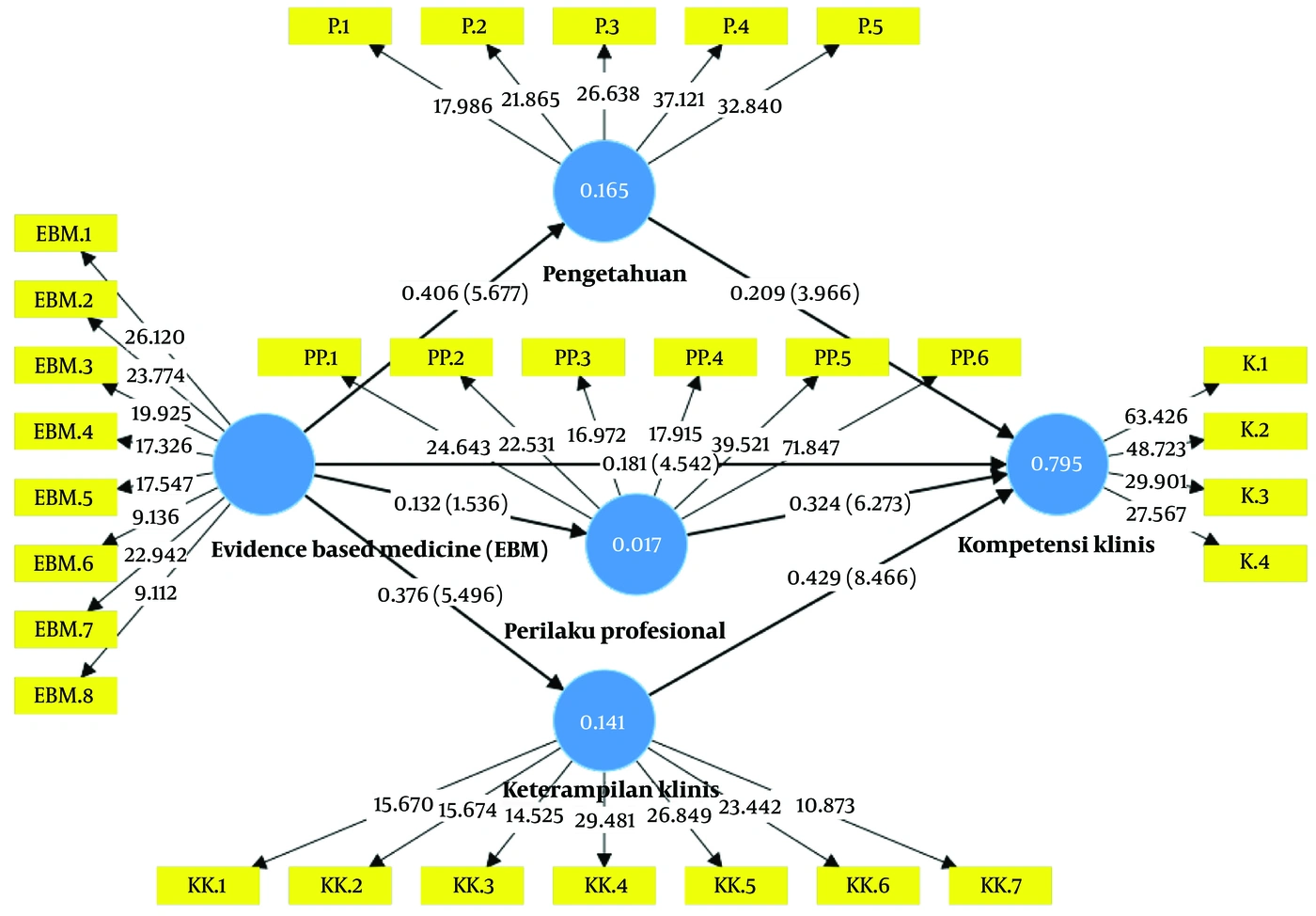
Figure 1.
Measurement Model (Outer Model) for Evidence-Based Medicine and Clinical Competence in Postpartum Hemorrhage Management—Structural Equation Modeling Based on Partial Least Squares Factor Loadings and Coefficient of Determination Values
4.3. Structural Model Evaluation and Hypothesis Testing
Table 2 presents R2 and Q2 values for the structural model. The model explained 79.5% of the variance in clinical competence, indicating strong explanatory power for the PPH clinical competence outcome. EBM accounted for a smaller share of the variance in professional behavior than in medical knowledge or clinical skills. All Q2 values were positive, indicating adequate predictive relevance. The inner model is presented in Figures 2 and 3.
Table 2.
Structural Model for PPH Clinical Competence: R2 and Q2a
| Endogenous Variable | R2 | R2 Adjusted | SSO | Q2 |
|---|---|---|---|---|
| Medical Knowledge | 0.165 | 0.159 | 750.000 | 0.105 |
| Professional Behavior | 0.017 | 0.011 | 900.000 | 0.010 |
| Clinical Skills | 0.141 | 0.135 | 1050.000 | 0.067 |
| Clinical Competence b | 0.795 | 0.790 | 600.000 | 0.568 |
a Q2 = 1 − SSE/SSO. All Q2 > 0 confirm predictive relevance. Abbreviations: PPH, postpartum hemorrhage; EBM, evidence-based medicine; R2, coefficient of determination; Q2, predictive relevance (Stone-Geisser criterion); SSE, sum of squares of errors; SSO, sum of squares of observations.
b Primary outcome.
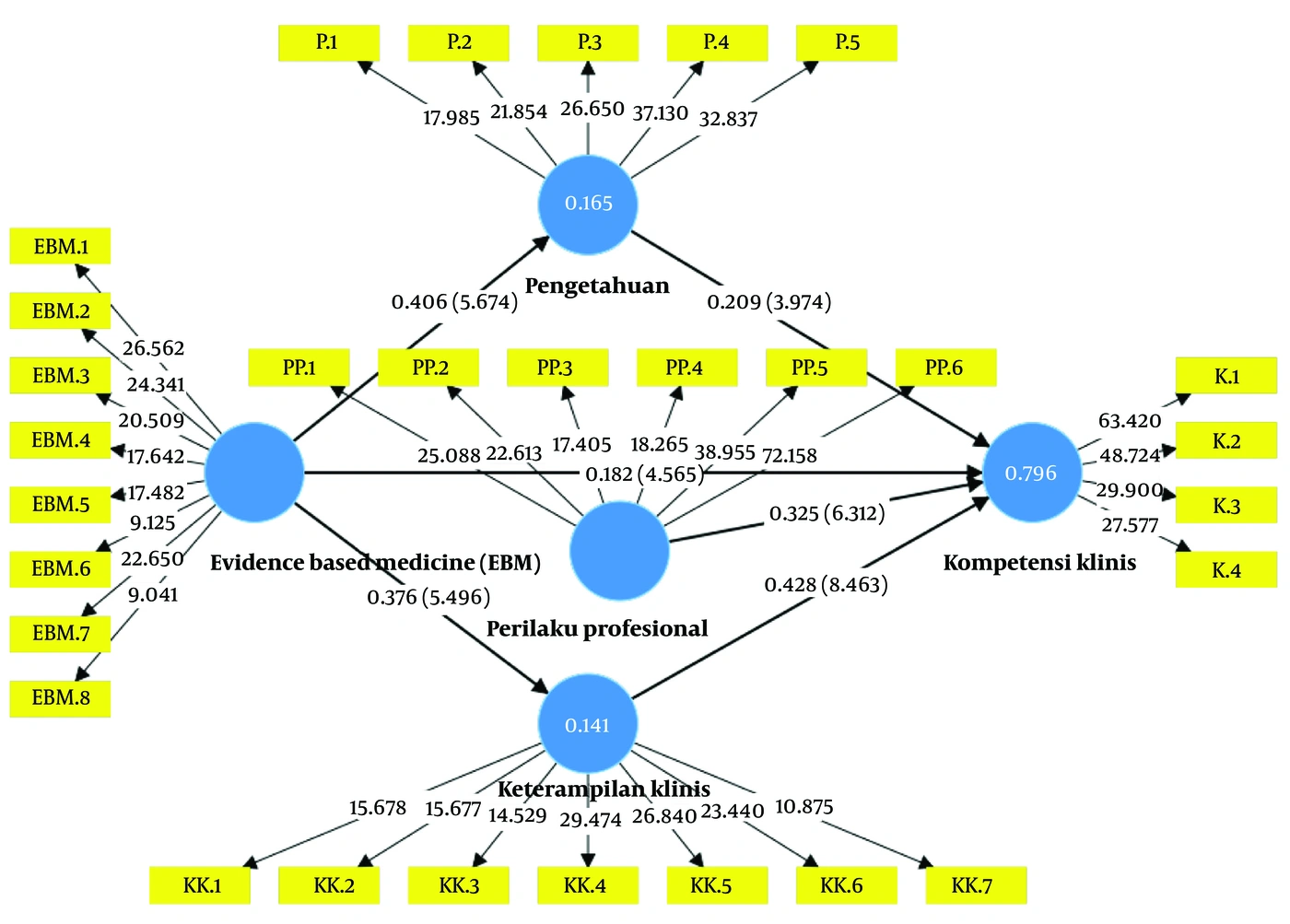
Figure 2.
Structural Model (Inner Model) for Postpartum Hemorrhage Clinical Competence—Bootstrapped Path Coefficients With t Statistics. Dashed line = non-significant path (Evidence-Based Medicine → Professional Behavior).
Table 3 presents the direct and indirect path coefficient results. EBM was significantly associated with medical knowledge and clinical skills, but not with professional behavior. EBM also showed a significant direct association with clinical competence. Among the three candidate mediators, clinical skills was the strongest direct predictor of clinical competence, followed by professional behavior and medical knowledge. Full coefficients, confidence intervals, and significance levels are reported in Table 3; the inner model with bootstrapped t statistics is shown in Figure 2.
Table 3.
Direct and Indirect Path Coefficients for PPH Clinical Competence: Hypothesis Testing Results a
| Path | β | t | P | 95% CI Low | 95% CI High | Result |
|---|---|---|---|---|---|---|
| Direct Effects | ||||||
| EBM → Medical Knowledge | 0.406 | 5.677 | < 0.001 | 0.263 | 0.549 | Supported |
| EBM → Professional Behavior | 0.132 | 1.536 | 0.124 | −0.036 | 0.301 | Not supported |
| EBM → Clinical Skills | 0.376 | 5.496 | < 0.001 | 0.239 | 0.513 | Supported |
| EBM → Clinical Competence (Direct) | 0.181 | 4.542 | < 0.001 | 0.101 | 0.261 | Supported |
| Medical Knowledge → Clinical Competence | 0.209 | 3.966 | < 0.001 | 0.105 | 0.313 | Supported |
| Professional Behavior → Clinical Competence | 0.324 | 6.273 | < 0.001 | 0.221 | 0.427 | Supported |
| Clinical Skills → Clinical Competence b | 0.429 | 8.466 | < 0.001 | 0.329 | 0.529 | Supported |
| Indirect Effects (Mediation) | ||||||
| EBM → Medical Knowledge → Clinical Competence b | 0.098 | 3.205 | 0.001 | 0.038 | 0.158 | Sig. (partial) |
| EBM → Clinical Skills → Clinical Competence b | 0.159 | 4.633 | < 0.001 | 0.093 | 0.225 | Sig. (partial) |
| EBM → Prof. Behavior → Clinical Competence | 0.043 | 1.554 | 0.120 | −0.012 | 0.098 | Not significant |
a 95% CIs from 5,000-resample percentile bootstrapping. Partial mediation: EBM retains a significant direct association with clinical competence alongside both significant indirect paths. Abbreviations: PPH, Postpartum Hemorrhage; EBM, Evidence-Based Medicine; β, standardized path coefficient; t, t statistic; P, probability value; CI, confidence interval.
b Primary mediation pathways of interest.
5. Discussion
This cross-sectional SEM-PLS study found that medical knowledge and clinical skills are significant dual mediators of the EBM–clinical competence relationship in PPH management, with clinical skills representing the dominant pathway. These findings are consistent with the broader EBM and simulation-training literature (25, 26) and extend it by quantifying the relative contributions of the knowledge and skills pathways within a single structural model rather than evaluating them separately.
The significant association between EBM and medical knowledge is consistent with evidence that EBM-based training is linked to gains in healthcare providers’ clinical knowledge through evidence retrieval, critical appraisal, and clinical synthesis (5, 21). In the PPH context, EBM exposure has been associated with improved knowledge of uterotonic selection, hemorrhage quantification, and referral decision-making (9, 27), all of which are relevant to competent PPH management. Medical knowledge was, in turn, significantly associated with clinical competence, suggesting a potential cognitive pathway to competence rather than establishing one. This pattern is broadly consistent with the Learning-to-Results linkage described in Kirkpatrick’s four-level training-evaluation framework, under which gains at the Learning level (Level 2) are associated with downstream gains at the Results level (Level 4) (28); this is noted as an interpretive parallel rather than a claim that the present cross-sectional design directly demonstrates this temporal linkage.
Clinical skills emerged as both the strongest direct predictor of clinical competence and the most potent mediator of the EBM–competence pathway, exceeding the contribution of the knowledge pathway. This finding is consistent with deliberate practice theory (29), which holds that psychomotor competence improves through structured, feedback-guided repetition anchored in evidence-based protocols. EBM-integrated simulation training has been associated with improved procedural performance across PPH management contexts (10, 12). The larger contribution of the skills pathway, relative to the knowledge pathway, suggests a potential pattern in which the psychomotor translation of EBM evidence is more proximally linked to clinical competence than cognitive retention alone—a pattern that warrants prospective testing and has direct relevance for training-program design.
Contrary to expectations, EBM showed no significant association with professional behavior, and professional behavior did not mediate the EBM–competence relationship. We offer two non-exclusive explanations for this null pathway, neither of which the present data can adjudicate, because no organizational-level variables were measured and no multilevel analysis was performed. First, changes in professional behavior may be governed predominantly by organizational-level factors—such as institutional culture, supervisory climate, peer norms, and accountability structures—rather than by individual EBM knowledge acquisition, consistent with the implementation-science literature on provider behavior change, including the Consolidated Framework for Implementation Research, and with recent evidence that organisational practice-environment factors shape nurses’ EBP adoption (16-18). Under this explanation, professional behaviors such as interprofessional communication, ethical commitment, and composure under pressure—which depend substantially on interprofessional collaboration (30)—would be expected to develop primarily through socialization and mentorship rather than information-based training alone. Second, an alternative and equally plausible explanation is that the 6-item professional-behavior scale used here—covering ethics, collaboration, communication, guideline adherence, composure, and transparency—may not align closely enough with PPH-specific behavioral demands to detect an EBM association even if one exists; with the present data, we cannot distinguish this measurement-alignment explanation from the organizational explanation. The sensitivity analysis excluding academic-setting participants (n = 137) indicated that the null result was stable. Professional behavior nonetheless remained a significant direct predictor of clinical competence, suggesting that it may contribute to competence through pathways external to EBM exposure, such as the organizational or measurement factors discussed above.
The model explained 79.5% of the variance in clinical competence, indicating that the integrative four-variable model captures a substantial share of variance in PPH clinical competence within this sample. This figure is interpreted cautiously rather than as straightforward evidence of model strength. Two safeguards were applied to assess whether common method bias could be inflating this figure: Harman’s single-factor test (first factor < 30% of variance) and a full collinearity VIF test (all construct VIFs < 3.3) (19); both indicate that common method bias is unlikely to be the dominant driver of the observed R2. However, because all constructs were measured via a single self-report instrument at a single time point, some degree of common method variance cannot be fully excluded, and no held-out sample or cross-validation procedure (e.g., k-fold validation, PLSpredict out-of-sample assessment) was used to confirm the model’s predictive performance beyond the estimation sample; this is flagged explicitly as a direction for replication rather than presenting the R2 as a fully validated effect size. The dual-pathway structure—EBM→Knowledge→Competence and EBM→Skills→Competence—nonetheless offers a preliminary, empirically grounded framework for curriculum design and training-program development, pending replication.
These findings have direct implications for nursing and midwifery education and practice. For educational institutions, curricula could be redesigned to integrate EBM systematically through simulation-based skills training, case-based clinical reasoning, and structured knowledge-application exercises. The larger contribution of the skills pathway suggests that simulation hours, procedural feedback, and scenario-based drills in PPH management may merit particular emphasis within EBM-aligned curricula (31), pending confirmation in studies using objective performance measures. For clinical institutions, EBM implementation could be positioned within a broader quality-improvement framework incorporating regular team-based emergency drills, clinical supervision, and auditing cycles—approaches that may address organizational drivers of professional behavior that EBM training alone did not appear to influence in this study. For policymakers, these findings provide preliminary support for considering the integration of EBM competencies and simulation-based skills assessment into midwifery credentialing standards; however, this recommendation is offered cautiously, as it is based on a single-center, cross-sectional study without objective performance measures and would benefit from replication across multiple institutions before informing policy at scale.
5.1. Limitations
Several limitations should be acknowledged. First, the cross-sectional design precludes causal inference; SEM-PLS path coefficients describe structural association, not causal order, and reverse causality (i.e., higher clinical competence leading to greater EBM engagement) cannot be excluded. Second, restriction to a single institution limits generalizability beyond the East Java bridging midwifery program context; all participants met a minimum inclusion threshold of six months of active PPH-related clinical experience, but the distribution of clinical experience beyond this minimum was not captured, and the findings may not generalize to other educational or national contexts with different experience profiles. Third, self-report questionnaire measures of clinical skills and competence may not correspond exactly to performance on objective measures (e.g., OSCE, direct observation); self-report assessments in the simulation-education literature have been observed to be higher than observer-rated assessments, which could inflate both construct correlations and downstream path coefficients to an extent that this design cannot quantify. Fourth, although Harman’s single-factor test and a full collinearity VIF test both suggested that common method bias was not dominant, a single-instrument, single-time-point design cannot fully eliminate this threat, and no cross-validation or held-out sample was used to confirm predictive performance beyond the estimation sample. Fifth, organizational determinants of professional behavior—including institutional culture, leadership, and supervisory quality—were not measured, limiting our ability to distinguish an organizational explanation from a measurement-alignment explanation for the near-zero EBM→professional-behavior association. Sixth, participant sex was not formally recorded as a study variable. Midwifery (kebidanan) education and practice in Indonesia is, by long-standing professional convention, composed overwhelmingly of women, so the sample was very likely predominantly or entirely female; however, this was not empirically verified in the present dataset. Finally, demographic characteristics beyond age and workplace setting (e.g., education level, prior EBM-specific training exposure) were not collected, limiting characterization of the sample; future replications should capture a broader demographic and organizational panel.
5.2. Conclusions
This study found that medical knowledge and clinical skills are significant dual mediators of the EBM–clinical competence relationship in PPH management among midwifery students, with the clinical skills construct as the dominant mediator and strongest predictor of clinical competence. The integrative model explained a substantial share of variance in clinical competence. EBM showed no significant association with professional behavior, which is consistent with—though not proof of—the organizational and measurement-alignment explanations discussed above. These findings contribute a dual-pathway structural model that distinguishes the relative contributions of cognitive and psychomotor pathways in the EBM–competence relationship and is offered as a basis for further testing rather than as a settled causal account.
Midwifery education institutions may wish to prioritize simulation-based skills training within EBM curricula to support development along the psychomotor pathway associated with clinical competence. Organizational investments in mentorship, interprofessional drills, and supervisory feedback are suggested as approaches to support professional behavior development through channels that appear to operate independently of EBM content delivery in this sample. Future research should employ longitudinal designs with objective competency assessments, incorporate organizational-level variables (institutional culture, supervisory quality), and replicate the model across diverse healthcare facility levels and geographic contexts to strengthen causal inference and generalizability.