Fulltext
-
Image Credit:Med Surg Nurs J
Authors
Background: Hospitalization in cardiac care unit (CCU) results in much anxiety followed by changes in hemodynamic indices in most patients. The accompanying family members play an important role in patient’s care and support. Therefore, the current study was performed to determine the impact of family-based training programs on hemodynamic indices and duration of hospitalization for patients with coronary artery disease.
Methods: The population of this clinical trial study consists of patients with coronary artery disease hospitalized in CCU of an educational hospital in Zanjan, Iran in 2013. Eighty patients were selected through convenience sampling method, and were randomly assigned into the two groups of intervention and control. The family-based training program for the intervention group was executed as three 40-60 min sessions of face-to-face meeting with the patients and the core accompanying family member. Mean hemodynamic indices of the patients including systolic and diastolic blood pressures, average arterial blood pressure, and heart rate were measured and recorded on days one to four of the hospitalization based on the hospitalization duration. Data analysis was performed by Chi-square, independent t-test, and repeated measures ANOVA.
Results: Post-intervention, the hemodynamic indices and hospitalization duration were lower in the intervention group compared to the controls. However, this difference was significant for heart rate (P<0.001), respiratory rate (P=0.002), and hospitalization duration (P<0.001).
Conclusion: Family-based training programs are recommended as a cost-benefit method in CCU.
© 2030, Author(s). This open-access article is available under the Creative Commons Attribution 4.0 (CC BY 4.0) International License (https://creativecommons.org/licenses/by/4.0/), which allows for unrestricted use, distribution, and reproduction in any medium, provided that the original work is properly cited.

Abdolahi Shahvali E, Adineh M, Davarpanah I, Saberipour B, Jahangirimehr A, et al. The Effect of Family’s Scheduled Visitation on Vital Signs and Satisfaction Level of Patients Admitted to the Cardiac Care Unit: A Randomized Clinical Trial. Jundishapur J Chronic Dis Care. 2022;11(2):e123165. doi: https://doi.org/10.5812/jjcdc-123165
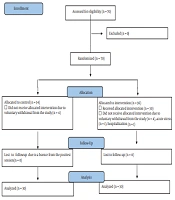
Jafari F, Shahriari M. Effects of Lifestyle Education on Depression, Anxiety, Stress, and Perceived Family Support Among Hypertensive Patients. Med Surg Nurs J. 2021;10(3):e122691. doi: https://doi.org/10.5812/msnj.122691
Shoushi F, Mousavinasab SN, Kamali M, Shafipour V. The impact of family support program on depression, anxiety, stress, and satisfaction in the family members of open-heart surgery patients. J Nurs Midwifery Sci. 2020;7(2):e140797. doi: https://doi.org/10.4103/jnms.jnms_21_19
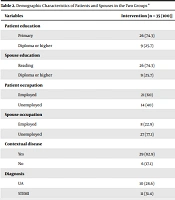
Rafeie R, Pishkar Mofrad Z, Momeni MK, Ebrahimi Tabas E. Effect of Couple Education on Spouses' Anxiety and Treatment Adherence in Patients with Acute Coronary Syndrome Admitted to Cardiac Intensive Care Unit. Med Surg Nurs J. 2021;10(4):e123617. doi: https://doi.org/10.5812/msnj.123617
Esmaeilpour H, Yazdi K, Yazdi K, Azimi HR, Mir Ahmadi AA. Effect of training and post discharge follow-up on self- care behavior of patients with ischemic heart disease. koomesh. 2017;19(2):e151098. doi:
Last Update: 2 days ago
Last Update: 2 days ago
Last Update: 2 days ago
Last Update: 9 hours ago
Last Update: 11 hours ago
Last Update: 4 days ago