
1. Background
Patients admitted to the intensive care unit are threatened due to their serious illnesses caused by secondary problems and diseases, such as hospital-acquired infections (1). For example, pneumonia is the second most commonly diagnosed hospital infection in intensive care unit (ICU) patients, affecting 27% of all patients. Mechanical ventilation accounts for 86% of hospital pneumonia and is known as ventilator-associated pneumonia (VAP) (2). By definition, VAP refers to respiratory infection, which occurs after the first 48 hours of endotracheal intubation (3, 4). One of the important risk factors for the development of VAP is aspiration, including aspiration of oropharyngeal droplets (5-8). This can be an indication of the importance of oral hygiene in intubated patients. Practicing good oral hygiene through subglottic suctioning, removing dental and microbial plaque through mechanical interventions, such as toothbrushes and mouthwashes, and chemical interventions, such as the use of antimicrobial mouthwashes, are among solutions that can be effective in reducing the incidence of VAP (9, 10). Methods like hand hygiene before performing any interventions and frequent patient repositioning, prevention of aspirating oral pharyngeal secretions by using the lowest possible dose of opiate and sedatives, elevating the head of the bed, frequent suctioning, and preventing gastric distension are also among the most important nursing interventions to prevent the accumulation of bacteria in the pharynx and reduce the incidence of complications, such as pneumonia (9, 11-14). Studies have shown that oral decontamination can reduce the incidence of VAP using pharmaceutical and mechanical agents and, if performed regularly and in a standard manner, can reduce the rate of respiratory tract infections caused by dental plaques and microbial colonization. However, oral care practices are not implemented routinely and continuously in the ICU (15, 16). American Association of Critical-Care Nurses (AACN) has confirmed differences between oral care policies and what is currently being done in terms of the frequency, technique, and pharmaceutical agents used for decontamination (15, 17, 18). Improving oral hygiene in intubated patients is a major nursing activity that can be considered as a marker of nursing care quality (19). There are approaches to decontamination that include the use of local antiseptic agents in the oropharynx, such as chlorhexidine or the use of antibiotics as prophylaxis (20, 21). Antibiotic prophylaxis can include a combination of oropharyngeal, intra-gastric, and intravenous antibiotics (22, 23). An antibiotic protocol has been designed for decontamination of abnormal bacteria from oropharyngeal and tracheal regions or prevention of such incidence, and since it is impossible to cleanse abnormal gram-negative aerobic basil through intravenous antibiotics without destroying the normal flora, some researchers have relied on high salivary levels of fatal antibiotics to ensure the success of oropharyngeal decontamination. These antimicrobial agents should be non-absorbent and not be inactivated by saliva so that their topical concentration remain high. It is better that their combination also has a synergistic effect (1). Considering that selective oral decontamination (SOD) is not considered as a major preventive care method in Iran's intensive care units on one hand, and its cost-effectiveness and safety in oral care use has been approved by many researchers and texts and literature worldwide, on other hand, the current research aimed at determining oropharyngeal decontamination using topical antibiotics on oropharyngeal and tracheal colonization of trauma patients admitted to the ICU.
2. Methods
The present double-blind clinical trial was conducted during years 2017 to 2018 after being approved by the vice-chancellor of research and technology of Zahedan University of Medical Sciences at the Ethics Committee of the University with the code of ethics of IR. ZAUMS. REC.1396.290. The researcher obtained the informed consent of the closest companions of all newly admitted patients, who had been admitted to the ICUs of Khatam-al-Anbia Hospital, Zahedan, Iran, due to trauma (fall, accident, etc.), during the first 24 hours and underwent the endotracheal intubation. The sample size was calculated as n: 46 in each group, according to Ranjbar et al.'s study with 95% confidence interval, and power of 80%, and the percentage difference formula. In order to consider possible drop-out, a total of 100 patients were assigned to both groups (n: 50 per group) (24).
Inclusion criteria included patients age of over 18 and under 65 years, absence of oral and maxillofacial injury, absence of diseases, such as cancer, diabetes, and chronic obstructive pulmonary disease (based on a review of the patient's previous medical history and conformation of the patient's physician), as well as lack of use of immunosuppressive drugs, oral health assessment checklist score of ≤ 10 (to control the impact of previous oral infections), Glasgow Coma Scale (GSC) score of < 9, and lack of history of broad-spectrum antibiotics in the past three months. Exclusion criteria also included intubation period of less than 72 hours, incidence of acute respiratory distress syndrome (ARDS), according to the physician's diagnosis, use of immunosuppressive drugs for the patient during the study period, transferring the patient to another ward, reflux or back up of the esophagus content in the mouth or establishment of a diet by mouth, accidental extubation, and performing a cardiopulmonary resuscitation (CPR). The subjects were selected using the convenience sampling method and then randomly assigned to intervention and control groups. In order to ensure the randomization process, a total of 100 green and orange cards (corresponding to the estimated sample size) were prepared. A total of 50 green and 50 orange cards were assigned to control and intervention groups, respectively. The cards were arranged randomly. The researcher then referred to the ward and examined the patients and determined their eligibility, according to the inclusion criteria. A card was picked up from the cards and assigned to each patient. The individual was then assigned to the control or intervention group based on the card color. Only the researcher was aware of the randomization procedure and recorded the allocation of samples in the groups, the information forms, and laboratory results for each patient. Blinding was carried out by choosing a nurse, who was familiar with how to provide care to ICU patients as a co-worker after being trained on how to use mouthwash and the tools used. The pharmaceutical solution used in the intervention group contained compounds, such as nystatin, polymyxin B, and neomycin. Also a solution with the same volume and appearance was prepared as a placebo for the control group and was provided to the nurse. Anesthesiologist, critical care nurse, laboratory co-workers, and statistics consultants were blinded to the randomization process. The data were collected using a form containing two parts, including the patient's demographic and clinical characteristics (age, gender, history of hospitalization, previous history of the disease, main cause of admission, type and dose of drugs and antibiotics, and days of intubation during the intervention), and a checklist for oral care intervention by specifying the turn, time, and date for the control and intervention groups. All patients were evaluated at the beginning and the end of the study with an oral hygiene assessment checklist (Safarabadi et al.). This tool was made using Beck’s Oral Assessment Scale (BOAS), and Mucosal Plaque Score (MPS) (25, 26). The reliability of which was confirmed by a test-retest method with a correlation coefficient of 0.92. This checklist consists of five subscales (lips, gingival mucosa, teeth, tongue, and saliva), each of which is graded to four parts and scored from one to four. The overall score range of this tool is five to twenty, with lower scores indicating better oral health status (or the absence of a problem and disorder) and vice versa. Scores 5, 6 to 10, 11 to 15, and 16 to 20 indicate the lack of disorder, a mild, moderate, and severe disorder, respectively. Accordingly, patients with mild disorder were included in the study (26). This study began since intubation and lasted for five days. If the patient was weaned from the ventilator before three days, they were excluded from the study, otherwise the intervention continued until the end of the fifth day. The intervention group received a normal saline mouthwash four times similar to the control group during the first 24 hours after intubation. After sending the oral and tracheal culture samples, they received the pharmaceutical solution four times a day on their mouth, lips, gums, and cheeks, using syringes and gloves. Prior to using the solution, clear oral contamination was removed and mouth-washing was carried out using normal saline solution. The mouth, teeth, tongue, and lips were then soaked with the solution. Before each intervention (normal saline or antibiotic), all areas of the mouth were checked for flocculation, redness, ulcers, and bleeding, using a flashlight. Oral suctioning was carried out, if necessary (for example, the possibility of the residual solution aspiration). Microbial culture was performed on the endotracheal and oral tube secretions at the beginning and the end of the study. Nursing reports were studied before each intervention and the nurse responsible for the patient was asked related questions in order to find some of the events (regurgitation of stomach contents or accidental extubation). Oropharyngeal and tracheal secretions were sampled by a nurse using a sterile swab and sterile pharynx suction container, respectively. The samples were then placed in the sample container and transferred to the laboratory, in which macroscopic and microscopic examinations of colonies were performed. Based on the bacterial species, gram-positive or gram-negative bacteria, diagnostic tests were performed to identify bacterial species, and the bacterial count was then carried out. The data was than collected and analyzed using SPSS version 21. Independent t test was used to compare the mean of quantitative variables in one group with the same group at the next turn. Paired t test was used to compare the mean of quantitative variables between the intervention and control groups. Chi-square test and, if necessary, Fisher's exact test were used to compare the frequency of the qualitative variables of the two groups, such as the comparison of the mean of the frequency of positive tracheal and oropharyngeal cultures.
3. Results
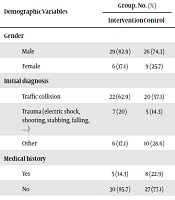
Out of a total of 100 patients (n: 50 per group) entered in the study, 12 patients (n: 6 per group) were excluded from the study, according to the inclusion criteria and 88 patients (n: 44 per group) were studied until the end of the study. The intervention group subjects were excluded due to the following reasons: Death (three cases), early extubation (two cases), and CPR (one case). The patients were also excluded from the control group due to early extubation (two cases), regurgitation of stomach contents (one case), death (two cases), and accidental extubation (one case). The mean age of patients in the intervention and control groups was 30 and 29 years, respectively. Most of the subjects (95.45%) were male. The mean GCS score in the intervention and control groups was 6.7 and 6.5, respectively. Most of the subjects underwent emergency intubation (72.7% in the control group and 79.5% in the intervention group) and there was no significant difference between the intervention and control groups in terms of demographic and clinical characteristics (Table 1). The mean oral hygiene score was 8.5 and 8.1 in the intervention and control groups, respectively. The number of negative oropharyngeal cultures of the intervention group increased from 31 cases (70.5%) in the pretest to 39 (88.6%) in the posttest, while the number of negative oral cultures in the control group remained unchanged, 25 cases (56.8%) in both the pre and posttest phases (there was no statistically significant difference between the intervention and control groups in terms of the mean number of negative cultures in the pretest (P : 0.18), yet there was a significant difference between the above groups in the post-test in this regard (P : 0.001) (Table 2). The number of negative tracheal cultures in the intervention group increased from 38 cases (86.4%) in the pretest to 44 (100%) in the posttest, and, despite achieving a negative culture in all patients in the posttest, this change was not statistically significant. The number of negative tracheal cultures in the control group increased from 39 cases (88.6%) in the pretest to 40 cases (90.9%) in the posttest, which was also not statistically significant. There was also no statistically significant difference between the intervention and control groups in terms of the mean number of negative tracheal cultures in the posttest (Table 3).
Table 1.
Comparison of Demographic and Clinical Characteristics of Trauma Patients Admitted to the ICU
| Variable | Intervention Group | Control Group | P Value |
|---|---|---|---|
| Age, mean ± SD | 30 ± 13.60 | 29 ± 11.93 | 0.56a |
| Gender, No. (%) | |||
| Male | 41 (93.2) | 43 (97.7) | 0.30b |
| Female | 3 (6.8) | 1 (2.3) | |
| Intubation method, No. (%) | |||
| Elective | 9 (20.5) | 12 (27.3) | 0.45c |
| Urgency | 35 (79.5) | 32 (72.7) | |
| GCS, mean ± SD | 6.7 ± 1.5 | 6.5 ± 1.3 | 0.50a |
a Independent samples test.
b Fisher's exact test.
c Pearson chi-square.
Table 2.
Comparison Number of Positive and Negative Oral Cultures in Intervention and Control Group Before and After of Intervention
| Group | Before | After | ||
|---|---|---|---|---|
| Positive | Negative | Positive | Negative | |
| Intervention, No. (%) | 13 (29.5) | 31 (70.5) | 5 (11.4) | 39 (88.6) |
| Control, No. (%) | 19 (43.2) | 25 (56.8) | 19 (43.2) | 25 (56.8) |
| P value | 0.18a | 0.001a | ||
a Pearson chi-square.
Table 3.
Comparison of Frequency of Positive and Negative Cultures of Tracheal Tube in Intervention and Control Groups
| Group | Before | After | ||
|---|---|---|---|---|
| Positive | Negative | Positive | Negative | |
| Intervention, No. (%) | 6 (13.6) | 38 (86.4) | 0 (0) | 44 (100) |
| Control, No. (%) | 5 (11.4) | 39 (88.6) | 4 (9.1) | 40 (90.9) |
| P value | 0.74a | 0.5b | ||
a Chi-square test.
b Fisher’s exact test.
4. Discussion
The present study revealed that selective decontamination causes a significant increase in the number of oropharyngeal negative cultures in patients. Negative tracheal (secretion) cultures also increased to 100% of patients of the intervention group in the posttest. Although this increase is not statistically significant, it is valuable clinically. This has been studied in other studies. Oostdijk et al. showed in theirs study that selective oral and digestive decontamination improves the conditions of patients admitted to the ICU, which is consistent with the results of the present study (27). Chan et al. also concluded in a systematic review and meta-analysis that oral decontamination can be effective in reducing the risk of VAP, duration of mechanical ventilation, and subsequent death (28). In a double-blind study, Bergmans et al. studied patients in three groups, namely gentamicin, colistin, and vancomycin used in the oral cavity for 21 days; the group undergoing preventive treatment in the same ward, and the third group consisted of 63 patients undergoing to preventive treatment in a different ward. The results showed that the pharyngeal and tracheal colonization rate reached zero in all patients in the intervention group, which was consistent with the results of the present study (29). There are differences in the way conventional protocols were used in previous studies. In previous foreign studies, in most cases, SOD was accompanied by a three-day intravenous administration of cephalosporin antibiotics that was discarded due to ethical and clinical limitations in this trial. Secondly, SOD, as an oral care and prophylactic method, has often been associated with selective digestive decontamination (SDD), except in cases where the purpose was differentiating the effectiveness of these two, including Zhao et al.'s meta-analysis on randomized clinical trials that investigated selective oral versus digestive decontamination. The results showed that selective oral and selective digestive contamination yielded similar results in terms of clinical outcomes of patients, although selective digestive decontamination showed greater effect in preventing bacteremia. However, they finally proposed oral selective decontamination in ICU patients considering the higher costs of SDD and its increased risk of antibiotic resistance (30). On the other hand, the homemade ointment is the drug form used in foreign studies, or even the only available domestic study (Rasoulinezhad et al. 2012). Rasoulinezhad et al. investigated the effect of selective oral decontamination on oropharyngeal colonization in patients admitted to the ICU. Their results revealed that the selective oral decontamination protocol every six hours led to a significant reduction in the oropharyngeal colonization (31). Given that the drug forms in previous conventional protocols are not on the list of Iranian generic drugs or, if available, they were not cost-effective and if they were prepared or made, the mouth wash availability was no longer relevant, therefore, similar pharmaceutical forms that were available in the Iranian Pharmacopoeia were used. Overall, studies have shown that oral selective decontamination is a cost-effective method. Oostdijk et al. examined cost-effective selective digestive decontamination and selective oral decontamination in ICU patients. The results showed that both methods are cheaper and yield more advantages than routine care; nevertheless, selective oral decontamination is 40 times cheaper than other methods (32). Gram-positive species were considered as the most common microorganisms found in oropharyngeal cultures (Staphylococcus epidermidis and Staphylococcus aureus). The results also referred to klebsiella species as the most common types of gram-negative bacteria found in the tracheal culture, and, in contrast in Rasoulinezhad et al.’s study (31), no case of pseudomonas was recorded. Selective oropharyngeal decontamination antibiotics have been selected in a way to enhance their effect on gram-negative microorganisms. Therefore, there was a lower number of gram-negative microorganism cultures in the intervention group in the posttest, which was lower than that of the control group. Sader et al. also referred to Klebsiella and Escherichia coli as the most prevalent organisms isolated from ICU patients (33). Eslami et al. also showed that Acinetobacter and Staphylococcus aureus were the most commonly isolated organisms in these patients (34). The presence of S. aureus in the isolated samples in the current study is consistent with the results of Sharifi et al.'s research, which showed that S. aureus colonization increased 1.9 times compared with carriers of this strain following the admission to the intensive care units of the university hospitals (35). Oral care does not have a comprehensive and purposeful protocol in many hospital care nursing systems. Although this is a global problem (15, 17, 18), the use of a comprehensive oral care approach, as the one in this study, not only leads to more coordination and interaction in the patient care group, yet also clarifies the horizons and targets for oral hygiene, measurable valid outcomes, and motivations for patient care (15, 16). One of the limitations of the present study was that the subjects were selected from patients, who were referred to four intensive care units at Khatam-ol-Anbia Hospital in Zahedan and taken care of by at least 45 different nurses in three shifts during the study period. The other limitation was that the oral care method was not standard, and the researcher could control many variables related to manpower and environment.
4.1. Conclusion
The present study demonstrated the effect of selective oral decontamination on reducing the invasive bacteria colonization in patients admitted to intensive care units. Clinically, unification of oral care procedure and following a systematic scientific approach in the treatment of ICU patients has a significant effect in reducing the incidence of inappropriate changes in oral and tracheal microbial flora. Since most cases of VAP are due to oropharyngeal droplet aspiration (36), providing routine oral care for all patients undergoing mechanical ventilation on a daily basis is a standard practice and is included in most pneumonia prevention programs, however, the most effective method should be based on evidence (19). Therefore, considering the lack of a standardized oral care method, an optimal selective oropharyngeal decontamination is the one, which is easy to use in the clinical setting, creates a sense of participation in the treatment group, cost-effective, and time-saving for clinical staff. It is suggested to carry out further comprehensive interventions with larger sample size on consequences, such as incidence of pneumonia and subsequent mortality in the intubated patients over the entire period of patient's intubation.