
1. Context
Today, factors, such as increased long expectancy as well as the prevalence of chronic diseases have transformed the need of population health. Long-term and comprehensive care is one of these needs that can increase the temporal length of hospitalization, thus, giving rise to a wide range of financial and physical consequences for patients and economic systems alike (1). Such needs and their associated challenges have led the global health systems to create and develop counseling and home care services.
Home care is a method for providing society-based health service based on the mutual interaction between a health service provider and the patient and their family. The purpose of this type of care is to promote and maintain health and transfer health training and treatment to the patient’s home (2). Hence, it features many benefits, such as the reduction of hospitalization costs for patients and the health system, better access to empty hospital beds, decrease of hospital acquired complications, and enhanced patient satisfaction (3).
Given its critical role in the health of societies, home care, besides being provided by public centers, has also taken up a commercial aspect in most countries as it is offered independently from public hospitals and clinics. This sort of care requires a coherent and precise teamwork, whose managerial and executive responsibility is primarily fulfilled by nurses as instructors and guardians of health at all levels of prevention and care (4). The significance and necessity of providing home care services has triggered many researchers in both developed and developing countries to investigate and assess nursing care in different contexts. The results of these studies could be used to identify current weaknesses and plan for the future.
A qualitative study carried out by Hemati et al. in Iran indicated the present deficiencies in providing home care services for infants. This research revealed people’s inadequate awareness of the need for home care for their infants, lack of continuous care, rejection of a stranger (nurse) at home, lack of the nurse’s safety at the patient's home, and the absence of legal supports for home care nurses (2). Another study carried out by Miller et al. examined the experiences of home caregivers in an American care center. The results pointed to the limitations of home care faced by patients, caregivers, and the healthcare system. The authors also stressed the necessity of performing further studies so that certain policies aimed at promoting this type of care as well as increasing its acceptance by the society could be developed and promoted (5). In Sweden, Castor et al. studied home care services for children and reported certain teamwork inadequacies. The research claimed that sometimes caregivers lack the necessary skills to care for patients; hence, they are not sure what the right method of care is in particular circumstances (6). Moreover, Febles et al. focused on immigrants and reported cultural and linguistic differences along with budget deficits, as challenges faced by home care services; they considered communication barriers as the most crucial challenge (7). Therefore, as evidence shows, home care services have a wide range, since they make health services more accessible to the society and, specifically, to families. However, they have numerous restrictions and barriers. Identifying these obstacles is a vital step in planning for a better health care system in the future.
Although previous studies have been carried out in a variety of cultures and areas, their integrative revision can help determine and resolve current impediments in order to facilitate future planning and policies. Thus, the present research aimed at detecting the challenges and barriers faced by home care centers in an integrative review.
2. Evidence Acquisition
This study was an integrative review of relevant findings and has been conducted using the Broome method, during year 2018. This approach is carried out in three stages, including searching for relevant literature, and evaluating and analyzing the data. In the first stage, the studies, after being retrieved, are investigated in four phases in terms of inclusion criteria, including having observed the necessary terms and conditions, researchers peruse, and content. Finally, after data reductions, data display, data comparisons, drawing conclusions, and verifying the data, the required analysis is undertaken (8).
The criteria for using articles in the present research included their topics, which had to be on home care, their investigation of the challenges of home care from the viewpoint of caregivers or healthcare specialists, the possibility of access to their full text, and their language (Persian or English). Here, no time limit was taken in account.
In this regard, the strategy of searching for Persian articles was that all the published articles with the keywords of home care, home care nursing, home care services, challenges, barriers, nursing, and homecare centers were searched. Here, SID, IranMedex, Magiran, and Iran Medical Research Portal were examined. In case of English articles, the searching process was carried out using keywords, including home care, nursing home care, home care services, challenges, barriers, and nursing, which were searched in internationally recognized databases, including EMBACE, SienceDirect, Scopus, MEDLINE, Google Scholar, and CINAHL.
In the first phase, out of 1029 articles, 11 were eliminated as their language was neither Persian nor English. In the second phase, 750 articles were removed since their purpose differed from that of the present study. In the third phase, 143 articles were excluded after reading their abstracts, and 86 were deleted due to their improper content after their full texts were reviewed. Finally, 39 articles met all the inclusion criteria to enter the study (Figure 1).
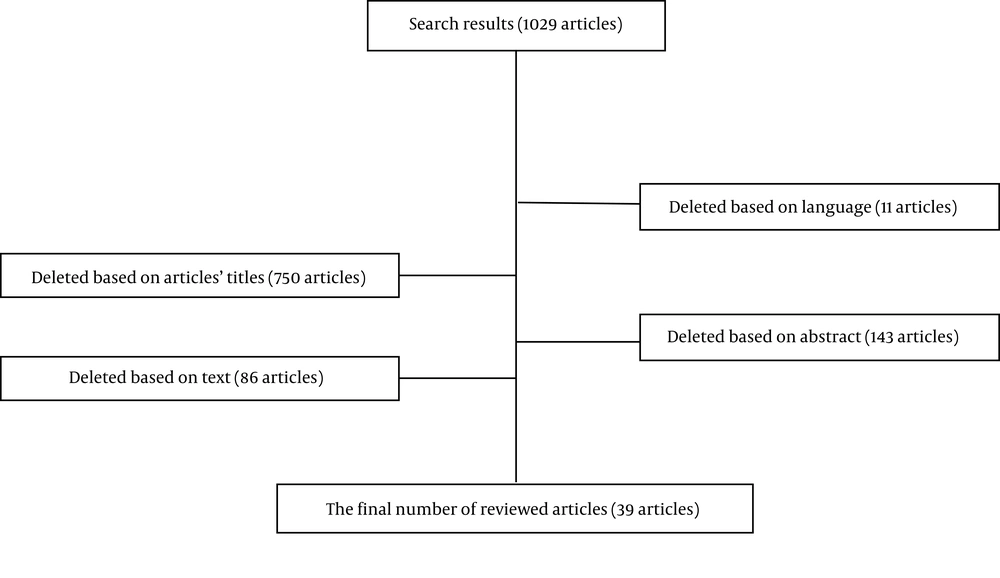
Figure 1.
Searching strategy
Data analysis was carried out based on the Broome method, and via data reduction, data representation, data comparison, drawing conclusions, and validation of data. The validity of the analyses was separately examined and confirmed by two researchers, who were working independently during the analysis process. The purpose was to compare the results obtained by these two experts and, then, in case of any contradiction, a third party was supposed to be consulted; however, no contradiction emerged.
3. Results
The findings obtained by reviewing the literature demonstrated that there are numerous challenges and barriers faced by caregivers and home care providers. They include the following:
Non-application of standard and integrated methods for home care nursing services, deficiency in intra- and extra-organizational communications, absence of proper organizational infrastructure, lack of adequate and effective human resources, absence of legal and security supports, economic problems, information poverty, cultural constraints and ignoring ethical issues. These challenges have been presented in detail in Box 1.
Box 1.
Challenges and Barriers Faced by Home Care Providers
| Related Evidence |
|---|
| Non-application of standard and integrated methods for home care nursing services (7, 9-17) (13, 18) (12, 15, 16, 19) |
| - Lack of basic protocols and coherent standards for home care services |
| - Absence of clear guidelines to introduce the duties and responsibilities of each member of a home care team as well as the patient and his/her family during the caring process at home |
| - Absence of standards, guidelines, and monitoring mechanisms for home care providers |
| - Lack of guidelines and standards for documenting home care and treatment measures |
| - Absence of an effective scientific model in providing home care services |
| - Non-application of scientific and integrated models for caring and nursing programs |
| - Need for written protocols and training standards that determine how to act in the case of clinical emergency and what types of risks and incidents may threaten a patient |
| - Deficiencies in the targeting process, needs assessment, prioritization, and planning for home care services |
| - Inappropriate use of present models |
| Deficiency in intra- and extra-organizational communications (4-6, 9, 12-15, 17, 18, 20-28) |
| - Absence of communication between nursing schools and home care centers |
| - Lack of registration and identification systems for licensed home care providers and nurses working in these centers to closely monitor their work |
| - Defective and discontinuous communication between a medical team, caregivers, and patients |
| - Inadequate communication between private and public sectors |
| - Ineffective communication network between those in charge of home care centers, home care nursing providers, the police, and the municipality |
| - Absence of coordination, cooperation, and proper communication among the entire members of a home care team (i.e. nurses, social workers, physical therapists, occupational therapists, speech therapists, and those in charge of home health aides) to care for a patient at her/his home |
| - Deficiencies in planning for as well as the system of referring a patient from hospital to home care centers and vice versa |
| - Inadequate exchange of information between hospitals and home care providing centers |
| - Inappropriate inter-professional cooperation such as lack of proper access to specialists in diverse fields of health and home care as well as lack of coordination between implementation of clinical care and patient paperwork |
| - Lack of knowledge of and, hence, non-application of the capacity of other organizations such as marketing agencies, medical equipment providers, and so forth to improve home care services |
| - Absence of coherent teams with strong nursing leadership in an organization to plan for the promotion of care based on needs assessment, derived from the reports on care services which have been provided so far by home care centers. |
| Absence of proper organizational infrastructure (9, 13, 14, 18, 20-23, 26, 28-36) |
| - Deficiencies in administrative and judicial systems, such as inadequacy of organizations’ budget for home care providing centers |
| - Lack of innovative technologies and smart systems |
| -Lack of access to and the easy use of medical equipment and facilities for home care services |
| - Prioritization of hospital services over societal services |
| - One-dimensional management in the health system (physician-based management) |
| - Flaws in the educational system and its way of training specialists for home care services |
| - Lack of a specific supervisory system to control the activity of centers and analyze their results |
| Lack of adequate and effective human resources (4, 6, 9, 12, 15, 16, 18-24, 28, 29, 37-39) |
| - Inadequacy of qualified human resources for providing full-time home care services |
| - Insufficiency of human resources specialized in key areas including implementation, monitoring, evaluation, and the management of home care programs |
| - Inadequacy of nurses with various racial, ethnic, and cultural backgrounds to meet home care needs and, subsequently, lack of heterogeneity between caregivers and caretakers |
| - Defects in the ability and competence of nurses working in this field to make appropriate decisions in specific and emergency situations |
| - Inadequacy of professional female nurses to provide home care services |
| - Assignment of home care services to those who are not nurse and are, thus, incompetent in providing home care |
| - Difficulty of employing, training, and preserving skillful and experienced nurses at home care centers |
| - Quitting the home nursing occupation due to working pressures caused by the absence of official and financial supports |
| Absence of legal and security supports (5, 14, 16-18, 22, 26, 35, 38, 40, 41) |
| -Absence of formal and legal supports for nurses |
| -Security problems for a nurse both on his/her way to a patient's home and at the patient’s home |
| Economic problems (4, 5, 7, 10, 12-15, 17-19, 21, 22, 24, 29, 30, 32, 34, 36, 39, 40, 42) |
| - High cost of home care services for patients |
| - Ineffective financial policies for supporting social workers and patients |
| - Lack of coverage of the costs of care services by insurance organizations |
| - High cost of medical equipment that cannot be rented |
| - Absence of funds and appropriate budget for home care providing centers so that they can provide technology-based services |
| Information poverty (4, 10, 28, 38, 42) |
| - Absence of general awareness of the existence and operation of home care providing centers |
| - Lack of appropriate health information systems |
| - Inappropriate marketing for home care providing centers |
| - Society’s lack of awareness of and support for nursing services and the existence of an inappropriate perception with regard to nursing services |
| - Lack of knowledge and consequently, negative attitude of beneficiaries, including policymakers, specialists, caregivers, and caretakers, regarding the opportunities offered by technology-based home care services |
| - Unavailability of care medical records and the interventions made for the patient at home |
| Cultural constraints (14, 17, 22, 28, 30, 34, 40, 42) |
| - Society's lack of trust in health specialists other than physicians |
| - Difference in the culture and language of the patient versus the caregiver |
| Ignoring ethical issues (5, 7, 12, 16, 18, 26, 28, 41) |
| - Families’ making direct and informal contacts with nurses and caregivers instead of calling authorized home care centers which are qualified to send licensed nurses to a patient's bedside |
| - Families’ demand of nurses to do tasks, such as changing clothes, other than those defined for their profession |
4. Discussion
The aim of this study was to identify and help resolve the challenges and barriers encountered by home care centers in order to improve the quality of home care services. The findings suggest that these problems could be classified in nine categories. They include the following:
Non-application of standard and integrated methods for home care nursing services, deficiency in intra- and extra-organizational communications, absence of proper organizational infrastructure, lack of adequate and effective human resources, absence of legal and security supports, economic problems, information poverty, cultural constraints, and ignoring ethical issues.
Non-application of standard and integrative methods for providing home care services was a challenge mentioned in most studies, a problem also present in Iran (11). This challenge can be the cause of certain other obstacles. For example, when there is no performance standard, the competency of employees to join home care centers will not be evaluated based on a specific criterion. This is while a nurse attending a patient must have high scientific and managerial abilities so that they can independently and instantaneously make the best decision (13, 40). Similarly, without the existence of a proper guidance, a patient's assessment is not subject to a specific rule and a coherent classification is not possible. Hence, the whole cycle of care will be dysfunctional.
The absence of standards and executive protocols may also contribute to the emergence of certain economic challenges, leading to lawlessness and the imposition of heavy costs on the patient and even allowing injustice to occur in paying the caregivers. When law, as a series of standard principles, is not provided to the centers, their activities fail to comply with correct principles and they will not be registered and documented. Therefore, there will be no monitoring, analysis, and planning (5-7, 9, 11, 12, 14-21, 23, 27, 28, 30, 34, 37, 40, 43, 44).
Setting standards and scientific models by consulting health experts is a solution to coordinate and prevent possible errors and shortcomings. Via accurate planning and analysis, these standards and models can be used to bridge the present gaps in the society. Although the mentioned studies refer to the absence of protocols, standards, clinical guidelines, and scientific models, which they consider vital, some developed countries, such as the United States (45), Canada (46), and Japan (47) deploy their standards as coded programs to aid their healthcare system.
Other challenges affecting the performance quality of home care centers, which were detected in the present study, were related to defects in intra-and extra-organizational communications. Such problems entail poor communications, ineffective care, inadequate referral systems, and a movement toward treatment rather than prevention (18, 26).
Unlike countries, such as the United States and Australia, where nursing centers are active with careful monitoring and transparent communication systems (48, 49), in some other countries, there is no special organization in charge of undertaking precise and comprehensive examination and evaluation of home care centers (4-6, 10, 12, 15, 18, 19, 21, 22, 24-26, 28, 29, 34, 38, 50, 51). The reason is that in some countries, such as Iran, there is no complete list of legal and illegal centers providing home care and no specific organization has monitored the activity of these centers and their staff is the presence of certain deficiencies in organizational communications (4).
When all centers are not united under the leadership and supervision of a particular organization, the legal offenses as well as unlicensed centers will appear in a society. Hence, their performance in patients’ houses will lead to people’s dissatisfaction and mistrust; this being a challenge in itself. When all centers are not united under the leadership and supervision of a particular agency, legal violations and the operation of unlicensed centers in the community take over. When such care centers permeate people’s houses, public dissatisfaction and mistrust emerge, a problem, which is itself one of the current challenges.
In the United States, there are some supervisory departments, such as the Centers for Medicare and Medicaid Services (CMS), which play a vital role in monitoring the activity of home care centers. They collect information about these centers and identify their problems, needs, and deficiencies in order to plan for and enhance the caring process. By employing experts and specialist teams, these monitoring and supporting centers supervise all aspects of home care centers and guarantee their patients’ and the society’s health.
The findings of this study indicated that an appropriate institutional infrastructure is not available for proper home care services. One of the most crucial infrastructural weaknesses leading to the shortage of skillful personnel is the absence of training qualified nurses to provide nursing services at home (14, 21, 22, 36). Since the range of nursing skills required at home is much more complex and widespread than clinical care, a nurse entering a patient's home must have specialized qualifications. In fact, they should be scientifically, psychologically, and socially trained in order to be a guide for the patient and their family (52, 53). They must be aware of numerous training strategies, should continuously develop them, and recognize available social resources (52, 54, 55). Unfortunately, this infrastructure is missing and due to a shortage of nurses, economic problems, and the introduction of cheap manpower, sometimes even people other than nurses are employed to provide home care services (4, 6, 9, 12, 16, 18, 21). The presence of these ineligible individuals and their improper care will lead to people’s mistrust of nursing and care (23, 37).
Another structural problem is that certain patients need some complex and expensive equipment at home that sometimes cannot be afforded by their families (21, 23, 26, 33, 34). As this part of the caring process has been neglected, a patient’s family experiences considerable anxiety about how to pay for the device and to repair it in case of any technical problem (32, 56). This critical issue requires that for the government to pass effective policies, employ the private sector, and provide subsidies for patients in need of these types of equipment.
It seems that one of the basic steps to address the present infrastructural challenges in the field of care, and in particular home care, is that nurses, as the leaders of the health system, should contribute to policy-making and lead health policies towards prevention (14, 17). Today, advanced countries in the sphere of home care provide their services in the form of smart and web-based systems. This can involve various aspects of evaluation and monitoring. In addition to their comprehensive coordination, they can facilitate information security, registration, access to a patient’s medical and caring information, and finally reduce costs (48, 57). Meanwhile, the absence of a smart health system in Iran is an undeniable fact.
Another barrier is the shortage of human resources to serve as nurse home visitors. Due to diverse managerial stresses, long and irregular working hours, daily crises, and lack of legal and security support, this profession is not appealing enough for nurses, especially female nurses (58). In order to resolve this problem, it is necessary to develop and implement strategic and fundamental plans to maintain security and create motivation. This requires flexible programming, financial and spiritual incentives, and continuous training programs (12). Visitor nurses are always exposed to violence and insecurity, for example when they have to go to certain insecure neighborhoods in order to visit their patients (21, 22, 41, 59).
Hence, a proper cooperation between security and support units of the government such as the police and the municipality can help provide security to nurses (5). Therefore, this is one of the most significant steps to preserve the effective nursing workforce (2).
Furthermore, economic problems faced by most countries, including Iran, have placed many challenges ahead of home care centers. If these challenges are not overcome, a proper care system will not be achieved. The reason is that when a patient cannot independently afford to pay for the costs of care (4, 5, 14, 18, 19, 21, 22, 28, 29, 34, 36, 38, 39), they cannot enjoy it. Thus, negative compensatory mechanisms, such as employing cheap labor forces will emerge without supervision.
Developing this type of comprehensive and effective care depends on allocation of funds and designing appropriate programs by governments. Today, in some countries, including the United States and Australia, governments pay some of the costs of home care services based on a well-designed process and people receive support packages with diverse levels of home care (48, 57). Hence, health policy-makers should follow countries, such as the United Kingdom, United States, and Japan in identifying their financial barriers and developing programs to transcend them (20, 60).
In Iran, information poverty, as mentioned in other previous studies, is an obstacle to providing home nursing services (2, 4, 18, 30, 34, 35, 61). This challenge is rooted in deficiencies of unilateral management and the absence of nurses in large-scale management and planning. This has led nursing care, essential for disease prevention and treatment, to remain hidden under the guise of physician-based management (25). Nursing communities in countries, including Iran, need a strong leadership to highlight the importance of home care so that the general population could realize that this type of care is the basis of fostering a society’s health, without which even the treatment process will not progress (14).
The results of previous studies reveal that cultural constraints are among barriers that make it difficult to provide home care services (14, 17, 22, 28, 30, 34, 40, 42). Demographic variability in some nations, such as Iran, implies the necessity of training for nurses, an issue which requires particular attention by educational programmers. Besides, this type of training presupposes familiarity with a society’s culture and its values. A nurse, who does not know their patients' values and overlooks them, fails to establish a proper relationship with the patient, and finishes the process of caring before its due time. As a result, the patient will be reluctant to have this nurse return to their home (9, 40, 61-63).
Another barrier to home care identified in the present study was ignoring ethical issues (64). The results indicate that sometimes people's expectations of a nurse are beyond their sphere of duties. This problem originates in the absence of a correct understanding of the nursing profession and the tasks of academic nurses. In practice, people sometimes cannot distinguish between a professional nurse and a daily caregiver of their patient; hence, they hire unqualified people as nurses and interpret the outcome as that of nursing care. This unethical judgment, rooted in the poverty of information, requires a systematic use of marketing plans to introduce this profession and its tasks to the public (23, 28).
Given that the transition of care from hospital to home has recently been addressed in Iran, investigating and analyzing challenges and obstacles faced by home care centers around the world will be a crucial step in recognizing the present needs of various areas.
Finally, one of the limitations of the present study was the lack of studies carried out on home care services in Iran. This constraint precluded the possibility for a comprehensive discussion of their situation.
5. Conclusion
According to the results, there are numerous challenges and barriers to providing home care services; these are often intertwined so that each leads to another. This wide range of obstacles requires coordination and a precise and comprehensive planning by the government, academic experts, and nurses so that they can provide an effective model for assessing, planning, implementing, and evaluating this type of vital care. Considering the shortage of studies on home care in Iran, it is suggested for further research to be performed in this regard, its strengths and blind spots be explored, and effective programs be proposed for its improvement.