
1. Background
Chronic renal failure (CRF) is a common disease, usually diagnosed at a later stage. It is a disease that has a long-term decline in renal function and will progress to end-stage renal disease. The leading causes of CRF include glomerular and tubular disorders, renal artery disease, congenital and genetic changes, or some physical factors such as stones, trauma, etc. Increased nephrotic syndrome is mainly caused by progressive hyperperfusion and hyperfiltration (1). Moreover, acid-base disorders are common in patients with CRF receiving the most attention clinically. In this population, some researches indicated the prevalence of acid-base disorders and their association with the outcomes, primarily focused on chronic metabolic acidosis (2). Acid-base balance is a dynamic due to the body is an open system, so it tends to change as external factors such as food, water, or internal factors, including cellular metabolites. However, acid-base balance status is quickly recovered by the activities of the buffer system and some vital organs, especially the kidneys (3). To maintain acid-base balance, the kidneys excrete acid generated by metabolism and reabsorb bicarbonate. The uptake of bicarbonate from glomerular filtration is very important (4). Calling attention, CRF is also one of the important factors to cause the acid-base balance disorders. When disturbed, a series of extracellular pH-dependent metabolites are affected. In this line, the acid-base balance mechanism also attempts to reach to the normal pH. Although, the buffers work quickly but are limited by kidneys related slow responds, which have a longer and more effective consequent (5). However, if the main factor of the acid-base balance disorder is not eliminated, it would gradually increase, and cause irreparable damage for the patients.
2. Objectives
The current study aimed to investigate the acid-base balance disorders and the relationship between its parameters and creatinine clearance in patients with chronic renal failure.
3. Methods
In this study, 300 patients with CRF were included based on the following criteria: a history of chronic renal disease, recurrence, edema, anemia, hypertension, proteinuria, urinary cast, decreased creatinine clearance (below 60 mL/min), urea, blood creatinine, and increased uric acid. Our research has been approved by the Hospital Ethics Committee and informed consent of all patients Diagnosis of CRF stage according to NKF KDOQI (The National Kidney Foundation Kidney Disease Outcomes Quality Initiative) clinical practice guidelines (6). At first, we took the patient’s medical history and then clinical examination as well as the blood tests include hematological, biochemical, urine test, and arterial blood gas (ABG) analysis were measured in all patients. Strict precautions were taken to avoid pre-analytical bias, and it was confirmed that it is an arterial and not a venous sample. After that, the samples were analyzed using ABG Analyzer GEM PREMIER 3000 (Werfen, Hanoi, Vietnam). The main parameters, like measured pH, pCO2, HCO3- values, were assessed. The calculation of base excess (BE) was calculated by the following given formula:
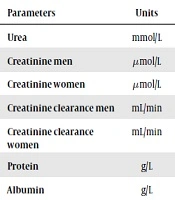
The other biochemical tests were also measured by Au5800 system (Beckman Coulter, Hanoi, Vietnam). The creatinine clearance (CrCl) of the kidney was calculated by the Cockcroft-Gault Equation. The methodology, units and all normal blood test values have been brought in Table 1.
Table 1.
Methodology and Blood Test Normal Values
| Parameters | Units | Normal Value | Methodology |
|---|---|---|---|
| Urea | mmol/L | 2.5 - 7.5 | Urease |
| Creatinine men | µmol/L | 90 - 120 | Jaffe |
| Creatinine women | µmol/L | 80 - 110 | Jaffe |
| Creatinine clearance men | mL/min | 97 - 137 | Calculated |
| Creatinine clearance women | mL/min | 88 - 128 | Calculated |
| Protein | g/L | 60 - 80 | Biuret |
| Albumin | g/L | 35 - 50 | BCG |
| Uric acid men | µmol/L | 180 - 420 | Uricase |
| Uric acid women | µmol/L | 120 - 360 | Uricase |
| pH | 7.38 – 7.42 | ISE | |
| PCO2 | mmHg | 35 - 40 | ISE |
| HCO3- | mmol/L | 22 - 26 | ISE |
| tCO2 | mmol/L | 25 - 30 | ISE |
| BE | mmol/L | 0 ± 2 | Calculated |
3.1. Statistical Analysis
All data were analyzed by the Statistical Package for Social Science (SPSS) version 20.0 (IBM, USA). Continuous variables were described as mean and standard deviation (SD). Two or more continuous variables were evaluated by t-test or one-way ANOVA. Categorical variables were described as frequency and percentage and two or more categorical variables were evaluated by the chi-square test.
4. Results
4.1. General Characteristics of the Patients
In this study, the 300 CRF patients (male: 180, female: 120), aged 50 to 81 years were participated. The average age of patients was: 51.95 ± 17.03. Patients aged ≥ 71 accounted for the highest proportion (20.8%). The youngest patient was 20 and the oldest patient was 81 years old. To note, none of the patients had stage I CRF, and most male patients had stage IV disease (40%), while most female patients had stage IIIb (39%) and the rate of CRF in patients aged from 31 to 40 was 19.8%. The blood biochemical parameters have been shown in Table 2. CrCl decreased in comparison with normal values and decreased with the stage of renal failure (P < 0.001). The level of creatinine, urea, uric acid increased with the stage of renal failure (P < 0.05). The mean value of protein and albumin did not change significantly (P > 0.05).
| Parameters | GD II (1) (N = 66) | GD IIIa (2) (N = 60) | GD IIIb (3) (N = 84) | GD IV (4) (N = 90) |
|---|---|---|---|---|
| Urea (mmol/L) | 15.51 ± 6.50C | 25.55 ± 8.85C | 31.76 ± 14.58C | 42.73 ± 11.67C |
| Creatinine (µmol/L) | 211.00 ± 45.61C | 393.0 ± 62.27C | 666.62 ± 10.91C | 1228.3 ± 411.4C |
| CrCl (mL/min) | 32.08 ± 4.56C | 15.77 ± 1.75C | 7.16 ± 1.08C | 2.79 ± 1.00C |
| Uric acid (µmol/L) | 485.95 ± 108.12A | 572.35 ± 129.70A | 589.28 ± 149.63A | 584.97 ± 139.50A |
| Proteine (g/L) | 63.18 ± 8.68B | 64.13 ± 7.95B | 64.88 ± 9.55B | 63.25 ± 6.69B |
| Albumine (g/L) | 32.74 ± 6.56B | 33.24 ± 4.45B | 32.95 ± 6.81B | 33.94 ± 5.49B |
Abbreviations: CrCl, creatinine clearance
aValues are expressed as mean ±SD
bP vs. normal value A P < 0.05; B P < 0.01; C P < 0.001.
4.2. Results of Acid-Base Balance Parameters
The results of acid-base balance parameters have been shown in Table 3. Among CRF patients, metabolic acidosis is predominantly 74%, while other types of disorders account for a very low rate. This disorder gradually increases with the stage of renal failure (Table 4).
Table 3.
Results of Acid-Base Balance Parameters
| Parameters | Stage II (1) (N = 66) | Stage IIIa (2) (N = 60) | Stage IIIb (3) (N = 84) | Stage IV (4) (N = 90) | Total (N = 300) |
|---|---|---|---|---|---|
| pH | 7.38 ± 0.09 | 7.37 ± 0.07 | 7.33 ± 0.08A | 7.22 ± 0.73A | 7.35 ± 0.09A |
| PCO2 (mmHg) | 36.45 ± 6.62 | 36.15 ± 5.86 | 33.48 ± 7.27A | 32.20 ± 7.00B | 34.28 ± 6.92A |
| StHCO3- (mmol/L) | 24.45 ± 4.45 | 23.10 ± 4.94 | 19.39 ± 4.53B | 18.35 ± 4.94C | 21.21 ± 5.16B |
| tCO2 (mmol/L) | 25.03 ± 5.64 | 23.49 ± 6.06 | 22.01 ± 15.97A | 18.90 ± 5.88C | 21.47 ± 6.48B |
| BE (mmol/L) | -0.50 ± 5.59 | -2.25 ± 6.19A | -7.08 ± 5.90B | -7.19 ± 6.32C | -4.72 ± 6.61A |
Abbreviations: BE, base excess; PCO2, the pressure of carbon dioxide; StHCO3, standard bicarbonate; tCO2, total carbon dioxide.
aValues are expressed as mean ±SD
bP vs. normal value AP < 0.05; BP < 0.01; CP < 0.001.
Table 4.
Types of Acid-Base Balance Disorders
| Types of acid-base balance disorders | N | % |
|---|---|---|
| Normal | 24 | 8 |
| Metabolic acidosis | 222 | 74 |
| Respiratory acidosis | 3 | 1 |
| Metabolic alkalosis | 2 | 0.7 |
| Respiratory alkalosis | 1 | 0.3 |
| Metabolic acidosis + respiratory alkalosis | 21 | 7 |
| Metabolic acidosis + respiratory alkalosis | 21 | 7 |
| Metabolic alkalosis + respiratory alkalosis | 3 | 1 |
| Metabolic alkalosis + respiratory acidosis | 3 | 1 |
| Total | 300 | 100 |
4.3. Relationship Between Acid-Base Balance Parameters and Creatinine Clearance
pH, tCO2, HCO3- and BE had a moderate positive correlation, only PCO2 have a weak positive correlation with creatinine clearance (Table 5).
Table 5.
Relationship Between Acid-Base Balance Parameters and Creatinine Clearance
| Parameters | r | P | The Regression Equation | |
|---|---|---|---|---|
| pH | Ccr | 0.380 | 0.0001 | Y = 40.674x - 286.333 |
| PCO2 (mmHg) | Ccr | 0.288 | 0.004 | Y = 0.391x - 0.418 |
| tCO2 (mmHg) | Ccr | 0.377 | 0.0001 | Y = 0.653x - 1.023 |
| StHCO3- (mmol/L) | Ccr | 0.404 | 0.0001 | Y = 0.923x - 6.577 |
| BE (mmol/L) | Ccr | 0.413 | 0.0001 | Y = 0.735x + 16.463 |
Abbreviations: BE, base excess; CrCl, creatinine clearance; PCO2, pressure of carbon dioxide; r, correlation coefficient; StHCO3, standard bicarbonate; tCO2, total carbon dioxide.
5. Discussion
5.1. Clinical and Subclinical Characteristics of the Research Subjects
In this study, 300 patients (180 men and 120 women), most of the patients were aged ≥ 71. The average age was 51.95 ± 17.03. Chih-Cheng Hsu et al. suggested that renal failure may be observed at any age. However, it is more likely to occur in the elderly population, due to the comorbidity of other diseases such as diabetes and hypertension (7, 8). In general, it seems that the cost of treatment for patients with renal insufficiency needs more attention. However, in developing countries, health care services for people who are at risk of kidney failure is still limited. It has been previously found that urea and creatinine levels in blood and urine are important indicators to evaluate kidney function (9). According to our results, blood urea and creatinine levels are closely related to the stage of CRF progression (Table 2). Overall, the kidney has the functional role in maintaining body homeostasis, therefore when the kidney failure occurs, the metabolites level especially urea, creatinine cannot completely excreted, resulting in the accumulating toxic substances in the body and affecting the function of multiple organs which finally present with a variety of clinical symptoms. Many authors have used creatinine clearance as a standard indicator to determine the different CRF stages (5, 10, 11). It is noteworthy that the blood uric acid level increased concomitantly with the CRF stage. Uric acid is a degradation product of the base purin primarily from nucleic acid. Uric acid is also excreted by the kidneys in the urine. Therefore, during renal failure, uric acid is not eliminated and accumulates in the blood. However, hyperuricemia is not only due to impaired kidney function also to other conditions such as gout, leukemia, high meat diet, alcohol consumption, etc. In our study, the blood proteins such as albumin levels in CRF patients decreased compared to normal subjects. presumably, it could be related to the damaged glomerular membrane, which causes proteins passing through the glomerular filtration membrane into the urine. However, both blood protein and albumin levels slightly decreased with the stage of renal failure (Table 2).
5.2. Acid-Base Balance Disorders in Patients with CRF
According to our findings, blood pH in CRF patients gradually decreased with the stage of renal failure (Table 3). The kidneys maintain the normal state of pH concentration by bicarbonate reabsorption and normalizing the acid excretion. Given that the normal urine pH is approximately 5.6 while the blood pH is between 7.38 - 7.42, it is proving that the role of the kidney in maintaining acid-base balance is undeniable (5). There are four types of acid-based disorders: respiratory alkalosis, respiratory acidosis, metabolic alkalosis and metabolic acidosis. When these conditions occur, to maintain normal levels of pH, the body can create an opposite counterbalance as a compensatory mechanism. For instance, if the patient has metabolic acidosis, the body will induce a respiratory alkalosis, but it rarely makes our pH return to normal at 7.4 (9). To maintain the acid-base balance, the activity of the buffers and lungs is fast but short and limited. In this regard, although the kidney function is slow but most effective and long-lasting (11, 12). as shown in Table 3, the amount of PCO2 decreased with the stage of renal failure (Table 3). In fact, CO2 is excreted through the respiratory system. Therefore, the compensatory mechanism induced by bicarbonate buffer and the lungs reduce both the stability of the blood acidity and limitation in the pH reduction due to kidney failure (9). However, the complementary activity of the buffer system and the lungs is limited, so if the patient has severe renal dysfunction, the pH is greatly reduced, and subsequently, the clearing operation would not be repeated as usual, and the pH decreases gradually according to the severity of chronic renal failure (10). On the other hand, the PCO2 level determines respiratory activity. Given that the reversible reaction between CO2 and H2O, which produces H2CO3, the respiratory system can adjust the pH level indirectly. For example, once the pH decreased, the respiratory system releases more CO2 by increasing breathing frequency, thereby reducing the acidity in the body, leads the pH rising as well as the PCO2 level reduction (12). Under the normal circumstance, the kidney excretes the acid (H+) to regenerate and reabsorb HCO3-, during the kidney failure, both acid excretion and reabsorption of HCO3- are reduced. In our study, actual HCO3- and tCO2 also decreased (13). On the other hand, tCO2 is a value to represent the total amount of CO2 in the blood, including dissolved CO2, carbonic acid (H2CO3), and HCO3-. tCO2 is also a valuable marker in distinguishing between acid-base disorders due to some metabolic or respiratory reasons (13). BE is excess or deficiency of acid or base in the blood, considered as an important indicator of acid-base balance disorders, which is also another value of the difference between total base buffer (BB) and BB. In our study, BE in patients with CRF is -4.72 ± 6.61 mmol/L. In stage II renal failure, it is -0.50 ± 5.59 mmol/L, but in stage IV renal failure, BE is -7.19 ± 6.32 mmol/L, lack of base and excess acid, need to be timely treated. Based on pH, PCO2, and HCO3-, most patients with CRF have metabolic acidosis (Table 4). According to Kopple et al. reports, the pH of cells and other physiological fluids is an important biological constant of the body, which fluctuates in a very narrow range to sustain life (10). Effros and Widell also suggested that in patients with CRF when the glomerular filtration rate decreased < 30 mL/min, blood urea increased > 14.3 mmol/L and creatinine increased > 354 µmol/L , the renal function decreased, acid is not eliminated and the ability of bicarbonate reabsorption is reduced leading to metabolic acidosis (14, 15). Using the Davenport diagram we also evaluated the state of acid-base balance disorder in the area of metabolic acidosis (data not shown). The indicators of acid-base balance disorders of renal failure different stages gradually change and pH, PCO2 and HCO decrease while the level of metabolic acidosis increases.
5.3. Relationship Between Acid-Base Balance Parameters and Creatinine Clearance
Many studies have shown a relationship between the various parameters of acid-base balance and creatinine clearance (12). In fact, acid-base balance parameters have a positive correlation with creatinine clearance, (correlation coefficient r = 0.377 → 0.413). Among them, only PCO2 is less correlated with creatinine clearance (r = 0.288, P < 0.01) (Table 5). The creatinine clearance not only helps clinicians to understand the level of acid-base balance disorders, but also has ability to predict the stage of kidney failure (5, 8). Ultimately, by monitoring the blood creatinine, we can manage the acid-base balance disorders to improve the quality of life for patients.
5.4. Conclusion
In the study of acid-base balance disorder, we found that different valuable biochemical indicators in CRF patients were lower than the normal range which gradually decreased based on the disease severity and stage of renal failure. Most patients with CKD have metabolic acidosis, and the mentioned parameters are positively correlated with creatinine clearance coefficient.