Minimally Invasive Management of Biliary Tract Injury Following Percutaneous Nephrolithotomy

Author(s):
Ata A Rahnemai-AzarAta A Rahnemai-Azar1, Amir A RahnemaiazarAmir A Rahnemaiazar1, Rozhin NaghshizadianRozhin Naghshizadian1, Jacob H CohenJacob H Cohen2, Iman NaghshizadianIman Naghshizadian1, Brian F GilchristBrian F Gilchrist1, Daniel T FarkasDaniel T Farkas1,*
1Department of Surgery, Bronx-Lebanon Hospital Center, Albert Einstein College of Medicine, New York, USA
2Department of Urology, Bronx-Lebanon Hospital Center, Albert Einstein College of Medicine, New York, USA

Nephro-Urology Monthly:Vol. 6, issue 5; e19943
Published online:Sep 05, 2014
Article type:Case Report
Received:May 06, 2014
Accepted:Jun 26, 2014
How to Cite:A Rahnemai-Azar A, A Rahnemaiazar A, Naghshizadian R, H Cohen J, Naghshizadian I, et al. Minimally Invasive Management of Biliary Tract Injury Following Percutaneous Nephrolithotomy. Nephro-Urol Mon. 2014;6(5):e19943. doi: https://doi.org/10.5812/numonthly.19943

Abstract

Introduction:

Percutaneous nephrolithotomy is generally considered a safe option for the management of large complex or infectious upper urinary tract calculi. Biliary tract injury is a rare and potentially serious complication of percutaneous nephrolithotomy that can even lead to mortality, especially in cases where biliary peritonitis develops. All reported cases of biliary tract injury have been managed by either open or laparoscopic cholecystectomy.

Case Presentation:

Herein for the first time, we report a 39-year old woman with biliary tract injury following percutaneous nephrolithotomy who was managed less invasively by insertion of a percutaneous cholecystostomy tube. The patient was discharged home shortly thereafter, and the tube was later removed at a follow up visit after a normal cholangiogram.

Conclusions:

Biliary tract injury is a rare and potentially serious complication of percutaneous nephrolithotomy that can even lead to mortality. If a biliary tract injury is suspected during percutaneous renal procedures, diverting the bile away from the leak may resolve the problem without the need for a cholecystectomy. Ideally this can be done with ERCP and a stent, but in cases where this is not technically feasible; a percutaneous cholecystostomy can be successful at accomplishing the same result.

1. Introduction

After being first reported by Goodwin et al. percutaneous renal access has become an established procedure during the past few decades (1). Based on a review of the literature, injury to the biliary tract rarely occurs after percutaneous renal procedures but can lead to serious outcomes including death. Early recognition and intervention is critical to minimize the morbidity and mortality associated with this type of biliary tract injury. The evolution of peritonitis, because of delayed intervention, will make laparotomy inevitable and can potentially be associated with serious complications. In review of the few reported cases, all of these patients with a biliary tract injury underwent a cholecystectomy via either a laparoscopic (2, 3) or open procedure (4-6). Herein we report the first case of biliary tract injury following a renal-targeted percutaneous procedure managed minimally invasively by insertion of a percutaneous cholecystostomy tube.

2. Case Presentation

A 39-year old woman, with past medical history of gastric bypass, was scheduled to undergo percutaneous nephrolithotomy (PCNL) for a 4 cm right renal pelvic calculus with partial staghorn extension to lower pole. At the time of passage of an 18-gauge needle to the right kidney under fluoroscopy guidance, bile stained fluid was aspirated and the procedure aborted. A large caliber ureteral stent and Foley catheter were placed to maximize urinary drainage and the patient admitted for observation. Overnight, the patient developed abdominal pain and became tachycardic and tachypenic. Laboratory studies showed an increased white cell count (19.9 × 10³ per microliter), while liver function tests stayed in normal range with total and direct bilirubin 0.6 mg/dL (0.2-1.3) and 0.2 mg/dL (0-0.4) respectively. Subsequently abdominal CT scan was performed which showed a large fluid collection in the right peri-hepatic and peri-nephric area (Figure 1). Interventional radiology was consulted to place a sub-hepatic drain.
Despite drainage of about 1 liter of bile stained fluid over the next 24 hours, the patient remained tachycardic and tachypenic with complaints of severe abdominal pain. General surgery was consulted and placement of a percutaneous cholecystostomy tube was recommended. Following this, the drainage from the sub-hepatic drain stopped and her clinical status improved significantly. Follow up ultrasonography revealed decreased peri-hepatic collection and the sub-hepatic drain was removed after three days. The patient was then discharged home in stable condition with the cholecystostomy tube. On post procedure day 17, a tube cholangiogram revealed good flow of contrast into the duodenum without any evidence of leak or filling defect. Subsequently the tube was clamped and later removed in general surgery clinic. The kidney stone was later treated with staged ureteroscopy. At 6 months follow up, the patient is doing well without any complications and is stone free.
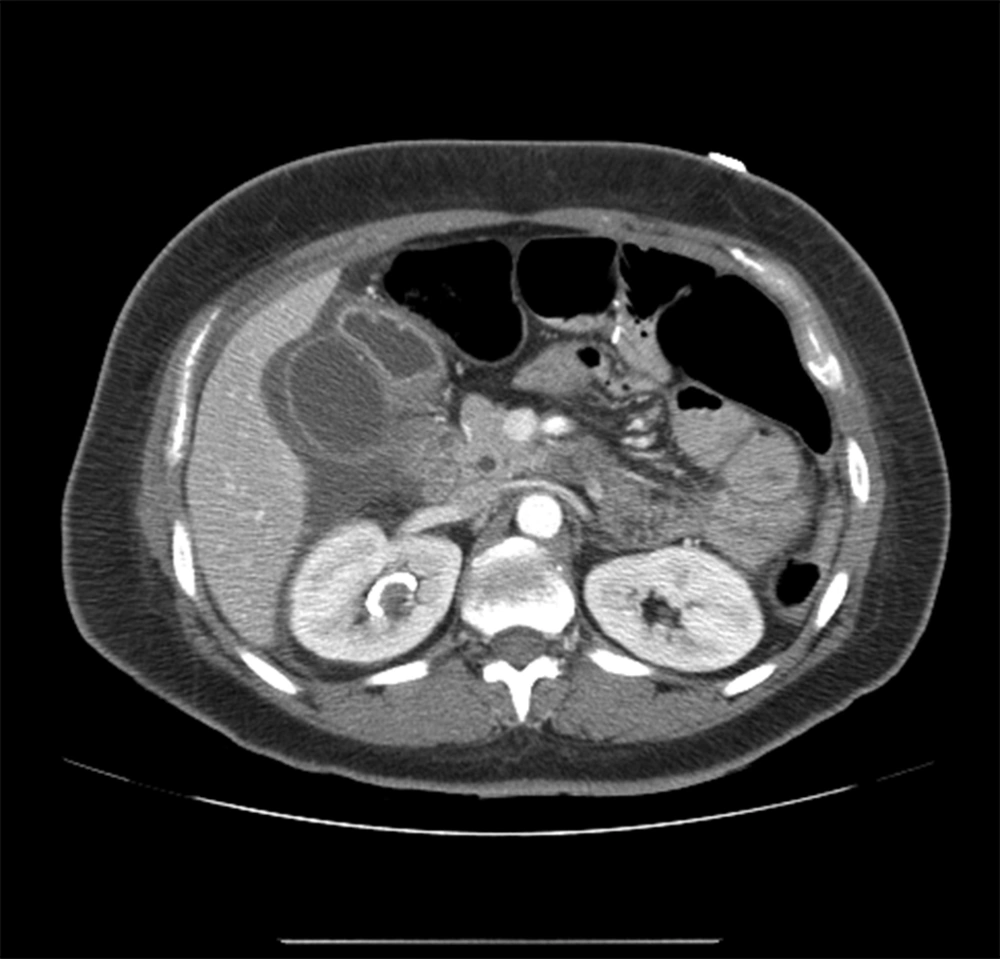
Abdominal CT Scan After Attempted Percutaneous Nephrolithotomy Showing Large Amount of Fluid Collection in Peri-Hepatic and Peri-Nephric Area
Figure 1.

Abdominal CT Scan After Attempted Percutaneous Nephrolithotomy Showing Large Amount of Fluid Collection in Peri-Hepatic and Peri-Nephric Area

3. Discussion

Percutaneous nephrolithotomy has comparable results to open surgery with the advantage of being less invasive and having a shorter hospital stay (7). Although PCNL is generally considered a safe procedure, it can still be associated with serious and potentially life threatening complications. These include urinary tract infection, bleeding and damage to surrounding structures like colonic perforation, duodenal injury and pleural injury (8, 9).
Injury to the biliary tract during percutaneous renal access is a rare complication. In a study of 8000 ultrasound-guided punctures, only 4 incidents were reported and none of them was with a renal puncture target (10). In review of the literature, there are few cases of biliary tract injury during isolated nephrostomy (6) or percutaneous nephrolithotomy (2, 4, 5), all of which have been managed by cholecystectomy.
Kontothanassis et al. (6) reported a case of gall bladder injury during an ultrasonography-guided nephrostomy done for urinary tract obstruction. Greenish fluid was noted during the procedure and the patient developed signs of abdominal distension and tenderness over the following 12 hours. The patient underwent a laparotomy and a cholecystectomy was performed.
Fisher et al. (2) reported another case of biliary tract injury after percutaneous access during PCNL. The patient developed abdominal discomfort and signs of peritoneal irritation on physical exam while a CT scan revealed peri-cholecystic and sub-hepatic fluid collection. Laparoscopic cholecystectomy was performed. Although gallbladder perforation secondary to percutaneous liver biopsy has been reported to be managed by insertion of percutaneous cholecystostomy tube, to our knowledge all reported cases of biliary injury during percutaneous renal accesses have been managed with cholecystectomy.
While bile peritonitis after PCNL is rare, it should always be kept in mind. Injury to the biliary tract should be suspected in patients who develop abdominal pain, peritoneal signs or any component of systemic inflammatory response syndrome (SIRS) post operatively. Aspiration of bile during procedure makes the diagnosis more likely. In our study as well as some previous case reports (6) the presence of "greenish fluid” was a clue to the biliary tract injury, although this finding does not always exist (2-4) and careful follow up is necessary after every percutaneous procedure. Certainly, prompt recognition of biliary tract puncture prior to renal access tract dilation is crucial to prevent further biliary tract damage.
Although some articles advise immediate cholecystectomy in gallbladder injuries during percutaneous nephrostomy (2), detection and appropriate drainage in a timely manner may avoid the need for cholecystectomy. One should consider this option even in the absence of peritonitis, if considerable amount of bile-colored fluid was initially aspirated during the procedure. Performing endoscopic retrograde cholangio-pancreatography (ERCP) and stent placement across the Sphincter of Oddi is a well-known and standard treatment approach for small bile leaks, such as cystic duct stump leaks. This allows bile to preferentially drain to the duodenum, so that the leak can heal. In this case with a history of gastric bypass, the option of performing an ERCP was significantly more complicated. As such, the decision was made to place a percutaneous cholecystectomy tube, with the same goal of allowing for preferential drainage of bile through the cholecystectomy tube rather than the area of leak. The patient’s symptoms resolved almost immediately, and the leak was resolved without ever needing a cholecystectomy. The ease of management and the lower risk of peri-operative complications with better outcome make cholecystectomy a preferential option over laparotomy and cholecystectomy. If a biliary tract injury is suspected during percutaneous renal procedures, diverting the bile away from the leak may resolve the problem without the need for a cholecystectomy. Ideally this can be done with ERCP and a stent, but in cases where this is not technically feasible; a percutaneous cholecystostomy can be successful at accomplishing the same result.

Footnotes

References

  • 1.
    Goodwin WE, Casey WC, Woolf W. Percutaneous trocar (needle) nephrostomy in hydronephrosis. J Am Med Assoc. 1955;157(11):891-4. [PubMed ID: 13233046].
  • 2.
    Fisher MB, Bianco FJ Jr, Carlin AM, Triest JA. Biliary peritonitis complicating percutaneous nephrolithomy requiring laparoscopic cholecystectomy. J Urol. 2004;171(2 Pt 1):791-2. [PubMed ID: 14713813]. https://doi.org/10.1097/01.ju.0000099167.05819.77.
  • 3.
    Patel SR, Nakada SY. Biliary peritonitis after percutaneous nephrolithotomy: case studies and management concerns. J Endourol. 2010;24(11):1729-31. [PubMed ID: 20849305]. https://doi.org/10.1089/end.2010.0144.
  • 4.
    Saxby MF. Biliary peritonitis following percutaneous nephrolithotomy. Br J Urol. 1996;77(3):465-6. [PubMed ID: 8814863].
  • 5.
    Ricciardi S, Sallustio P, Troisi R. Life-threatening biliary complications after percutaneous nephro-lithotomy: a case report. Acta Chir Belg. 2007;107(3):336-7. [PubMed ID: 17685267].
  • 6.
    Kontothanassis D, Bissas A. Biliary peritonitis complicating percutaneous nephrostomy. Int Urol Nephrol. 1997;29(5):529-31. [PubMed ID: 9413757].
  • 7.
    Preminger GM, Clayman RV, Hardeman SW, Franklin J, Curry T, Peters PC. Percutaneous nephrostolithotomy vs open surgery for renal calculi. A comparative study. JAMA. 1985;254(8):1054-8. [PubMed ID: 4021044].
  • 8.
    Wu P, Wang L, Wang K. Supine versus prone position in percutaneous nephrolithotomy for kidney calculi: a meta-analysis. Int Urol Nephrol. 2011;43(1):67-77. [PubMed ID: 20628815]. https://doi.org/10.1007/s11255-010-9801-0.
  • 9.
    Kumar A, Banerjee GK, Tewari A, Srivastava A. Isolated duodenal injury during relook percutaneous nephrolithotomy. Br J Urol. 1994;74(3):382-3. [PubMed ID: 7953276].
  • 10.
    Nolsoe C, Nielsen L, Torp-Pedersen S, Holm HH. Major complications and deaths due to interventional ultrasonography: a review of 8000 cases. J Clin Ultrasound. 1990;18(3):179-84. [PubMed ID: 2155937].

Similar Articles

7
Jul
2024
Nephro-Urol Mon

Low Intraoperative Bleeding During Laparoscopic Nephrolithotomy: A Case Report

Ahmad Sulaiman Lubis,
Ahmad Zulfan Hendri,
Dhirajaya Dharma Kadar,
Pradipta Haydan Aldiosta,
Wildan Chanieful Wajiih,
Fadhli Rizal Makarim

Sulaiman Lubis A, Zulfan Hendri A, Dharma Kadar D, Haydan Aldiosta P, Chanieful Wajiih W, et al. Low Intraoperative Bleeding During Laparoscopic Nephrolithotomy: A Case Report. Nephro-Urol Mon. 2024;16(2):e146785. doi: https://doi.org/10.5812/numonthly-146785

28
Aug
2022

Risk Factors for Intra-operative Bleeding in Percutaneous Nephrolithotomy in an Academic Center: A Retrospective Study

Hamidreza Nasseh,
Gholamreza Mokhtari,
Samira Ghasemi,
Gelareh Biazar,
Ehsan Kazemnezhad Leyli,
Keivan Gholamjani Moghaddam

Nasseh H, Mokhtari G, Ghasemi S, Biazar G, Kazemnezhad Leyli E, et al. Risk Factors for Intra-operative Bleeding in Percutaneous Nephrolithotomy in an Academic Center: A Retrospective Study. Anesth Pain Med. 2022;12(4):e126974. doi: https://doi.org/10.5812/aapm-126974

20
Aug
2017
Comparison of Complications and Surgical Outcomes of Percutaneous Nephrolithotomy with and Without Nephrostomy: A Double-Blind Randomized Controlled Trial

Comparison of Complications and Surgical Outcomes of Percutaneous Nephrolithotomy with and Without Nephrostomy: A Double-Blind Randomized Controlled Trial

Esmaeil Mousapour,
Mohammad Sadegh Mahfuzi,
Mokhtar Hoseini,
Pouria Mousapour

Mousapour E, Mahfuzi MS, Hoseini M, Mousapour P. Comparison of Complications and Surgical Outcomes of Percutaneous Nephrolithotomy with and Without Nephrostomy: A Double-Blind Randomized Controlled Trial. Jentashapir J Cell Mol Biol. 2017;8(4):e58328. doi: https://doi.org/10.5812/jjhr.58328

28
Jun
2025
Nephro-Urol Mon

Comparison of Papillary and Non-papillary Access to the Calyces in Patients Undergoing Percutaneous Lithotripsy

Saman Farshid,
Alireza Pasha,
Pooya Kolahghoochi,
Behnam Habibi

Farshid S, Pasha A, Kolahghoochi P, Habibi B. Comparison of Papillary and Non-papillary Access to the Calyces in Patients Undergoing Percutaneous Lithotripsy. Nephro-Urol Mon. 2025;17(3):e161701. doi: https://doi.org/10.5812/numonthly-161701

8
Aug
2023
Nephro-Urol Mon

Comparison of Percutaneous Nephrolithotomy Success Rate and Complications in Patients with a History of Different Therapeutic Interventions for Kidney Stone

Saman Farshid,
Mohammadreza Tayyeb Ghasemi,
Mansour Alizadeh

Farshid S, Tayyeb Ghasemi M, Alizadeh M. Comparison of Percutaneous Nephrolithotomy Success Rate and Complications in Patients with a History of Different Therapeutic Interventions for Kidney Stone. Nephro-Urol Mon. 2023;15(2):e137474. doi: https://doi.org/10.5812/numonthly-137474


Crossmark
Crossmark
Checking
Share on
Cited by
Metrics

Ordering Reprints

Articles are published under the Creative Commons license stated on each article. No permission or royalty fee is required for uses permitted by that license. CCC handles optional bulk and customized reprint orders. Any quotation covers production and delivery services only, not copyright permission. > Request Reprints from CCC 

Search Relations

Author(s):

Related Articles
