Full Text
Full text is available in PDF
Authors
Background and Aims: AGEs (advanced glycation end products) are involved in the pathogenesis of vascular damage and progression of chronic kidney diseases. They are detoxified by the glyoxalase (GLO) system. The aim of the study was to test whether A419C polymorphism of GLO I gene is associated with the outcome of kidney transplantation.
Methods: A419C polymorphism of the GLO I gene was assessed in 145 renal transplant recipients and its relationship to histological changes in 12 months protocol kidney graft biopsy and renal function was examined.
Results: Genotype frequencies of the studied polymorphism corresponded to the expected frequencies according to Hardy-Weinberg equilibrium. No significant differences among allelic and genotype frequencies among patients with normal histological findings, interstitial fibrosis/tubular atrophy and subclinical rejection and renal parameters were found. However, a trend towards lower levels of serum creatinine and proteinuria was observed in patients with CC genotype.
Conclusions: This is the first study of glyoxalase I gene polymorphism in patients with the transplanted kidney. Although no significant relationship of the GLO I genotype to the histology of the transplanted kidney and renal parameters could be found, a trend towards better outcome in patients with the CC genotype was observed.
© 2010, Author(s). This open-access article is available under the Creative Commons Attribution 4.0 (CC BY 4.0) International License (https://creativecommons.org/licenses/by/4.0/), which allows for unrestricted use, distribution, and reproduction in any medium, provided that the original work is properly cited.
Modarresi A, Nafar M, Sahraei Z, Salamzadeh J, Ziaie S. Early Graft Function in Deceased Donor Renal Recipients: Role of N-Acetylcysteine. Iran J Pharm Res. 2020;19(1):e124439. doi: https://doi.org/10.22037/ijpr.2019.15546.13167
rostami Z, Shafighiee N, Baghersad MM, Einollahi B. Influence of Donors’ and Recipients’ HLA Typing on Renal Function Immediately After Kidney Transplantation. Nephro-Urol Mon. 2013;5(5):e93989. doi: https://doi.org/10.5812/numonthly.12328
Nomani H, Aidy A, Vaisi Raygani A, HaghNazari L, Reissi D, et al. The association between glutathione s-transfrases T1, M1, and P1 polymorphisms with end stage renal disease. J Kermanshah Univ Med Sci. 2013;17(8):e74390. doi:
Mohammad Rahimi M, Hemmati M, Zomorrodi A, Mosaddeghi-Heris R, Lotfi B. Risk Factors and Causality of Early Graft Loss in Kidney Transplanted Patients in Northwestern Iran: A 10-Year Retrospective Study. Shiraz E-Med J. 2023;24(8):e138566. doi: https://doi.org/10.5812/semj-138566
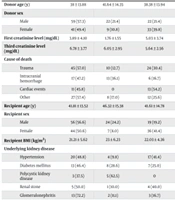
Cheheltanan T, Ezzatzadegan S, Mohammad Karimi V, Ghanbarinasab Z, Alemzadeh N, et al. Evaluation of the Prevalence of Acute Rejection in Post-kidney Transplant Patients with Acute Tubular Necrosis in Nemazee Hospital During 2010 - 2016. Shiraz E-Med J. 2026;27(4):e169703. doi: https://doi.org/10.5812/semj-169703
More by these authors
Last Update: 3 days ago
Last Update: 3 days ago
Last Update: 3 days ago
Last Update: 4 days ago
Last Update: 2 days ago
Last Update: 1 day ago
