
1. Background
The issue of cancellation and its adverse consequences has been the focus of many clinical studies, especially in surgical wards. Canceling the planned procedure on an intended day negatively impacts the hospital’s finances and the patient’s health (1, 2). However, no previous study has assessed the pattern and reasons for cancelation in ECT patients, and the literature is limited to a few case reports (3). Clearly, providing strategies to prevent ECT cancelations is as important as surgical cases. Indeed, ECT is the last life-saving option in resistance cases and those at risk of suicide (4-6). Therefore, regular and uninterrupted treatment sessions are crucial for these cases. Medical team, the scheduled patients to receive ECT are sometimes canceled on the appointed day, which causes anxiety among relatives and disrupts the patient’s healing process. Inappropriate dental conditions, inadequate consultations, abnormal laboratory tests, and paraclinical results, which need further evaluation, are among the reasons for cancellation. It should be considered that, in some situations, the procedure under general anesthesia can be fatal for the patient, and there is no other choice but to cancel it. During the ECT process, significant hemodynamic fluctuations occur due to stimuli of the sympathetic and parasympathetic nervous systems (7, 8). Therefore, it is important to find a practical solution so that the treatment session is not canceled while the patient is managed safely. The successful management of ECT patients results from teamwork and proper communication between anesthesiologists and psychiatrists (9). It has been well documented that this procedure was considered inhumane before anesthesia was used in the ECT process (10). In this regard, the hospital’s anesthesia team designed a checklist for the optimal preparation of patients who were candidates for ECT treatment. This checklist was designed according to the valid related references pointing to the high-risk situations and taking into account the common causes of cancelations in our department (11, 12). Based on this checklist, the necessary consultations and paraclinical evaluations were performed. To the best of our knowledge, it was the first study that discussed the issue of cancelation among ECT patients and tried to provide practical preventive strategies, a topic that seems to have not been sufficiently focused on.
2. Objectives
In this study, we investigated the pattern of cancellation among ECT patients in Shafa Hospital, along with the related reasons and factors. In addition, we shared our successful experience with the quality of the designed checklist.
3. Methods
This retrospective cross-sectional descriptive study occurred at Shafa Hospital, an academic and referral center affiliated with Guilan University of Medical Sciences (GUMS).
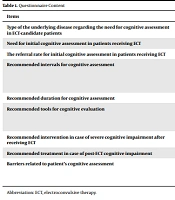
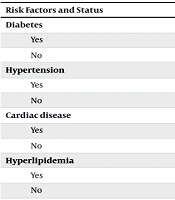
In order to reduce the rate of cancellations with preventive reasons among ECT patients, a checklist was prepared by the anesthesiology team based on the common causes of cancellations in our patients and valid references. It consisted of 6 main items divided into some sections indicating that the patient required further evaluation and consultation with other medical fields was essential. The checklist was shared with involved psychiatrists, faculty, and residents. In this study, the main target was to evaluate the efficacy of the preparing checklist in the reduction of the cancellation rate, while the reasons for cancelations and some related factors, such as the role of residential visits, were the second outcome. For this purpose, the files of canceled cases during the two years of the study, from May 2019 to May 2020 and the second year from June 2020 to May 2021, meaning the year before and after presenting the checklist, were reviewed, and the obtained data were compared. The documented data included patients’ age, gender, psychiatric disorder, the number of ECT sessions, the reason for cancellation, and whether or not a residential visit was performed (Appendix 1).
3.1. Statistical Analysis
In order to analyze the recorded data of 2 different and independent groups during 2 years of the study, before using the checklist and after using the checklist in SPSS software 21, the chi-square test and Fisher’s exact test were used, and a P-value less than 0.05 was considered as the significance level.
4. Results
One hundred fifty-one cancelations were recorded during the two study years, 82 cases in the first year and 69 in the second year. Considering annually 3000 admitted patients in this ward, the rate of cancelation was 2.7 % in the first year compared with 2.3% in the second year. Sixty-five point nine percent of all were men, and 34.1 % were women. Patients’ demographic data are shown in Table 1. The most common reason for the cancellation was inadequate consultations followed by abnormal lab tests. According to a comparison of cancellations between the two years, before and after providing the checklist, no significant difference was observed in terms of age (P = 0.288), gender (P = 0.24), psychiatric disorder (P = 0.399), or the number of ECT sessions (P = 0.36). However, after presenting the checklist, the number of cancelations due to incomplete consultation significantly reduced (P = 0.049), while unstable hemodynamics and changing patients’ conditions on an intended day as the other reason significantly increased (P = 0.024) (Table 2). Residential visits did not significantly affect the cancelation rate in 2 years (P = 0.139) (Table 3). However, comparing the frequency of the reasons for cancelation among those cases visited by residents before and after presenting the checklist, a significant difference was observed (P = 0.001). During the first year, 75 % of the cancelations were due to inadequate consultations, which was reduced to 24% during the second year. In contrast, cancellations due to unavoidable items, such as patients’ unstable status and changing his/her conditions on an intended day, increased from 2.5 % to 24% (Table 4).
Table 1.
Comparing Patients’ Demographic Data Before and After Providing a Checklist a
| Variables | Cancellations Before Checklist | Cancellations After Checklist | P Value |
|---|---|---|---|
| Gender | 0.24 | ||
| Male | 54 (65.9) | 39 (56.5) | |
| Female | 28 (34.1) | 30 (43.5) | |
| Age (y) | 0.288 | ||
| < 30 | 8 (9.8) | 11 (15.9) | |
| 31 - 40 | 16 (19.5) | 13 (18.8) | |
| 41 - 50 | 23 (28) | 16 (23.2) | |
| 51 - 60 | 26 (31.7) | 15 (21.7) | |
| > 60 | 9 (11) | 14 (20.3) | |
| Psychiatric disorders | 0.399 | ||
| Schizophrenia | 38 (46.4) | 33 (47.8) | |
| Bipolar | 29 (35.4) | 29 (42) | |
| Major depression | 7 (8.5) | 1 (1.4) | |
| Psychosis | 14 (17.1) | 12 (17.4) | |
| Other | 8 (9.8) | 6 (8.7) | |
| Number of ECT sessions | 0.36 | ||
| 1 | 62 (75.6) | 53 (76.8) | |
| 2 | 11 (13.4) | 8 (11.6) | |
| 3 | 1 (1.2) | 4 (5.8) | |
| > 3 | 8 (9.8) | 4 (5.8) | |
| Total | 82 (100) | 69 (100) |
a Values are expressed as No. (%).
Table 2.
Comparing the Frequency of the Reasons for Cancelation Before and After Providing a Checklist a
| Causes of Cancellation | Cancellations Before Checklist | Cancellations After Checklist | P Value |
|---|---|---|---|
| Incomplete consultations | 55 (67.1) | 27 (39.1) | 0.049 |
| Abnormal lab tests | 13 (15.2) | 19 (27.5) | 0.568 |
| Loose or decayed teeth | 7 (8.5) | 2 (2.9) | 0.18 |
| Unstable hemodynamics | 4 (4.9) | 20 (28.98) | 0.024 |
| Other | 3 (3.7) | 1 (1.4) | 0.62 |
a Values are expressed as No. (%).
Table 3.
Comparing the Cancelation Status in Terms of Residents’ Visits Before and After Providing a Checklist a
| Variables | Cancellations Before Checklist | Cancellations After Checklist | Total | P Value |
|---|---|---|---|---|
| Residential visit | 0.139 | |||
| Yes | 40 (48.8) | 25 (36.2) | 65 (43) | |
| No | 42 (51.2) | 44 (63.8) | 86 (57) | |
| Total | 82 (100) | 69 (100) | 151 (100) |
a Values are expressed as No. (%).
Table 4.
Comparing the Frequency of the Reasons for Cancelation Among Cases Visited by Residents Before and After the Checklist a
| Reasons of Cancellation | Cancellations Before Checklist | Cancellations After Checklist | Statistical Estimation |
|---|---|---|---|
| Incomplete consultations | 30 (75) | 6 (24) | P = 0.0001 |
| Abnormal lab tests | 7 (17.5) | 11 (44) | |
| Loose or decayed teeth | 1 (2.5) | 1 (4) | |
| Unstable hemodynamics | 1 (2.5) | 6 (24) | |
| Other | 1 (2.5) | 1 (4) |
a Values are expressed as No. (%).
5. Discussion
Studies have described well that, under certain conditions, the anesthesia management of ECT patients could be very challenging (13, 14). Therefore, it is crucial that patients, especially the elderly and those with comorbidities, receive ECT under safe and optimal medical conditions (15, 16). Several case reports have discussed how ECT patients were affected by unexpected hazardous situations, even death (17-20). According to this study’s results, 82 cases were canceled within the year before the intervention and 69 cases during the next year, when the checklist was provided to the psychiatrists and the residents. There was no significant difference between the rate of cancellation before and after the checklist regarding gender, age, psychiatric disease, or the number of ECT sessions; however, a significant difference was observed regarding the reasons for cancelation. It was observed that the number of cancelations due to incomplete consultation as an avoidable reason decreased significantly after developing the checklist; in contrast, changing patients’ conditions on an intended day as an unavoidable reason increased, which indicates the positive effects of the checklist on limiting the number of cancelations. The main reasons for cancelation were inadequate consultations in the first year and abnormal laboratory tests in the second year. It was noteworthy that during the second year of the study, most of the canceled cases were not visited by psychiatric residents, meaning that the academic department of the hospital paid more attention to the checklist, and as a result, fewer cancelations were reported. In terms of residential visits and their intervention, it was found that in the year before the checklist was provided, 48.8% of canceled cases had residential visits, which reduced to 36.2% in the following year. It was also noticeable that after providing the checklist, in cases with the visits of psychiatric residents, the preventable causes of cancellation, such as inadequate consultations, had significantly reduced compared to the previous year. In contrast, unavoidable reasons, such as changing the patient’s medical conditions on the day of the procedure, increased. Comparing the reasons for canceled cases, those who had a resident visit showed that the number of cancellations due to inadequate consultations significantly decreased. In the second year, the number of cancellations due to abnormal laboratory tests increased compared to the first year. It indicates that following the presentation of this checklist, the faculty and residents of the hospital performed the required consultations, but they did not properly follow up on the results of the requested tests. Some laboratory tests and para-clinical evaluations are ordered after consultation, and their results should be checked. In this process, the faculty and residents play a key role, while nurses are also involved and can help reduce preventable reasons for cancellation. In order to reach the goals and minimize the cancelation rate, proper communication between psychiatrists and anesthesiologists and their supervision of the medical staff performance are crucial.
For example, some cancelations are still reported due to poor dental conditions, which could be avoided entirely with a simple evaluation by the nurse. Although there has been much debate about the importance of admitting patients under optimal conditions, the anesthesia team cooperated fully with psychiatrists in the emergency setting, such as catatonia. For example, a pregnant woman at the gestational age of 38 weeks with suicidal ideation was considered for ECT treatment and received 6 ECT sessions despite her high-risk status (21). On the whole, it was found that using this checklist can effectively limit the cancellation rate in ECT patients. We acknowledge that it was a fundamental work that needs further revisions to improve its quality and validity and to create minimum rigor and restrictions in preparing the patients while maintaining maximum safety for them. Therefore, we would greatly appreciate any recommendations on this checklist.
5.1. Conclusions
This study showed promising findings for the efficacy of the preparing checklist as it reduced the rate of cancelation and preventable reasons. It was also revealed that psychiatric residents’ visits after presenting the checklist had a significant role. However, to reach optimal situations, the attempt should be made to omit all preventable causes.