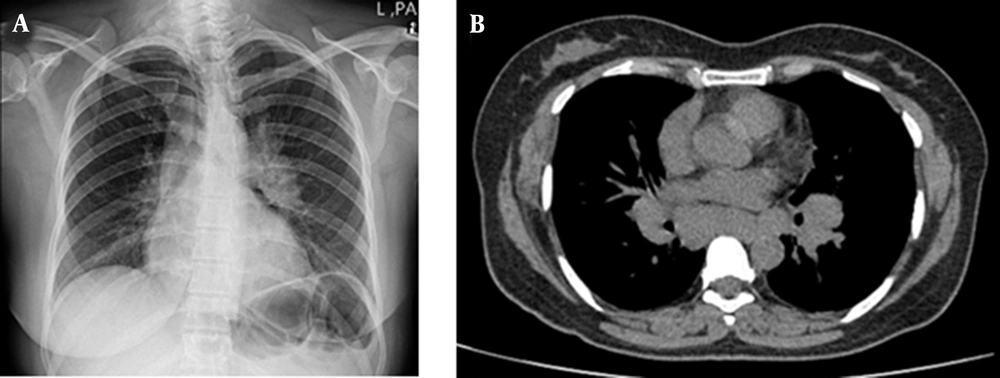
Sarcoidosis is a condition that may coexist with both forms of IBD, UC, and Crohn’s disease (CD), and vice versa; patients with sarcoidosis may complicate with gastrointestinal involvement (
4,
5). It has been estimated that prevalence of gastrointestinal involvement in sarcoidosis is about 0.1% - 0.9%, and the stomach (mainly antrum) is the most affected part. Nevertheless, gastrointestinal involvement may be asymptomatic (
6).
Inflammatory bowel disease, including UC and CD, can cause extra-intestinal involvement and may affect the lungs causing different forms of pulmonary abnormalities concomitantly (
5). Although they may be clinically asymptomatic, it has been estimated that pulmonary function test (PFT) or chest imaging of about 37% - 55% of cases with IBD reveal abnormalities. The value of PFT abnormalities reaches about 90% in patients with active phase of gastrointestinal disease (
7). Cases with IBD may suffer from various forms of lung involvement, including tracheal stenosis, bronchitis, bronchiectasis, alveolitis, pulmonary fibrosis, pleural diseases, etc. (
4,
5,
7,
8). A decreased forced expiratory volume in first second (FEV1) and diffusion capacity of the lungs for carbon monoxide (DLCO) are among the most common PFT abnormalities associated with IBD. Additionally, medications used for the treatment of IBD, like methotrexate, may cause lung injury (
7).
Although some cases with coexistence of sarcoidosis and IBD have been reported (
Table 2), no clear evidence has been identified to precisely explain the association between these two diseases so far (
9-
11). It has been suggested that this coexistence may be related to common genetic and immunological mechanisms, and both diseases may have common allelic regions implicated in their pathogenesis (
5,
6). Several studies focused on genes involved in the regulation of the immune responses, in particular the major histocompatibility complex (called HLA in humans). HLA-DRB1, HLA-DQA1, and HLA-B loci have shown the strongest and broadest associations with IBD (
12). However, no distinct allele is implicated as the primary disease susceptibility gene in UC. The most consistent associated alleles with UC are the positively associated HLA-DRB1*1502 (subtype of HLA-DR15) and HLA-DRB1*0103, and negatively associated DRB1*0401 alleles (
12,
13). HLA-DRB1*12 and HLA-B*52 may also contribute to the development of UC (
13,
14).
| References | Year | Age (y)/Sex | Order and Interval of Onset (y) | Human Leukocyte Antigen | Preceding Treatment |
|---|
| (3) | 1967 | 30/M | UC - SAR (2) | N.C. | Steroid |
| 1969 | 26/M | UC - SAR (2) | N.C. | Steroid, salazopyrin |
| 1971 | 52/F | SAR - UC (13) | N.C. | - |
| 1981 | 64/F | Coincidence | N.C. | - |
| 1986 | 44/F | UC - SAR (20) | Three patients with HLA A1, B8, and DR3+ | Steroid |
| 31/M | Coincidence | - |
| 64/M | SAR - UC (12) | Steroid |
| 38/F | SAR - UC (6) | - |
| 33/M | SAR - UC (15) | Steroid |
| 20/M | UC - SAR (16) | - |
| 37/F | SAR - UC (9) | - |
| 47/M | UC - SAR (13) | - |
| 1987 | 30/M | UC - SAR (13) | B8 | Steroid, sulfasalazine |
| 1989 | 42/M | UC - SAR (13) | N.C. | - |
| 1995 | 38/M | UC - SAR (13) | N.C. | Steroid, sulfasalazine |
| 1996 | 41/M | UC - SAR (6) | N.C. | Tixocortal |
| 1996 | 58/F | UC - SAR (36) | N.C. | Steroid |
| 1997 | 22/M | UC - SAR (6) | A27, B52, B54, DR2, DR4 | - |
| 1999 | 33/F | Coincidence | DR52 | - |
| 2001 | 38/F | UC - SAR (10) | A2, A28, B27, B44 | Steroid, sulfasalazine |
| 2003 | 53/M | UC - SAR (3) | N.C. | Steroid, mesalamine |
| 2005 | 33/F | UC - SAR (10) | N.C. | Steroid |
| 2013 | 50/M | UC - SAR (8) | N.C. | Steroid, salazopyrin |
| 2015 | 62/F | UC - SAR (24) | A24, A26, B62, B52, DR14, DR15 | Mesalazine |
| (24) | 2017 | 30/M | UC - SAR (5) | A24, B62, DR14- A26, B52, DR15 | Infleximab, 5-ASA, azathioprine, steroid |
| Our study | 2022 | 48/F | UC - SAR (20) | A*01, DRB1*13-DQB1*06 haplotype | Mesalazine |
Abbreviation: N.C., not considered.
Likewise, familial clustering of sarcoidosis has been reported previously. Various genes have been suggested to contribute to genetic susceptibility to sarcoidosis, including genes encoding angiotensin converting enzyme, vitamin D receptor, T-cell receptor genes, immunoglobulin genes, and, most relevant, HLA genes (
15). It is claimed that HLAs DRB1*08, DRB1*11, DRB1*12, DRB1*14, DR 15 (serotype of HLA DRB1*15), and DR 17 (equivalent to HLA DRB1*03) cause susceptibility to developing sarcoidosis; however, some others, including HLAs DR1 (HLA DRB1*01), DR4 (HLA DRB1*04), and possibly DQ*0202 may play a protective role (
9,
16).
Barr et al. showed that HLA A1, B8, and DR3 phenotype occur with a higher frequency in cases with sarcoidosis associated with UC than the patients with either disease alone (
17). The present case had HLA-A*01 allele, which may be related to the occurrence of sarcoidosis in association with UC.
DRB1*13-DQB1*06 haplotype is one of the most prominent positive HLA associations of primary sclerosing cholangitis (PSC). The present case, though not complicated by PSC, had the DRB1*13-DQB1*06 haplotype. The frequency of the DRB1*13-DQB1*06 haplotype is about 3.3-7.7% in different Iranian ethnic populations (
18). This suggests that this haplotype may play a role in different autoimmune disorders, including sarcoidosis.
Some cases have been shown to harbor both sarcoidosis-related HLA alleles and UC-related alleles (
3). However, patients suffering from both diseases without any of the known susceptible HLA genotypes have also been reported (
3). These cases, along with our reported case suggest that there might be unknown common susceptible genes outside the MHC class I and II region influencing the onset of both sarcoidosis and UC. Some non-classical HLA genes involved in antigen processing and presentation, namely TAP, LMP, and DM, and alleles of the tumor necrosis factor gene cluster (TNFA, LTA, LTB), seem to contribute (
15). The association of IL23R with sarcoidosis has also been identified, and based on genetic results, possible aetiologic similarities between sarcoidosis and IBD were reported (
19). Further studies are required to better understand the genetic associations between sarcoidosis and UC. It has also been reported that patients with UC treated with infliximab are susceptible to develop sarcoidosis (
20-
24).
3.1. Conclusions
Herein, we reported a case that developed sarcoidosis 20 years after the onset of UC symptoms without a prior history of infliximab therapy. Patients with UC who possess HLA-A*01 phenotype may possibly be more susceptible to developing sarcoidosis.