
1. Background
ECT with several advantages in comparison to the other treatment techniques is recommended for the most severe psychiatric diseases. It is a simple treatment with limited and transient side effects and a rapid therapeutic response and is proved to be effective in drug- resistant cases and earlier return to normal life. The procedure is performed under general anesthesia inducted by a hypnotic agent such as Propofol or thiopental sodium, followed by succinylcholine as a muscle relaxant. Airway control is maintained by mask ventilation. After a short hyperventilation, an electrical current is delivered to the brain through two electrodes placed bilaterally on temporal area, resulting in a short-lasting seizure (1-4). According to the current evidence, anxiety as the main distressing complication in this procedure results in refusing or stopping this treatment (5). Studies have reported different factors leading to ERA, including memory loss, GA, unconsciousness, drug injection, and brain damage (6-8). Unfortunately, this issue is less concerned (7, 9). A number of ERA interventions, including the presence of relatives during the first stages of the procedure, talking about ECT, relaxation techniques, movies and media, and the provision of an educational pamphlet, have been already used (10, 11). Furthermore, a significant technological progress such as the use of anesthesia has been observed over the last decades. In spite of such attempts, a growing body of evidence has recently revealed that ECT-related deep anxiety is still remained and we have not yet achieved a standard clinical guideline to tackle with ECT patients’ fear and anxiety (12, 13). Given the importance of the issue, understanding why these patients continue to endure hostility to ECT should be further investigated. In order to reduce the patients’ ERA, the first step is to explore the main reasons. In spite of a few similar studies, the results of other studies could not be generalized due to the differences in terms of culture, level of education, and beliefs as a wide range of reported prevalence rates highlight this fact. Accordingly, each district should be separately examined to reveal its own specific pattern.
2. Objectives
The present study aimed to investigate the main causes of ECT-related anxiety (ERA) in an academic hospital in the north of Iran.
3. Methods
The study protocol was first approved by the Research Ethics Committee of Guilan University of Medical Sciences (GUMS) (Ref: IR.GUMS.REC.1398.126). Then this descriptive study was carried out at the department of psychiatry of a Tertiary Academic Center having outpatient facilities and a general psychiatry ward. The hospitalized patients in the psychiatric ward of Shafa Hospital, who had proper communication skills and provided us with their informed consent, were included in the survey.
First, a responsible resident of psychiatry explained the patients the objective of the study. After receiving their consent forms, the resident filled out the questionnaire during a face-to-face interview. The questionnaire was adopted from Ranjbar’s study and contained four sections, including ECT side-effects, procedure factors, medical team communication, and familial, social, and economic factors. Each section encompassed some items, with total number of 12 items. Demographic information contained gender, age, psychiatry disorder, level of education, and history of ECT.
4. Results
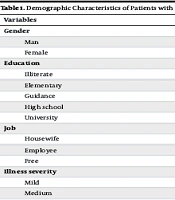
The data collected from 353 patients were analyzed. The patients’ demographic profile and their diagnosis are depicted in Tables 1 and 2. A majority of the participants were male (59.2%), and the mean age of the patients was 40.52 ± 12.8 years. A large number of patients (92.3%) reported at least one item for ERA, and 143 patients (85.6 %) had the history of ECT. All the participants (100%) had no experience in this regard (P = 0.0001). The most common cause of ERA was ECT-related side effects (70.7%) such as memory impairment (60.4%), disablement (24.9%), and death (14.7%) followed by procedure factors (27.2%), general anesthesia (GA) (73.2 %), and electric current (26.8 %); however, none of the patients reported any concern about medical team behavior (Table 3). A significant relationship was observed between gender and the history of ECT with the patients’ anxiety reasons (P = 0.0001). The patients with ECT experience and women had significantly lower levels of ERA. Furthermore, the other variables, including age (P = 0.72), type of disease (P = 0.144), and the level of education (P = 0.012) had no impact on the results.
Table 1.
Patients’ Demographic Information
| Variable | Number (%) |
|---|---|
| Gender | |
| Female | 144 (40.8) |
| Male | 209 (59.2) |
| Age | |
| < 30 | 89 (25.2) |
| 31 - 40 | 99 (28) |
| 41 - 50 | 77 (21.8) |
| > 50 | 88 (24.9) |
| Level of education | |
| Illiterate and Elementary | 163 (46.2) |
| Under Diploma | 44 (12.5) |
| Diploma | 106 (30) |
| Graduate | 40 (11.3) |
Table 2.
Patients with Psychiatric Disorder
| Diagnosis | Number (%) |
|---|---|
| Schizophrenia | 138 (37.1) |
| Bipolar | 119 (33.7) |
| Drug psychosis | 53 (17) |
| Personality disorder | 20 (5.7) |
| Major depression | 18 (5.1) |
| Obsessives compulsive disorder | 5 (1.4) |
| Total | 353 (100) |
Table 3.
Causes of ECT-related Anxiety
| The Causes of ERA/Subgroups | Number (%) |
|---|---|
| ECT side effects | 275 (70.7) |
| Memory impairment | 189 (60.4) |
| Disablement | 78 (24.9) |
| Death | 46 (14.7) |
| Procedure factors | 106 (27.2) |
| General anesthesia | 82 (73.2) |
| Electrical current | 30 (26.8) |
| Medical team communication | 0 (0) |
| Familial, social and economic factors | 8 (2.1) |
| Isolation | 6 (75) |
| Costs | 2 (25) |
| 100 | 389 |
5. Discussion
Studies have revealed that ERA is a common phenomenon with a prevalence rate ranging from 29% - 75% (14). Due to negative attitudes and misconceptions, most of the patients experience a feeling of fear and anxiety. On the other hand, studies have shown that the patients, after treatment, do not find it a really frightening and painful experience (15). Our study supported this finding because ERA was significantly lower among the patients with a history of ECT. Notably, a majority of the participants (92.3%) appeared to have ERA. According to the findings of this survey, the main cause of ERA was GA and memory impairment, followed by electrical current. We found out that different ERA levels and causes have been reported by similar studies. Rajogopal et al. reported that one third of their cases had had fear and anxiety of ECT due to their inadequate information (16). The other studies indicated that a high-quality informed consent could help the patients suffer from less anxiety. In Vergese’s et al. study, the proportion of patients with ERA was 75%, and the main cause of such an anxiety was memory disturbance (17). In Hughes’ et al. study, 44% of the patients experienced anxiety before ECT mostly due to their fear of memory loss (18). Guruvaiah et al. reported severe fear and anxiety in 17% of their participants before ECT. They found the patients had higher levels of anxiety for GA than ECT. This finding was in a similar vein with our findings. Malcolm et al. reported that 60% of the patients had some levels of fear and anxiety before ECT, and the most common reasons for such a feeling were brain damage and memory loss, followed by GA and pain (19). In Gallinek’s et al. study, 67% of the cases experienced ERA before the treatment (20). Comparing our findings with the other findings, in spite of the similarity regarding the causes of fear and anxiety, a larger number of patients reported ERA in this study. Definitely, we have to focus on these findings and pay enough attention to find out the underlying problems such as the role of social media. We noticed that GA was the most common cause of ERA, while it has been confirmed that ECT under GA was a revolution that brought safety to the procedure. Accordingly, it seems that enough time has not been devoted to provide the patients with accurate and real information. In general, the differences among the studies with regard to the wide range of ERA prevalence could be explained by different methodologies. Firstly, there was no agreement on a standard definition for ERA. Secondly, there were different measurement scales for anxiety, including researcher-developed questionnaires or researcher-developed interviews, whose validity and reliability are not confirmed. Thirdly, the non-heterogeneous populations were included in the studies. Unlike some previous studies, our participants were not candidates for ECT therapy. They were hospitalized in psychiatric ward and they were on medication. They were included in this study because they had better views and communication skills to answer the questions. In addition, although they were not receiving ECT courses, they were exactly the patients who might require them due to their resistant conditions, their own request, or any other unexpected emergency situation. Moreover, cultural differences, beliefs, and levels of education should also be taken into consideration. Another effective factor was the interview time. Obviously, the results might be different when the patients are interviewed retrospectively, compared to the cases interviewed before the treatment. Studies have shown that longer intervals are associated with higher levels of ERA. The effects of forgetting should be considered, which was not included according to the methodology of this study. The potential effects of forgetting on the results was disregarded. Additionally, we did not specify different levels of ERA. Obviously, 92.3% of the participants with ERA were not in the same condition. For example, Guruvaiah et al. reported severe fear and anxiety in 17% of their participants. Our results might be different if we limit ERA to the severe forms. To sum up, according to our findings, further attempts should be made to plan effective strategies to eliminate ERA in patients. In this regard, a well-developed informed consent form, which provide enough information to the patients and their families, could be as the first effective measure.
5.1. Limitations
In this study, the severity of anxiety was not assessed and was considered as mild in pathological forms.
5.2. Conclusion
This paper revealed that ECT side-effects and the procedure factors were the main causes of ERA. A multidisciplinary team, consisting of psychiatrics, anesthesiologists, nurses, and families is recommended to help these patients to handle their fear and anxiety successfully, follow up the treatment, and take the suggested courses. Future studies are welcomed to find out the other effective and practical interventions to achieve the same goal.