1. Background
Family is one of the main elements in providing health care to patients (1). The role played by the family for the patients, in the nursing program, must to be taken as important as the role of the patients (2, 3). Clearly, having a clear understanding of the family needs and attenuating stress as well as anxiety in the family entails with employing different techniques by the nurse (4-6). According to the Iran society of anesthesia and critical care (2011), about 1.5 - 2 million are admitted to hospitals every year due to road accidents, stroke, and the like; 30% of them are hospitalized in the ICU. Usually, finding the loved ones in the critical and stressful situation of an ICU with all those complicated machines attached to the patient is stressful and increases mental and spiritual pressures on the family (7). The patients in the ICU are in critical condition or in a highly risky situation and need special attention (8-10). This situation can be a cause of sorrow, hopelessness, and loss of ability in the family (11-13). There have been many studies to uncover the factors that may help people in stressful situations or prevent sustaining more damages under severe pressure. One of the main abilities that make adaptation to risk factors easier is resilience. Resilience and resilient behavior, potentially, help people overcome their negative experiences and convert them into positive ones (14-18). Through attenuating emotional problems, resilience improves satisfaction in life (19, 20). It is a dynamic process featured with positive adaptation to unpleasant and hard situations. The key beliefs effective on resilience in the family are categorized into 3 categories including attempts to find a meaning for the disaster, create a positive outlook, and developing higher beliefs and spirituality (21). Spiritual atmosphere in Muslim families, directly and through improving quality of communication, results in higher resilience and better management of family affairs. Several recent studies have highlighted the role of spiritual and religious beliefs in the resilience of family. Spiritual beliefs are both personal and community matters (21-23). Through realization of peace of mind and relief from mental pressures caused by the disease, spiritual interventions facilitate the process of treatment and recovery indirectly. People in different cultures tend to seek help from a holy and divine source in hard situations when they feel more need for spirituality in hardships (24-29). Studies have shown that spirituality and spiritual beliefs improve one’s ability to deal with diseases or facilitate the recovery process. Leading a healthy life entails with a balance among all aspects of health viz. physical, social, mental, and spiritual; therefore, studying physical, mental, and social aspects minus spiritual aspect would not be fruitful (24). In general, spiritual care in the nursing profession is a unique feature of health care, which cannot be replaced by religious, mental, and social health cares as it answers fundamental needs like meaning of life, pain, hardships, and death (30-38). Along with other nursing interventions, spiritual intervention creates a balance between physic, psyche, and spirituality toward acquiring a complete and comprehensive health. This means that nurses need to pay attention to spiritual needs as a part of society-based health care (31, 38, 39).
2. Objectives
Given the effect of having an ICU patient on ability and resilience of family and the effect of resilience on overcoming and controlling negative experiences, the present study is aimed at surveying the effect of spiritual religious interventions on resilience of Muslim family members of ICU patients.
3. Methods
This quasi-experimental study is based on an MSc dissertation in nursing with research plan No.: 94252, and Ethics Committee ID No.:kums.rec.1394.39. The study was carried out in Kermanshah Imam Reza hospital in 2015. The study population included all the blood relatives of ICU patients in the hospital. The participants were selected through convenient sampling and were randomly allocated to experiment and control groups.
Sample size was obtained based on the formula for comparing mean score of a quantitative trait between 2 groups with level of confidence of 95% and test power of 90%. Other parameters of the formula were adopted based on a similar study (24). Minimum sample size for each group was obtained equal to 10 (totally 20 subjects needed). Taking into account probable leaves during the course of study, 17 participants were selected for each group. The participants were selected through the convenient sampling method and then grouped randomly.
The inclusion criteria included the main company of the patients, a member of family (spouse, children, parents), desire to participate, no physical disability (hearing or visual impairment), older than 18 years, incurable disease of the patient (depression of brain function and no response to stimuli), reading and writing ability, and belief in Islam. The exclusion criteria included resigning, discharge or death, and failure to attend one of the intervention sessions. Data gathering tools included a demographics questionnaire (age, gender, marital status, education, income, number of children, etc.) and CD-RIS (Connor- Davidson’s resilience scale) including 25 statements, which is validated for Iranian subjects (40-46). The latter is designed to measure resilience and the statements are based on Likert’s scale (completely false = 0, relatively false = 1, no idea = 2, relatively right = 3, and completely right = 4). The obtained score is the algebraic sum of scores of all statements (0-100); therefore, the higher the score, the higher the resilience and vice versa.
Having secured permission from the research and technology department of Kermanshah Medical Science University and the officials of Imam Reza hospital, the researchers referred to the ICUs and briefed the candidates about the process and objectives of the study. Those interested in participation signed a letter of consent. Resilience of the subjects was measured by CD-RIS and then the intervention was carried out based on 26 ethics codes through group sessions; the intervention consisted of spiritual-religious interventions based on Richards and Bergin’s model (47) with emphasis on Islamic rules (8 sessions; 3 times a week; 45 - 60 minutes each). The sessions were held in a room next to the general ICU of the hospital (Table 1).
Table 1.
Religious Spiritual Interventions
| Session | Title | Activities |
|---|---|---|
| 1 | Introduction, Objectives and regulations brief, Establishing group solidarity. | Participants were introduced to each other. A easy and friendly atmosphere was created and the participants were motivated. Religious and spiritual status and needs of the participants were determined. The participants were encouraged to share their religious feelings and beliefs. |
| 2 and 3 | The role of reading the Holly Quran in personal peace and tranquility | A volunteer read the Holy Book loudly In Arabic and Farsi and the participants were motivated to express their religious feelings and beliefs. |
| 4 and 5 | Discussion about praying | The participants were asked to read Mojir prayer in group along with other prayers in Mafatih Aljenan with their Farsi translation. Group discussion about prayers and their role in personal peace. |
| 6 | Developing role models based on religious characters | Life story of religious characters were narrated by a volunteer and practical role models such as prophets Job and Mohammad were discussed. Calamities suffered by Ahl Beit (PBUT) such as Kerbala event and Zeinab’s (PBUH) life were reminded. |
| 7 | Repentance and asking for God’s forgiveness | Repentance and asking God’s forgiveness were discussed in the group |
| 8 | Participation in religious spiritual events | Preparing the environment for praying individually and in group. To make pilgrimages. Participation in charity activities managed by charity institutes. |
Spiritual interventions:
1. Motivating trust, solidarity, and honesty in establishing proper relationship throughout the sessions.
2. Listening attentively to the physical problems, worries, and concerns of family members.
3. Providing spiritual support as needed.
4. Raising hope in the participants.
5. Utilizing positive energy statements and sharing healthy and constructive thoughts.
6. Supporting the family members in their search for a meaning and reason in the disease and that none of life events is beyond God’s will. One who believes in God’s rule in the world finds the universe system reasonable and rejects negative, nihilistic, and despairing thoughts.
7. Motivating the members to pray and read the Holy Quran.
8. Motivating the members to follow their religious beliefs.
9. Motivating the members to consult with religious experts and clergies.
10. Motivating the members to improve their relationship with the individuals they feel more peace with.
11. Ensuring the members that nurses will be available for providing mental and spiritual supports.
12. Repenting and asking God’s forgiveness for the sins in the past and trying to forgive others’ for their faults.
13. Motivating the members to listen to the music except the music used in parties and dancing.
14. Motivating the members to establish friendly relationships with others.
15. Motivating the members to take part in religious and community activities.
It is notable that in observance of ethical concerns, the intervention pack was made available for the participants in the control group though an educational CD.
4. Results
The collected data was analyzed in SPSS (20) using descriptive and inferential statistics for the demographical information and t-test to compare the mean score of resilience in the control and intervention groups.
Table 2 lists the results of consistency assessment of the background variables such as age of the family members, gender of the family members, marital status, the education level of the family members, religion, employment status, income level, number of children, and domicile. The assessment was done using Chi-squared test (for qualitative variables) and independent t-test (for quantitative variables) (P > 0.05).
Table 2.
Descriptive Information of Consistency of the Two Groups
| Variable | Intervention | Control | Chi Square | P Value | ||
|---|---|---|---|---|---|---|
| N | % | N | % | |||
| Gender | 0.724 | |||||
| F | 6 | 17.6 | 7 | 20.6 | 0.164 | |
| M | 11 | 32.4 | 10 | 29.4 | ||
| Total | 17 | 50 | 17 | 50 | ||
| Marital Status | 0.473 | |||||
| Unmarried | 7 | 20.6 | 5 | 14.7 | 0.515 | |
| Married | 10 | 29.4 | 12 | 35.3 | ||
| Total | 17 | 50 | 17 | 50 | ||
| Education | 0.303 | |||||
| Junior high school and high school | 7 | 206 | 11 | 32.4 | 1.06 | |
| College | 10 | 29.4 | 6 | 17.6 | ||
| Total | 17 | 50 | 17 | 50 | ||
| Occupation | 0.3 | |||||
| Employed | 8 | 23.5 | 11 | 32.4 | 1.074 | |
| Unemployed | 9 | 26.5 | 6 | 17.6 | ||
| Total | 17 | 50 | 17 | 50 | ||
| Income | 1 | |||||
| Below the average (2000000 RIs >) | 15 | 44.1 | 13 | 38.2 | 0.000 | |
| Above the average (2000000 RIs ≤) | 2 | 5.9 | 4 | 11.8 | ||
| Total | 17 | 50 | 17 | 50 | ||
| Number of children | 0.492 | |||||
| Less than 2 | 10 | 29.4 | 8 | 23.5 | 0.472 | |
| 2 or more | 7 | 20.6 | 9 | 26.5 | ||
| Total | 17 | 50 | 17 | 50 | ||
| Domicile | 0.955 | |||||
| City | 14 | 41.2 | 15 | 44.1 | 0.234 | |
| Village | 3 | 8.8 | 2 | 5.9 | ||
| Total | 17 | 50 | 17 | 50 | ||
| Age | 0.533 | |||||
| Mean ± SD | Independent t-test | |||||
| Intervention | 36.53 ± 2.03 | -0.631 | ||||
| Control | 38.53 ± 2.44 | |||||
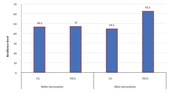
Independent t-test results showed that the mean scores of resilience of the experiment and control groups before the interventions were 62.06 and 64.24, respectively, and given the probability value (P = 0.663) there was no significant difference between the 2 groups in this regard (Table 3). Moreover, the mean scores of resilience of the experiment and control groups after the intervention were 71.59 and 62.59, respectively, and given the value of probability (P = 0.025), the 2 groups were significantly different after the intervention in this regard (Table 3).
Table 3.
Mean Score of Resilience of Control and Experiment Groups Before and After the Interventions (2015)
| CD RIS | Spiritual Interventions | Group | Mean ± SD | Independent t-Test | P Value |
|---|---|---|---|---|---|
| Total | Before | Intervention | 62.06 ± 3.350 | -0.44 | 0.663 |
| Control | 64.24 ± 3.65 | ||||
| After | Intervention | 71.59 ± 2.074 | 2.363 | 0.025 | |
| Control | 62.59 ± 3.195 |
The results of independent t-test in Table 3 show that there is no statistically significant difference between the 2 groups (i.e., the experimental group and control group) before the intervention (P value = 0.663). Whereas, there is a statistically significant difference between the 2 groups (i.e., the experimental group and control group) after the intervention (P value = 0.025).
Based on paired t-test and probability value (P = 0.001), there was a significant difference in terms of resilience score in the experiment group before (62.06 ± 3.350) and after (71.59 ± 2.074) the interventions (Table 4). Moreover, and based on the value of probability (P = 0.0525), there was no significant difference in terms of resilience score in the control group before (64.24 ± 3.65) and after (62.59 ± 3.195) the interventions (Table 5).
Table 4.
Mean Score of Resilience of the Experiment Group Before and After the Intervention (2015)
| CD RIS | Experiment Group | Mean ± SD | Paired t-Test | P Value |
|---|---|---|---|---|
| Total | Before | 62.06 ± 3.350 | -3.85 | 0.001 |
| After | 71.59 ± 2.074 |
The results of paired t-test showed that there was a statistically significant difference in experiment group before and after the interventions (P value = 0.001).
Table 5.
Mean Score of Resilience of the Control Group Before and After the Interventions (2015)
| CD RIS | Control Group | Mean ± SD | Paired t-Test | P Value |
|---|---|---|---|---|
| Total | Before | 64.24 ± 3.65 | -0.650 | 0.525 |
| After | 62.59 ± 3.195 |
The results of paired t-test showed that there was no statistically significant difference in control group before and after the interventions (P value = 0.525).
5. Discussion
The findings indicated that there was no significant difference between the control and experiment groups before the interventions. However, given the cut point of the questionnaire (score = 50), all the participants were resilient. Hossini Ghomi et al. (2013) listed prolonged hospitalization, incurable nature of the disease, and senescence of the patients as the factors effective on the resilience of family members (48). Openshaw (2011) reported that the resilience and performance of family members were considerably and strongly related to the aspects of quality of life (physical health, mental health, job, education, leisure time, communication with others, intra-family relationships, social relationships, financial condition, independence, spirituality, and religion) of the disabled individuals (49). Naemi (2015) reported that there was no difference between the resilience of women with drug addict husbands in the control and intervention groups before the intervention (50). Taking into account that the drug addicts are a source of stress in their families, the extent of resilience in the present study is correlated with resilience in Naemi’s study. Consistently, Hosseini Ghomi (2013) reported that CD-RIS resilience score of the mothers of children with cancer in control and intervention groups was high (48). Therefore, one may conclude that human’s resilience and ability to adapt to disease, pain, and hardships caused by stressors in life is high (49, 51). According to the authors, resilience of family is the ability of family to encounter changes in critical situations, ability to rehabilitate, and ability to achieve rebalance after a crisis (51). Resilience influences different feelings and emotions like positive attitudes and satisfaction with life consequently. Changes in emotions results in changes in attitudes about events and changes in emotions are in turn rooted in a set of skills and capabilities, which are acquirable. Thus, positive attitudes can be nurtured through implementing proper interventions (21). Additionally, the results showed a significant difference between the control and intervention groups after the intervention in terms of the mean score of resilience. There was also a significant difference in the intervention group in terms of resilience before and after the intervention. Despite the increase in resilience in the both groups, the results showed effectiveness of the spiritual-religious interventions on increase of the resilience of family members in the intervention group. Taghizade et al. (2013) showed, in their study titled “effectiveness of spirituality-therapy on resilience of women with MS”, the intervention was effective on increasing resilience of the subjects (52). Moreover, Momeni (2012) reported a positive relationship between resilience, spirituality, problem-oriented resilience strategy, and quality of life; therefore, the increase in resilience resulted in higher quality of life (53). Saeidi (2010) reported about effectiveness of spiritual-religious intervention on resilience (21).
The effects of religious-spiritual intervention on the resilience of family members of ICU patients were examined. The results showed that the intervention can be as effective as medicines in increasing resilience and decreasing mental pressure caused by hospitalization of the loved ones. In addition to bringing more peace to the family members, such intervention improves physical ease, mental peace, and satisfaction, which results in improvement of quality of health care services. In summary, a spiritual atmosphere in families, directly and through improving quality of communication, results in higher resilience and better problem management in families.
5.1. Conclusion
This finding puts emphasis on the necessity of paying attention to and empowering religious/spiritual beliefs of the patients (ICU patients in particular) and their family members; this is possible through a proper programming.
5.2. Limitations
Absence of similar studies, reluctance of candidate participants, and operational limitations to hold the group sessions were of the limitations.