The results of our study demonstrate that the extracts of
U. dioica and
P. boissieriana exhibit strong scolicidal activity, particularly at higher concentrations. While various studies have explored the protoscolicidal effects of hypertonic saline (
25), cetrimide, ethyl alcohol (95%) (
26), silver nitrate (
27), 10% povidone-iodine (
28), albendazole (
29), and mannitol (
27), their usage is limited due to multiple dangerous complications (
3). Consequently, there is an urgent need for novel therapeutic approaches due to the inadequate therapeutic effects of existing drugs. Natural remedies and herbal products have long been utilized in treating microbial and fungal infections (
30), owing to their biodegradability and safe nature for host organs. In recent decades (
31), traditional and natural medicines have undergone detailed study for drug discovery purposes. Additionally, natural and herbal products serve as inspiration for developing new medications to treat various diseases (
32). Although the extract of
P. boissieriana exhibited lower potency compared to
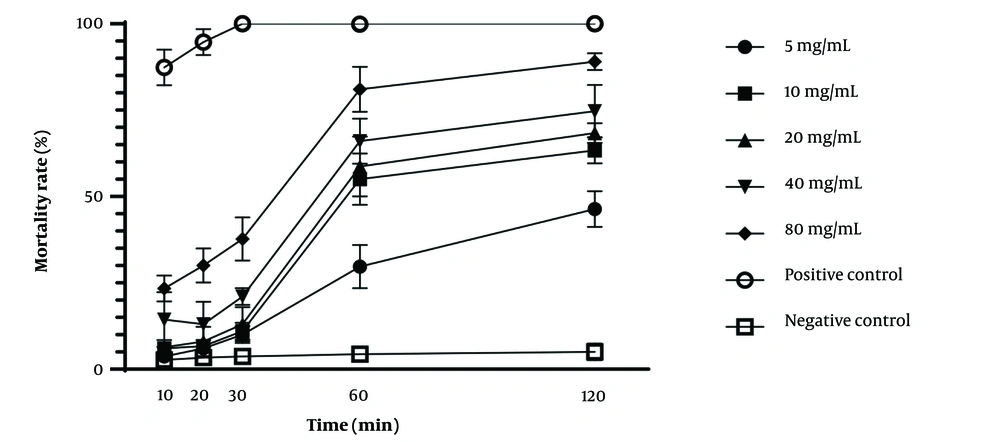
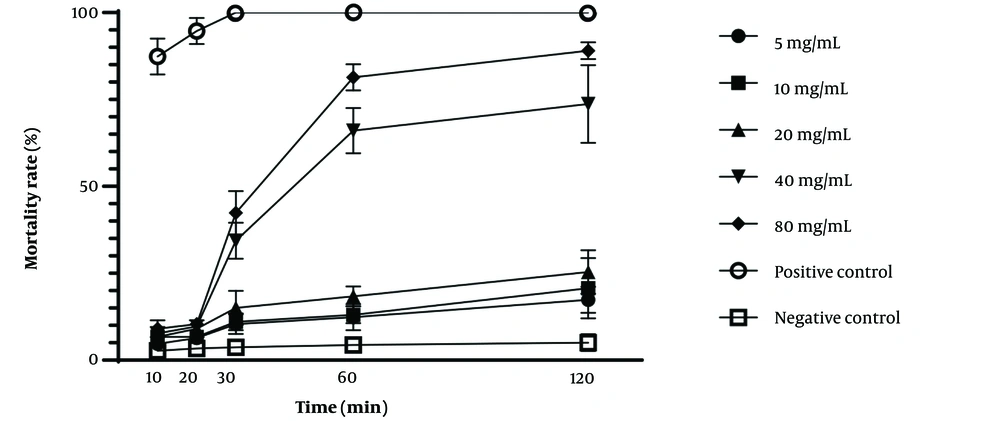
U. dioica at lower concentrations, both extracts at a concentration of 80 mg/mL showed significant scolicidal effects after 60 and 120 minutes. Therefore, these natural extracts have the potential to be utilized as safe medications in the treatment of CE.
Numerous studies have explored the effects of various herbal extracts on the protoscoleces of CE cysts. In 2008, Sadjjadi et al. conducted a study assessing the in vitro effects of different Allium sativum extracts on protoscoleces. They found that the chloroform extract of garlic at a concentration of 200 mg/mL exhibited the highest scolicidal activity, with a mortality rate of 99.97% and 100% after 60 and 120 minutes of exposure, respectively (
33). Conversely, the aqueous extract of garlic at a concentration of 500 mg/mL showed the lowest scolicidal activity, with mortality rates of 29.51% and 40.6% after 60 and 120 minutes of exposure, respectively. A study conducted in 2019 investigated the protoscolicidal effects of the methanolic extract of Allium hirtifolium on protoscoleces of
E. granulosus. It revealed that at a concentration of 50 mg/mL of
A. hirtifolium extract, only a 16.96% scolicidal effect was observed after 50 minutes of exposure. Despite belonging to the allium family,
A. hirtifolium's methanolic extract demonstrated less scolicidal effect (
23). Another study by Zibaei et al. in 2012 evaluated the scolicidal effects of Satureja khuzestanica and Olea europaea against CE, showing
S. khuzestanica to be a more effective scolicidal agent. At 0.01% concentrations,
S. khuzestanica exhibited 83.3% and 68.6% scolicidal effects after 60 and 120 minutes of exposure, respectively (
34), which aligns closely with our results.
U. dioica and
P. boissieriana, at a concentration of 80 mg/mL, demonstrated approximately 81% and 89% mortality rates, respectively, after 60 and 120 minutes of exposure, consistent with these findings. Moazeni and Roozitalab investigated the scolicidal effects of
Zataria multiflora on protoscoleces and found that the extract of
Z. multiflora is a potent protoscolicidal agent (
35).
Urtica dioica has been utilized for centuries in treating various ailments. Previous studies have confirmed its antioxidant, antiviral, antibacterial, antifungal, anthelmintic, and analgesic properties, alongside its richness in minerals and vitamins (
20,
36). Hadizadeh et al. explored the fungicidal potential of
U. dioica against plant pathogenic fungi, establishing its efficacy as a strong fungicide (
37). Mikaeili et al. investigated its antifungal effects against Microsporum canis both in vitro and in a guinea pig model, suggesting its topical application for treating tinea corporis (
38). Sarma Kataki demonstrated the dose-dependent anthelmintic activity of the methanolic extract of
U. dioica against adult Indian earthworms (
Pheretima posthuma) (
39). Similarly, Turel et al. examined its anthelmintic potency against mice naturally infected with
Aspiculuris tetraptera, confirming its effectiveness (
40). A 2020 study validated the dose-dependent anti-leishmania effects of
U. dioica in vitro and in vivo (
41). Additionally, Yongabi et al. evaluated its activity against multiple fungi, affirming its potent antifungal properties without significant side effects, attributed to the plant lectin agglutinin and its effective component (
42), carvacrol (
18). Furthermore, tannin, another compound found in
U. dioica, has been shown to inhibit enzymes and prevent microbial adhesion, rendering the plant effective against bacteria and fungi (
43). Given the favorable outcomes of our study and other research,
U. dioica could serve as a safe protoscolicidal agent.
Several studies have highlighted the antibacterial, antifungal, antioxidant, and antidiabetic activities of
P. boissieriana (
21). Azadbakht et al. demonstrated its antilarval, antibacterial, and antifungal properties against
Candida albicans and
Cladosporium. Arbutin, a significant component of
P. boissieriana, exhibited antifungal and antioxidant effects (
44). Additionally, arbutin was found to possess significant antibacterial activity, particularly in treating urinary tract infections (
45). Jin and Sato investigated the antibacterial effects of aqueous extracts from young shoots of
Pyrus spp., identifying benzoquinone, derived from arbutin, as a potent antibacterial agent (
46). Güven et al. confirmed significant antifungal effects of
Pyrus serikensis (
47), while a recent study in 2019 established the antifungal effects of
Pyrus communis against
Aspergillus flavus and
Candida albicans, along with antibacterial activities against
Salmonellatyphimurium (
48). Considering this evidence alongside our study results,
P. boissieriana shows promise in treating CE.
Natural remedies are widely used for their safety and minimal side effects in treating infections globally (
31,
49-
51). However, this study did not evaluate the cytotoxic effects of the extracts, which is a limitation. Nonetheless, other studies have assessed and confirmed the safety of these extracts. Asadi and Abbasi Maleki demonstrated the LD
50 of hydroalcoholic extract
U. dioica in mice as 2900 mg/kg during acute toxicity testing, much higher than the doses used in our experiment (
52). Similarly,
P. boissieriana extract given to mice models at doses of 500 and 1000 mg/kg showed no reported side effects or mortalities (
21,
53). Other
Pyrus species, such as
Pyrus pashia and
P. communis, exhibited LD
50 of 1500 and 2000 mg/kg, respectively, in rat models (
54,
55), further supporting the safety of these herbal extracts in in vivo models.
5.1. Conclusions
In conclusion, this in vitro study suggests that both U. dioica and P. boissieriana extracts possess significant protoscolicidal activities and could serve as alternative natural medicines for treating CE. Furthermore, these plants and their properties could inspire the development of new scolicidal agents. However, further investigations are necessary to identify and isolate the active components of these extracts and to explore their therapeutic effects in in vivo models. Despite the absence of significant side effects in animals and humans thus far, additional studies are warranted in this regard.