
1. Background
Post-spinal anesthesia shivering (PSAS) remains a common and uncomfortable complication during cesarean delivery, with reported incidences ranging from 30% to 80% (1, 2). Shivering increases maternal oxygen consumption, impairs monitoring accuracy, and may exacerbate patient distress (3, 4).
Dexmedetomidine, a highly selective α_2-adrenergic receptor agonist, has been investigated for its anti-shivering properties through central thermoregulatory modulation, lowering vasoconstriction and shivering thresholds (5, 6). Both intravenous (IV) and intrathecal (IT) routes have shown promise; however, evidence remains inconsistent regarding comparative efficacy (7, 8).
Most IV dexmedetomidine studies demonstrating benefit have used weight-based boluses of 0.3 - 0.5 µg·kg-1 or continuous infusions initiated after spinal block or cord clamping (8, 11). Intrathecal dexmedetomidine, typically 5 - 10 µg co-administered with hyperbaric bupivacaine, has been associated with prolonged sensory block and a reduced incidence of shivering; however, direct head-to-head trials comparing it with IV administration are scarce (7, 12, 13).
2. Objectives
Given the variability in reported findings and the lack of adequately powered trials comparing these two routes at equivalent microgram doses, we designed a randomized controlled trial to evaluate the prophylactic efficacy and safety of 10 µg IT dexmedetomidine, 10 µg IV dexmedetomidine, and placebo in preventing PSAS during elective cesarean delivery under spinal anesthesia.
3. Methods
3.1. Study Design and Setting
This randomized, double-blind, parallel-group, controlled trial was conducted at Shahid Beheshti Hospital, Isfahan, Iran. The study protocol was approved by the Ethics Committee of Isfahan University of Medical Sciences (IR.MUI.MED.REC.1403.062) and registered in the Iranian Registry of Clinical Trials (IRCT20240524061880N1). The trial was conducted in accordance with the Declaration of Helsinki and the CONSORT guidelines for randomized controlled trials.
3.2. Participants and Sampling Process
During the study period, all parturient women scheduled for elective cesarean section under spinal anesthesia were consecutively screened for eligibility during the preanesthetic evaluation. Consecutive sampling was used to minimize selection bias and to ensure that all eligible patients presenting during the recruitment period had an equal opportunity to participate.
Women aged 18 - 40 years with American Society of Anesthesiologists (ASA) physical status II who met the inclusion criteria and had none of the predefined exclusion criteria were considered eligible. After a detailed explanation of the study protocol, written informed consent was obtained from all participants before enrollment.
A total of 155 patients were assessed for eligibility. Thirteen patients were excluded after randomization because of surgical cancellation, withdrawal of consent, or protocol violations. Ultimately, data from 142 participants were included in the final analysis, as shown in the CONSORT flow diagram.
3.3. Inclusion and Exclusion Criteria
Eligible participants were healthy parturient women aged 18 - 40 years with ASA physical status II who were scheduled for elective cesarean delivery under spinal anesthesia.
Patients were excluded before enrollment if they had contraindications to neuraxial anesthesia, known hypersensitivity to dexmedetomidine, pre-existing cardiovascular instability, thyroid dysfunction, baseline hypothermia (< 36°C) or fever (> 38°C), chronic use of sedatives or analgesics, Body Mass Index (BMI) ≥ 35 kg/m2, or high-risk pregnancy conditions.
Participants were excluded after randomization if spinal anesthesia failed or was converted to general anesthesia, surgery was canceled, study drug administration was interrupted or incorrectly administered, data collection was incomplete, or the patient withdrew consent at any stage of the study.
3.4. Randomization and Blinding
Eligible participants were randomly allocated in a 1:1:1 ratio to the IV dexmedetomidine group, IT dexmedetomidine group, or control group. Randomization was performed using a computer-generated random sequence with permuted blocks of 6 to ensure balanced group sizes throughout the study.
Allocation concealment was maintained using sealed, opaque, sequentially numbered envelopes prepared by an independent statistician who was not involved in patient recruitment, anesthesia management, or outcome assessment. Upon enrollment, the next envelope in sequence was opened by an anesthesia nurse who was not involved in data collection.
The study was double-blinded; participants, attending anesthesiologists, surgeons, and outcome assessors remained unaware of group assignments throughout the perioperative and postoperative periods.
3.5. Intervention Protocol
All patients received standardized spinal anesthesia in the sitting position using hyperbaric bupivacaine. In the IV dexmedetomidine group, patients received 10 µg of dexmedetomidine intravenously after establishment of spinal anesthesia. In the IT dexmedetomidine group, 10 µg of dexmedetomidine was added to the intrathecal local anesthetic solution. Patients in the control group received spinal anesthesia without dexmedetomidine. Perioperative management, ambient operating room temperature, intravenous fluids, and warming strategies were standardized across all groups.
3.6. Outcome Measures
The primary outcome was the incidence of PSAS. Secondary outcomes included time to onset of shivering, shivering intensity, perioperative temperature changes, hemodynamic variables, including MAP and heart rate (HR), and the incidence of adverse events such as hypotension, bradycardia, nausea, vomiting, and the need for rescue medications.
3.7. Statistical Analysis
Data were analyzed using SPSS version 26 (IBM Corp., Armonk, NY, USA). Continuous variables were expressed as mean ± standard deviation (SD) and compared using one-way analysis of variance or the Kruskal-Wallis test, as appropriate. Categorical variables were analyzed using the chi-square test or Fisher exact test. Repeated-measures analysis of variance was used to evaluate changes in hemodynamic variables over time. Multivariable logistic regression was performed to assess factors associated with shivering occurrence. A two-tailed P value of < 0.05 was considered statistically significant.
4. Results
4.1. Demographic Characteristics
A total of 149 women participated in this study and were divided into 3 groups: dexmedetomidine IV (35.9%), dexmedetomidine IT (28.2%), and control (35.9%). The CONSORT flow diagram detailing enrollment, allocation, and follow-up is presented in Figure 1. The mean ± SD age of the total study population was 32.43 ± 6.17 years (range, 18 to 44 years). The mean age did not differ significantly among the 3 groups (P = 0.271). In addition, there were no significant differences in height (P = 0.974), weight (P = 0.709), BMI (P = 0.832), or pregnancy week (P = 0.524) among the 3 groups (Table 1).
Table 1.
Comparison of Demographic Characteristics Between the Three Study Groups a
| Variables | Dexmedetomidine IV (n = 51) | Dexmedetomidine IT (n = 40) | Control (n = 51) | P-Value |
|---|---|---|---|---|
| Age (y) | 31.73 ± 6.35 | 33.13 ± 6.03 | 33.1 ± 5.84 | 0.271 |
| Height (cm) | 162.1 ± 6.12 | 167.9 ± 47.7 | 160.2 ± 14.7 | 0.974 |
| Weight (kg) | 77.64 ± 12.56 | 80.5 ± 13.61 | 78.43 ± 13.37 | 0.709 |
| BMI | 29.61 ± 4.96 | 31.27 ± 10.43 | 33.22 ± 25.4 | 0.832 |
| Gravid | 2.62 ± 1.83 | 2.92 ± 1.34 | 1.76 ± 0.71 | < 0.0001 |
| Pregnancy (wk) | 36.84 ± 2.12 | 36.55 ± 2.48 | 37.51 ± 1.15 | 0.524 |
a Values are expressed as mean ± SD.
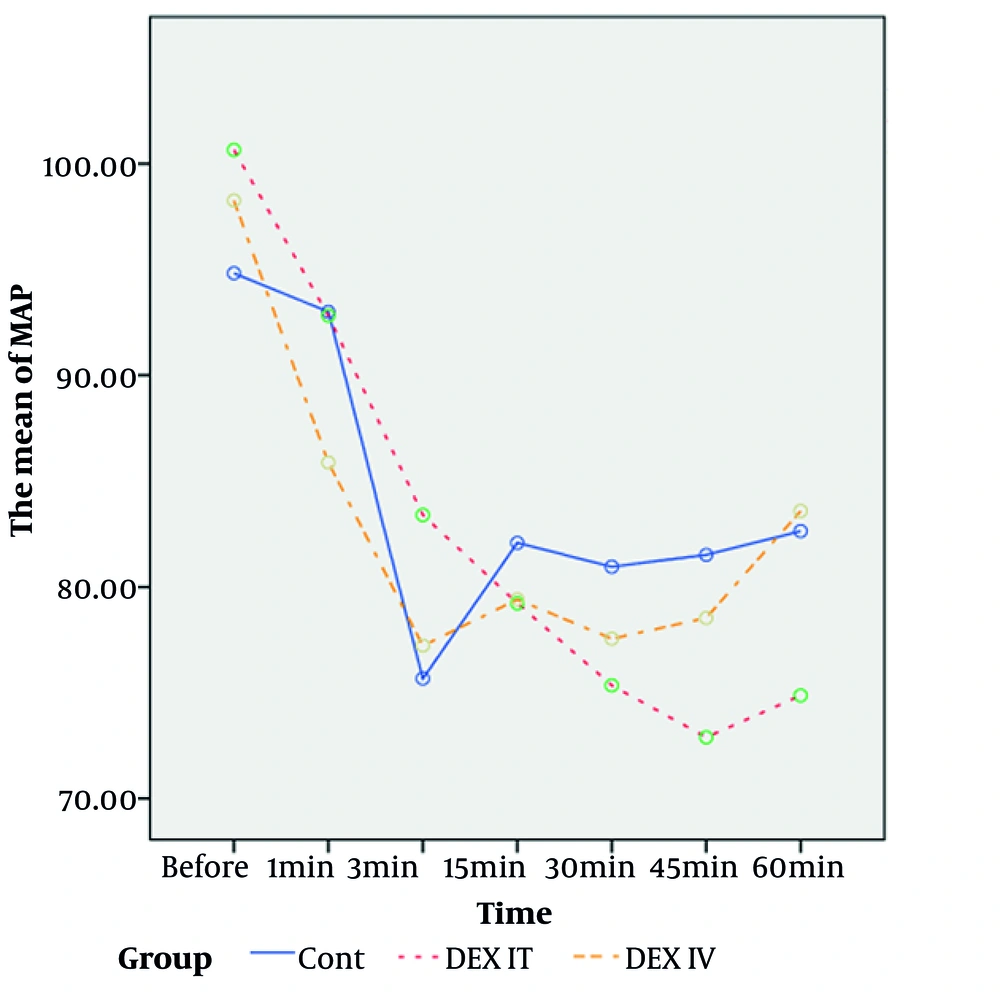
Figure 1.
The process of the study according to the CONSORT flow diagram
However, mean gravid differed significantly among the 3 groups (P < 0.0001). Post hoc testing showed that the control group had significantly lower gravid than the other 2 groups (P < 0.0001), whereas the dexmedetomidine IV and IT groups did not differ from each other (P = 0.457) (Table 1).
4.2. Hemodynamic Variables
The patients’ vital signs, including MAP and HR, were monitored at multiple time points: before the intervention and at 1, 3, 15, 30, 45, and 60 minutes after the intervention. MAP before the intervention did not differ significantly among the 3 groups (P = 0.071). However, at 45 and 60 minutes after the intervention, MAP in the dexmedetomidine IT group was significantly lower than that in the other 2 groups. No difference was found between the dexmedetomidine IV group and the control group. As shown in Figure 2, mean MAP decreased significantly over time from 1 to 60 minutes after the intervention in all 3 treatment groups; however, MAP changes over time did not differ significantly among the 3 groups (P = 0.616) (Table 2).
Table 2.
Changes in MAP and HR Between the Three Groups Over Time a
| Variables | Dex IV | Dex IT | Control | P-Value | |||
|---|---|---|---|---|---|---|---|
| Three groups | Dex IV and Dex IT | Dex IV and Control | Dex IT and Control | ||||
| Mean arterial pressure | |||||||
| Before | 98.25 ± 16.8 | 100.6 ± 11.5 | 94.81 ± 12.7 | 0.071 | 0.691 | 0.418 | 0.129 |
| min 1 | 85.86 ± 19.05 | 92.8 ± 15.1 | 93 ± 13.2 | 0.090 | 0.097 | 0.060 | 0.998 |
| min 3 | 77.2 ± 16.7 | 83.4 ± 37.6 | 75.7 ± 16.3 | 0.820 | 0.426 | 0.939 | 0.283 |
| min 15 | 79.4 ± 13.7 | 79.2 ± 11.8 | 82.1 ± 11.3 | 0.235 | 0.997 | 0.503 | 0.523 |
| min 30 | 77.55 ± 11.9 | 75.35 ± 12.5 | 80.96 ± 13.7 | 0.085 | 0.675 | 0.346 | 0.095 |
| min 45 | 78.54 ± 11.7 | 72.9 ± 11.9 | 81.52 ± 12.8 | 0.007 b | 0.047 b | 0.367 | 0.001 b |
| min 60 | 83.6 ± 11.3 | 74.87 ± 11.5 | 82.64 ± 12 | 0.001 b | 0.001 b | 0.905 | 0.005 b |
| P value (comparison over time) | P < 0.0001 b | P < 0.0001 b | P < 0.0001 b | 0.616 c | 0.930 c | 0.370 c | 0.383 c |
| Before and min 1 | -12.39 (-17.16, -7.62) b | -7.84 (-12.84, -2.84) b | -1.82 (-3.67, 0.031) | ||||
| Before and min 3 | -21.02 (-26.72, -15.33) b | -17.24 (-29.32, -5.15) b | -19.14 (-23.55, -14.73) b | ||||
| Before and min 15 | -18.84 (-24.22, -13.46) b | -21.41 (-25.77, -17.05) b | -12.72 (-17.71, -7.73) b | ||||
| Before and min 30 | -20.7 (-25.87, -15.52) b | -25.3 (-29.7, -20.9) b | -13.85 (-18.79, -8.91) b | ||||
| Heart rate | |||||||
| Before | 97.59 ± 18.35 | 103.95 ± 19.4 | 102.5 ± 16.1 | 0.076 | 0.199 | 0.328 | 0.923 |
| min 1 | 100.29 ± 20.8 | 106.13 ± 19.8 | 101.69 ± 17 | 0.191 | 0.309 | 0.925 | 0.524 |
| min 3 | 98.5 ± 20.5 | 101.08 ± 21.4 | 92.12 ± 26.42 | 0.048 b | 0.849 | 0.318 | 0.047 b |
| min 15 | 92.57 ± 17.6 | 94.8 ± 19.7 | 94.0 ± 19.7 | 0.759 | 0.834 | 0.918 | 0.978 |
| min 30 | 91.76 ± 12.14 | 91.8 ± 17.12 | 94.96 ± 17.8 | 0.764 | 0.998 | 0.593 | 0.656 |
| min 45 | 88.1 ± 14.22 | 86.9 ± 12.36 | 88.14 ± 13.1 | 0.871 | 0.900 | 1.000 | 0.900 |
| min 60 | 83.71 ± 12.9 | 85.0 ± 11 | 89.2 ± 12.3 | 0.055 | 0.865 | 0.054 | 0.240 |
| P value (comparison over time) | P < 0.0001 b | P < 0.0001 b | P < 0.0001 b | 0.609 c | 0.339 c | 0.527 c | 0.703 c |
| Before and min 1 | 2.7 (-3.29, 8.71) | 2.17 (-3.24, 7.59) | -0.82 (-4.17, 2.52) | ||||
| Before and min 3 | 0.91 (-4.91, 6.74) | -2.87 (-9.17, 3.41) | -10.39 (-18.5, -2.27) b | ||||
| Before and min 15 | -5.01 (-10.76, 0.73) | -9.15 (-16.6, -1.7) b | -8.51 (-13.84, -3.18) b | ||||
| Before and min 30 | -5.82 (-11.6, -0.05) b | -12.15 (-19.3, -4.99) b | -7.54 (-12.42, -2.67) b | ||||
a Values are expressed as mean ± SD or Mean difference (95% CI).
b Significant at the 0.05 level.
c Comparison over time between groups.
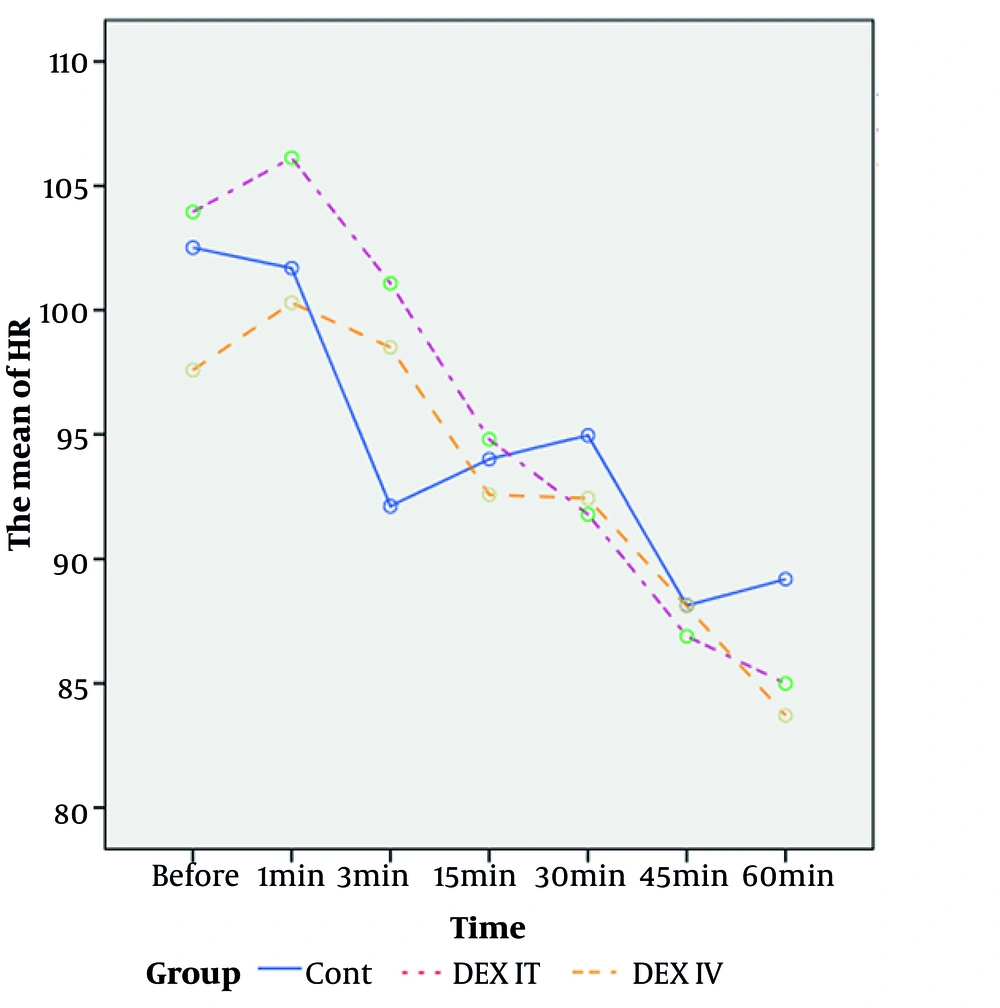
Figure 2.
Changes in mean MAP over time by the three groups
Mean HR did not differ significantly among the 3 treatment groups before the intervention or over time, with one exception: at minute 3, HR in the control group was significantly lower than that in the dexmedetomidine IT group (P = 0.047). In addition, mean HR decreased significantly over time across all 3 groups (P < 0.0001) (Figure 3), with no significant differences in HR changes among the groups (P = 0.609).
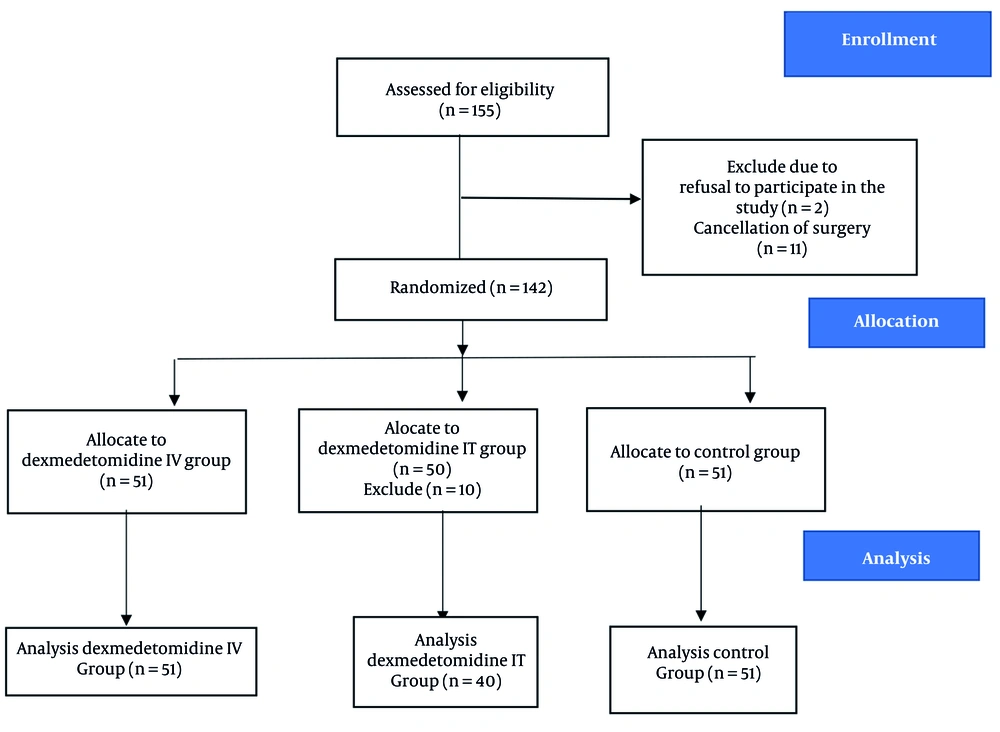
Figure 3.
Changes in mean HR over time by the three groups
4.3. Clinical Characteristics Related to Shivering
The clinical characteristics related to shivering are shown in Table 3. The incidence of shivering was lower in the dexmedetomidine IV group (35.3%) and higher in the control group than in the other 2 groups (49%). However, no significant difference was found among the 3 groups (P = 0.373).
Table 3.
Clinical Characteristics Related to Shivering in Patients in the Three Treatment Groups a
| Variables | Dex IV | Dex IT | Control | P-Value | |||
|---|---|---|---|---|---|---|---|
| Three Groups | Dex IV and Dex IT | Dex IV and Control | Dex IT and Control | ||||
| Shivering | 0.373 | 0.836 | 0.230 | 0.672 | |||
| Yes | 18 (35.3) | 17 (42.5) | 25 (49) | 0.373 | 0.836 | 0.230 | 0.672 |
| No | 33 (64.7) | 23 (57.5) | 26 (51) | 0.373 | 0.836 | 0.230 | 0.672 |
| Shivering intensity | 0.445 | 0.671 | 0.535 | 0.263 | |||
| No to mild shivering (grade 0 - 1) | 35 (68.6) | 24 (60) | 37 (72.5) | 0.445 | 0.671 | 0.535 | 0.263 |
| Moderate to very severe shivering (grade 2 - 4) | 16 (31.4) | 16 (40) | 14 (27.5) | 0.445 | 0.671 | 0.535 | 0.263 |
| Time of shivering | 48.33 ± 15.9 | 105 ± 21.21 | 43.75 ± 9.8 | < 0.0001 | < 0.0001 | 0.256 | < 0.0001 |
| Pethidine prescription | 15 (25.9) | 13 (32.5) | 13 (25.5) | 0.711 | 0.502 | 0.965 | 0.445 |
| Ephedrine prescription | 39 (67.2) | 22 (55) | 27 (52.9) | 0.263 | 0.289 | 0.365 | 0.957 |
| Temperature before intervention | 37.03 ± 0.19 | 37.26 ± 0.18 | 36.94 ± 0.14 | < 0.0001 | < 0.0001 | 0.052 | < 0.0001 |
| Temperature during shivering | 36.95 ± 0.21 | 37.13 ± 0.15 | 36.85 ± 0.18 | < 0.0001 | 0.015 | 0.291 | < 0.0001 |
a Values are expressed as mean ± SD or No (%).
The clinical characteristics related to shivering are shown in Table 3. The incidence of shivering was lower in the dexmedetomidine IV group (35.3%) and higher in the control group than in the other 2 groups (49%). However, no significant difference was found among the 3 groups (P = 0.373). The risk ratio (95% CI) for shivering incidence was 0.72 (0.47, 1.10) for IV-DEX versus control and 0.81 (0.52, 1.27) for IT-DEX versus control. Control (37.03 ± 0.19°C) and Dex IV (36.94 ± 0.14°C) differed significantly from Dex IT (P < 0.0001). During shivering, Dex IT maintained the highest temperature (37.13 ± 0.15°C), whereas Dex IV recorded the lowest temperature (36.85 ± 0.18°C), with significant differences for Dex IT versus control (P < 0.0001) and Dex IT versus Dex IV (P = 0.015) (Table 3).
In contrast, shivering intensity (no to mild shivering vs. moderate to very severe shivering) did not differ significantly among the 3 groups (P = 0.445). The time to shivering was significantly longer in the dexmedetomidine IT group than in the other 2 groups (P < 0.0001), with no difference between the dexmedetomidine IV and control groups (P = 0.256). The effect size for the delay in shivering onset in the IT-DEX group compared with the control group was moderate (Cohen d = 0.46). Pethidine administration (P = 0.711) and ephedrine administration (P = 0.263) did not differ significantly among the 3 groups.
5. Discussion
In this randomized, double-blind, parallel-group trial, we found no significant differences in overall shivering incidence or severity among a fixed 10-µg dose of IV dexmedetomidine, a fixed 10-µg dose of IT dexmedetomidine, and placebo, despite distinct physiological trends: lower MAP at 45 - 60 minutes in the IT group, similar HR reductions over time across all groups, and higher peri-shivering temperatures in the IT group (1 - 3).
5.1. Comparison With the Literature and Dose Explanation
Our results contrast with prior randomized controlled trials in which IV dexmedetomidine reduced shivering incidence during cesarean delivery, often using larger weight-based doses (2, 4-7). For example, another study reported significant prevention of shivering with 0.5 µg·kg-1 IV dexmedetomidine after cord clamping, without major hemodynamic compromise (2). Given that our fixed 10-µg dose corresponds to approximately 0.14 µg·kg-1 in an average 70-kg parturient, this relatively low fixed dose is the most likely explanation for the neutral finding regarding shivering incidence. This interpretation is reinforced by a 2023 ED_50/ED_95 study of IV dexmedetomidine for treating established shivering, which suggested an ED_95 of 0.39 µg·kg-1, indicating that higher prophylactic doses may be necessary (6). Recent network meta-analyses confirm the efficacy of IV dexmedetomidine but highlight dose-timing interplay as critical (4, 5).
The literature on IT dexmedetomidine in cesarean anesthesia more consistently demonstrates shivering reduction and block prolongation (3, 8-10, 15). However, most studies compare IT dexmedetomidine with IT placebo rather than directly with IV administration and often use local anesthetic combinations that may synergize with the anti-shivering effects of IT dexmedetomidine. Our head-to-head design found no superiority with equal microgram dosing.
5.2. Benefits Versus Harms
Although the IT group showed lower late-time MAP, there was no significant increase in the incidence of hypotension (MAP < 65 mmHg) or bradycardia (HR < 50 bpm) between groups (Table 3), indicating an acceptable safety profile at this dose. The primary benefit of IT administration was a significant delay in shivering onset and preservation of peri-shivering temperature, a distinct physiological effect likely mediated at the spinal level that may improve patient comfort even without reducing overall incidence. This finding aligns with previous studies reporting segmental modulation of shivering thresholds (7, 11, 12). Dexmedetomidine centrally lowers vasoconstriction and shivering thresholds through α2-adrenoceptor activation, potentially contributing to temperature-shivering dissociation.
5.3. Limitations
Limitations include the single-center setting, fixed low-dose regimen, lack of core temperature monitoring, and modest sample size, which limited the power to detect smaller intergroup differences. Moreover, potential confounders such as baseline anxiety, operating room temperature, and transfer origin, which are known shivering risk factors, were not stratified (13-15). The observed difference in mean gravida among groups, although not found to be a significant confounder for shivering incidence, remains a potential limitation in baseline comparability. In interventional studies in our country, obtaining consent is very difficult. Many individuals have an unfavorable view of medications; therefore, we lost a number of patients because they did not consent. In addition, coordinating operating room schedules and patients is difficult. Some patients received the medication, but the effective timing of administration was disrupted, and the patient was excluded from the study. However, we attempted to meet all necessary ethical requirements, and sample collection took about 3 years. Future trials should use dose-finding methods to establish equivalent effective doses for IV and IT dexmedetomidine, use standardized core temperature measurement, and incorporate broader shivering risk stratification.
5.4. Conclusions
At the doses tested, neither IV nor IT dexmedetomidine significantly reduced shivering incidence compared with placebo during elective cesarean spinal anesthesia. Intrathecal dexmedetomidine produced lower late-time MAP and higher peri-shivering temperatures. Optimizing dose and timing is likely essential to realize anti-shivering benefits without compromising maternal hemodynamics.