
1. Background
The comprehensive concept of Quality of Life (QoL) refers to how a person views their current situation in connection to their cultural and value systems, as well as their goals, expectations, standards, and concerns (1). When it comes to social, physical, psychological, and environmental aspects, QoL is a crucial indicator of total well-being (2). In providing necessary medical care and advancing public health, healthcare workers (HCWs) are crucial (3). A decrease in the quality of healthcare services and health problems may result from the demanding nature of the job, which includes work conditions, workloads, and sociodemographic factors (4, 5). Nurses who worked longer hours were still happy with their jobs, but they may need to pay attention to their physical well-being and workplace culture. It is important to develop nursing policies that address the physical well-being and surroundings of nurses. It is important to implement health promotion initiatives like physical activity and mindfulness training to support nurses' overall well-being and provide a safe and healthy work environment, which will improve their quality of life (6).
Human health and quality of life are strongly correlated. Given their status as the most significant group of health providers, nurses need to lead fulfilling lives (7). Healthcare workers deal with difficult circumstances that lower their quality of life by causing stress, worry, and exhaustion. Compassion satisfaction may positively influence their professional well-being. Professional Quality of Life (PQoL) includes several elements. Health-related Quality of Life (HRQoL), which is especially relevant to nurses, measures perceived health on a variety of parameters and is impacted by sociodemographic and occupational stresses (8).
Most workplace back injuries occur among healthcare professionals, and for patients, low back pain not only causes physical discomfort but also functional limitations that impair quality of life and may lead to disability (9). Nursing is seen as a challenging profession, and the stress of the job can be detrimental to one's health and quality of life. Stress at work has a detrimental impact on nurses' health-related quality of life (10). During COVID-19, frontline healthcare workers faced high stress, anxiety, and poor sleep, highlighting the need to support their well-being and quality of life (11). Quality of life, shaped by health, work, and social factors, is defined by the World Health Organization as one’s perception of life within cultural and personal contexts. Job stress, in particular, negatively impacts health, linking to heart disease, mental issues, and musculoskeletal disorders (12).
Nursing is a demanding career with high stress from workload, emergencies, and patient care, leading to burnout and stress-related illnesses. Active coping (optimism, proactive strategies) improves nurses’ quality of life, while passive coping (avoidance, denial) worsens outcomes. Strong support networks and organizational backing are vital for resilience and well-being (13). QoL includes functional, physical, mental, and social well-being, and work plays a major role in shaping it. Quality of Working Life (QWL) reflects how employees perceive pay, benefits, and growth opportunities. With global nursing shortages, high turnover remains a serious challenge for healthcare systems (14).
Due to ongoing political instability and conflict, HCWs in Palestine are more likely to experience poor QoL. Nonetheless, to our knowledge, there is a lack of data regarding the QoL and its related factors among HCWs in Palestine. Due to the difficult socioeconomic conditions in Palestine, it is imperative to assess the QoL of nurses.
2. Objectives
The objective of this study is to assess the health-related quality of life of nurses employed in Palestinian hospitals and to identify factors associated with their quality of life.
3. Methods
3.1. Design, Setting, Population
A cross-sectional design was used. With this approach, data from a wide range of participants may be gathered in a short amount of time, giving a glimpse into their opinions and experiences. The study was conducted between January and March 2024, collecting data from nurses at Palestinian hospitals across the northern, central, and southern regions. The study population consisted of nurses working in Palestinian hospitals (n = 1400).
3.2. Sampling and Sample Size
The required sample size was calculated using the Raosoft® Sample Size Calculator (Raosoft, n.d.) with a 95% confidence level and a 5% margin of error. The calculation was informed by the standard deviation reported in a previous study conducted among nurses (SD = 4.66) (15). Based on this, the minimum required sample size was estimated at 374 nurses. Due to an 80% response rate, a total of 301 nurses were ultimately included in the study. A convenience sampling method was used to recruit bedside nurses with at least one year of clinical experience, regardless of educational qualification (from bachelor’s to PhD). Participation was voluntary, and only those who provided informed consent were included. Nurses who had less than one year of bedside experience were excluded from the study to ensure that participants had sufficient clinical exposure related to bedside nursing care.
3.3. Data Collection
The data collection period was from January 2024 to March 2024. Data were collected through a self-administered questionnaire using Google Forms during this timeframe. The data collection questionnaire included various demographic and health-related questions. It covered demographic information such as sex, age, years of experience, marital status, level of study, accommodation type, permanent work shift, profession, workplace, residential area, and monthly income. Additionally, it included questions about physical health, chronic diseases, frequency of sickness, limitations in physical activities, and the impact of pain on daily life. Moreover, it assessed mental health components, including emotional effectiveness, precision and attention, inner peace, energy levels, feelings of depression, and social restrictions during activities.
The Short Form-12 (SF-12) is a widely used instrument for assessing health-related quality of life. The SF-12 is based on the Short Form-36 (SF-36) and only has 12 items. Both the mental and physical domains of these questions have six items each, according to Ware et al. (16). The scores for the QoL domains range from 0 to 100, where higher scores indicate a greater QoL. Numerous research investigations have documented the strong psychometric qualities of the SF-12 across several age cohorts, including the elderly, and across numerous nations (17).
In the current study, the questionnaire used was a previously validated standardized instrument. Its validity was established based on prior study that demonstrated satisfactory validation (16). As no modification or translation of the original instrument was performed, content validity was ensured by adopting the validated version without alteration. Reliability was assessed in the present study using Cronbach’s alpha coefficient, with values ≥ 0.70 considered indicative of acceptable internal consistency. All questionnaire components demonstrated satisfactory reliability, with Cronbach’s alpha coefficients exceeding the recommended threshold.
3.4. Data Analysis
The data collected from the questionnaire were analyzed using statistical methods by SPSS version 20. The participants' health-related factors and demographic characteristics were examined using descriptive statistics. Analysis of variance (ANOVA) and t-tests were used as inferential statistics to look at the relationships between various variables. The standard threshold for significance was P < 0.05.
3.5. Ethical Considerations
This work has been carried out in accordance with the Declaration of Helsinki (2000) of the World Medical Association. This study was approved by the Institutional Review Board of Modern University College (MUC011-2025), and informed consent was obtained from all participants. No private information was obtained and each respondent’s answers were anonymized to protect their research information and privacy. Participants were made aware that the information gathered would only be utilized for study. Additionally, they were not punished if they left at any time. These procedures uphold protections to preserve the participants' rights and well-being while validating the study's ethical features.
4. Results
4.1. Sociodemographic Characteristics of Participants
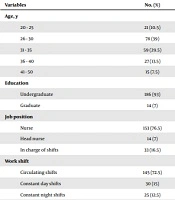
Table 1 indicates that the majority of the 301 participants were young adults between the ages of 20 and 30, with a higher percentage of females (59.8%). The majority of participants were unmarried (53.2%) and had a bachelor's degree (68.4%). Nearly half (49.5%) worked varied shifts, and more than half (52.8%) had little to no work experience spanning one to five years. The majority of participants (44.2%) lived in central regions, and participants were split nearly evenly between government institutions (43.9%) and private hospitals (45.8%). Notably, over half (52.5%) indicated that they might leave their current employment, suggesting possible job discontent, and the majority reported middle-income levels.
Table 1.
Sociodemographic Variables (N = 301)
| Variables | No. (%) |
|---|---|
| Age group | |
| 20 - 25 | 126 (41.9) |
| 26 - 30 | 90 (29.9) |
| 31 - 35 | 60 (19.9) |
| 36 - 40 | 15 (5.0) |
| > 40 | 10 (3.3) |
| Gender | |
| Male | 121 (40.2) |
| Female | 180 (59.8) |
| Accommodation type | |
| Owned housing | 103 (34.2) |
| Housing for rent | 86 (28.6) |
| Living with family | 112 (37.2) |
| Level of study | |
| Diploma | 71 (23.6) |
| Bachelor's | 206 (68.4) |
| Master's | 24 (8.0) |
| Marital status | |
| Single | 160 (53.2) |
| Married | 126 (41.9) |
| Divorced | 11 (3.7) |
| Widow | 4 (1.3) |
| Experience years | |
| 1 - 5 | 159 (52.8) |
| 6 - 10 | 88 (29.2) |
| 11 - 15 | 43 (14.3) |
| 16 - 20 | 6 (2.0) |
| > 20 | 5 (1.7) |
| Permanent type of work | |
| Morning shift | 106 (35.2) |
| Evening shift | 34 (11.3) |
| Night shift | 12 (4.0) |
| Varied | 149 (49.5) |
| Workplace | |
| Government hospital | 132 (43.9) |
| Private hospital | 138 (45.8) |
| Emergency centers | 31 (10.3) |
| Residential areas | |
| Northern regions | 68 (22.6) |
| Southern regions | 100 (33.2) |
| Central regions | 133 (44.2) |
| Monthly income | |
| < 2000 | 33 (11.0) |
| 2001 - 3000 | 82 (27.2) |
| 3001 - 4000 | 119 (39.5) |
| 4001 - 5000 | 44 (14.6) |
| > 5000 | 23 (7.6) |
| Is there a possibility of leaving the hospital? | |
| Yes | 158 (52.5) |
| No | 143 (47.5) |
4.2. Descriptive Statistics of Participants’ Physical Health
Table 2 shows that participants tend to have moderate levels of perceived health. The composite average score for physical health was 43.01 ± 10.37, much below the U.S. population norm of 50, thus implying poor subjective physical quality of life. Here, pain could perhaps be of concern affecting the participant and their daily activities in the Pain and General Health subscales, but average scores in General Health (44.72 ± 11.28) are slightly higher than those in Bodily Pain (41.67 ± 10.12). The participants feel that their physical health interferes with their ability to perform activities and hold responsibilities, as indicated by both Physical Functioning (42.60 ± 9.82) and Role Limitations due to Physical Health (43.04 ± 11.25) subscale scores. All in all, the participant data imply a lessening of physical health and functioning as compared with population norms.
Table 2.
Descriptive Statistics of Participants’ Physical Health (N = 301)
| Physical Health Variables | Mean ± SD |
|---|---|
| General health perception (GH) | 44.72 ± 11.28 |
| Physical functioning (PF) | 42.60 ± 9.82 |
| Role limitations due to physical health (RP) | 43.04 ± 11.25 |
| Bodily pain (BP) | 41.67 ± 10.12 |
| Total of physical health component | 43.01 ± 10.37 |
4.3. Descriptive Statistics of Participants’ Mental Health
Table 3 shows that the population norm was nearly met by the overall mental health component (50.2 ± 17.07). Better energy and social/psychological functioning were suggested by comparatively higher scores for vitality (52 ± 17.2) and mental health/depression and social functioning (59 ± 18.14). However, participants' emotional well-being (44.8 ± 16.54) and cognitive functioning (45 ± 16.24) were lower, suggesting that they were experiencing mild emotional pressure and cognitive challenges.
Table 3.
Mental Health Components (1 = Always, 5 = Never)
| Mental Health Variables | Mean ± SD |
|---|---|
| Emotional well-being | 44.8 ± 16.54 |
| Cognitive functioning | 45 ± 16.24 |
| Vitality | 52 ± 17.2 |
| Mental health (depression and social functioning) | 59 ± 18.14 |
| Total of mental component | 50.2 ± 17.07 |
4.4. Physical Health Component by Sociodemographic Variables
According to Table 4, analysis of the physical health component across sociodemographic variables revealed several significant differences. Gender was not associated with significant variation in physical health scores (t = 1.06, P = 0.291). However, the possibility of leaving the hospital showed a significant effect (t = -2.42, P = 0.016), with participants who anticipated leaving reporting lower physical health compared to those who did not.
Regarding age, a significant difference was observed (F = 3.12, P = 0.016), with participants aged 20 - 25 years reporting higher physical health scores than those above 40 years. Marital status differences were not statistically significant (F = 2.21, P = 0.088), although widowed participants tended to have the lowest scores. Workplace setting showed a significant association (F = 4.08, P = 0.018), with staff in government hospitals reporting better physical health than those working in emergency centers.
Monthly income was strongly associated with physical health (F = 5.44, P < 0.001), where participants earning more than 5000 reported significantly higher physical health scores compared to all other income groups. These findings highlight the influence of socioeconomic and occupational factors on physical health, whereas gender and marital status did not demonstrate statistically significant differences.
Table 4.
Physical Health Component by Sociodemographic Variables (N = 301)
| Variables/Groups | Mean ± SD | Test Statistic | P-Value | Post-Hoc/Interpretation |
|---|---|---|---|---|
| Gender | t = 1.06 | 0.291 | ||
| Male | 43.85 ± 10.12 | |||
| Female | 42.43 ± 10.55 | |||
| Possibility of leaving hospital | t = -2.42 | 0.016 a | ||
| Yes | 41.98 ± 10.44 | |||
| No | 44.25 ± 10.15 | |||
| Age group (y) | F = 3.12 | 0.016 a | 20 - 25 higher than > 40 | |
| 20 - 25 | 44.95 ± 10.18 | |||
| 26 - 30 | 43.52 ± 10.29 | |||
| 31 - 35 | 42.85 ± 10.44 | |||
| 36 - 40 | 41.02 ± 9.88 | |||
| > 40 | 39.80 ± 10.25 | |||
| Marital status | F = 2.21 | 0.088 | ||
| Single | 44.12 ± 10.25 | |||
| Married | 42.56 ± 10.48 | |||
| Divorced | 40.64 ± 10.12 | |||
| Widow | 39.25 ± 9.97 | |||
| Workplace | F = 4.08 | 0.018 a | Government hospital > Emergency center | |
| Government | 43.95 ± 10.38 | |||
| Private | 42.65 ± 10.42 | |||
| Emergency centers | 40.88 ± 10.29 | |||
| Monthly income | F = 5.44 | < 0.001 a | > 5000 higher than all other groups | |
| < 2000 | 40.45 ± 10.15 | |||
| 2001 - 3000 | 41.92 ± 10.29 | |||
| 3001 - 4000 | 43.75 ± 10.35 | |||
| 4001 - 5000 | 45.10 ± 10.12 | |||
| >5000 | 46.45 ± 10.22 |
a Significant at P-value < 0.05.
4.5. Mental Health Component by Sociodemographic Variables
According to Table 5, the analysis of the mental health component indicated several significant sociodemographic differences. Gender was found to be associated with mental health, with males reporting slightly higher scores than females (t = 1.98, P = 0.049). Similarly, the possibility of leaving the hospital had a significant effect (t = -2.21, P = 0.028), where those anticipating discharge reported lower mental health compared to those not expecting to leave.
Age group differences were also significant (F = 2.74, P = 0.030). Participants aged 20 - 25 reported higher mental health scores compared to those older than 40 years. Marital status showed a significant relationship (F = 2.96, P = 0.033), with single participants reporting higher scores compared to divorced or widowed participants, who had the lowest mental health levels. Workplace was another significant factor (F = 3.22, P = 0.042). Participants employed in government hospitals reported higher mental health than those working in emergency centers.
Table 5.
Mental Health Component by Sociodemographic Variables (N = 301)
| Variables | Mean ± SD | Test Statistic | P-Value | Post-Hoc/Interpretation |
|---|---|---|---|---|
| Gender | 1.98 | 0.049 a | ||
| Male | 51.42 ± 16.78 | |||
| Female | 49.31 ± 17.21 | |||
| Possibility of leaving hospital | -2.21 | 0.028 a | ||
| Yes | 48.65 ± 17.03 | |||
| No | 51.93 ± 16.87 | |||
| Age group (y) | 2.74 | 0.030 a | 20 - 25 higher than > 40 | |
| 20 - 25 | 51.30 ± 16.77 | |||
| 26 - 30 | 50.65 ± 16.92 | |||
| 31 - 35 | 49.92 ± 17.12 | |||
| 36 - 40 | 47.63 ± 17.45 | |||
| > 40 | 46.20 ± 17.58 | |||
| Marital status | 2.96 | 0.033 a | Singles higher than divorced/widowed | |
| Single | 51.04 ± 16.81 | |||
| Married | 49.35 ± 17.20 | |||
| Divorced | 46.82 ± 17.65 | |||
| Widow | 45.10 ± 17.90 | |||
| Workplace | 3.22 | 0.042 a | Gov. hospital > emergency center | |
| Government | 51.60 ± 16.70 | |||
| Private | 49.85 ± 17.19 | |||
| Emergency centers | 47.22 ± 17.44 | |||
| Monthly income | 4.67 | 0.002 a | > 5000 > all other groups | |
| < 2000 | 47.15 ± 17.53 | |||
| 2001 - 3000 | 48.64 ± 17.20 | |||
| 3001 - 4000 | 50.52 ± 16.88 | |||
| 4001 - 5000 | 52.03 ± 16.60 | |||
| > 5000 | 53.45 ± 16.41 |
a Significant at P-value < 0.05.
5. Discussion
Our findings are consistent with prior research underscoring the influence of sociodemographic characteristics on healthcare workers’ well-being. For example, Ansari demonstrated the role of gender, age, and marital status in shaping nurses’ quality of life (7). Similarly, Ioannou et al. reported comparable patterns among Greek nurses, while our study extends these insights by examining both physical and mental health dimensions within a different demographic context, thus contributing to the understanding of universal challenges faced by healthcare professionals (18). Building on this, Ruiz et al. explored the impact of such factors on health-related quality of life, whereas our study provided a more detailed examination of specific physical and mental health components (8). Likewise, Tran et al. emphasized the importance of targeted interventions to protect mental well-being during crises, a finding that resonates with our results highlighting the negative effects of professional stress, compassion fatigue, and burnout on quality of life and caring behaviors (19).
Other studies have explored complementary dimensions of healthcare workers’ health and quality of life. For instance, Kowitlawkul et al. emphasized the role of social support, while our study highlighted the impact of sociodemographic and workplace factors (6). Similarly, Zahra et al. focused on low back pain and disability as determinants of quality of life, which complements our broader assessment of physical and mental health outcomes (9). The issue of work–life imbalance was also noted by Makabe et al. among Japanese nurses, and our findings similarly underscore the global challenge of balancing professional and personal demands (20). Moreover, Babapour et al. found that job stress negatively correlates with nurses’ quality of life and caring behaviors, aligning with our findings but extending them to a broader sample of healthcare professionals (10).
In relation to mental health, Stojanov et al. documented the impact of anxiety and depressive symptoms on healthcare workers during the COVID-19 pandemic, while our study identified broader factors influencing mental health and quality of life beyond crisis conditions (11). The role of psychosocial work environments has also been highlighted in the literature; for example, Teles et al. examined the effort–reward imbalance model among primary care providers in Brazil, whereas our findings extend these insights to diverse healthcare settings (12). Additionally, studies on coping mechanisms, such as those by Fathi and Simamora among Indonesian nurses, support our results emphasizing the importance of healthy coping strategies for improving quality of life (13). Finally, Abbasi et al. highlighted the relationship between workload and work-related quality of life in high-complexity hospital units, which complements our findings by broadening the scope to various workplace settings (14).
Previous research has highlighted factors influencing nurses’ well-being and quality of life. For instance, a study examined the relationship between spiritual health and anxiety among nurses caring for COVID-19 patients, emphasizing the impact of psychological and spiritual factors on overall nurse well-being (21). Additionally, a study investigated the effects of continuous nursing care on hemodialysis patients’ quality of life and lifestyle, demonstrating how nursing interventions can influence health outcomes and, by extension, the well-being of nursing staff (22).
The present study examined differences in physical and mental health components among healthcare workers based on sociodemographic factors. Findings revealed that younger nurses reported better physical and mental health outcomes compared to older age groups.
Gender differences were observed only in mental health, where males scored slightly higher than females. This pattern has been reported in other healthcare workforce studies, where female employees often face dual work–family responsibilities and higher emotional demands in patient care roles, potentially affecting mental well-being (20).
Marital status influenced mental but not physical health, with single participants scoring higher. This may relate to fewer family-related responsibilities and stressors, as well as greater flexibility in self-care routines. Conversely, divorced and widowed participants may experience social isolation or financial strain, which can impact mental health (23, 24).
Workplace setting was a significant factor for both domains, with government hospital employees scoring higher than those in emergency centers. Emergency center work is often characterized by unpredictable schedules, high patient turnover, and critical case exposure, all of which are linked to physical fatigue and psychological distress (25).
Monthly income was strongly associated with both physical and mental health. Participants earning higher incomes (> 5000) reported better outcomes, consistent with literature highlighting the role of financial security in reducing stress, improving access to healthcare, and facilitating healthier lifestyle choices (26).
5.1. Recommendations
Based on the study findings, it is recommended that healthcare institutions implement targeted wellness programs for older healthcare workers, focusing on physical fitness support, ergonomics training, and stress management workshops to address age-related challenges. Gender-sensitive mental health interventions should be developed to support female employees, particularly in balancing work and family responsibilities. Special attention should be given to divorced and widowed employees by enhancing support systems, such as peer support groups and access to counseling services. Working conditions in emergency centers should be improved by optimizing shift schedules, increasing staffing levels, and providing regular debriefing sessions after high-stress incidents. To reduce turnover intentions, organizations should introduce retention incentives that include professional development opportunities, recognition programs, and flexible scheduling. Addressing income disparities through salary structure reviews and performance-based rewards that reflect workload and responsibilities is also essential. Finally, fostering an organizational culture that promotes work–life balance, job satisfaction, and employee engagement will contribute to improving both physical and mental health outcomes among healthcare workers.
5.2. Limitations
This study has several limitations. First, the cross-sectional design does not allow causal inferences between variables. Second, only descriptive statistics, t-tests, and analysis of variance were performed; more advanced analyses such as regression modeling could provide deeper insight into predictors of outcomes. Third, convenience sampling limits the generalizability of the findings to all Palestinian nurses. Additionally, the use of self-reported data may have introduced response bias. The questionnaire was administered in its original language rather than an Arabic-translated version, which may have affected participants’ comprehension of some items and influenced their responses. Future studies should address these limitations through longitudinal designs, probability sampling, and advanced analytical methods.
5.3. Conclusions
This study demonstrated that age, workplace, and income are consistent determinants of both physical and mental health among healthcare workers, while gender and marital status selectively influence mental health. The possibility of leaving one’s current hospital was associated with poorer health across both domains, indicating that staff retention strategies may play a crucial role in employee well-being. Interventions targeting high-stress environments, particularly emergency centers, as well as policies that support income equity and work–life balance, are essential to maintaining a healthy healthcare workforce.