
1. Background
Industrial changes and development of social relations have highlighted the need to modify and manage the developmental process both theoretically and practically. Previously, major attention was paid to economic development, while in the 19th century, with the emergence of the negative consequences of economic development, the significance of economic development as the main developmental objective was questioned. In the early 1990’s, the United Nations (UN) published a developmental report, with particular emphasis on human development. From this time on, especially after the Amsterdam announcement, social development factors, such as social funding and social affinity, entered the developmental literature, and changes occurred in the hierarchy of developmental goals.
With the support of UN, social well-being and quality of life (QOL) were considered as developmental priorities, and social affairs, including education, health, environment, and partnership in social development, were highlighted. In recent theories, the needs of the target population, satisfaction of the beneficiaries of developmental programs, and promotion of QOL have been of prime importance, and gradual improvement of QOL has been considered as a development goal. Moreover, performance indicators of programs have changed, and the importance of QOL has exceeded that of objective phenomena, such as nutrition, clothing, health, and housing.
New dimensions, such as social security, QOL, environmental protection, and meeting the prerequisites for people’s participation in different levels of the developmental process were later included in developmental programs. In the past decades, with the priority of social development issues, human and sociological approaches to QOL have gradually entered the literature of developmental programs, planning, and policymaking of countries. The policies focus on factors influencing the cultural QOL. Generally, QOL is being discussed as a key element in policymaking and review of public policies (1).
Today, in competitive organizations, only those that enhance their performance quality and proficiency can survive. Meanwhile, the nursing staff are considered as the most important index of proficiency enhancement in the health sector (2). In recent years, researchers have paid particular attention to the relationship between efficiency and QOL around the world (3). It is known that occupational burnout affects the physical and mental strength of nurses and gives rise to negative responses and attitudes toward themselves and others (4).
Generally, there are various ways to improve the QOL of social groups. Investigation of these strategies and improvement of nurses’ QOL should be among the priorities of the healthcare administration.
2. Objectives
Therefore, in this study, we aimed to measure QOL and related factors in the nursing staff of three selected hospitals.
3. Methods
This study aimed to inspect the nursing staff’s QOL in three selected hospitals in Tehran, Iran. To gather data, the World Health Organization Quality of Life (WHOQOL-BREF) questionnaire was used. Evaluation of the Persian version of this questionnaire showed that it can be also used in Iran. Also, the intra-cluster correlation coefficient of the questionnaire was measured within two-week intervals four times (0.75 - 0.84). The Cronbach’s alpha coefficient and structural validity indicated the acceptable validity of the Persian version of this questionnaire.
The WHOQOL-BREF questionnaire, which assesses the overall QOL, includes four domains, that is, physical, mental, social, and environmental health, and consists of 24 questions (seven, six, three, and eight questions for each domain). Moreover, this questionnaire contains two questions that are not related to these domains and assess the overall health status and QOL in general. This questionnaire contains a total of 26 questions. Physical health includes different facets, such as mobility, daily activities of life, work capacity, energy, pain and discomfort, and sleep. Similarly, the domain of psychological health includes different facets, such as bodily image and appearance, negative emotions, positive emotions, self-esteem, thinking, learning, memory and concentration, religion, and psychological state.
Regarding social interactions, personal communication, social support, and marital life are investigated in the WHOQOL-BREF questionnaire. In terms of environmental health, this questionnaire assesses financial resources, physical security, social health, home environment, opportunities for acquiring new skills, physical environment (e.g., air and water pollution), and transportation (1, 5). The score of each domain ranges from four to 20, with a score of four representing the lowest QOL, and a score of 20 representing the highest QOL in the target domain. This questionnaire has been translated and validated in more than 40 countries. Therefore, since it is a commonly applied tool, comparison of the average scores between countries can present accurate assumptions for future studies.
This cross-sectional descriptive study was conducted on 200 nurses, working in the teaching hospitals of Tehran, Iran. The nurses received full information about the content of the questionnaire and gave their informed consent. In this study, the nurses’ QOL was investigated in four domains of physical, psychological, social, and environmental health. The study population included nurses working in Shahid Rajaie Heart Center, Baharloo Hospital, and Imam Khomeini Hospital in Tehran. The participants had at least two years of clinical experience. In addition to collecting the sociological forms, five QOL questionnaires were also presented to the participants. Besides, the demographic information included sex, educational level, work experience, work shift, income, and job position.
Data were collected using questionnaires and entered in SPSS version 16. The distribution of numerical variables was examined using one-sample Kolmogorov-Smirnov test. Quantitative variables were defined as mean ± standard deviation (SD), and qualitative variables were described as percentage and frequency. One-way ANOVA or student’s t-test was used to compare the subgroups. P < 0.05 was considered statistically significant.
4. Results
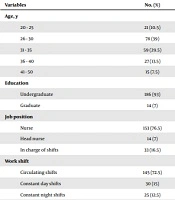
The demographic characteristics of the subjects are presented in Table 1. According to this table, the age range of nurses was 20 - 45 years, and most of them were 26 to 30 years. The majority of nurses were female (75.5%), and 63.5% were married. Overall, 122 (61%) nurses were employed by Rajaie Hospital, 47 (23.5%) by Imam Khomeini Hospital, and 31 (15.5%) by Baharlo Hospital. The nurses’ work experience ranged from two to 20 years, with an average of 6 - 10 years. Based on the results, 93% of the nurses had undergraduate degrees, and 7% had a master’s degree.
Table 1.
Frequency Distribution of Nurses’ Demographic Characteristics
| Variables | No. (%) |
|---|---|
| Age, y | |
| 20 - 25 | 21 (10.5) |
| 26 - 30 | 78 (39) |
| 31 - 35 | 59 (29.5) |
| 36 - 40 | 27 (13.5) |
| 41 - 50 | 15 (7.5) |
| Education | |
| Undergraduate | 186 (93) |
| Graduate | 14 (7) |
| Job position | |
| Nurse | 153 (76.5) |
| Head nurse | 14 (7) |
| In charge of shifts | 33 (16.5) |
| Work shift | |
| Circulating shifts | 145 (72.5) |
| Constant day shifts | 30 (15) |
| Constant night shifts | 25 (12.5) |
| Gender | |
| Female | 151 (75.5) |
| Male | 49 (24.5) |
| Work experience, y | |
| 2 - 5 | 68 (34) |
| 6 - 10 | 82 (41) |
| 11 - 15 | 24 (12) |
| 16 - 20 | 26 (13) |
| Income level | |
| Desirable | 8 (4) |
| Average | 123 (61.5) |
| Undesirable | 69 (34.5) |
Thirty-three (16.5%) nurses were responsible for their work shifts, and 14 (7%) were head nurses. Also, 72.5% of nurses were shift workers, 15% only worked night shifts, and 12.5% only worked day shifts. In terms of income, 61.5% of nurses reported an average income, 34.5% reported an undesirable income, and 4% reported a desirable income. The results showed that 100 (50%) nurses worked in the private sector, 75 (37.5%) worked in the public sector, and 25 (12.5%) were in the emergency department.
The highest scores of nurses in the age range of 31 - 35 years were related to physical and environmental health; however, the difference was not significant (P > 0.05 and P = 0.23, respectively). The average scores of mental health and the overall QOL were higher in the age range of 26 - 30 years, as compared to other age groups; however, the difference was not significant (P = 1 and P > 0.05, respectively). Regarding the association of gender with the overall QOL and the physical, mental, and environmental health, it was found that the environmental health score of women was significantly higher than that of men (P = 0.04 and P < 0.05, respectively). However, the score of social relations was higher in men than in women (P > 0.05 and P = 0.31, respectively).
Regarding the relationship between marital status and QOL, the overall QOL was higher in married couples than in single men; however, only the mean score of social relations was significantly higher in married nurses, compared to their single counterparts (P = 0.0001). On the other hand, the environmental health of single nurses was higher than that of married ones, although the correlation was not significant (P = 0.44 and P > 0.05, respectively). In terms of work experience, physical health, mental health, environmental health, and the overall QOL were higher in nurses with a work experience of 11 - 15 years, compared to others. However, only the average scores of environmental health and the overall QOL were higher in nurses with a work experience of 11 - 15 years, compared to others (P < 0.05 and P = 0.014, respectively).
Regarding the balance between work shifts and the overall QOL, the scores of physical health and social relationships were higher in nurses working constant morning shifts, compared to nurses who only worked night shifts or circulatory shifts. Also, mental health was higher in nurses working constant shifts, compared to those working circulatory shifts; however, the relationship between these variables was not significant (P > 0.05). Based on the results, mental health, social relationships, environmental health, and QOL were higher in nurses working in the public sector, compared to those working in the emergency department or the private sector; however, the difference was not significant (P > 0.05).
5. Discussion
In a previous study (6), the highest mean scores of QOL dimensions were related to physical health. On the other hand, in the present study, the average score of mental health was higher than the physical dimension. In a study by Fallahi (7), the highest QOL scores of nurses working in psychiatric wards were related to physical and family health. In a similar study on nurses in Chile, the results showed the high level of social interaction in nurses, while the lowest level of physical environment was reported (8). This study suggested that the multiplicity of nursing roles (e.g., wife, child, mother or father, and nurse) strongly affects the physical aspect of their lives. Considering the physical and emotional conflicts of nurses, fatigue, pain, and sleeplessness, caused by a heavy workload, are predictable.
Contrary to the mentioned study conducted in Chile, in the present study, the health aspect of QOL obtained the highest score, while environmental health showed the lowest score. Moreover, by evaluating the nurses’ work environment, it can be explained why environmental health was prominent than other dimensions, despite the negative physical and mental effects. Security, transportation facilities, distance from work, place of residence, living conditions, and access to recreational facilities were the components of environmental health with the lowest scores among Iranian nurses. In contrast to the study from Chile, in a study by Nedjat et al. (9) on the QOL of people living in Tehran, Iran, in 2007, the scores of environmental and mental health were lower than the overall QOL around the world.
5.1. Conclusions
Based on the present findings, the environmental and social health scores were significantly higher in married women as compared to men. Also, social health was higher in married nurses, regardless of gender. Therefore, improvement of nurses’ QOL should be considered by health managers in communities and prioritized in health plans in the light of various factors described in this study.