


1. Background
Religious places, including mosques, tombs, and shrines, play a crucial role in the cultural life of the people. The daily presence of people in these places, at certain time intervals, and the role that these sacred places have in people’s social interactions is well-known in Islamic countries (1). Among these religious places, mosques are the most important and crowded places. These are known as the most distinctive places that interact with people more than other public places. According to this important overview, it is important to equip these sites thoroughly to ensure that people attend a comfortable place in which the health and safety of people are guaranteed (2). There are 2 million mosques in the world and over 72 000 mosques in Iran (about one mosque per 1000 persons); considering the Muslim population of over 60 million people in Iran and the daily presence of people in this place, the importance and extent of using these places are well shown (3).
Safety is defined as the degree of freedom against hazard and injury, and represents the set of measures, regulations, and activities to prevent the occurrence of accidents and reduce the losses (4). After the Industrial Revolution and the advancement of industry, in order to prevent the occurrence of occupational accidents, most studies on safety merely examined the accidents and the promotion of the safety of industries (5). In Iran, there are also studies in the field of industrial safety. However, in the field of urban and urbanization as well as non-industrial sites such as offices and commercial buildings, schools, educational environments, mosques, and religious places, there are no rules or regulations like industries. The existing regulations are limited to the status of buildings and their resistance (2). Several recent accidents, such as Hajj’s accident, that occurred in 2006, which killed 346 pilgrims, and reports of fire in the church also highlight the importance of monitoring the safety of public and urban areas. Fires in churches are introduced as one of the disasters that has cost around $ 14 million over the past 10 years in such a public place (6, 7). Plasko (a commercial building) and ARG mosque accidents in Tehran can also be mentioned in Iran. Plasko accident that occurred in one of the commercial buildings, fire and lack of infrastructure and safety principles resulted in the death of about 30 people, and one of the causes of the accident was mentioned as a lack of safety and security features of the building. ARG mosque accident in Tehran also occurred due to a fire and lack of infrastructure for evacuation of people and a large amount of people at religious ceremonies left 78 people dead (8, 9).
2. Objectives
Regarding the aforementioned issues and considering that there has not been a study on the safety of mosques and religious places, according to the authors’ best knowledge, and also our knowledge regarding the mosques’ safety status is limited. This study aimed to assess the risk of safety and health in mosques in Shiraz, Iran. Shiraz is the fifth-most-populous city of Iran, the capital of Fars, and one of largest provinces in Iran. Most of the population of Shiraz are Muslims (99%); there were total of 250 mosques in Shiraz (10).
3. Methods
This cross-sectional study was conducted on the mosques in Shiraz, in 2017. Out of 250 mosques in Shiraz, 131 mosques were included in the study.
The instrument used in this study was an audit checklist based on the ELMERI Index of Finland Occupational Health Institute, which was used after the change and localization for mosques. ELMERI is an authoritative and very simple tool for inspection of industrial health and safety, which was presented by the Finland Health Care Institute in 2000 to carry out occupational safety and health inspections. In this method, the occupational safety and health status are examined in seven dimensions including unsafe behaviors, housekeeping, machinery safety, industrial hygiene, ergonomics, commution routes, fire safety, and first aid (11). In order to use the ELMERI index to assess the mosque’s safety status, in the first stage, a basic study of the most important safety issues of mosques was collected using standards, regulatory requirements and health and safety regulations, as well as an opinion of safety experts; then, we adapted and modified the items of this index according to the conditions of the mosques in 6 areas: (1) housekeeping (4 items), (2) heating and cooling systems (8 items), (3) environmental health (10 items), (4) building safety (10 items), (5) electrical safety (7 items), and (6) fire safety and emergency response (FSER) (9 items). The checklist dimensions, items, and criteria for a correct score (short version) are listed in Table 1.
Table 1.The Items Used in Various Dimensions of the Mosque Safety Checklist Used in This Study
| Dimensions | Items | Criteria for a Correct Score |
|---|---|---|
| Housekeeping | Suitable place for cabinets and shelves, the housekeeping of shelves and cabinets, the proper layout of the equipment, etc. | Shelves: Stability of the shelves in right place; Layout: Proper layout of the equipment; Routs: No unnecessary object in routes. |
| Heating and cooling systems | Correct installation and non-fracture stack of heating appliances, no clogging of stacks, correct installation of gas hose, etc. | Stack: Correct installation and non-fracture; Gas hose: Correct installation; Cooler: Existence air vent; Ceiling fan: Correct installation, fulfill safety standards. |
| Environmental health | Kitchen hygiene, well ventilated halls, mosque and toilet care, the availability and suitability of the trash bins, the number of suitable toilet, housekeeping of toilet, etc. | Kitchen door: Existence door net; Toilet: The number of suitable toilet and cleaning of toilets; Shoes-holding staff: Uses all the necessary PPE. |
| Building safety | Strength of materials, fire resistance of materials, distance of mosque from dangerous areas, standard stairs, etc. | Materials: fire resistant; Location of mosque: being away from dangerous areas such as gas stations and hazardous industries; scaffolding, ladders, and chairs: Being safe and strong appropriately. |
| Electrical safety | Safety of the electrical panel, proper wiring coverage, proper keys and sockets, grounding system, etc. | Electrical panel: existence of fire extinguishers, wiring insulation, earthing system |
| Fire safety and emergency response (FSER) | Fire alarm system, fire extinguisher, installation and maintenance of the extinguishers, emergency exits, proper maintenance of exit routes, etc. | First aid kit: all the necessary first aid supplies are available; Fire extinguisher: available, easy to access and activate; Emergency exits: available, free, markings also in case of power failure. |
The relevance, clarity, and simplicity standpoint of the first version of the prepared checklists was examined by 10 OHS experts. They were asked to make comments on the items and also to add any other items they think is required for safety inspections of mosques. In the next stage, the experts were also asked to rate each item of final checklist in a three-point scale: 0 (not necessary), 1 (useful but not essential), and 2 (essential) on a judging panel. Content validity ratio (CVR) and content validity index (CVI) was then calculated. Items with CVR of less than 0.62 were removed from the checklists.
Inter-rater reliability of checklists was checked by Intra-class correlation coefficient (ICC). For this purpose, 5 mosques (25 stations) were rated by 3 OHS experts. The inter-evaluator correlation results showed that there was an acceptable inter-rater reliability between the evaluators (0.875).
In order to assess the safety status, three trained assessors completed the checklist at 5 stations from each mosque in an observational manner. Each item of the checklist, depending on the safety status, was assigned one of the correct, incorrect, and unobserved responses, and finally, the overall score of the mosque safety index (MSI) was calculated as the percentage of correct items per total observed cases (i.e. correct and incorrect), using equation 1. Classification of MSI levels was carried out at four levels of good (75 to 100 %), moderate (50 to 75 %), poor (25 to 50 %), and very poor (0 to 25 %).

Equation 1:
Where a is correct items, and n is total observed cases.
Some indexes like MSI that determined the percentage of provided safety measures was used successfully in recent studies in an Iranian hospital (12), safety measures among nurses (13), Micro-scale enterprises (14), and student housings (5) .
In order to assess the probable effect of developmental, economical, and cultural differences on the safety of mosques, the mean of MSI were compared in different regions of the city including; region 1: highly developed, region 2: moderately developed, region 3: slightly developed, and region 4: poorly developed.
Finally, SPSS 16 was used to analyze the data and the results were presented as descriptive and analytic. One-way ANOVA test was used for statistical analysis among city regions. The significance level for performing statistical tests was less than 0.05 (P < 0.05).
4. Results
MSI examined in different dimensions are presented in Table 2. The highest scores were obtained in dimension of building safety (91.7 ± 11.3%) and the lowest scores were related to the dimension of FSER (28.9 ± 12.4%). According to the dimension of housekeeping, the mosques were well-equipped (classified in good level 82.8 ± 18.2%), and for dimension of heating and cooling systems, although they were in a good level, they varied greatly (83.9 ± 20.7%). Regarding the environmental health, the status of the mosques in different regions, they were in a similar situation and classified at a moderate level (72 ± 15%). In addition, regarding the electrical safety, mosques were a worse position than other dimensions (except for FSER), and there was deviation (62.6 ± 18.6%). Finally, MSI scores indicated that the mosques’ safety status was classified in moderate level (66 ± 9.5%). Based on the results presented in Table 2, there were no significant differences between different studied city regions regarding safety and health status (P > 0.05).
Table 2.Average Values of Safety Status Among the Studied Mosques in Different Dimensions and City Regions
| City Regions | No. of Mosque | Mean ± SD | Minimum and Maximum | F | P Valuea |
|---|---|---|---|---|---|
| Housekeeping | 2.52 | 0.060 | |||
| 1 | 5 | 93.7 ± 6.1 | 86.7 - 100 | ||
| 2 | 40 | 82.1 ± 20.6 | 20 - 100 | ||
| 3 | 71 | 80.5 ± 18.2 | 25 - 100 | ||
| 4 | 15 | 92.5 ± 7.3 | 80 - 100 | ||
| Total | 131 | 82.8 ± 18.2 | 20 - 100 | ||
| Heating and cooling systems | 1.84 | 0.143 | |||
| 1 | 5 | 92.1 ± 8.7 | 80 - 100 | ||
| 2 | 40 | 87.8 ± 12.8 | 38.5 - 100 | ||
| 3 | 71 | 80.1 ± 24.3 | 0 - 100 | ||
| 4 | 15 | 88.8 ± 19.3 | 41.7 - 100 | ||
| Total | 131 | 83.9 ± 20.7 | 0 - 100 | ||
| Environmental health | 1.94 | 0.126 | |||
| 1 | 5 | 80.7 ± 3.6 | 76.9 - 86.4 | ||
| 2 | 40 | 76.1 ± 14.9 | 34.8 - 100 | ||
| 3 | 71 | 70.6 ± 15 | 40 - 100 | ||
| 4 | 15 | 69 ± 15.5 | 37.5 - 85.2 | ||
| Total | 131 | 72 ± 15 | 34.8 - 100 | ||
| Building safety | 2.26 | 0.084 | |||
| 1 | 5 | 93.5 ± 5.1 | 85.7 - 100 | ||
| 2 | 40 | 95.4 ± 7.4 | 71.4 - 100 | ||
| 3 | 71 | 90.2 ± 13.5 | 35.5 - 100 | ||
| 4 | 15 | 88.7 ± 8 | 73.9 - 100 | ||
| Total | 131 | 91.7 ± 11.3 | 34.8 - 100 | ||
| Electrical safety | 2.41 | 0.070 | |||
| 1 | 5 | 69.4 ± 12.9 | 56.5 - 89.5 | ||
| 2 | 40 | 68.4 ± 19.2 | 28.6 - 100 | ||
| 3 | 71 | 59.7 ± 18.9 | 21.7 - 100 | ||
| 4 | 15 | 58.5 ± 13.8 | 40 - 91.3 | ||
| Total | 131 | 62.6 ± 18.6 | 21.7 - 100 | ||
| Fire safety and emergency response (FSER) | 0.308 | 0.819 | |||
| 1 | 5 | 25.9 ± 5.9 | 16.7 - 32.4 | ||
| 2 | 40 | 27.9 ± 13.6 | 11.1 - 63.6 | ||
| 3 | 71 | 29.8 ± 12.8 | 9.1 - 59.5 | ||
| 4 | 15 | 28.4 ± 9.4 | 15.6 - 45.8 | ||
| Total | 131 | 28.9 ± 12.4 | 9.1 - 63.6 | ||
| Mosque Safety index (MSI) | 1.82 | 0.146 | |||
| 1 | 5 | 70 ± 4.2 | 66.4 - 76.9 | ||
| 2 | 40 | 68.5 ± 9 | 43.3 - 83.9 | ||
| 3 | 71 | 64.5 ± 10.2 | 40 - 89.2 | ||
| 4 | 15 | 65.3 ± 7.1 | 50.5 - 78.4 | ||
| Total | 131 | 66 ± 9.5 | 40 - 89.2 |
a One-way ANOVA test.
In the dimensions of housekeeping, heating and cooling systems, environmental health, electrical safety, and overall MSI, the mosques in region 1 were better off, while in the dimension of building safety of mosques in region 2, in the dimension of FSER region 3 mosques were in a better condition.
The average value of MSI in different dimensions is presented in Figure 1. As seen, the lowest score was related to FSER, electrical safety, and after these two dimensions, better scores were in terms of environmental health, housekeeping and heating and cooling systems; in addition, the best score was for building safety, and eventually the MSI score was also depicted.
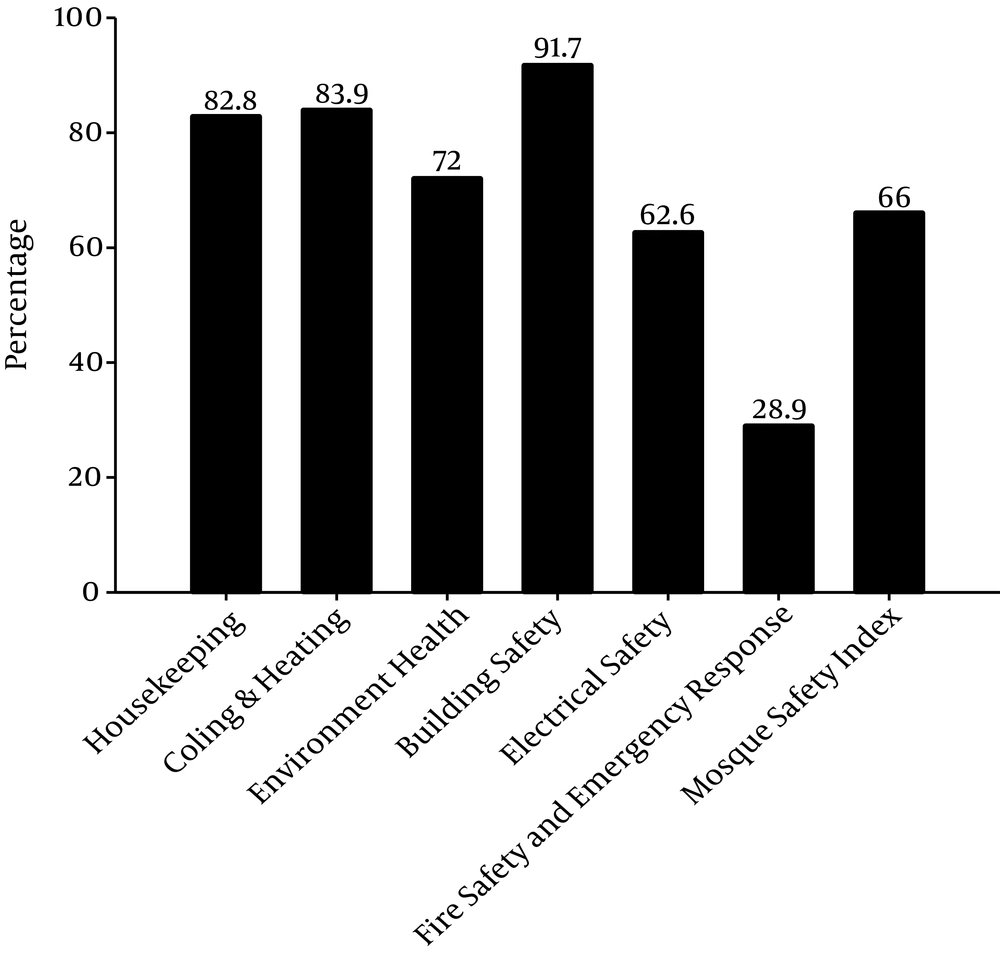
Figure 1.
The average percentage of mosque safety index (MSI) in varied dimensions in the studied mosques
Furthermore, the MSI and the scores of all dimensions are shown in four levels in Table 3: good, moderate, poor, and very poor in numbers and percentages. As can be seen in Table 3, none of the mosques were classified in a good level in the dimension of FSER that received the lowest score, and the highest score was related to poor level 55 mosques (42%). Additionally, in the dimension of electrical safety, the highest number of mosques, 62 (47.2%), was in the moderate level. The status of environmental health, 64 mosques (48.9%), was in a good level. Dimensions of building safety with 121 mosques (92.4%), heating and cooling systems with 106 mosques (80.9%), and housekeeping with 99 mosques (75.6%) had the highest number of mosques in a good level, respectively. The table also shows that none of the mosques were at a very poor level in building safety and environmental health. Eventually, based on the overall MSI score, the safety status of the mosques were evaluated at moderate level, so that 101 mosques (77.1%) were at a moderate level, 20 mosques in a good level (15.3%), and none of the mosques in a very poor level.
Table 3.Safety Level Classification Among the Studied Mosques (n = 131)
| Dimensions | Safety Level, No. (%) | |||
|---|---|---|---|---|
| Good (Safe) 75 - 100% | Moderate (Relatively Safe) 50 - 75% | Poor (Relatively Unsafe) 25 - 50% | Very Poor (Unsafe) 0 - 25% | |
| Fire safety and emergency response (FSER) | 0 | 6 (4.6) | 70 (53.4) | 55 (42) |
| Electrical safety | 32 (24.4) | 62 (47.3) | 35 (26.7) | 2 (1.5) |
| Building safety | 121 (92.4) | 9 (6.9) | 1 (0.8) | 0 |
| Environmental health | 64 (48.9) | 50 (38.2) | 17 (13) | 0 |
| Cooling and heating | 106 (80.9) | 16 (12.2) | 5 (3.8) | 4 (3.1) |
| Housekeeping | 99 (75.6) | 22 (16.8) | 9 (6.9) | 1 (0.8) |
| Mosque safety index | 20 (15.3) | 101 (77.1) | 10 (7.6) | 0 |
Figure 2 shows classification of MSI scores in percentage, indicating that the highest score was obtained at the moderate level; then, the good level, and eventually the poor level obtained the lowest percentage.
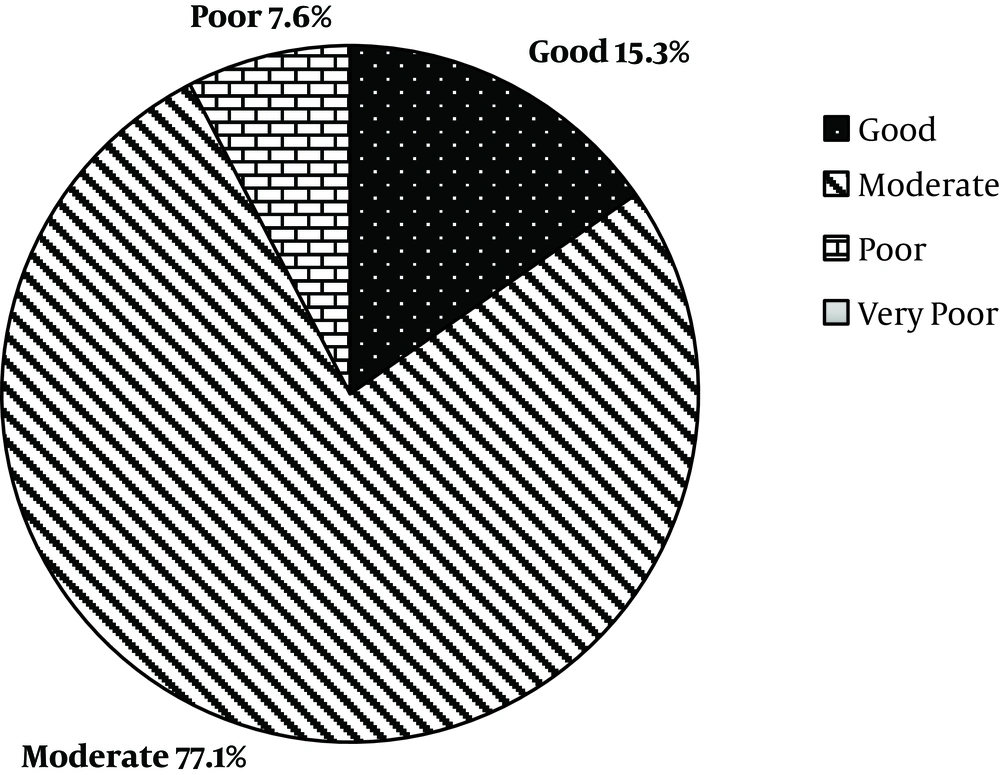
Figure 2.
Classification of mosque safety index (MSI) levels in the studied mosques
5. Discussion
The aim of this study was to assess the level of safety and health risks in mosques in Shiraz, Iran. According to the overall MSI score of the mosques in this study (66 ± 9.56%), their safety status was categorized at a moderate level; however, it is far from the desired status. Among the studied dimensions, the highest and lowest MSI were related to building safety (91.7 ± 11.3%) and FSER (28.9 ± 12.4%), respectively.
Due to the fact that there is no similar study in this field in Iran as well as around the world, according to the author’s search, it is not possible to compare the results of this study with other studies. However, the relatively poor safety of the mosques under the study can be attributed to several factors, including the lack of specific safety requirements for the safety of the mosque and the lack of legal authority to monitor it, which, of course, is not limited to mosques, and there are such weaknesses in the case of administrative and commercial buildings, schools, and general and urban places. In other words, in the case of workplaces, in Labor Law, responsibility of safety inspections has been delegated to the Ministry of Labor; there is no specific statutory requirement for safety inspection in public and urban environments, and this is stated in the report of the Parliament Construction Commission on the accident of Plasko, in Tehran, where attention was drawn to the lack of safety inspections as well as to the lack of building safety to prevent fire, the provision of suitable storage facilities for storing materials, and building retrofitting to prevent collapse (9).
In this study, the lowest MSI score was related to FSER (28.9 ± 12.4%). The most important nonconformity of this dimension among the mosques studied was the lack of a fire alarm system, high fire load, the use of inappropriate heating systems and the poor condition of electrical installations. Another factor considered in this dimension was the inappropriate status of emergency exit doors, insufficient number of emergency exits, and the emergency exit doors opened in the direction inward in all mosques, which according to the number of people in mosques, especially in ceremonial events, can delay the evacuation of people at the incident. The accident of Arg mosque in Tehran, which occurred in February 2004, in which the explosion of the gas cylinder on the second floor caused the fire, reported factors such as a ceiling covered by tarpaulin impregnated with paraffin with 800-squer meter to prevent cold, and improper use of gas capsules. In this accident, 78 people were killed, and the main causes have been mentioned due to the lack of emergency exit doors, the opening of the exit door inward, the locking of the door due to congestion and high population, the narrow width of the path leading to the exit door, and the lack of fire alarms and fire extinguisher (8).
In this study, MSI, in the dimension of electrical safety (62.6 ± 18.6%), was classified in the moderate level. The most important nonconformity observed in this dimension is the lack of proper wiring, the lack of earthing (grounding), and the absence of a fire extinguisher near the electrical plan. Since electricity can cause fire and electric shock, it is crucial to follow electrical safety principles. In this regard, it is also possible to point out that the Plasko accident report mentioned that a part of the fire triggering factors were inappropriate wiring, improper use of electric heating appliances, as well as improper placement and installation of electrical fuses (9). Therefore, considering that new wiring in the mosques must necessarily comply with safety rules, it is necessary to check the old equipment and correct the safety of these devices in order to reduce the incidence of fire and explosion. Moradi et al. (2), studied the electrical safety in the mosques of Tehran’s 1st district states, noting that 50% of the mosques in this area, regarding the safety of the electrical plan, in such matters as lack of observing the 1 and a half meters distance, openness and unlocked panel doors, unauthorized and burned wiring, and the uncovered power outlets and wires.
In addition to safety issues, the health issues of the mosques were also studied in this study and the condition of mosques in this regard was classified at a moderate level (72 ± 15%). In the studies of mosques in different cities of Iran including Amol, Ravar, Tabas, Kashan (15) and Sabzevar (16), various scores were reported as 69%, 44%, 82%, 40%, and 43%, respectively; the difference between this study and others could be due to in the instruments used and the manner in which the mosques were run. This is consistent with the results of the study by Zazouli et al. (17) in the mosques and religious sites of Amol city (69%) with a relative consistency, as well as the study of Loloee et al. (18), in Ravar (44%). Barjasteh Askari et al. (16), in the mosques of Tabas, mentioned that the environmental health of these places was 82%, which is close to the present study. Similarly, studies on the health status of Kashan mosques (40% favorable condition) and Sabzevar (43%) were far worse than the results of this study (15, 19).
Although the average MSI was not significantly different among city regions, mosques in highly developed and moderately developed regions of the city (areas 1 and 2) were probably more likely to be better off than others due to allocation and budget. However, in all four urban areas, there is a need for improvement in the dimension of fire safety and emergency response.
5.1. Limitations
Our work clearly has some limitations. The most important one lies in the fact that the general status of the mosques’ safety was assessed by using a checklist and observational method and also more comprehensive risk assessment methods are required to study the safety of mosques, especially for fire safety. In addition, out of 250 mosques in Shiraz, only 131 were included in the study, and it is likely that the mosques that refused to be included in the study had a poor safety status.
5.2. Conclusions
The results of this study showed that the general safety status of the mosques in Shiraz was moderate. However, the level of provided safety measures in the dimensions of FSER and electrical safety were categorized into the poor level. Therefore, there is a need to inform the authorities about safety priorities in the mosques to promote the safety conditions, especially in FSER. The results could also be used to raise awareness regarding their role and responsibilities about the safety of the mosques. Moreover, according to the low score of FSER and the importance of this issue, the researchers are recommended to include items such as regular monitoring of the mosques safety and improvement of safety status in the mosques as the responsibility of municipality and organization in charge of mosques’ safety.
Further work needs to be done more precisely on fire and emergency response and electrical safety so that weaknesses are examined in more detail and more comprehensive solutions can be found to enhance the safety of the mosques.



