
1. Background
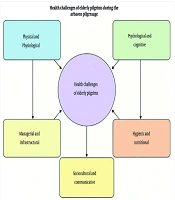
Mass gatherings are complex events that bring together large numbers of people in a specific location for a defined period, often under unique social, cultural, or religious circumstances (1). Among these, the Arbaeen Hosseini pilgrimage stands out as one of the largest annual religious congregations globally, drawing millions of devotees to Karbala, Iraq, to honor the martyrdom of Imam Husayn, a central figure in Shia Islam (2). This unparalleled influx of pilgrims creates a significant demand on infrastructure, public health systems, and emergency management services, presenting unique challenges that merit focused research and intervention (3).
Mass gatherings, such as Arbaeen, are associated with a broad spectrum of public health risks (4), including overcrowding, food and water safety concerns, waste management, disease transmission, and the strain on healthcare facilities (5). Previous studies have underscored the need for effective risk management strategies to minimize these challenges and ensure the safety and well-being of participants (6). For instance, research has highlighted the importance of structured risk assessments in identifying vulnerabilities, such as gaps in crowd control or deficiencies in health service delivery, that could exacerbate the risks associated with these large-scale events (7).
However, while the existing literature provides valuable insights into mass gatherings, many studies have focused on events in developed countries or under contexts that do not fully account for the unique cultural and environmental conditions of the Arbaeen pilgrimage (8, 9). One significant limitation in the current body of research is the lack of studies utilizing standardized, validated tools to systematically assess health risks in mass gatherings of this magnitude (9). Moreover, the absence of context-specific investigations that incorporate local cultural, environmental, and infrastructural nuances has limited the generalizability of findings to events like Arbaeen (10). Addressing these gaps is essential to developing tailored strategies that effectively mitigate health risks and enhance preparedness and response mechanisms (11, 12).
The present study aims to bridge this gap by conducting a comprehensive, quantitative health risk assessment during the Arbaeen Hosseini pilgrimage. This research leverages the mass gathering risk assessment tool (MGRAT), a psychometrically validated instrument, to evaluate various risk domains, including emergency preparedness, health service delivery, and crowd management. By engaging experts, officials, and pilgrims through structured interviews and direct observations, this study provides a robust and evidence-based framework to understand and address the public health challenges associated with Arbaeen.
1.1. Mass Gathering Risk Assessment Tool
The MGRAT facilitates a comprehensive understanding of the risk factors in mass gatherings, enabling event organizers and health professionals to identify vulnerabilities and prioritize interventions to ensure participant safety and well-being. The tool was prepared and validated by Asghar Tavan (13). The MGRAT is a structured questionnaire designed to evaluate health and safety risks associated with mass gatherings comprehensively (14, 15). The tool is organized into five domains, each addressing specific aspects of health and safety risks: Individual risks (questions 16 - 21), environmental risks (questions 1 - 15), health risks (questions 27 - 46), psychological risks (questions 22 - 26), and management risks (questions 47 - 83). The tool contains a total of 83 questions. Each question is answered as "yes" or "no". Some questions may also have an option for "not applicable". For some questions, a "yes" response indicates a positive condition and scores a point, while for others, a "no" response is favorable and scores a point. The scoring rules specify which response corresponds to a "favorable" condition for each question. Based on the percentage of favorable responses, the total risk level is categorized into one of four levels:
- Very low risk: > 75% favorable responses
- Low risk: 50% - 74% favorable responses
- High risk: 25% - 49% favorable responses
- Very high risk: < 25% favorable responses
2. Objectives
The findings of this study will contribute to the growing body of knowledge on mass gathering health risk management and offer actionable insights to policymakers, public health practitioners, and event organizers. Additionally, the study's emphasis on a validated risk assessment tool ensures that its methodology can be replicated or adapted for similar mass events worldwide. This descriptive, cross-sectional study was conducted to ensure a comprehensive evaluation of the risks associated with one of the world’s most significant religious gatherings.
3. Methods
This study employed a descriptive cross-sectional design to quantitatively assess health risks associated with the gatherings of Arbaeen Hosseini pilgrims. Conducted between August and October 2024, the research aimed to evaluate the health risks using a structured and systematic approach. The primary tool for data collection was the MGRAT, a validated and widely used instrument designed for assessing risks in large gatherings.
3.1. Study Setting and Population
The research was conducted in the context of the annual Arbaeen pilgrimage, a large-scale religious gathering that attracts millions of pilgrims. The target population included three distinct groups of participants: (1) Experts: Professionals with experience and expertise in mass gatherings and public health; (2) relevant officials: Government and non-government officials involved in planning, managing, and overseeing the Arbaeen pilgrimage; (3) pilgrims: Individuals attending the Arbaeen pilgrimage.
3.2. Sampling and Recruitment
Participants were selected using purposive sampling to ensure representation across the three groups. Inclusion criteria required participants to have direct involvement or experience in the Arbaeen pilgrimage. Interviews with experts and officials were conducted in coordination with relevant organizations, while pilgrims were approached directly at key gathering points.
3.3. Data Collection Tools and Procedure
The MGRAT served as a tool for data collection. This tool is designed to capture comprehensive information about health risks in mass gatherings across various domains. The MGRAT was utilized through the following methods: (1) Interviews: Structured interviews were conducted with experts, officials, and pilgrims to gather qualitative insights to evaluate risk factors; (2) direct observation: Researchers performed systematic observations of the event, focusing on crowd management, public health infrastructure, and emergency preparedness. Also, functional documentation, such as event plans, medical reports, and safety protocols, was reviewed and analyzed.
3.4. Data Analysis
Data collected through interviews and observations were systematically organized and analyzed. The following steps were undertaken:
3.4.1. Scoring
The MGRAT tool provided structured scoring for various fields, including emergency preparedness, health service delivery, crowd management, and communication strategies. The overall health risk score and scores for individual domains were calculated based on MGRAT guidelines.
3.4.2. Interpretation
Quantitative scores were interpreted to identify areas of high risk, potential gaps, and strengths in risk management. Descriptive statistics were used to summarize and present findings.
3.4.3. Validation
Triangulation of data from interviews, observations, and documentation reviews was conducted to ensure the reliability and validity of the findings.
3.5. Ethical Considerations
All participants were informed about the purpose of the study, and written informed consent was secured before data collection. Participation was voluntary, and confidentiality of personal data was maintained throughout the study.
4. Results
The age of participants ranged from 22 to 71 years, with most participants between 22 and 42 years (44%). Of all participants, 78% were male and the remaining 22% were female. The educational level ranged from illiterate (1%) to PhD (15%). Furthermore, 19 experts, 37 officials, and 53 pilgrims were interviewed (Table 1).
Table 1.
Demographic Characteristics of the Participants
| Variables | No (%) |
|---|---|
| Gender | |
| Male | 85 (78) |
| Female | 24 (22) |
| Age (y) | |
| 22 - 42 | 48 (44) |
| 43 - 62 | 46 (42) |
| > 62 | 15 (14) |
| Educational level | |
| Illiterate | 1 (1) |
| Diploma | 15 (14) |
| Bachelor | 41 (38) |
| Master | 35 (32) |
| PhD | 17 (15) |
| Role | |
| Experts | 19 (17) |
| Officials | 37 (34) |
| Pilgrims | 53 (49) |
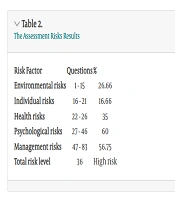
The assessment results provide a comprehensive view of the health risks associated with the Arbaeen Hosseini pilgrimage. Highlighting consistent observations, the findings reveal that psychological health risks are the most prominent, accounting for 60% of the assessed threats. This is followed by risks in the management field (56.75%), health field (35%), environmental field (26.66%), and personal field (16.66%). These results underscore the pressing need for targeted interventions to address the vulnerabilities identified across these domains (Table 2).
Table 2.
The Assessment Risks Results
| Risk Factor | Questions | % |
|---|---|---|
| Environmental risks | 1 - 15 | 26.66 |
| Individual risks | 16 - 21 | 16.66 |
| Health risks | 22 - 26 | 35 |
| Psychological risks | 27 - 46 | 60 |
| Management risks | 47 - 83 | 56.75 |
| Total risk level | 36 | High risk |
The analysis of the psychological field demonstrates its dominant role in the overall risk landscape, reflecting the heightened stress and mental health challenges that participants experience due to overcrowding, long journeys, and potential exposure to crises. Similarly, management-related risks, accounting for over half of the total score, highlight inefficiencies in organizational preparedness, resource allocation, and emergency response strategies. Health risks, comprising 35% of the threats, point to gaps in healthcare service delivery, including inadequate medical support and limited access to essential healthcare resources. Environmental risks, such as waste management issues and water contamination, were assessed at 26.66%, emphasizing the strain on infrastructure during mass gatherings. Personal risks, although constituting the smallest percentage at 16.66%, are critical due to the involvement of vulnerable groups, including women, children, the elderly, and individuals with disabilities, who face unique challenges in accessing facilities and navigating the event.
The total score of 36 highlights the substantial cumulative risks faced by participants. The analysis of the current situation reflects significant gaps in preparedness and resilience, underscoring the need to reassess the existing conditions and infrastructure supporting the pilgrimage. The prevalence of high-risk factors in both health and environmental categories illustrates the urgent need for interventions to address sanitation, water safety, and healthcare access. While the majority of observations align with the expected challenges of mass gatherings, discrepancies were noted in the lower assessment of personal risks. This may indicate a need for further exploration of the factors influencing this domain, as well as potential underreporting or inadequate recognition of individual vulnerabilities.
In summary, the findings underscore the critical need for comprehensive risk management strategies, with particular emphasis on enhancing psychological support, improving management efficiency, strengthening health services, and addressing environmental challenges. The involvement of vulnerable groups necessitates focused attention to ensure equitable access to safety and resources. The observed distribution of risks provides a roadmap for prioritizing interventions to mitigate health threats during the Arbaeen Hosseini pilgrimage.
5. Discussion
The study presents a comprehensive assessment of health risks associated with the Arbaeen Hosseini pilgrimage, emphasizing the psychological field as the most significant area of concern, accounting for 60% of the total risks. The management field followed with 56.75%, health at 35%, environmental at 26.66%, and personal risks at 16.66%. These results indicate a multifaceted risk landscape, with psychological and management challenges being the most pressing. The overall risk score of 36 suggests substantial cumulative vulnerabilities, necessitating targeted interventions to address these diverse domains. The findings of this study align with existing literature on the health risks associated with mass gatherings, particularly concerning the psychological, managerial, health, environmental, and personal dimensions.
The prominence of psychological risks, identified as the most significant category in this study (60%), echoes findings from other large-scale events such as the Hajj. Ahmed and Memish emphasized the heightened psychological strain experienced by participants at the Hajj due to factors like overcrowding, extended travel, and limited personal space (16). Similarly, Hopkins and Reicher noted that psychological support mechanisms were often insufficient in mass gatherings, exacerbating stress and anxiety among participants (17). These findings reinforce the importance of prioritizing mental health interventions at events like the Arbaeen pilgrimage.
Management-related risks, which accounted for 56.75% of this study, have also been widely reported in the context of mass gatherings. Memish et al. highlighted the critical role of organizational preparedness and resource allocation in mitigating risks during events like the Olympics and religious gatherings (18). The inefficiencies in management, as observed in this study, align with these findings, underscoring the need for robust crowd control strategies and emergency response systems.
Health risks (35%), such as inadequate medical support and limited access to healthcare services, are consistent with observations made at the Hajj and other mass gatherings. Al-Tawfiq and Memish noted similar challenges in ensuring timely healthcare delivery, particularly in high-density environments (19). Additionally, infectious disease transmission remains a significant concern, as highlighted in studies by Al-Tawfiq and Memish, which documented the challenges of controlling outbreaks during mass gatherings (19).
Environmental risks (26.66%), including waste management and water contamination, are commonly reported in mass gathering settings. For example, a study by Yousefian et al. on the Hajj identified sanitation and environmental hygiene as critical areas requiring attention (20). These parallels suggest that environmental challenges are universal across large-scale events, regardless of cultural or geographical context.
Personal risks (16.66%), though the lowest in this study, are of particular concern due to the inclusion of vulnerable populations, such as women, children, the elderly, and individuals with disabilities. This finding aligns with observations by Yousefian et al., who reported that vulnerable groups often face disproportionate challenges in accessing resources and navigating the logistical complexities of mass gatherings (20). These insights highlight the need for tailored interventions to address the unique needs of these populations.
The comprehensive risk assessment conducted in this study also aligns with frameworks proposed by the World Health Organization (WHO) for mass gathering health (21). These guidelines emphasize the need for structured risk assessments to identify vulnerabilities across multiple domains, a methodology mirrored in the use of the MGRAT tool in this study. In contrast to studies focusing on developed contexts, such as the Olympics or major music festivals, this research highlights the unique challenges posed by the Arbaeen pilgrimage, a religious event in a resource-constrained environment. For instance, while studies like those of McCloskey et al. address advanced technological solutions for risk management, the findings here underscore the importance of culturally and contextually appropriate strategies tailored to local conditions (22).
This comparison underscores the value of integrating global best practices with localized approaches to effectively address the diverse challenges of mass gatherings. These insights can inform targeted interventions, ensuring both the safety and well-being of participants and the resilience of host communities.
5.1. Conclusions
The findings underscore the urgent need for comprehensive risk management strategies to address the health challenges associated with the Arbaeen pilgrimage. Prioritized interventions should focus on enhancing psychological support services, improving management efficiency, strengthening health services, and addressing environmental challenges. Special attention must be given to including vulnerable groups, ensuring equitable access to safety measures and resources. Future research should aim to refine risk assessment methodologies by incorporating real-time data and expanding the focus on personal vulnerabilities. Additionally, longitudinal studies could offer insights into the effectiveness of implemented interventions, guiding continuous improvement in managing health risks during mass gatherings. By adopting a data-driven and inclusive approach, policymakers and organizers can better safeguard the well-being of participants and enhance the overall safety of the Arbaeen pilgrimage.
5.2. Implication and Explanation of Findings
The dominance of psychological risks highlights the immense mental health challenges posed by the Arbaeen pilgrimage, likely exacerbated by overcrowding, prolonged journeys, and crisis exposure. Addressing these risks requires the integration of mental health support services, such as counseling and stress management programs, tailored to the unique needs of participants. Management-related risks underscore the need for enhanced organizational preparedness, including better crowd management, resource allocation, and emergency response planning. The significant health risks point to gaps in medical service delivery and access to essential healthcare resources, necessitating the deployment of mobile health units and increased medical staffing during the event. Environmental challenges, such as waste management and water contamination, highlight the critical need for infrastructural improvements, including the implementation of effective waste disposal systems and ensuring clean water availability. Personal risks, though lower in percentage, remain crucial given the unique challenges faced by vulnerable groups. These findings suggest a need for inclusive strategies that ensure equitable access to facilities and resources for all participants.
5.3. Strengths and Limitations
A key strength of this study is its use of the MGRAT, a psychometrically validated instrument, which provides a robust framework for evaluating risks across multiple domains. The inclusion of diverse data sources—interviews with experts, officials, and pilgrims, alongside direct observation—enhances the study's comprehensiveness and reliability. However, the study is not without limitations. The lower assessment of personal risks may reflect underreporting or insufficient recognition of individual vulnerabilities, warranting further exploration. Additionally, the study's cross-sectional nature limits its ability to capture dynamic changes in risk factors over time. Future longitudinal studies could provide a more nuanced understanding of risk evolution throughout the pilgrimage.