


1. Background
One of the most important and influential sanitary issues in the school is observing the ergonomic issues. Applying ergonomic principles in the school environment prevents musculoskeletal injuries such as back pain, neck pain, wrist pain, etc. It also prevents incidents and increases students’ motivation, willingness to study, well-being, comfort, and safety; moreover, observing the ergonomic issues increases education productivity and quality and prevents academic failure (1, 2). The most important factors reducing the quality of environmental health, safety, and ergonomics in elementary schools include insufficient educational space capitation, the closeness of the school to the insanitary and unsafe places, old school buildings, toilets, sinks, and drinking fountains with insanitary conditions, classes and schoolyards with insanitary and unsafe conditions, the likelihood of electric shock and fire, insufficient first aid facilities, and inappropriate boards, desks, and benches (3). According to educational experts with a systematic viewpoint, in addition to the educational factors, the architecture of the school and its elements such as location, lighting, physical condition, desks and benches, etc. can considerably affect the students (4-8). It is one of the students’ inalienable individual and social rights to educate in a safe and sanitary environment and enjoy health services (9). That is why the improvement of sanitary conditions in educational environments should always be prioritized in educational planning. Taking into account the ergonomic factors such as light, heat, coldness, noise, desks, and benches, dimensions of the chairs and many other ergonomic factors at schools can increase students’ concentration on the lesson as well as the teacher’s (10).
Zazuoli et al. (2008) conducted a study on the environmental health conditions of Sari elementary schools and concluded that the restrooms of these schools are not in a favorable condition. They attributed this condition to the ignorance or carelessness of the responsible authorities and educational managers as well as paying more attention to quantity rather than quality (11). However, Zazouli et al. (2012) reported that the health condition of 90% of the restrooms in Mazandaran province was favorable (12). Furthermore, Kermani et al. (2011) argued that the condition of Pakdasht schools’ restrooms was unfavorable (13). Neshat et al. (2010) reported that the condition of restrooms in Zabol elementary and junior schools was unfavorable (14). Malakootian et al. (2007) studied the condition of the environmental health and safety in schools of Kerman city and concluded that the health condition of 80 percent of the schools is favorable (15). Shahriari et al. (2008) conducted a study on the environmental health condition of schools in Birjand city and reported that the health condition of the schools is favorable (16). Zare Jamalabadi et al. studied the health condition of the elementary schools in the second educational district of Yazd province and compared it to the required standards of the health regulations in the academic year 2011 - 2012. They concluded that most of the schools have a proper area, health care rooms, standard first aid kits, appropriate drinking fountains, and standard toilets. They indicated that the health condition is consistent with the required standards of school health regulations and it is not significantly different between all-girl and all-boy schools (17). Ganji et al. (2013) studied the environmental health condition of the female public elementary schools in Khomeyni Shahr, Isfahan, and reported that it is unfavorable (18).
The sanitary facilities in schools refer to a set of factors that the lack of any of which may unfavorably affect the health condition and educational programs. Instances of these facilities are toilets, sinks, drinking fountains, and health care rooms. It is of students’ inalienable individual and social rights to educate in a safe and sanitary condition and enjoy health services. The school is where children study and their social and mental personality is shaped, so it should fulfil the students’ physical and mental needs, particularly in terms of hygiene and health. Following general principles of environmental health (supplying drinking water, proper disposal of wastewater and solid wastes, supplying desirable heat, light, and air conditioning, defensive actions against insect and rodent attack, etc.) is among the sanitary necessities of educational environments, which should be taken into account in all schools. That is why the improvement of sanitary conditions in educational environments should always be prioritized in educational planning. Therefore, the present study sought to investigate the condition of restrooms in Masjed Soleyman schools regarding ergonomic principles.
2. Methods
This is a descriptive survey to investigate the condition of restrooms in Masjed Soleyman schools regarding ergonomic principles in the school year 2015 - 2016. The population included all teachers at elementary, junior, and high schools (first and second secondary schools) of Masjed Soleyman, of whom 267 people were selected as the sample of the study based on cluster sampling. The data collection instrument was a researcher-made questionnaire developed as observation checklist to investigate both the physical characteristics of the schools’ restrooms with 7 items on a 5-degree scale (very high, high, moderate, low, and very low) and the participants’ demographic information (age, gender, educational level, etc.). The experts approved the validity of the questionnaire while its reliability was confirmed by Cronbach’s alpha (0.91). The 5-point items of this questionnaire were quantitatively scored from 1 to 5 based on the Likert scale. The highest score and the lowest score were indicative of the most desirable and the least desirable condition of the schools’ restrooms, respectively. The researcher administered the questionnaires to the teachers and collected the completed questionnaires after a week. Data were analyzed using descriptive (frequency, percentile, mean, and standard deviation) and inferential statistics (univariate t-test and Kolmogorov-Smirnov test) using SPSS 21. Furthermore, the ethical considerations like the participants’ consent and ensuring them about confidentiality of their opinions were taken into account.
3. Results
The demographic information of the participants, i.e. their frequency in terms of gender, age, and educational level, is presented in Table 1. Regarding gender, males were more frequent, constituting 60% of the sample. As with educational level, most participants held a BA degree, constituting 53% of the sample. Regarding age, most participants were in the range of 31 - 40 years.
Table 1.Demographic Specifications
| Variables | Number and Percentage of Individuals |
|---|---|
| Gender | |
| Male | (161) - 60% |
| Female | (106) - 40% |
| Total | (267) - 100.0% |
| Educational level | |
| Associate’s degree | (28) - 10 |
| Bachelor’s degree | (141) - 53 |
| Master’s degree | (83) - 31 |
| Ph.D. | (15) - 6 |
| Total | (267) - 100.0 |
| Age | |
| Under 30 years | (52) - 5% |
| 31 - 40 | (53) - 20% |
| 26 - 30 | (106) - 40% |
| 41 - 50 | (89) - 33% |
| above 50 years | (19) - 7% |
| Total | (267) - 100.0% |
The mean, standard deviation, desirability, and standardized percentile are presented in Table 2 based on the points the participants gave to the physical variables of the schools’ restroom conditions in the 7 items on a 5-degree range (very high, high, medium, low, and very low). According to Table 2, item 1 ‘the students should be provided with hand washing liquid or soap in the toilets’ had 52% of marking. Item 2 ‘students should not drink water in restrooms’ drinking fountains and they need to become aware of this by installing warning signs’ had 39% of marking. Item 3 ‘the height of the restrooms should be consistent with the students’ age in three levels of elementary, junior, and high school’ had 51% of marking. Item 4 ‘one toilet is needed per 45 students’ had 51% of marking. Item 5 ‘toilets should be equipped with siphon and washable trash bin with lid’ gave 58% of marking. Item 6 ‘the presence of airflow for ventilation, i.e. there should be electric fans and openable guarded windows’ had 60% of marking. Finally, item 7 ‘the floor and walls should be covered with washable materials’ had 59% of marking. Besides, these items are presented in Figure 1. The t-test results of the items related to the variables of the restroom are shown in Table 3.
Table 2.Mean, Standard Deviation, and the Standardized Percentile of the Schools’ Restroom Conditions
| Items | Code | No. | Mean | SD | Standardized Percentile |
|---|---|---|---|---|---|
| One toilet is needed for every 45 students | X24 | 267 | 2.6105 | 1.40018 | 52 |
| The floor and walls should be covered with washable materials | X25 | 267 | 1.9738 | 1.11182 | 39 |
| Toilets should be equipped with siphon and washable trash bin with lid | X26 | 267 | 2.5618 | 1.40050 | 51 |
| The presence of airflow for ventilation, i.e. there should be electric fans and openable guarded windows | X27 | 267 | 2.5506 | 1.31799 | 51 |
| The height of the restrooms should be consistent with the students’ age in the three levels of elementary, junior, and high school | X28 | 267 | 2.9064 | 1.51019 | 58 |
| The students should be provided with hand washing liquid or soap in the toilets | X29 | 267 | 3.0000 | 1.41952 | 60 |
| Students should not drink water in restrooms’ drinking fountains and they need to become aware of this by installing warning signs | X30 | 267 | 2.9438 | 1.46662 | 59 |
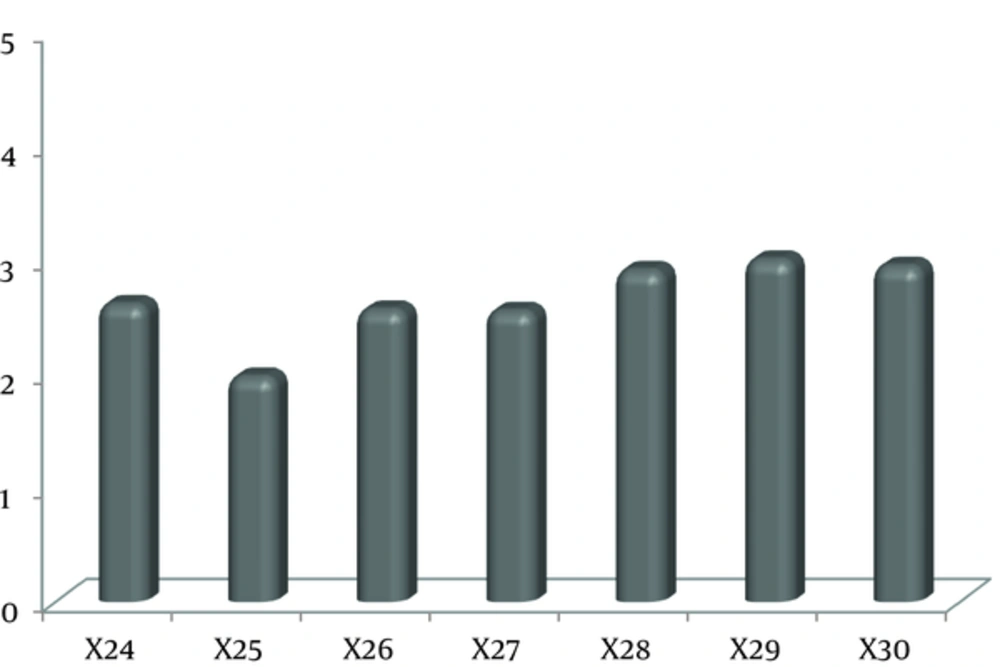
Figure 1.
Central Indices of the Restroom Variable Items
Table 3.T-Test Results of the Restroom Variable Items
| Items | Test Value = 3 | |||||
|---|---|---|---|---|---|---|
| t Statistic | df | P | Mean Difference | 95% Certainty | ||
| Minimum | Maximum | |||||
| One toilet is needed per 45 students | -4.546 | 266 | 0.000 | -0.38951 | -0.5582 | -0.2208 |
| The floor and walls should be covered with washable materials | -15.082 | 266 | 0.000 | -1.02622 | -1.1602 | -0.8922 |
| Toilets should be equipped with siphon and washable trash bin with lid | -5.113 | 266 | 0.000 | -0.43820 | -0.6070 | -0.2694 |
| The presence of airflow for ventilation, i.e. there should be electric fans and openable guarded windows | -5.572 | 266 | 0.000 | -0.44944 | -0.6083 | -0.2906 |
| The height of the restrooms should be consistent with the students’ age in the three levels of elementary, junior, and high school | -1.013 | 266 | 0.312 | -0.09363 | -0.2756 | 0.0883 |
| The students should be provided with hand washing liquid or soap in the toilets | 0.000 | 266 | 1.000 | 0.00000 | -0.1710 | 0.1710 |
| Students should not drink water in restrooms’ drinking fountains and they need to become aware of this by installing warning signs | -0.626 | 266 | 0.532 | -0.05618 | -0.2329 | 0.1205 |
Table 3 indicates that the Sig. values of the items 28, 29, and 30 are higher than 0.05 and they are in a moderate condition. The Sig. values of other items are less than 0.05 that indicates they had a negative mean difference, implying a moderate to week condition.
4. Discussion
The results indicated that the condition of the schools’ restrooms in Masjed Soleyman is unfavorable regarding ergonomic principles (53%). The most inappropriate conditions included non-standard floors and walls, lack of air conditioning, lack of electric fans and openable guarded windows, and incongruity between the number of restrooms and students, in sequence. As such, the results are in line with the results of the studies conducted by Zazouli et al. (11), Kermani et al. (13), Neshat et al. (14), and Ganji et al. (18). However, they are not consistent with the results of the studies conducted by Malakootian et al. (15), Shahriari et al. (16), and Zare Jamalabadi et al. (17). Following the school environmental health standards, one can save millions of Rials in repairing and maintaining schools, prevent various incidents happening at schools, and prevent the spread of diseases, particularly infectious diseases. It also reduces disabilities resulted from the incidents, decreases pharmaceutical and medical costs, provides students with favorable physical and mental conditions to educate, improves the quality of education, and prevents educational failure.
It is proposed that a greater deal of cooperation be made between the health units in the schools of Masjed Soleyman department of education, health deputy of Ahvaz Jundishapur University of Medical Sciences, and Khuzestan Province Education Department to eliminate the unfavorable and non-standard items of the schools’ restrooms in Masjed Soleyman.
The major limitations of this study included the distribution of the population, lack of desirable access to subjects, and unwillingness of some participants to cooperate.

