Fulltext
This part is available in the PDF file.
Image Credit:Shiraz E-Med J
Authors
Background: Concerns about infection with Human Immune Deficiency Virus (HIV) among adolescents has renewed interest in developing countries, where they represent a large proportion of population and are at high risk. Little is known about sexual knowledge of university students in Malaysia. University students’ pattern of risky behavior and the extent of their knowledge regarding HIV can determine the type of interventional programs that can be developed for the sensitive issue of HIV in a country where Islam is the national religion. Methodology: A cross-sectional study on sexual and drug use behavior, knowledge and attitude of HIV risk was undertaken amongst 530 university students using simple random sampling. The study was conducted using a self-administered questionnaire. Result: Knowledge of university students about HIV was high but there are still some remaining misconceptions. Contribution of parents and medical personnel in informing students about HIV was negligible while audiovisuals including internet were found to be the main source of knowledge. Students’ risk taking behavior was low as only 2.3% of students reported sexual activity during last 12 month, 58.3% of whom were using condoms. Frequency of intravenous drug use was 1.7% only. Two percent self-reported as HIV positive. However frequencies of tobacco use and alcohol intake was 21.2% and 9.7% respectively. Peer pressure (63.9%) and lack of guidance (23.9%) was reported to be the main reasons for students’ drug use. Females had a better attitude than males (p=0.02). There was a correlation between score of knowledge with attitude (p=0.01) and behavior (p=0.05). Discussion and conclusion: Parents’ guidance about risk taking behavior should be encouraged. Peer education intervention programs are needed for university students to clarify their Shiraz E Medical Journal, Vol. 11, No. 3, July 2010 127 misconceptions, improve their attitude and prevent risky behavior. Further studies to investigate the role of tobacco and alcohol use on the students’ risk taking behavior are recommended.
© 2010, Author(s). This open-access article is available under the Creative Commons Attribution 4.0 (CC BY 4.0) International License (https://creativecommons.org/licenses/by/4.0/), which allows for unrestricted use, distribution, and reproduction in any medium, provided that the original work is properly cited.
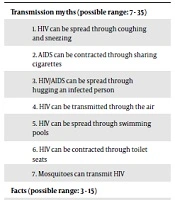
Akhlaghdoust M, Chaichian S, Davoodi P, Ahmadi Pishkuhi M, Azarpey A, et al. AIDS Attitude in First-Year Students with History of Sexual Behaviors: A Cross-Sectional Study. Int J High Risk Behav Addict. 2019;8(3):e94612. doi: https://doi.org/10.5812/ijhrba.94612
Abdeyazdan Z, Sadeghi N. Knowledge and Attitude Toward AIDS/HIV Among Senior School Students in Isfahan. Arch Clin Infect Dis. 2008;3(2):. doi:
Mazloomy-Mahmoodabad S, Abbasi-Shavazi M. Knowledge and attitude survey of high school students of Yazd province of Iran about HIV/AIDS. Zahedan J Res Med Sci. 2006;8(1):e94913. doi:
Cheraghi MA, Mohammad Nejad E, Begjani J, Rabirad N, Ehsani SR, et al. Knowledge and Attitudes of Nurses Regarding HIV/AIDS (Tehran –2010). Arch Clin Infect Dis. 2011;6(3):e93416. doi:
Pharr JR, Enejoh V, O. Mavegam B, Olutola A, Karick H, et al. A Cross-Sectional Study of the Role of HIV/AIDS Knowledge in Risky Sexual Behaviors of Adolescents in Nigeria. Int J High Risk Behav Addict. 2017;6(4):e63203. doi: https://doi.org/10.5812/ijhrba.63203
Last Update: 1 month ago
Last Update: 1 month ago
Last Update: 1 month ago
Last Update: 5 days ago
Last Update: 1 day ago
Last Update: 2 days ago