
1. Background
Since its inception in 1981, the Acquired Immune Deficiency Syndrome (AIDS) has been undoubtedly one of the most important challenges for developed and developing countries (1-4). Based on the World Health Organization (WHO) estimates, there were about 37 million people in 2016 in the world suffering from AIDS and Human Immunodeficiency Virus (HIV) (2-4). Moreover, according to the latest WHO report in 2016, 1.8 million people across the world were infected with HIV and more than one million patients died of AIDS-related disease (4-8).
In recent years, concerns about sexual health have increased throughout the world (9). In most countries, the increasing prevalence of Sexually Transmitted Diseases (STDs), especially HIV infection, in young people is alarming (10, 11). According to the report of the Ministry of Health and Medical Education in Iran, 36,571 people were living with HIV in 2018, while this number was 5,086 in 2003 (5). Studies have shown that new HIV-infected people in Iran were drug users, but there is a rapidly rising trend in the number of people infected sexually (8). Reports published by the WHO over the past 10 years show that the pattern of HIV transmission through sexual relationships has changed (4). Teens and young people are more at risk of AIDS than adults (3). The WHO estimates that 50% of individuals newly diagnosed with HIV are young, between the ages of 15 and 24; additionally, 53% of new patients infected with HIV in Iran are in the age group of 21 to 35-years-old (8-11). Young people and university students are a major group involved in sexual activity and the first sexual experience like intercourse can occur during the university period (12-16). In Iran, there is no sexual relationship/STD education provided by the national media and the Ministry of Education that causes unreliable education to young people.
2. Objectives
The aim of this study was to investigate the AIDS attitude in first-year students with prior sexual behavior experience.
3. Methods
This cross-sectional study was performed on first-year Medical Sciences students (Islamic Azad University, Tehran Medical Sciences Branch) and first-year Technical Sciences students (Islamic Azad University, Shahr-e-Rey Branch) between May 2017 and June 2018. The sample was recruited by the census-sampling method and 2,643 first-year students in the first or second semesters were included to complete the questionnaires (n ≥ 1,300 students from each university). The inclusion criteria included first-year students from the selected universities, an age of at least 18 years, and a prior sexual behavior experience. The exclusion criteria included incomplete questionnaires and a history of participating in AIDS educational courses.
In this study, we used the International AIDS Questionnaire-Persian Version (IAQ-P) for data collection (14). The IAQ was developed by Davis et al. (1999) (17). This questionnaire includes 18 questions for assessing the four dimensions of HIV/AIDS attitude, including myths, facts, personal risk, and attitudes. Every question was scored on a five-point Likert scale. Finally, higher scores indicated positive and accurate attitudes toward AIDS. Alipour et al. (2016) confirmed the validity and reliability of the Persian version of this questionnaire (13). The data were analyzed using SPSS version 21 using the chi-square test and nonparametric tests. P values of less than 0.05 were considered significant.
4. Results and Discussion
Overall, 950 first-year students entered the study. Approximately, 36% of the students (n = 2643) had a prior sexual behavior experience (Medical sciences group = 33.1% and Technical Sciences group = 38.8% (Table 1). The total mean score of the questionnaire was 31.93 ± 5.67 (technical sciences group = 32.36 ± 5.53 and medical sciences group = 30.75 ± 4.17) (P value < 0.001). The mean scores of myth, personal risk, and attitude dimensions were significantly different between the two groups (P value < 0.001). The finding of the study showed that technical sciences students had more sexual experiences than medical sciences students and they had a higher attitude level (Table 2). The study by Alipour et al. (2016) showed the following mean scores for various dimensions: myth (28.34 ± 4.73), attitude (19.75 ± 3.72), personal risk (10.19 ± 2.28), facts (12 ± 3.41), and total (70.04 ± 8.77) (13). Therefore, the AIDS attitude of Iranian students has decreased over time. It seems that this difference may be due to the greater involvement of technical students with electronic media, making them contact more with Western culture. in addition, the pride of medical students might be a driving force for back-out of having sex.
Table 1.
Demographic Characteristics of Medical and Technical Sciences Students
| Technical Sciences Group (N = 513) | Medical Sciences Group (N = 437) | P | |
|---|---|---|---|
| Age, mean ± SD | 21.66 ± 1.14 | 20.57 ± 1.00 | 0.591 |
| Gender, No. (%) | 0.024 | ||
| Female | 387 (75.5) | 297 (68) | |
| Male | 126 (24.5) | 140 (32) | |
| Marital status, No. (%) | 0.558 | ||
| Single | 453 (88.3) | 396 (90.6) | |
| Married | 60 (11.7) | 41 (9.4) |
Table 2.
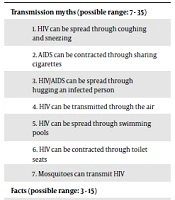
Comparison of HIV/AIDS Attitude Scores Between Technical (A) and Medical (B) Sciences University Students
| International AIDS Questionnaire-Persian Version | A | B | P Value | Total | |||
|---|---|---|---|---|---|---|---|
| Mean ± SD a | Agreement, % b | Mean ± SD | Agreement, % | Mean ± SD | Agreement, % | ||
| Transmission myths (possible range: 7 - 35) | 9.82 ± 2.81 | 25.3 | 8.90 ± 2.16 | 15.91 | < 0.001 | 9.31 ± 2.52 | 23.60 |
| 1. HIV can be spread through coughing and sneezing | 1.12 ± 0.46 | 7.6 | 1.04 ± 0.19 | 3.50 | 0.004 | 1.09 ± 0.40 | 6.41 |
| 2. AIDS can be contracted through sharing cigarettes | 1.43 ± 0.82 | 24.2 | 1.16 ± 0.41 | 15.20 | < 0.001 | 1.31 ± 0.69 | 21.54 |
| 3. HIV/AIDS can be spread through hugging an infected person | 1.11 ± 0.41 | 8 | 1.04 ± 0.30 | 2.92 | 0.002 | 1.09 ± 0.39 | 6.57 |
| 4. HIV can be transmitted through the air | 1.08 ± 0.37 | 7 | 1.02 ± 0.24 | 1.16 | 0.001 | 1.01 ± 0.14 | 5.26 |
| 5. HIV can be spread through swimming pools | 1.50 ± 0.82 | 13.5 | 1.42 ± 0.63 | 36.25 | 0.158 | 1.47 ± 0.73 | 19.90 |
| 6. HIV can be contracted through toilet seats | 1.39 ± 0.70 | 37.5 | 1.48 ± 0.77 | 9.70 | 0.290 | 1.45 ± 0.75 | 36.51 |
| 7. Mosquitoes can transmit HIV | 1.98 ± 1.11 | 79.6 | 1.75 ± 0.99 | 42.69 | < 0.001 | 1.91 ± 1.07 | 69.07 |
| Facts (possible range: 3 - 15) | 5.00 ± 1.90 | 73 | 5.12 ± 1.18 | 91.03 | 0.273 | 5.07 ± 1.55 | 36.34 |
| 8. Condoms will decrease the risk of HIV transmission | 2.95 ± 0.98 | 74 | 3.51 ± 0.72 | 94.15 | < 0.001 | 3.19 ± 0.84 | 35.03 |
| 9. HIV can be transmitted from mother to baby | 2.50 ± 0.96 | 83 | 3.20 ± 1.01 | 87.13 | 0.092 | 2.59 ± 1.13 | 28.28 |
| 10. HIV is spread through infected semen | 3.57 ± 0.82 | 62 | 3.39 ± 0.97 | 91.81 | < 0.001 | 3.43 ± 0.93 | 45.72 |
| Personal risk (possible range: 3 - 15) | 4.20 ± 1.72 | 18 | 3.62 ± 1.04 | 30.60 | < 0.001 | 3.88 ± 1.42 | 20.55 |
| 11. Iranians are less susceptible to contracting AIDS than other nationalities | 1.33 ± 0.47 | 17 | 1.33 ± 0.67 | 22.80 | < 0.001 | 1.56 ± 0.87 | 15.62 |
| 12. AIDS only affects intravenous drug users, prostitutes, and homosexuals | 2.53 ± 1.81 | 24 | 1.84 ± 0.01 | 51.46 | < 0.001 | 1.95 ± 0.88 | 28.28 |
| 13. You can protect yourself against AIDS by being vaccinated for it | 2 ± 1.20 | 13 | 1.27 ± 0.72 | 17.54 | < 0.001 | 1.72 ± 1.09 | 17.76 |
| Attitudes (possible range: 5 - 25) | 14.1 ± 2.77 | 16.48 | 13.21 ± 2.37 | 23.27 | < 0.001 | 13.62 ± 2.59 | 34.25 |
| 14. People with HIV should be kept out of school | 1.41 ± 0.93 | 19.4 | 1.09 ± 0.29 | 8.18 | < 0.001 | 1.28 ± 0.78 | 7.73 |
| 15. I would end my friendship if my friend had AIDS | 1.13 ± 0.33 | 18 | 1.23 ± 0.61 | 15.78 | < 0.001 | 1.20 ± 0.30 | 63.98 |
| 16. I am willing to do volunteer work with AIDS patients | 2.69 ± 1.26 | 12 | 2.81 ± 1.16 | 76.02 | < 0.001 | 2.28 ± 1.07 | 65.68 |
| 17. If a family member contracts HIV he/she should move out | 1.46 ± 1.00 | 5.3 | 1.07 ± 0.37 | 4.09 | 0.458 | 1.28 ± 0.82 | 13.32 |
| 18. People with HIV should stay home or in hospital | 1.43 ± 0.89 | 27.7 | 1.22 ± 0.66 | 12.28 | 0.010 | 1.33 ± 0.80 | 20.55 |
| Total score (possible range: 18 - 90) | 32.36 ± 5.53 | 33.19 | 30.75 ± 4.17 | 40.20 | < 0.001 | 31.93 ± 5.67 | 28.68 |
aItems were scored on a five-point Likert scale ranging from 1 (strongly agree) to 5 (strongly disagree).
bAgreement percentage calculated by points 1 and 2 of the Likert scale.
The results showed that after adjustment for the confounding effects of age, gender, and marital status (Table 3), the university had a significant effect on students’ attitude toward HIV/AIDS (β = -0.154, P value < 0.001). The study by Davis et al. (2007) in Chinese adolescents showed similar results although the average scores in our study were lower in all four dimensions (17). The AIDS attitude was more in female students than in male students but there was no significant relationship between gender and AIDS attitude. However, male students had more sexual behaviors. Some studies have shown that new HIV-infected patients in the world are mostly young females (18). In the study by Mulu et al. (2014), the attitude of men was more than that of women (19). In addition, Alipour et al. (2016) showed females had more AIDS attitude than males (P < 0.0001); however, in our study, there was no significant difference between males and females.
Table 3.
Predicting Factors of the Total Score of HIV/AIDS Attitude Using Linear Regression Models
| Groups | Mean ± SD | P Value | CI for Mean Difference | Standardized β Coefficient | P Value | CI for Standardized β Coefficient | ||
|---|---|---|---|---|---|---|---|---|
| Lower | Upper | Lower | Upper | |||||
| Age | 0.059 | -0.049 | 2.570 | -0.022 | 0.504 | -1.794 | 0.882 | |
| < 20 | 32.69 ± 6.31 | |||||||
| ≥ 20 | 31.43 ± 4.69 | |||||||
| Gender | 0.036 | -1.410 | -0.047 | 0.059 | 0.066 | -0.043 | 1.318 | |
| Female | 31.29 ± 4.53 | |||||||
| Male | 32.02 ± 5.43 | |||||||
| University type | < 0.001 | 0.992 | 2.204 | -0.154 | < 0.001 | -2.110 | -0.853 | |
| Technical | 32.36 ± 5.53 | |||||||
| Medical | 30.75 ± 4.17 | |||||||
| Marital status | 0.359 | -0.544 | 1.498 | -0.032 | 0.320 | -1.529 | 0.500 | |
| Single | 31.55 ± 4.81 | |||||||
| Married | 31.07 ± 4.81 | |||||||
The level of students’ attitude toward AIDS/HIV was not desirable that may be due to the limited educational resources for HIV and sexual activity targeting Iranian students (8-11). In some developing countries including Iran, society and culture create stigma around discussing sexual activity and related issues and there are misconceptions and myths about sexual activity, sexual health, and STDs (8-11, 14).
The limitations of our study were the small sample size, the stigma around the subject, unwillingness of some students to participate in the study and report on their prior sexual behaviors like intercourse. This finding showed that Iranian students’ attitude was poor toward AIDS and HIV, especially in Medical Sciences students. There is an increasing trend in sexual activity among students and young people while it is not true about its attitude and awareness. Therefore, we need to increase attitude toward AIDS in developing countries.