1. Background
Pain typically results from a sensory event, but non-sensory perceptual and interpretive processes such as cognition and emotion can also influence the perception of pain and how it is experienced. Evidence suggests that both physical and psychosocial components interact complexly in shaping the pain experience (1). Chronic pain, a psychosomatic issue, is a multidimensional experience that can significantly impact various aspects of an individual's life, potentially leading to complete disability (2, 3).
Although chronic pain is incurable, it can be managed (4). Adhering to medical treatment recommendations is a fundamental principle for managing chronic pain and reducing its consequences. This adherence can lead to a reduction in symptom severity and pain-related costs, ultimately improving the quality of life (5, 6). Non-adherence to treatment plans is recognized as a major health problem. Moreover, adherence to treatment plans is associated with controlled risk factors, fewer hospitalizations, and reduced healthcare costs for chronic patients (7).
Non-adherence, defined as the extent to which individuals follow health or treatment recommendations, is a complex behavioral process influenced by various factors, including the patient's psychological status, social support, healthcare system challenges, disease-related issues, and individual characteristics. Consequently, multi-level support is essential for enhancing treatment plan adherence (8).
Non-adherence to treatment plans among chronic patients is linked with frequent hospitalizations, lack of therapeutic benefits, high treatment costs, and numerous physician visits (7). Reports indicate that the mortality rate among chronic medical patients who do not adhere to their treatment plans is twice as high as that of other patients (9).
Some studies reveal that 4 to 31 percent of patients with chronic pain never obtain their prescribed medications without specific medical reasons, and 30 to 50 percent of these patients refrain from taking their prescribed medications during the first week of treatment, significantly impacting pain severity (10, 11). Various factors, including self-efficacy beliefs, influence adherence to medical recommendations in chronic patients (12).
As pain becomes chronic, patients' cognition and emotions evolve. Negative and limiting cognitive beliefs in patients with chronic pain increase the likelihood of severe pain, physical disability, and fear of movement, setting the stage for anxiety and depression symptoms (13).
Scientific evidence suggests that self-efficacy beliefs play a crucial role in initiating, maintaining, and sustaining health behaviors and behavioral pathology in chronic patients (14), especially for those suffering from chronic pain (15). Self-efficacy is defined as individuals' confidence in their ability to perform specific behaviors to achieve desired outcomes (16). Regarding pain, self-efficacy refers to individuals' confidence in managing their abilities despite experiencing pain (17). Studies have shown that self-efficacy beliefs are associated with coping with pain and can elucidate various aspects of the pain experience in chronic patients (17, 18).
Soyoon & Ekaterina (19) argue that when patients effectively engage in self-care behaviors, they can better connect with their bodies. Mindfulness brings awareness to the present moment and bodily sensations, including both pleasant and unpleasant feelings, through meditation practices or physical awareness. This increased body awareness enhances patients' likelihood of paying closer attention to themselves and adhering to self-care behaviors more diligently. Mindfulness, by integrating meditation practices and specific mental orientations towards the present moment, can non-judgmentally influence the experience of chronic pain and its treatment. Recent experimental examinations of this concept suggest it plays a significant role in health and well-being (20).
Past studies suggest that mindfulness enhances emotional self-regulation by increasing awareness of thoughts and feelings, which helps to reduce stress based on Buddhist traditions. Consequently, mindfulness can aid patients in overcoming automatic thoughts and unhealthy behaviors related to pain, potentially improving adherence to treatment plans (21). A review of the literature also shows that most studies on mindfulness therapy have focused on the psychological and behavioral aspects of chronic patients. These studies demonstrate that mindfulness can effectively reduce or modify stress in individuals with chronic diseases, thereby positively impacting their quality of life and lifestyle (13, 22). However, research on the role of mindfulness in enhancing treatment plan adherence among patients with chronic pain remains limited.
Given this context, psychological factors such as self-efficacy and mindfulness are influential in the formation and maintenance of pain. Understanding the underlying cognitive and psychological variables in treatment plan adherence for patients with chronic pain has numerous clinical applications. Thus, conducting research in this area can significantly draw the attention of therapists and researchers to the behavioral and psychological challenges faced by patients with pain. Given the prevalence of problems associated with chronic pain and the limited research on mindfulness and self-efficacy in Iran, there is a clear need for further investigation. The results of such studies can provide valuable insights for health and mental health professionals working to address behavioral issues in patients with chronic pain.
2. Objectives
This study aims to determine whether treatment plan adherence based on mindfulness and self-efficacy beliefs is predictable in patients with chronic pain.
3. Methods
3.1. Statistical Population, Samples, and Sampling Method
This descriptive and correlational research was approved by the ethics committee of the Islamic Azad University of Karaj under ethical code IRIAU.K.REC.1401.147, dated February 28, 2023. The study population comprised male and female patients suffering from chronic pain who visited Shahid Rajaei and Shahid Madani Hospitals in Karaj City for medical treatment during the last six months of 2022. These patients volunteered for the study.
The convenience sampling method was utilized in this research. According to the Plant formula (N ≥ 50+8) proposed by Tabachnick et al. (23), the sample size was initially calculated to be 114. However, to account for potential dropout, a final sample size of 150 individuals was chosen.
After securing the title and proposal approval from the supervisor and the department, I visited Shahid Rajaei and Shahid Madani Hospitals in Karaj City. Necessary coordination with hospital authorities was conducted, and their consent for conducting the research was obtained. Over three months and eleven days, visits were made to these centers on even days. During these visits, the study objectives, methods, and information confidentiality were explained to potential participants. With assistance from the hospital staff, patients meeting the eligibility criteria—minimum necessary literacy and suffering from chronic pain—were selected to participate. Research tools were then presented to them for completion. Each participant had one hour to respond to the instruments, with the researcher available to provide any necessary clarifications.
Following data collection, the data were prepared for statistical analysis. After developing the research tools and obtaining written informed consent from the participants, ensuring confidentiality, the questionnaires were administered. Participants who withdrew were replaced by others. It is important to note that the study was funded by the researcher, incurring no cost to the participants. The tools used for data collection in this study included:
3.2. Mindfulness Attention Awareness Scale (MAAS)
This tool, developed by Brown and Ryan in 2003, measures mindfulness, attention, and awareness. It comprises 15 questions across three subscales: Concentration, non-reactivity, and awareness, and utilizes a 6-point Likert scale for responses, ranging from 1 ("almost never") to 6 ("almost always"). The tool's overall Cronbach's alpha coefficient is reported as 0.87 (24). Ghorbani et al. (25) reported a Cronbach's alpha of 0.81 for this tool in an Iranian sample and noted its correlations with the Costello-Comrey Anxiety and Depression Questionnaire as - 0.33 and - 0.36, respectively (26). In Talebi’s study (27), the Cronbach's alpha for this tool was also calculated at 0.81. In the present study, the Cronbach's alpha coefficient was determined to be 0.78.
3.3. General Self-efficacy Scale (GSES)
This tool, developed by Schwarzer and Jerusalem in 1982, measures general self-efficacy. It comprises 17 questions divided into three subscales: Initiation of behavior, perseverance of behavior, and coping with failure. It employs a 5-point Likert scale for responses, ranging from 1 ("strongly disagree") to 5 ("strongly agree"). In this tool, questions numbered 17, 16, 14, 12, 11, 10, 7, 6, 5, 4, and 2 are reverse-scored. The overall Cronbach's alpha coefficient of the tool is reported to be 0.79 (28). In a study by Bakhtiari et al. (29), the reliability of this tool was calculated to be 0.82 using the Cronbach's alpha coefficient. In the present study, the Cronbach's alpha coefficient was calculated to be 0.72.
3.4. Treatment Plan Adherence Questionnaire
This tool, developed by Morisky et al. in 2008, assesses treatment plan adherence. It consists of 8 questions that measure a single-factor index of non-adherence. Responses are scored on a two-point scale (yes = 0, no = 1), with the total score obtained by summing the scores of all questions. The reliability of this tool has been measured using Cronbach's alpha coefficient, reported to be 0.83 (30). Ghanei Gheshlagh et al. (31) reported the reliability of this questionnaire as 0.72 based on Cronbach's alpha, while Badrizadeh et al. (32) found it to be 0.81. In the present study, the Cronbach's alpha coefficient was calculated to be 0.73.
Data analysis was performed using descriptive statistics, including frequency, percentage, mean, and standard deviation. Pearson correlation coefficient and multiple regression analysis with the simultaneous entry method were employed. A significance level of 0.05 was established. Data analysis was conducted using SPSS statistical software version 26.
4. Results
The demographic information revealed that 54% (81) of the participants were male, and 46% (69) were female. Additionally, 45% (68) were aged 40 and above, 40% (59) were aged 34 to 39, and 15% (23) were aged 28 to 33. Most of the participants (60%, 89 individuals) had a high school diploma or lower education level, 36% (54) had an associate degree, and 4% (7) had a master's degree. Descriptive statistics for the research variables are presented in Table 1.
The Pearson correlation coefficient results indicated a positive and significant correlation between the total mindfulness score (r = 0.64, P < 0.012) and self-efficacy beliefs (r = 0.66, P < 0.010) with treatment plan adherence among individuals with chronic pain at the 0.05 level (Table 2). The results of the multiple regression analysis testing the statistical hypotheses are displayed in Table 3.
Table 1.
Mean, Standard Deviation, and Pearson Correlation Coefficient of Research Variables
| Research Variables | Mean ± SD | (1) | (2) | (3) |
| 1- Mindfulness | 67.77 ± 13.30 | 1 | ||
| 2- Self-efficacy belief | 65.57 ± 8.64 | 0.47 a | 1 | |
| 3- Treatment plan adherence | 9.47 ± 1.45 | 0.64 a | 0.66 a | 1 |
aP < 0.05.
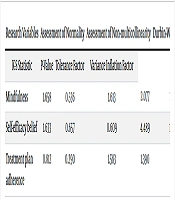
Before conducting the regression analysis, its assumptions were verified. The one-sample Kolmogorov-Smirnov test showed that the significance levels of normality statistics were above 0.05 (P > 0.05), indicating a normal distribution of variable scores at a 95% confidence level. The Durbin-Watson statistic, used to check for the independence of errors, showed values of 1.729 for mindfulness and 1.665 for self-efficacy. Since these values are between 1.5 and 2.5, it confirms that the errors were not correlated (Table 2).
Table 2.
Examination of Statistical Hypotheses
| Research Variables | Assessment of Normality | Assessment of Non-multicollinearity | Durbin-Watson Statistic | ||
|---|---|---|---|---|---|
| K-S Statistic | P-Value | Tolerance Factor | Variance Inflation Factor | ||
| Mindfulness | 1.658 | 0.536 | 1.613 | 2.077 | 1.729 |
| Self-efficacy belief | 1.633 | 0.657 | 0.609 | 4.489 | 1.665 |
| Treatment plan adherence | 0.812 | 0.290 | 1.583 | 1.390 | - |
To assess the absence of multicollinearity, the tolerance and variance inflation factor (VIF) were calculated. The tolerance values were 2.077 for mindfulness and 4.489 for self-efficacy, with no index significantly exceeding 10, confirming that multicollinearity was not a concern, thereby validating the use of linear regression (Table 2). Consequently, with no multicollinearity among the predictive variables, parametric tests such as the Pearson correlation coefficient and multiple regression analysis were applicable and reliable.
Multiple regression analysis using the simultaneous entry method showed that the predictive variables (mindfulness and self-efficacy beliefs) significantly explained the variance in the criterion variable (treatment plan adherence). The beta values were 0.27 for mindfulness and 0.30 for self-efficacy, both significant at the 0.05 level. The results also indicated that together, these variables accounted for 31% of the variance in treatment plan adherence among patients with chronic pain (Table 3).
Table 3.
Multiple Regression Coefficients Between Research Variables
| Criterion Variable | Predictive Variable | Standard Beta | Constant Value | R2 | T-Value | Significance Level |
|---|---|---|---|---|---|---|
| Treatment plan adherence | Mindfulness | 0.27 | 51.14 | 0.31 | 10.16 | 0.021 |
| Self-efficacy belief | 0.30 | 7.83 | 0.017 |
5. Discussion
This study aimed to predict treatment plan adherence based on mindfulness and self-efficacy beliefs in patients with chronic pain. The results revealed a significant and positive correlation between mindfulness scores and treatment plan adherence in these patients. This finding aligns with previous studies by Saeidi et al. (33), Herbert et al. (34), Barriga-Valenzuela et al. (35), and Bąk-Sosnowska et al. (36).
The findings suggest that individuals practicing mindfulness do not judge issues and events; rather, they are patient and perceive events as if encountering them for the first time. Instead of reacting indifferently or with intense emotion based on past experiences, they aim to perceive events afresh each time. Such individuals trust themselves and their emotions, accept themselves as they are, perceive internal and external realities without distortion, and possess a strong ability to handle various thoughts and emotions. They respond to events thoughtfully and are adept at recognizing, managing, and resolving daily challenges. These characteristics suggest that mindful individuals are proactive in accepting and managing problems in novel ways. Since the treatment and prevention of disease—or the aggravation of its symptoms—are largely dependent on individuals' management of self-care behaviors and healthy lifestyles, increased mindfulness levels in patients lead to better disease control and adherence to self-care behaviors and healthy lifestyles.
The study also found a significant and positive correlation between self-efficacy beliefs and treatment plan adherence in patients with chronic pain. This result is supported by earlier studies by Sohrabi and Yousefi (37), Shokrgozar et al. (2), Ansari Moghadam et al. (38), Heidari-Soureshjani et al. (39), Owen et al. (40), Burke et al. (41), and Caetano et al. (42).
To understand the significant positive correlation between self-efficacy beliefs and treatment plan adherence in patients with chronic pain, it is crucial to first define self-efficacy. Self-efficacy, a concept introduced by Bandura, relates to an individual's persistence and effort when facing obstacles and adverse experiences. It encompasses a sense of competence and capability in dealing with life, which strengthens when individuals meet and maintain performance standards and diminishes when they fail to do so. Self-efficacy beliefs form a cognitive aspect of individuals' self-concepts, evolving from lifelong learning experiences. These beliefs are integral to self-regulatory processes and involve knowledge structures that influence evaluative processes and behaviors. They originate from the confidence individuals have in their abilities to organize and execute actions necessary to manage prospective situations, significantly affecting self-regulation and the quality of human performance.
Since self-efficacy pertains to an individual's perception of their capabilities across a range of actions necessary to achieve valuable goals—including nutrition, exercise, personal hygiene, and medication adherence—it is inherently linked to health-related lifestyles. It also impacts individuals' belief in their agency and ability to effect change in their circumstances, thereby influencing treatment plan adherence.
Life presents a series of challenges and opportunities, and individuals leverage their capabilities to navigate these. Self-efficacy embodies resilience and the capacity to persist under various circumstances. It is a cognitive process that empowers individuals to manage daunting situations effectively and to approach problems with a capacity for handling them. Those with high self-efficacy demonstrate a greater sense of competence, intrinsic motivation, decisiveness, commitment to goals, and perseverance through difficult tasks compared to those with lower levels of self-efficacy.
According to the rational-emotive model, the way individuals cognitively and emotionally process information about their symptoms and treatments is crucial for adherence to treatment plans. This model integrates cognitive and emotional factors involved in how patients process information, constructing mental representations of their illness based on available information regarding identity, timeline, cause, perceived controllability, and anticipated consequences (43). The model emphasizes the importance of patients’ self-regulation and their perceptions of disease severity and consequences, identifying these as crucial factors in treatment plan adherence. It posits that patients who accurately perceive the severity of their condition and employ strategies to control exacerbating factors typically exhibit the most effective adherence patterns (44).
This study, like others in the field of behavioral sciences, had its limitations. It assessed patients with chronic pain in hospitals in Karaj City; therefore, caution is warranted when generalizing the results to broader populations, particularly to patients with chronic pain from different medical conditions or residing in other regions. The study's descriptive and cross-sectional nature necessitates further research into the long-term effects of mindfulness and self-efficacy on health behaviors and treatment adherence among diverse patient groups, especially those suffering from chronic pain. Another challenge was the difficulty in recruiting participants and some patients' reluctance to complete questionnaires due to time constraints and associated costs, which hindered the ability to classify patients by type of chronic pain or to conduct detailed studies on specific types such as neck or back pain. Future research should consider separate evaluations for men and women with chronic pain, as personality and demographic factors may influence psychological and behavioral functions and pain perception differently in these groups. Additionally, it is recommended to use multiple data collection methods, including interviews alongside self-report tools, to yield more reliable outcomes. Developing an intervention model to boost treatment plan adherence, particularly through mindfulness training, could enhance the effectiveness of treatment approaches and improve self-efficacy.