
1. Background
Procrastination is considered as the tendency to avoid mandatory duties or tasks. Some studies reported between 75% - 95 % of the students procrastinate [1]. Procrastination is correlated with low self-rated health [2]. A meta analysis showed procrastination was related to academic performance [3], well-being, and anxiety [4-6] because some individuals procrastinate to avoid a variety of aversive experiences such as fear, anxiety, and self-evaluative, anxiety-provoking thoughts. Support for this notion comes from a series of studies suggesting that procrastination may serve as an emotion regulatory function [7]. Students who pursue fun activities in order to increase their mood experience a paradoxical rise in distress [8]. Not only is the academic procrastination correlated with depression and anxiety, but also procrastination is conceptualized as a variable that affects the academic and social lives of the individuals in a negative way [9]. An experimental study [10] indicated subjects with a high-anxiety state were more likely to procrastinate. Academic procrastination was negatively related to academic performance satisfaction [11]. Anxiety underlies the links between chronic procrastination and health [12], and people with high anxiety are more likely to procrastinate than people with low anxiety [13]. However, results are inconsistent. While some studies show there is a significant relationship between procrastination and anxiety [3, 13-15] some findings do not confirm this relationship [16, 17]. Similarly, some studies revealed the role of anxiety in procrastination is trivial [18, 19].
Researchers [20] focus on the main role of people’ reactions in attenuating or exacerbating the anxiety response. Adaptive coping reactions such as self-compassion help successfully delete or decrease the stressor. Although self-compassion is correlated with anxiety [15], its role in the relationship between anxiety and procrastination has not been widely investigated. Self-compassion is defined as being aware of one’s own suffering, offering kindness towards oneself, taking a non-judgmental understanding towards one’s failures, and framing one’s own experience in light of the common human experience [21]. A research reported self-compassion was correlated with emotional health and was negatively associated with thought suppression, anxiety, self-criticism, depression [21]. Evaluating oneself in an critical and unkind way can explain the fact that procrastination plays a significant role in trait anxiety- which refers to a person’s general tendency to become anxious [22].
Hence, it is not clear if anxiety is correlated with procrastination. Similarly, underlying mechanism in this relationship is not fully known. To date the role of components of self-compassion in explaining the anxiety correlated with procrastination has not been investigated in Iran, contributing to lack of designing the treatment protocol. Since psychological variables such as self-compassion [23] are totally different in Western and Eastern cultures, further investigation is necessary. So, we hypothesized there is a significant relationship between anxiety, procrastination and self-compassion, and components of self-compassion mediate the relationship between anxiety and procrastination.
2. Methods
This cross-sectional study was conducted in Shahed University in 2016. Subjects were selected from different faculties, including, faculty of humanities, engineering, basic sciences, medicine, dentistry, and nursing faculties through cluster sampling method. Researchers have indicated a minimum sample size of 200 is necessary for structural equation models [24]. Hence, we distributed 300 questionnaires, but 210 questionnaires were appropriate to analysis. The subjects completed tests, including procrastination, self-compassion, and anxiety scales. Informed consent was obtained from all subjects.
2.1. Trait Anxiety Inventory (TAI):
This instrument was developed by Spielberger, Gorsuch, and Lushene (1970), and has 20 items [25]. Internal consistency coefficients for high school students were 0.86 [25]. To optimize content validity, most items were selected from other anxiety measures on the basis of strong associations with the Taylor manifest anxiety scale [26] and Cattell and Scheier’s anxiety scale questionnaire [27]; overall correlations between the STAI and these 2 measures were 0.73 and 0.85, respectively. An Iranian (Farsi) version of TAI was validated with a 0.90 Cronbach’s alpha coefficients for trait anxiety 0.90 and a re-test reliability coefficient of .68 for the trait anxiety scale [28]. Validity of the test was confirmed with a significant correlation with Kattell anxiety questionnaire (r = 0.71).
2.2. Self-Compassion Scale Short Form (SCS-SF):
SCS-SF [29] has been developed by Raes et.al. (2011). SCS-SF has 12 items. Researchers showed a high correlation between its long and short versions [29]. In a study, the test-retest reliability coefficient of this scale was obtained as 0.89 [30]. Moreover, factor analysis showed six factors for this scale, including common humanity, isolation, Over-identification, self-judgment, self-Kindness, Mindfulness. A study in Iran showed the internal consistency of this scale was 0.73. Additionally, validity of this scale was confirmed using Kentucky inventory of mindfulness skills (KIMS) and the acceptance and act inventory-second edition (AAQ-II) (r = 0.43, P ≤ 0.001 and r = 0.63, P ≤ 0.001 respectively) [31].
2.3. Procrastination Assessment Scale-Student (PASS)
The PASS was developed by Solomon and Rothblum (1984) [4]. It has 18 items. Researchers reported alpha coefficient of 0.77 and showed that it has 3 factors [32]. The validity of the PASS was confirmed during the early development of the scale [4]. An Iranian study showed the reliability of the test was 0.78. The predictive validity of the procrastination scale was confirmed by the negative correlation (r = -0.13) between the scores of procrastination and the students’ average score. Noteworthy, the factor analysis showed there are four factors [33].
Data were analyzed in SPSS-23 (for calculating descriptive results and Pearson correlation), and AMOS. Since structural equation modeling (SEM) provides a more appropriate inference framework for mediation analyses [34], we used AMOS to analyze the mediating role of self-compassion in the relationship between procrastination and anxiety. In order to calculate the significance of the indirect effect we used bootstrapping with 2000 sampling in the 95% confidence interval.
3. Results
88 male students and 122 female students participated in this study, including 79 students from faculty of humanities (38 percent), 43 students from engineering faculty (20.5 percent), 31 students from basic sciences faculty (14.9 percent), 27 students from medicine faculty (13 percent), 15 students from dentistry faculty (7.2 percent), 15 (7.1%) students from nursing faculty. The mean (standard deviation) age of the subjects was 20.54 (2.008) years. Table 1 represents the descriptive findings of variables.
Table 1.
Descriptive Results
| Variable | Mean | Std. Deviation | Maximum | Minimum | Kurtosis | Skewness |
|---|---|---|---|---|---|---|
| Total procrastination | 55.6413 | 8.94489 | 85.00 | 32.00 | 0.136 | -0.036 |
| Common humanity | 5.9505 | 1.59073 | 10.00 | 2.00 | 0.116 | 0.211 |
| Isolation | 5.8503 | 1.86775 | 10.00 | 2.00 | -0.506 | 0.152 |
| Over-identification | 6.0312 | 1.76673 | 10.00 | 2.00 | 0.006 | 0.001 |
| Self-judgment | 6.3998 | 1.76658 | 10.00 | 2.00 | -0.120 | -0.088 |
| Self-kindness | 6.4119 | 1.49446 | 10.00 | 2.00 | 0.072 | -0.139 |
| Mindfulness | 6.7512 | 1.72323 | 10.00 | 2.00 | 0.036 | -0.434 |
| Anxiety | 2.0146 | 0.47614 | 3.37 | 1.00 | 0.066 | 0.430 |
Table 1 shows Kurtosis and Skewness lie within the acceptable range for normal distribution of data. Hair [35] argued data is considered to be normal if Skewness is between ‐2 to +2 and Kurtosis is between ‐7 to +7.
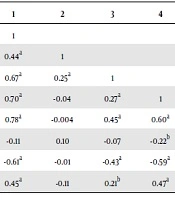
Table 2 shows the correlation coefficients among predictive variables (anxiety), mediating variable (subscales and total score of self-compassion), as well as dependent variable (procrastination).
Table 2.
Correlation Coefficient Matrix (N = 210)
| Variables | 1 | 2 | 3 | 4 | 5 | 6 | 7 | 8 |
|---|---|---|---|---|---|---|---|---|
| 1. Anxiety | ||||||||
| 2. Self-judgment | 0.475a | |||||||
| 3. Common Humanity | -0.210b | -0.253b | ||||||
| 4. Self-kindness | -0.407a | -0.240b | 0.409a | |||||
| 5. Isolation | 0.458a | 0.422a | -0.065 | -0.171c | ||||
| 6. Mindfulness | -0.428a | -0.314b | 0.383a | 0.553a | -0.187c | |||
| 7. Over-Identification | 0.485a | 0.536a | -0.207b | -0.177c | 0.536a | -0.199a | ||
| 8. Self-compassion | -0.635a | -0.720a | 0.569a | 0.624a | -0.635a | 0.663a | -0.697a | |
| 9. Procrastination | 0.304b | 0.305a | 0.041 | -0.025 | 0.225b | -0.085 | 0.288a | -0.238b |
a0.001 > α.
b0.01 > α > 0.001.
c0.05 > α > 0.01.
As Table 2 shows, anxiety has a significant relationship with procrastination and all subscales and total score of self-compassion (P < 0.05). With the exception of common humanity, self-kindness, and mindfulness, other subscales had a significant relationship with procrastination (P < 0.05).
In addition, due to the lack of a significant relationship with procrastination all dimensions of self compassionate scale cannot play a significant role in mediating the effects of anxiety on procrastination. Hence, first, in order to obtain a more exact estimation of the optimal combination of self-compassion's subscales in predicting procrastination relationship between dimensions of self-compassion scale with procrastination was calculated after controlling the relationship among dimensions of self-compassion scale. Figure 1 shows the output of these calculations.
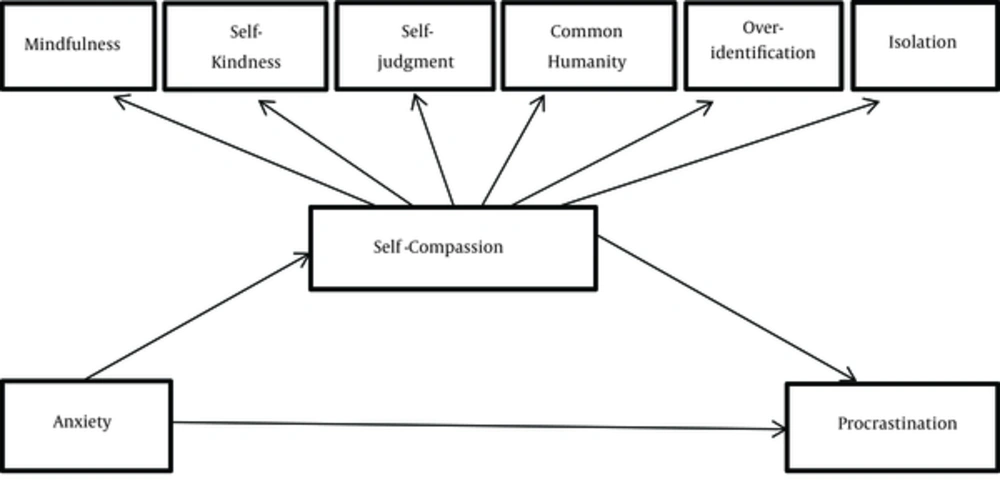
Figure 1.
Conceptual Model
As Figure 2 shows, after controlling the overlap among 6 subscales of Self-Compassion, only 2 components including self-judgment (r = 0.22, P = 0.004) and over-identification (r = 0.17, P = 0.044) have a significant unique relationship with procrastination. Additionally, these two subscales have a significant relationship with each other (r = 0.54, P > 0.001). Since first model was a saturated model (DF = 0), no fitness indices were calculated. In the next step, the mediating role of self-compassion subscales including self-judgment and over-identification in the relationship between procrastination and anxiety were calculated. In order to calculate the significance of the indirect effects, the model was conducted using bootstrapping method (with 2000 sampling). Figure 3 shows the output related to standard coefficients of the model.
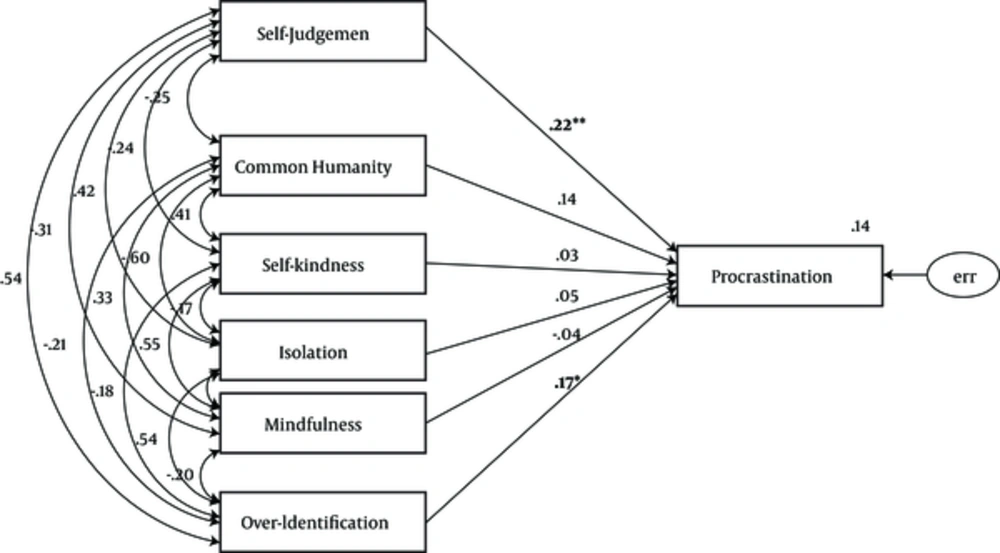
Figure 2.
**, 0.01 > α > 0.001; *, 0.05 > α > 0.01.
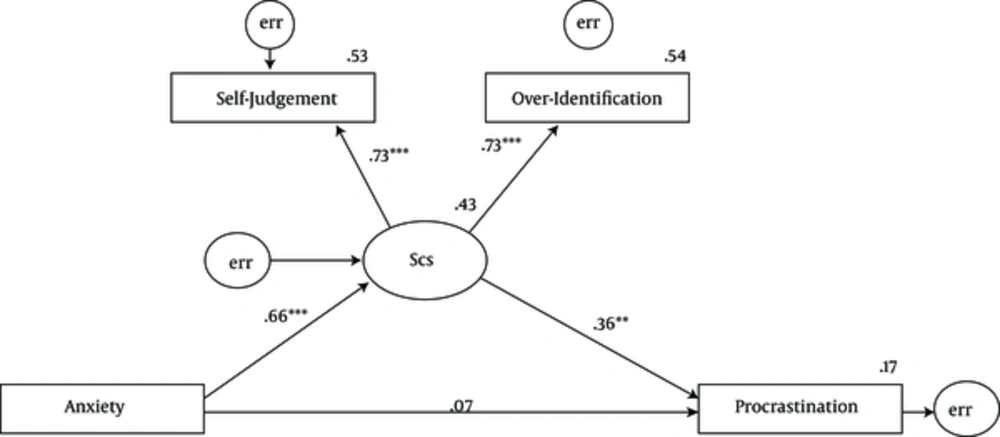
Figure 3.
***, 0.001 > α; **, 0.01 > α > 0.001. Scs: latent variable derived from two components of self-judgment and over identification. Fitness indices: Chi-square/df =0.119; P = 0.730; SRMR = 0.004; GFI = 1.000; AGFI = 0.997; NFI = 0.999; RFI= 0.996; IFI = 1.005; TLI = 1.031; CFI = 1.000; RMSEA < 0.001; PCLOSE = 0.790.
Figure 3 shows anxiety has a significant and positive effect on latent variable derived from two components of self-judgment and over-identification (r = -0.66, P < 0.001). The effects of latent variable on procrastination was positive and significant (r = 0.36, P = 0.003). Similarly, the direct effects of anxiety on procrastination was statistically insignificant (r = 0.07, P = 0.503). Table 3 shows the results of bootstrapping in order to calculation of significance of the indirect effects in model 2.
Table 3.
The Results of Bootstrapping in Order to Calculation of Significance of the Indirect Effects in the Relationship Between Anxiety and Procrastinationa
| Indirect Paths | Boot SE | Boot LLCI | Boot ULCI | r | P Value |
|---|---|---|---|---|---|
| Anxiety → SCS → over identification | 0.070 | 0.318 | 0.600 | 0.482 | 0.002 |
| Anxiety → SCS → self-judgment | 0.065 | 0.347 | 0.599 | 0.479 | 0.001 |
| Anxiety → SCS → procrastination | 0.098 | 0.069 | 0.453 | 0.236 | 0.008 |
aScs: latent variable derived from two components of self-judgment and over identification; bootstrapping with 2000 sampling, 95% confidence interval.
As Table 3 shows the indirect effects of anxiety on procrastination was significant: 95% CI (0.069, 0.453); P = 0.008; r = 0.236. Hence, self-compassion via its two subscales including self-judgment and over-identification plays a mediating role in the relationship between anxiety and procrastination. Since Figure 3 showed direct effect of anxiety on procrastination was insignificant, it can be concluded self-judgment and over-identification were full mediators of the relationship between anxiety and procrastination.
4. Discussion
This research showed there is a significant relationship between anxiety and procrastination. This result is consistent with earlier findings [3, 4, 14, 15], and can be explained according to an appraisal-anxiety-avoidance (AAA) model. Main cognitive theories of stress and coping [36] suggest if people perceive a circumstances to be threatening and their abilities and resources inadequate to deal with that threat, they are likely to react with stress. In fact, they may manifest anxiety and try to run away from that situation. Similarly, there is a significant relationship between self-compassion and procrastination and anxiety which is consistent with the literature [15]. People with higher levels of self-compassion adopt constructive coping strategies in the face of academic failure [37]. Self-compassion can increase self-regulation via decreasing negative states and negative self-evaluations like self-blame which may disturb well-being and adaptive regulation [38]. Procrastination is considered as a form of self-regulation failure which is correlated with poor well-being [39], self-blame [38], and negative self-evaluations [13]. It is feasible a lack of self-compassion may lead to exacerbation of the procrastination [40]. Theory of meta-cognitive awareness [41] suggests lack of self-compassion to oneself after procrastinating leads to self-blame and over-identification with negative states. These negative self-evaluations can increase procrastination. Research on the correlation between low levels of self-compassion and fear of failure [37] suggests there is a possible multi-directional relationship between procrastination and self-compassion so that fear of failure is considered as a reason for procrastination [3].
Researches show self-compassion provides people with the chance to recognize their part in negative events without becoming engaged in the ruminative procrastinator cognitions and negative emotions [40]. Self-compassion can have a substantial role in adaptive self-regulation through decreasing the negative emotional states and self-blame [42]. It should be noted Self-compassion is associated with the use of positive coping strategies such as cognitive restructuring which may help decrease anxiety [42]. This research showed self-judgment and over-identification mediate the relationship between anxiety and procrastination. However, a western study showed self-compassion is the mediator in the relationship between anxiety and procrastination [15]. As far as we know, this result was unique to this study. This result can be explained from some point of view. Firstly, a study showed procrastination had correlation with stress and self-blame [43]. This study indicated procrastination was correlated with self-blame for not engaging in the health-related behaviours and performances. It was also revealed self-blame could explain the relationship between stress and procrastination. People with habitual procrastination are likely to engage in rumination about previous procrastination behaviors since they can not engage in instrumental performances to move them closer to their goals [40]. Gradually, these constant negative self-evaluations can lead to a significant increase of tendency towards self-criticism, self-blame. In line with this, researchers [44] showed a generalized tendency to be critical and unkind to oneself in people with procrastination.
Secondly, self-compassion, in the face of failure, facilitates the learning process through freeing people from the harmful consequences of over-identification, isolation, and self-criticism. So, it is not surprising that over-identification and self-judgment mediated the relationship between anxiety and procrastination. Self-compassion is a unique construct for the youth because they face with social comparison and they evaluate themselves [42]. They experience more stressful factors which are related to academic performance and getting accepted by peers. These factors result in over-identification and self-judgment which are correlated with anxiety [42] and can lead to procrastination.
Last but not least, researchers [44] showed Taiwanese participants scored higher than the American participants in three negative SCS subscales of self-judgment, over-identification, and isolation. The researchers found the Taiwanese parents explicitly or implicitly use shame-based strategies to socialize their children [23]. The researchers concluded the Eastern societies emphasize shame, judgment, and threatened isolation as means of self-improvement.
Noteworthy, this study has some limitations. First, only student sample was selected. So, the generalization of the findings are nor possible. Secondly, cross-sectional studies do not reveal casual relationships. So, it is suggested future studies target other populations and longitudinal studies be conducted. On the other hand according to literature, the role of variables such as mindfulness and acceptance [14] should be investigated in the link between anxiety and procrastination since designing a protocol requires understanding the other factors.
In conclusion, people with procrastination treat themselves with self judgment rather than self-compassion, contributing to the anxiety they experience. Therefore, encouragement of self-compassion in students can be highly constructive. These kinds of interventions can be a useful treatment, since they lead to remediate harmful self-attitudes in a more constructive way. The encouragement of self-compassion on the part of teachers and an emphasis on mastery rather than performance goals can be more beneficial.